

By Aryan Singh
In the ever-changing skyline of Delhi, where metros and traffic flyovers dominate the view, few pause to notice the weathered walls tucked quietly into parks and neighbourhoods. These stones belong to Lal Kot and Qila Rai Pithora — the earliest known fortifications of Delhi, built by the Rajput rulers of the Tomar and Chauhan dynasties. Long before Delhi became a symbol of Mughal grandeur or British power, it was a Rajput citadel known as Dhillika, a city carved out of ambition, courage, and strategic vision.
Today, while much of Delhi races ahead with modern life, the fading ramparts of these forts still stand as reminders of an age when Rajput kings shaped the destiny of this region. This article revisits their legacy — exploring how these ancient walls tell a story not just of stone and mortar, but of Delhi’s very first chapter as a city of power and pride.
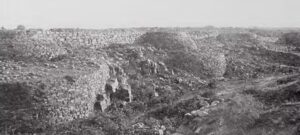
Source: Varma, 2016, Ruins of Qila Rai Pithora
Tomars and Chauhans
In the early medieval period, Delhi’s history took shape under the rise of two powerful Rajput dynasties — the Tomars and the Chauhans — who together laid the very foundation of the city we know today. The Tomars, a Hindu clan that ruled parts of North India, left their mark not just through forts and settlements but also in some legendary stories. Their ancestry can be traced to the Pandavas of the Mahabharata, says BR Mani, Former Joint Director General of ASI, who led excavations between 1992 & 1995 at Lal Kot & Anang Tal.
Whereas Chauhans, also known as Chahamanas, ruled over Rajasthan, Haryana & Delhi from the 7th Century to 12th Century. The descent of the Chauhans is very controversial, with many theories and legends. One popular legend traces the ancestry of Chauhans to the Suryavanshi lineage of the ancient Indian kings. According to this legend, the Chauhans were descended from Raja Yayati, a king of the lunar dynasty who had two sons, Puru & Yadu. The Chauhans were said to be descendants of Puru. Another legend associates the Chauhans with the Agnivanshi lineage, which claimed descent from Agni, the god of fire. Their origin can also be traced to a Rajput clan Shakambharis, who rose to power in Rajasthan.
Foundation of the city of ‘Dilli’
One such legend, narrated in the Prithviraja Raso, recounts the story of the Tomar king Anangpal and his connection to the Iron Pillar. A learned Brahmin warned the curious king that the pillar was fixed firmly because its base rested on the hood of Vasuki, the mythical king of serpents, and that his dynasty’s rule would remain secure as long as the pillar stayed unmoved. But driven by curiosity, Anangpal ordered it to be dug up, but found the lower part stained with the serpent’s blood. Alarmed, he had the pillar reinstalled, but it could never stand as firm again; it remained slightly loose, or dhili. According to the story, this “looseness” gave birth to the ancient name Dhillika, which over the centuries transformed into the city’s present name: Delhi. (Upinder Singh)
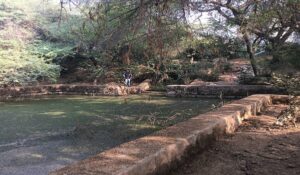
Source: Wikipedia commons, Anangtal baoli
Some historians believe Anangpal Tomar was the first ruler to establish Delhi. About 30 km south of Delhi, the quiet village of Anangpur in the Badarpur area still features old stone walls and ruins that honor his name and memory. Near this village there you can still see sturdy stone masonry likely built by him. Later, in the 11th century, the Tomars moved closer to what we now call Delhi and built a new city named Dhilli near the temple town of Yoginipura. Anangpal II built a large fortified area called Lal Kot, which means “Red Fort,” between AD 1052 and 1060. This was the first major walled city of Delhi and became the starting point of the Delhi we know today.
During excavations, an intriguing discovery came to light—a grand water tank called Anangtal. Shaped like an eight-petalled lotus and built in an elegant octagonal design, this massive tank once lay within the heart of the palace complex. Stretching about 45–48 meters across and plunging 10–12 meters deep, Anangtal wasn’t just a marvel of design—it was a vital lifeline, built to store and supply water for the royal family.
Surajkund Reservoir
The reservoir of Suraj Kund is also attributed Tomara king Surajpala. (Urmila Varma) In Asar us sanadid (the remnants of ancient heroes) by Sir Syed Ahmad Khan says this reservoir was constructed in 686 AD. However, Alexander Cunningham, the founder of ASI (Archaeological Survey of India), dated this reservoir in 1061 AD. As Surajpala worshipped the sun, this reservoir might be dedicated to the sun god. This reservoir is built in the Aravali hills & is constructed in a semi-circular-shaped embankment. It is designed in the shape of a rising sun with an eastward arc. This reservoir is spread over 6 acres and was fed by water from the hills. However, because the Tomar capital was Lal Kot, the lake may have fallen into disuse.
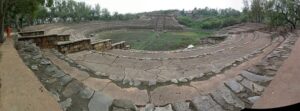
Source: Wikipedia, Surajkund Reservoir
After the Tomars, the powerful Chauhans rose to power, and it was Prithviraj Chauhan who left his mark on Delhi by building a grand fort named after his title—Rai Pithora. This title celebrated his bravery, leadership, and knightly virtues.
The mighty walls of this fort stretched wide—from the northern bastion known as Fateh Burj, sweeping southwest to Dam Dama, reaching as far as Adham Khan’s Tomb and running across the rugged Northern Ridge. The Badaun Gate served as its main entrance. The fort covered around 4 km in circumference. Qila Rai Pithora expanded beyond the earlier Lal Kot, whose walls then became its inner citadel. Together, they enclosed the area around the present-day Qutub Minar and the entire Mehrauli region. (Urmila Varma)
Yogini Temple
According to ancient Jain texts, Prithviraj Chauhan was also a patron of a Yogini temple in this area, then known as Yoginipura. Legend says this temple stood on the site of an even older shrine dating back to the Mahabharata era. Centuries later, under the reign of Akbar II, Lala Sidhu Mal, a wealthy resident of Chandini Chowk, rebuilt this sacred temple between 1806 and 1837, keeping the spirit of Yoginipura alive through the ages. This temple is dedicated to Maya, the sister of Lord Krishna. (Those who know the story of Krishna could recollect that Krishna’s uncle Kansa was trying to kill a female infant, which took the form of the Mother Goddess. She is Maya, Krishna’s sister.) (Vidisha Kuntamalla)
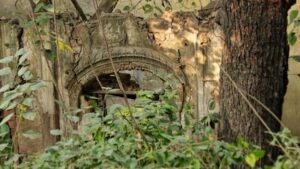
Source: The Indian Express, Remains of Yogini Temple
In 1191 AD, Muhammad of Ghur marched to Delhi, only to be crushed by the valiant Chauhan King, Prithviraj. Showing royal magnanimity, Prithviraj spared his rival’s life. But destiny turned cruel the very next year: in 1192 AD, at the fateful Battle of Thanesar, Prithviraj was defeated, marking the end of his reign and paving the way for Ghurid conquest and later the establishment of the Delhi Sultanate.
References
1. “Romancing Delhi: From Lal-Kot to Shahjahanabad: Varma, Urmila, Author: Free Download, Borrow, and Streaming: Internet Archive.” Internet Archive, 2016, archive.org/details/romancingdelhifr00varm/page/10/mode/1up?q=lal+kot+qila+rai+pithora. Accessed 4 Aug. 2025.
2. “History of Ancient and Early Medieval India from the Stone Age to the 12th Century: Free Download, Borrow, and Streaming: Internet Archive.” Internet Archive, 2022, archive.org/details/history-of-ancient-and-early-medeival-india-from-the-stone-age-to-the-12th-century-pdfdrive.
3. Singh, Yadu. “Lal Kot – the First Red Fort of Delhi.” Times of India Voices, Times of India, 18 Apr. 2022, timesofindia.indiatimes.com/blogs/voices/lal-kot-the-first-red-fort-of-delhi/.
https://www.researchgate.net/publication/369169127_A_CRITICAL_ANALYSIS_OF_JAINISM_AND_THE_RULERS_OF_CHAUHAN_DYNASTY_DURING_12TH_CENTURY_CE
4. Safvi, Rana. “The Lake of the Sun.” The Hindu, 17 Feb. 2018, www.thehindu.com/opinion/columns/the-lake-of-the-sun/article22785488.ece. Accessed 3 Oct. 2025.