
By Prishnika Mazumdar
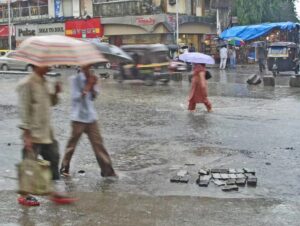
Monsoon evokes a range of emotions in us. For the city dwellers, it means relief from the scorching heat and dust of the summer months, even if momentarily so. For our farmers, it is the rain brought by the monsoon that supports their crops and thus their livelihood. And yet it can lead to floods, landslides, traffic jams, and a plethora of other inconveniences. There is such perilous beauty and ambiguity in the monsoon winds that it has something for all of us. Poets and writers have read signs of love and longing in the monsoon rains, communities have revered and celebrated the coming of the monsoon, all the while, scientists continue their argument about what monsoon means.
The Many Meanings of Monsoon
Clouds burst with terrifying peals of thunder;
lightnings flash. Women shrinking in fear
cling closely in bed to their loved husbands,
guilty though these men are of philandering (Kālidāsa, trans. Rajan 1971, Canto II).
These are the words of Kālidāsa, the poet, the playwright and the man who will forever be counted among the greatest writers of India and even the world. His works include Abhijnana Shankuntalam, Malavikagnimitram, Raghuvamsam, Meghdootam and Ṛtusaṃhāram and others. Most of us are familiar with Meghdootam, which is about a Yaksha (a demigod) who was banished by Kubera (the God of wealth and the king of Yakshas) from Alaka. For the Yaksha, such banishment meant separation from his beloved. The pang of love then led him to request the clouds to carry his message of love to his beloved (Sastri, 1933).
In Ṛtusaṃhāram, Kālidāsa presents us with six cantos, each dedicated to a season: grisma for summer, varsha for monsoon, sarat for autumn, hemant for the cool weather, sisira for winter and vasanta for spring. It is the second canto that deals with the dramatic season of monsoon. The coming of monsoon is heralded by the drum of thunder, with the rainbow as its bow, and the showers of rain as its arrows. It calls out to the hearts of those who are away from their lovers. We observe the frequent use of elements of nature as symbols for separated lovers. We see swollen rivers being compared to love-maddened maidens and grass that shines like beautiful maidens after the coming of the monsoon. We see inconsolable wives of men who are far away with tearful eyes on such nights of thunder and lightning. These lover-seeking women then find themselves on dark paths that are lighted only by the glows of lightning (Sastri, 1933).
If we shift our attention to Indo-Persian poetry, some other meanings can be read too. For example, Masud Sa’d Salman, an 11th-century Persian poet of the Ghaznavid empire, described the monsoon as the ‘spring of India’ for its restorative qualities and for the relief from heat that it brought. He writes;
Monsoon, the spring of India, saviour from the torment of summer.
You brought the tidings of the month of Tir, once again, we escaped the heat (Sharma 2018, p. 47).
It is to be noted that Tir is the Persian month of June and July and marks the coming of summer in the Iranian plateau. It is in the Indian context that this period marks the beginning of the monsoon. Both shared qualities of restoration. In both Indic and Indo-Persian poetry, the undertones of longing, separation from the beloved and the joy of union are common metaphors for the monsoon (Sharma, 2018). Now that we have articulated metaphoric meanings of the season, we can understand what it means scientifically.
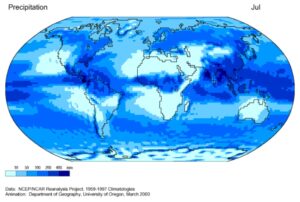
Etymologically, the term monsoon comes from the Arabic term Mausim, meaning season. In India, most of the rainfall takes place between June and September, which is known as the summer monsoon season. And what we generally refer to as the monsoon is the Indian Summer Monsoon (ISM) or South Asian Summer Monsoon (SASM) (Gadgil and Srinivasan, 2010). The influence of the ISM is observed in the Indian subcontinent, the Indo-China Peninsula and the South China Sea. The other important monsoon sub-system is the East Asian Summer Monsoon (EASM), which largely influences China, the Korean Peninsula and Japan (Dimri et al., 2020).
Monsoon Traditions in India featuring Women
Hair cascading down to the hips,
fragrant flowers nestling behind the ears,
pearl strings fondling the breasts,
wine perfuming the breath—
Women set the hearts of their lovers on fire (Kālidāsa, trans. Rajan 1971, Canto II).
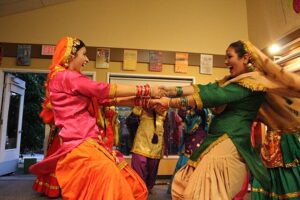
Here, flowers nestling behind the ears of women are those that are associated with the monsoon season such as Kadamba (burflower), Ketaki (Screw Pine) and Yuthika (Needle Jasmine). As monsoon festivals enjoy the bounty of nature, they are accompanied by many social activities, rituals and customs. Across India, many such festivities have women at the centre. Among these, Teej in Rajasthan, Savitri Brata in Odisha, Madhu-Sravani in Mithila, and Ambubachi Mela are a few that place women at the cultural and ritualistic centre. In Rajasthan, Teej celebrates the reunion of Goddess Parvati with Shiva and is marked by swings, song, dance, and adornment, symbolising marital bliss and fertility. Married women wear green, red, or yellow, apply henna, and sing folk songs that express longing and joy (Bhatnagar, 1988). Similarly, Savitri Brata, observed during the monsoon month of Jyestha, involves fasting and storytelling by married Odia women, who pray for their husbands’ longevity through the legendary devotion of Savitri, who persuaded Yama to return her husband’s life (Joshi, 2013).
This season of massed rain clouds arranges
chaplets of Bakula blossoms twined with buds of Malati,
Yuthika and other fresh-blooming flowers
on the heads of young wives as a fond husband would,
and fresh Kadamba sprays to fall over their ears (Kālidāsa, trans. Rajan 1971, Canto II).
Celebrating the love of such young wives and their fond husbands is Madhu-Sravani, a fifteen-day ritual performed by newlywed brides in Mithila during Sawan. Herein, the bride dresses up in bridal attire, adorns herself with jewellery, and fasts throughout the day for the well-being of her husband and harmony of her married life. She collects seasonal flowers like marigold and champa along with her friends and siblings. Madhu-Sravani is celebrated at the mayka or the natal home of the bride. The groom’s family also contributes as they send Bharo, a collection of clothes, food, fruits, and gifts to support the bride during her observance. On the last day, they send gifts for the bride’s family and village elders. These traditions help in strengthening the bonds between both families and ease the transition of the couple into married life (Khushboo & Soren, 2024).
Other than the festivals that we have discussed, many other lesser-known traditions and rituals observe the engagement of women. The following section expands on such traditions.
Monsoon Traditions of the Northeastern Region
The Northeast of India, with its rich biodiversity and indigenous cultures, celebrates a variety of monsoon-related festivals. Some of these festivals not only celebrate the agricultural and ecological cycles of the land but also place women as central ritual agents. Among them, the Deodhani dance of Assam, the Umrao Kherai of the Bodos, and the Dree festival of the Apatanis in Arunachal Pradesh are of importance to us for their women-centric performances during the monsoon cycle.
Deodhani Dance and Female Possession Rituals in Assam
The heavens pour torrents of rain.
Thunder roars and lightning dazzles the eye.
The wind howls through the forest like a mad beast,
bending trees to the ground…
We have no home, no fire, no comfort but damp earth (Ganguli, trans. 1883–1896, Vana Parva).
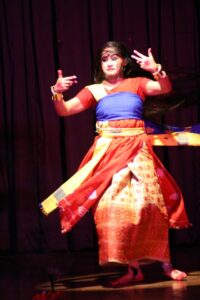
Monsoon is the season when the damp earth and the soggy forest bed displace snakes and push them out. For protection against snakebites, we worship Manasa, the Goddess of snakes. The Deodhani dance is a centuries-old ritual performance linked to the worship of the snake goddess Manasa, particularly among communities in Darrang, Udalguri, Kokrajhar, and Goalpara in Assam. It is typically performed during the Maroi Puja, which coincides with the monsoon season and aims to protect people from snake bites and other natural calamities intensified during this time of year (Nath, 2022).
The dance is exclusively performed by women known as Deodhanis, who are considered mediums possessed by the goddess. These women, often unmarried and consecrated to the deity from childhood, enter trances during the ritual. The dance begins with slow movements and builds to a frenetic climax. This symbolises spiritual possession and the presence of Manasa (Nath, 2022).
We need to remind ourselves here that much of Indian agriculture is rain-fed, with the monsoon rains delivering approximately 70% of the rainfall needed to water the farms and replenish the aquifers (Jadhav 2025). So, rain in excess or a shortage of it can bring many troubles for the Indian farmer. In Northeast, and particularly Assam, where rice, a water-intensive crop, is the dominant crop, this performance is intended to ward off natural disasters and ensure fertility and well-being during the rain-heavy season.
Umrao Kherai: Monsoon Ritual of the Bodos in Assam
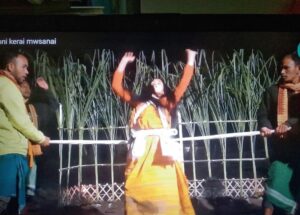
Among the Bodo people of Assam, the Umrao Kherai is a distinctive monsoon-centric form of the larger Kherai festival. This ritual is conducted during the rainy season and is often also known as Asu Kherai. It invokes the rain gods and natural forces for the protection of crops and for communal prosperity (Hajowary, 2022).
At the heart of this ritual is the Doudini, also known as Deodhani, about whom we have read in the previous section. She is a female shaman-dancer believed to be possessed by spiritual forces. She performs physically demanding dances, often holding symbolic objects like swords, shields, or ritual branches. Her trancelike state allows her to channel divine powers and communicate oracles. The presence of women as principal agents in Umrao Kherai informs us about their role as ritual mediators between the human and divine, particularly during the agriculturally crucial monsoon months (Hajowary, 2022).
Daminda Dance in the Dree Festival in Arunachal Pradesh
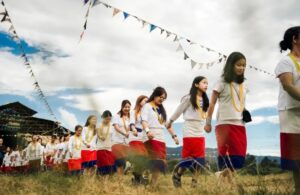
The Dree Festival, celebrated annually on 5 July by the Apatani community in Arunachal Pradesh, is a harvest and fertility festival that is again tied to the seasonal cycle of monsoon. Among its many events is the Daminda dance, which is performed solely by women and plays a key role in narrating the mythology surrounding the origin of the festival (Chaudhuri, 2022).
The Daminda dancers recount the mythological story of Anii Donii (mother Donii) and Abba Liibo (father Liibo), who began cultivation in the land of Iipyo Supuñ. They faced many difficulties while trying to sow seeds and protect the crops. These challenges were overcome through rituals. These Dree rituals, including Tamù, Metii, Meder, and Mepiñ, aim to ward off pests, diseases, and natural disasters (Chaudhuri, 2022).
Women emerge as central figures in many of these practices: women are powerful ritual agents, storytellers, healers, and spiritual mediums. These festivals and traditions celebrate the arrival of rains and affirm the generative power of the feminine. Yet those explored in this article are only a few among the many such traditions. Within the Northeastern region and across India, countless such traditions, rituals, and festivals that engage with the monsoon season, the cycles of nature, and the position of women in our society are yet to be studied.
References
1. Gadgil, S. and Srinivasan, J., 2010. Understanding and predicting the Indian summer monsoon. Current Science, 99(9), pp.1184–1186. Available at: https://www.jstor.org/stable/24068510.
2. Narain, S., 2010. What monsoon means. Down To Earth. Available at: https://www.downtoearth.org.in/environment/what-monsoon-means-1508 [Accessed 09 July 2025].
3. Dimri, A.P., Roxy, M., Sharma, A., Pokharia, A.K., Gayathri, C.H.R., Sanwal, J., Sharma, A.K., Tandon, S.K., Pattanaik, D.R. and Mohanty, U.C., 2020. Monsoon in history and present. Journal of Palaeosciences, 69, pp.1–18.
4. Bhatnagar, M., 1988. The Monsoon Festival Teej in Rajasthan. Asian Folklore Studies, 47(1), pp.63–72. Available at: https://www.jstor.org/stable/1178252.
5. Joshi, D.K., n.d. Sabitri Brata: Important Ritual of Married Women with Husbands Alive. Odisha Review.
6. Chaudhuri, P.R., 2022. In-Between Sound and Landscape: Inter-Community Innovations and Sustainability through Dree Festival among the Apatani People of Arunachal Pradesh. Man, Environment and Society, 3(1), pp.1–21. doi:10.47509/MES.2022.v03i01.01.
7. Hajowary, T., 2022. The Dance Forms of a Doudini in Kherai Festival of the Bodos of Assam: An Analytical Study from Religious Perspective. ShodhKosh: Journal of Visual and Performing Arts, 3(2), pp.22–30. doi:10.29121/shodhkosh.v3.i2.2022.148.
8. Nath, M., 2022. A Critical Study of Deodhani Dance. IJRAR, 9(1), pp.840–845. Available at: https://www.ijrar.org/viewfull.php?&p_id=IJRAR22A1262.
9. Das, S., 2018. Ambubachi Mela in Assam’s Kamakhya Temple: A Critical Analysis. International Journal of Research and Analytical Reviews (IJRAR), 5(1), pp.492–495.
10. Kālidāsa. Ṛtusaṃhāra (The Gathering of the Seasons). Canto II: The Rains. Available at: https://www.sacred-texts.com/hin/rtus/index.htm [Accessed 24 July 2025].
11. Ganguli, K.M. (trans.) 1883–1896. The Mahabharata of Krishna-Dwaipayana Vyasa, Book 3: Vana Parva. Calcutta: P.C. Roy. Available at: https://www.sacred-texts.com/hin/m03/index.htm [Accessed 24 July 2025].
12. Sastri, K.S.R., 1933. Kalidasa: His Period, Personality and Poetry. Vol. 1. Srirangam: Sri Vani Vilas Press.
13. Sharma, S., 2018. The Spring of Hindustan: Love and War in the Monsoon in Indo‑Persian Poetry. In: I. Rajamani, M. Pernau & K.B. Schofield, eds. Monsoon Feelings: A History of Emotions in the Rain. New Delhi: Niyogi Books, pp. 45–69.
14. Jadhav, R., 2025. Indian farmers accelerate summer crop sowing amid strong monsoon. Reuters, 21 July. Available at: https://www.reuters.com/business/environment/indian-farmers-accelerate-summer-crop-sowing-amid-strong-monsoon-2025-07-21/ [Accessed 24 July 2025].
Image Sources
1. UCAR Center for Science Education, n.d. India during Monsoon. [image] Available at: https://scied.ucar.edu/learning-zone/storms/monsoons [Accessed 13 July 2025].
2. UCAR Center for Science Education, n.d. Global Pattern of Precipitation in July. [image] Available at: https://scied.ucar.edu/learning-zone/storms/monsoons [Accessed 13 July 2025].
3. Wikimedia Commons, n.d. Women celebrate Teej. [image] Available at: https://commons.wikimedia.org/w/index.php?search=teej&title=Special%3AMediaSearch&type=image [Accessed 13 July 2025].
4. Wikimedia Commons, n.d. Deodhani dance. [image] Available at: https://commons.wikimedia.org/w/index.php?search=deodhani+dance&title=Special%3AMediaSearch&type=image [Accessed 13 July 2025].
5. Brahma, B.K., 2023. Kherai Ritual and Cultural Performance. In: D. Saikia and D.K. Borah, eds., Society and Culture in North-East India: Emerging Issues and Trends. Singapore: Springer. [image] Available at: https://link.springer.com/chapter/10.1007/978-981-19-9292-6_8 [Accessed 13 July 2025].
6. Ziro Festival, n.d. Daminda Dance from Dree Festival. [image] Available at: https://www.zirofestival.com/artists/daminda/ [Accessed 13 July 2025].