
By Anukriti Upreti
As the day winds down and the sun sets behind the mountains, in the serene twilight, children and elders light the Bhailo, bundles made from dry sesame wood, bhangjire (a Himalayan herb), and pinewood. Together, they twirl these large torches in circular motions, banishing the darkness of the night. This beautiful tradition is part of the Igaas Bagwal or Budhi Diwali, which is celebrated 11 days after Diwali.
While Diwali in most parts of India commemorates Lord Rama’s return to Ayodhya after 14 years of exile and his victory over Ravana, Igaas has a slightly different story. It is believed that the news of Lord Rama’s return reached the mountainous regions of Himachal and Uttarakhand 11 days later, which is why the festival is celebrated later in these regions. However, an interesting aspect of the festival is its eco- friendly celebration; harmony which is reflected in the form of dance and songs, and the intermixing of local legends and history with the dominant ideas of Hinduism. The festival in itself suggests that it is the diversity of culture and traditions which shapes our country and its people.
According to a popular Garhwali legend, the origin of Igaas is attributed to the warrior Madhav Singh Bhandari, who served as the commander-in-chief under 17th century Garhwal ruler Mahipati Shah. After a victorious battle at Dapaghat against Tibet, Bhandari’s return was delayed, and locals, assuming he had been martyred, did not celebrate Diwali. However, when he returned triumphantly after 11 days, the people of Garhwal lit diyas and bhailo celebrating valour and victory.
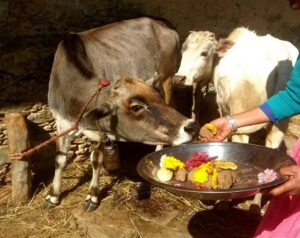
Villagers worshipping cattle. Image courtesy Kafaltree.com
Another reason for the timing of the festival is its alignment with Dev Uthani Ekadashi, the day Lord Vishnu is believed to awake from his four-month cosmic sleep cycle, marking the end of Chaturmas. This day is considered highly auspicious for various religious rituals, including marriages. It is also a time of harvest, symbolizing the end of autumn. Agricultural tools such as okhali (mortar and pestle) and supa (winnower) are worshipped as part of the rituals. Cattle are also honored; villagers wash their cows and bulls, massage them with mustard oil, and adorn them with turmeric as a gesture of gratitude.
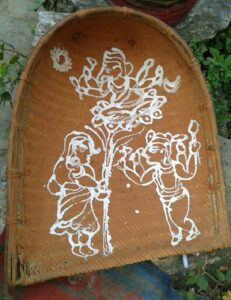
Laxmi Narayan depicted on supa. Image courtesy. ekumaoun.
In the Kumaon region, Igaas, also known as Budhi Diwali, has its own distinctive traditions. Symbolizing the victory of good over evil, the winnower called supa is first smeared with geru mitti (red ochre clay), and then decorated with images of Goddess Lakshmi and Lord Narayan using a paste made of ground rice (Biswar). On the back of the supa, a demon named Bhuiya is painted. The next morning, elders carry the supa around the house, chanting: “Lakshmi-Narayan ghar me padharo, bhaag Bhuiya bhaag bhaag” (“Lakshmi and Narayan, please enter our home; begone, Bhuiya, begone”). Following this, they step outside and smash a walnut on the ground, symbolizing the destruction of the demon. People also believe Diwali has three phases, reflecting three life stages of Goddess Lakshmi: Choti Diwali, observed on Sharad Purnima about 21 days before the main Diwali, symbolizes her childhood. Diwali, widely celebrated across India, represents her youth and Budhi Diwali or Igaas marks her elder age. On Budhi Diwali, people hang sugarcane stalks at their doorways, believing that the goddess will use them as stairs to enter and bless their homes. (Source: Kafaltree.com)
In the Garhwal region, the celebrations are marked by Bhailo dances and bonfires. Communities gather around these fires, singing folk songs like Chanchhari and Jhumailo, accompanied by traditional instruments such as the dhol and damau. These songs often narrate historical tales, venerate local deities, and—especially in Jhumailo—feature the voices and participation of women. Traditional dishes are also prepared, including urad dal ke pakode, Singal (a sweet dish made from wheat flour and curd), Jhangore ki kheer (a porridge made from barnyard millet), puri, and swala (a fried snack). भैलो रे भैलो काखड़ी को रैलू उज्यालू आलो अंधेरो भगलू (This Garhwali song celebrates Bhailo which symbolises light and happiness over dark and sorrow).
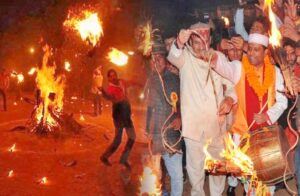
Bhailo Lighting. Image courtesy Himantar.com
Previously, Igaas was not recognized as a state holiday, but due to local demands, it is now officially observed. In recent years, the festival has also gained traction as a tourist attraction. Social media has played a significant role in popularizing it among wider audiences. Last year, Prime Minister Narendra Modi attended the Igaas celebrations at the residence of Lok Sabha MP Anil Baluni in New Delhi. He emphasized the importance of preserving heritage and traditional practices.
The Uttarakhand Culture and Tourism Department has also taken steps to promote the festival. At the Mall of Dehradun, performances of Uttarakhand’s folk dances, including Jhoda (a circular group dance) and Choliya (a sword and shield dance symbolizing valor), were showcased. Visitors enthusiastically joined the performers, enjoying and appreciating the cultural richness of the event.
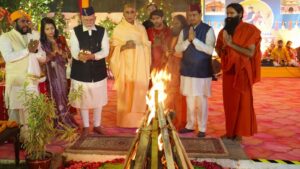
Prime Minister Narendra Modi celebrating Igaas. Image courtesy Amar Ujala
Festivals have always played a vital role in human life. Historically, they provided not only entertainment but also promoted social harmony and cultural blending. Igaas hold a special place in the hearts of the people of Uttarakhand. In modern times, as rural migration increases and folk traditions are waning down due to changing lifestyles and priorities, this festival reminds us of a simpler era, when there were no firecrackers and the soft twinkling diyas light the houses; when agricultural tools like okhali were worshipped; and when rice-paste rangolis adorned homes. It takes us back to a time when Bhailo torches and bonfires lit up the hills in place of artificial lights. On those darker nights, when houses were scattered across vast hilly landscapes, people from different villages would gather to play Bhailo together representing a different tradition but reflecting the same idea of Lord Rama’s
References:
1. Kumar, S. (2024). भैलो रे भैलो काखड़ी को रैलू उज्यालू आलो अंधेरो भगलू. [online] Kafal Tree. Available at: https://kafaltree.com/igas-festival-uttarakhand-2024/ [Accessed 23 Oct. 2025].
2. Tyagi, T. (2024). Vibrant traditions illuminate Igas festival celebrations in state. [online] The Times of India. Available at https://timesofindia.indiatimes.com/city/dehradun/igas-festival-2023-celebrating-traditions-and-resilience-in-uttarakhand/articleshow/115227561.cms [Accessed 23 Oct. 2025].
3. Alka T.(2022). Uttarakhand: दिवाली के 11वें दिन यहां मनता है रोशनी का त्योहार, जानें क्या है इगास और कैसे मनाते हैं उत्सव. [online] Amar Ujala. Available at: https://www.amarujala.com/photo-gallery/dehradun/uttarakhand-igas-festival-recognition-and-how-its-celebrate-after-11-days-of-diwali [Accessed 23 Oct. 2025].
4. Outlook India. (2024). Outlook India. [online] Available at: https://www.outlookindia.com/brand-studio/igas-diwali-celebrating-uttarakhands-unique-folk-festival-and-its-importance-in-pahadi-community [Accessed 23 Oct. 2025].
5. Personal interactions with locals.
6. Uttarakhand Ki Diwali – IGAAS – Short Film