
Inside India’s Neolithic Era: Why Location Was Everything for Early Farmers
- October 6, 2025

By Arnav Kala
The Neolithic Age in India, also known as the New Stone Age period, began circa 7000 BCE. The Neolithic period is characterised by the advent of agriculture and the first recorded instances of domestication of animals by human beings. New occupations such as crop cultivation, animal husbandry and pottery emerged during this period. Older practices of hunting and gathering started to be relied on less as food could now be produced in large quantities. Crops cultivated common to several Indian sites included wheat, barley, horse gram, ragi and rice. Animals domesticated during this period included dogs, sheep and goats. Pottery was an important development that rose to prominence during this era, as pots were used for storage of grains and cooking of food, but also as an art.
India is renowned for having a rich Neolithic material culture and has been home to many important settlements during the Neolithic age. In the Indian subcontinent, several Neolithic sites, famous ones including places such as Bhirana(7570 BCE – 6500 BCE) and Mehrgarh(6500 BCE – 5500 BCE), are scattered across diverse regions. The geography of where they were located affected their architecture, agriculture, pottery, burials and art. Their cultural impact was key as it also influenced future civilisations across South Asia which came up in later historical periods. An analysis of this diversity can be made by comparing the cultures of major Neolithic sites of three major regions in India.
Burzahom, Jammu and Kashmir(Himalayan valley)
Burzahom, located in the Kashmir Valley, is one of the most extensively studied Neolithic sites in northern India, dating from 3000 BCE to 1000 BCE. The site is situated on an ancient Pleistocene lake bed on the outskirts of the modern day city of Srinagar, which provided fertile soil for early cultivation practices. Excavations have revealed a unique feature of this site in the form of pit dwellings which were an architectural adaptation to the cold climate. These pits, often circular or oval, were dug into the ground and reinforced with wooden posts and birch bark roofing, indicating early construction methods.
The material culture at Burzahom is rich, with evidence of bone tools, including harpoons, needles, and scrapers, suggesting a reliance on hunting and fishing alongside agriculture. Polished stone tools, such as celts and chisels, indicate advanced lithic technology. The pottery tradition includes handmade cord-impressed ware, which is stylistically similar to other Neolithic cultures across the Indian subcontinent.
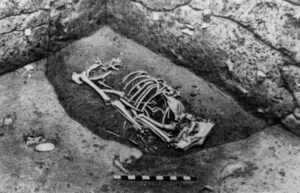
Burzahom also provides significant insights into burial practices. Skeletal remains were found in extended and flexed positions, often accompanied by grave goods such as red ochre, stone beads, and animal bones, suggesting ritualistic beliefs. The presence of megalithic structures in later phases indicates a transition towards more complex social structures.
Trade networks were evident through the discovery of agate, carnelian, and jasper beads as these materials are not native to the region of the Kashmir valley, which implies possible long-distance exchange. The site also shows evidence of early domestication of animals, as remains of cattle, sheep, and goats were found alongside cultivated wheat and barley.
Chechar, Bihar(Gangetic plains)
Chechar, located in Bihar, represents the Neolithic culture of the Middle Ganga Plain, dating to around 2500 BCE to 1600 BCE. Unlike Burzahom, Chechar exhibits mud houses rather than pit dwellings, indicating a different architectural adaptation suited to the alluvial plains, as the climate of the region is much warmer and humid as compared to the Kashmir valley. The settlement pattern suggests small clustered villages, possibly indicating early social organization.
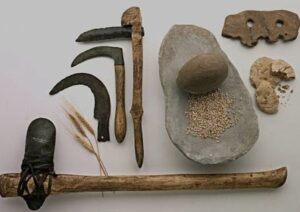
Agriculture played a dominant role, with evidence of rice and millet cultivation, marking an important phase in the transition to sedentary farming. The presence of querns, grinding stones, and pestles suggests food processing techniques. The pottery tradition includes cord-impressed and burnished ware, similar to other Neolithic sites in eastern India.
Burial practices at Chechar were relatively simple, with fewer grave goods compared to Burzahom. However, the presence of differentiated dwelling sizes may indicate early signs of social stratification, where certain households had larger and more structured living spaces.
Chechar also exhibits evidence of early metallurgy, with copper artifacts found in later phases, indicating technological advancements. Because the site is in close proximity to large river systems, there is a possibility that it may have harboured active trade and communication networks, which would have facilitated the exchange of goods and cultural influences.
Sanganakallu, Karnataka(Deccan plateau)
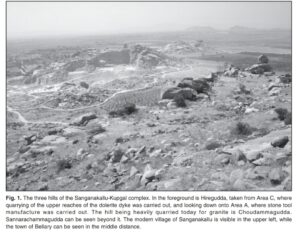
Sanganakallu, one of the largest Neolithic settlements in South India, dates back to 2000 BCE to 1000 BCE. The remains of the site are located near the west bank of the Hagary river close to the town of Bellary in Karnataka. The site is known for its ashmounds, which indicate cattle herding and ritualistic burning practices. Unlike Burzahom and Chechar, Sanganakallu exhibits extensive lithic production, with evidence of specialised axe-making workshops.
The settlement pattern exhibits hilltop villages, which may have been constructed for defensive purposes. The presence of circular stone structures is an indicator of early architectural planning. Though agriculture was practiced in this site, pastoralism also played a dominant role, with evidence of large-scale cattle herding.
Material culture at Sanganakallu includes ground stone tools, microliths, and polished axes, which indicates the practice of advanced tool-making techniques. The presence of rock art and symbolic engravings suggests a rich cultural and artistic tradition. There is evidence of a transition from the Neolithic Age to the Iron Age as well, which is exhibited by signs of increasing social complexity and trade networks.
Sanganakallu also provides possible evidence of ceremonial and ritualistic activities, with ashmounds possibly serving as communal gathering spaces. The presence of exotic materials such as carnelian and steatite beads may be an indicator of long-distance trade connections.
Conclusionary Comparative Analysis
The three major Neolithic sites of Burzahom, Chechar and Sanganakullu can be compared based majorly on five key features:
- Settlement Patterns: Burzahom exhibits early construction techniques in the form of pit dwellings, which were an adaptation to the cold climate of the Kashmir valley. They were built in an oval or circular dugout and were reinforced with birch bark roofings or wooden posts.
Chechar had mud houses suited to the flat terrain and to shield against the warm climate of the Indo – Gangetic plains in small village settlements.
Sanganakallu had hilltop settlements likely for the purpose of defence which were built along with early architectural planning in the form of circular stone structures.
- Subsistence Economy: Burzahom and Chechar relied heavily on agriculture, with Chechar having remains of a more diverse variety of food crops grown owing to its fertile location, with evidence of rice and millet cultivation.
However in Sanganakullu, pastoralism appears to have been the dominant occupation other than agriculture due to evidence of large scale cattle herding in comparison.
- Material Culture: Burzahom had bone tools such as needles, harpoons and scrapers, which suggests that there was reliance on hunting and fishing alongside agriculture for sustenance.
Chechar had grinding stones, querns and pestles which show advancement in food processing due to abundance of agricultural produce in the fertile region.
Sanganakallu specialized in lithic production and advanced tool making techniques as is supported by the evidence of specialised axe production, ground stone tools and microliths.
- Burial Practices: Burzahom had elaborate burials with skeletal remains in flexed and extended positions which were buried with grave goods such as red ochre, stone beads and animal bones, suggesting ritualistic beliefs.
Chechar had simpler burials but with a possibility of evidence of social stratification, and Sanganakallu’s burial evidence is limited.
- Trade and Networks: All three sites show evidence of trade, as Burzahom had materials not native to the region suggesting long distance trade and Chechar was located on the banks of complex and extensive river systems, but Sanganakallu had specialized craft production, indicating a more structured economy.
Bibliography
- Burzahom (Burzohama) a Neolithic Site in Kashmir: Sartaj Ahsan Bhat, M. Phil Research Scholar and M C Dubey, Professor, Department of History, Mewar University, Rajasthan, India
- Neolithic Settlements in Kashmir Valley: An Explanation of Gufkral and Burzohom: Shoaib Mohammad, Lovely Professional University
- Neolithic Settlement Patterns of the Middle Ganga Plain: Dr. Nasreen Begum Associate Professor, Department of Ancient History, Culture and Archaeology, Hamidia Girls’ Degree College, (Constituent P.G. College of the University of Allahabad) Uttar Pradesh, India
- Sanganakullu: Ravi Korisettar, History of India: Protohistoric Foundations (Vol. 2)