
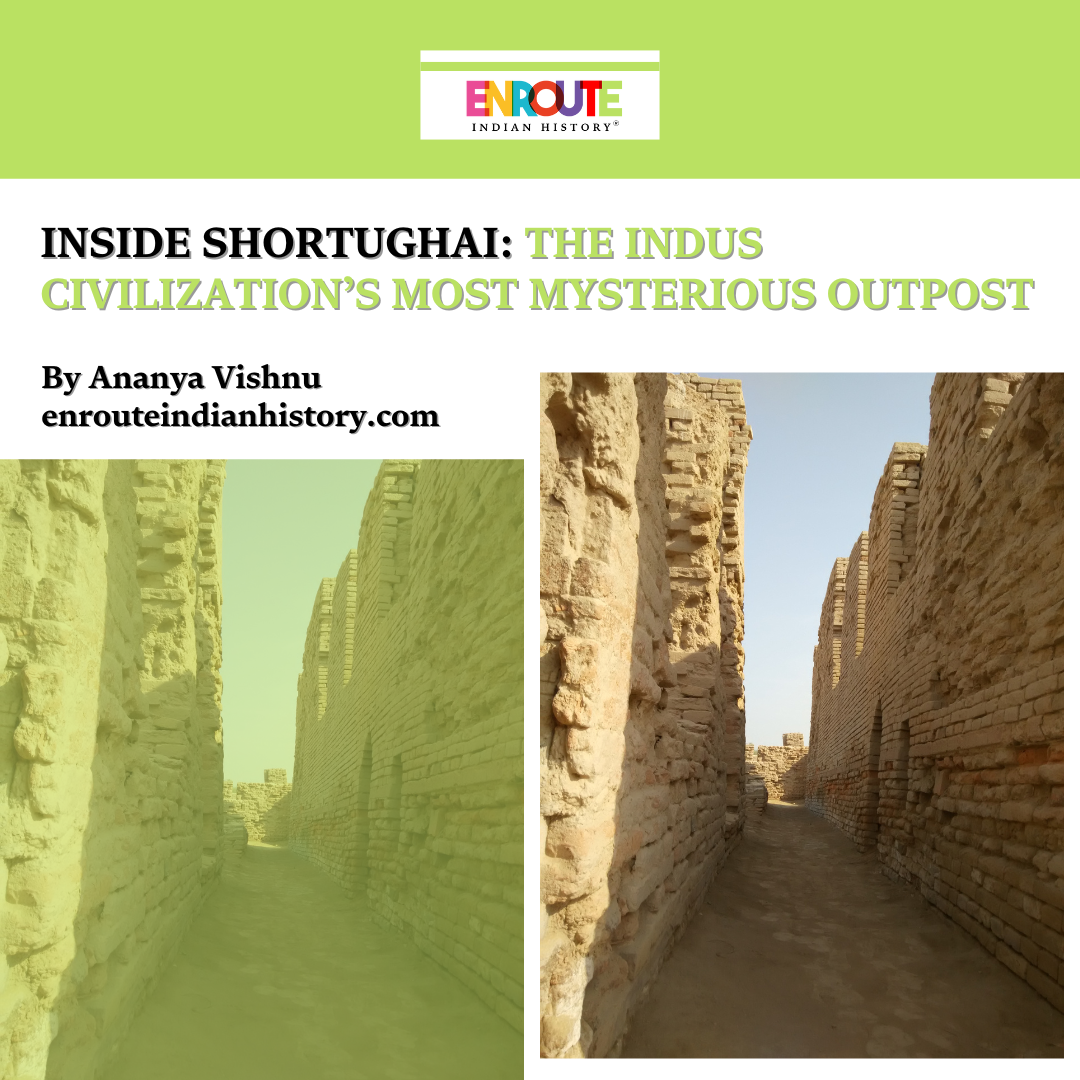
Inside Shortughai: The Indus Civilization’s Most Mysterious Outpost
- October 10, 2025
By Ananya Vishnu
The Indus Valley Civilization (IVC) stands as one of the ancient world’s most enigmatic and sophisticated urban cultures. While renowned for its meticulously planned cities like Harappa and Mohenjo-Daro, the true breadth of its influence and its intricate connections with distant lands are perhaps best exemplified by Shortughai. Situated strategically along the Amu Darya (Oxus) River in northern Afghanistan, Shortughai served as the IVC’s crucial northern outpost, a tangible representation of its commercial ambitions and a vibrant hub for the exchange of “important wealth,” most notably the coveted blue stone, lapis lazuli.
Established around 2500 BCE, Shortughai was no mere trading post; it was a bona fide Harappan colony. Its very layout, with typical Harappan mud-brick architecture and characteristic pottery, unmistakably signals its origins within the IVC (Francfort, 2016). Archaeological excavations have unearthed a wealth of material culture that mirrors that found in core Indus cities: distinctive square seals with rhinoceros motifs and Indus script, terracotta figurines of cattle and carts, carnelian and lapis lazuli beads, and bronze objects. The presence of these quintessential Harappan artifacts, rather than just limited trade goods, confirms Shortughai’s role as a direct extension of the Indus Civilization in Central Asia.
Old World Diplomacy : Shortughai and the Politics of Prestige Goods
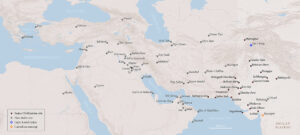
Map with important sites including major geological sources of lapis lazuli and carnelian.
The establishment of Shortughai, far from the plains of the Indus Valley, was a deliberate strategic move. Its location was paramount, positioning the IVC at the threshold of rich mineral sources. While it undoubtedly facilitated access to diverse Central Asian commodities like gold and tin, the procurement of lapis lazuli from the nearby Sar-i Sang mines in Badakhshan was arguably its most significant function. This blue stone, unparalleled in its vibrant hue, held immense value across the ancient world, from Mesopotamia to Egypt, and its secure supply was vital to the prestige and economy of the Indus elite.
Shortughai’s role in this network was pivotal. This settlement directed the flow of Badakhshan-mined lapis lazuli into the Harappan trade systems and onward to Mesopotamian and Iranian markets. Evidence from Shortughai includes not just finished lapis lazuli beads, but also raw lumps, flakes, and production tools, indicating that the stone was processed on-site by Harappan artisans. This suggests a direct involvement in the preliminary stages of lapis lazuli extraction and preparation for onward trade, magnifying Shortughai’s importance beyond a simple transshipment point. The Indus people, renowned for their bead-making skills, would transform these raw materials into highly sought-after ornaments, underscoring the craftsmanship and added value provided by the IVC.
The scatter of prestige goods (stone vessel, seals, pottery) has given the evidence of exchange networks linking southeastern Iranian and eastern Arabian settlements with those from the Indus civilization and with Mesopotamian urban centers. While scholars like Dales and Shaffer interpreted early third-millennium bce exchange networks as reciprocal interactions not driven by material gain, Possehl specifically argued that networks on the Iranian Plateau were “integrated within more general social configurations” rather than economic systems. Significantly, Possehl drew upon Thomas Harding’s concept of “important wealth” – which posits that certain objects were exchanged not merely for their economic utility but for their profound social and ritual significance – developed from his Melanesian Vitiaz Strait research. Possehl applied Harding’s concepts beyond interpersonal Vitiaz Strait networks to investigate east-west exchanges.Unlike a modern market-driven commodity, lapis lazuli’s value was intertwined with its rarity, beauty, and the distant, perilous journey it undertook (Wright,2013). Its presence in a Mesopotamian royal tomb in Ur (Possehl,2007) or as an intricate statuette in the Halil Rud Valley spoke volumes about the status of its owner and the far-reaching networks they commanded.
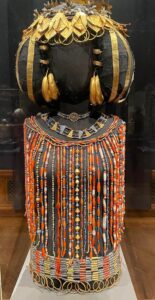
The burial shroud of Queen Puabi of Ur, Mesopotamia adorned with carnelian, lapis lazuli, gold and agate.
Jiroft’s Role in Interregional Exchange
The recent revelations of the Jiroft Civilization in the Halil Rud Valley of southeastern Iran have added another crucial dimension to the understanding of ancient exchange networks and the role of lapis lazuli. Jiroft’s burgeoning urban centers and their rich material culture also reveal a strong connection to this precious stone. The discovery of a lapis lazuli statuette of a breastfeeding female, possibly a goddess, in Jiroft is particularly compelling. This exquisite 14 cm high carving is undoubtedly crafted from Badakhshan lapis, given the lack of the material in the Iranian Plateau (Eskandari et al., 2023)
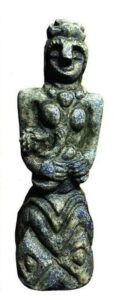
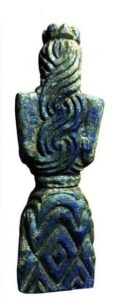
This Female statuette belonging to the Jiroft Civilisation is called La Déesse-mére, meaning Mother Goddess.
Further supporting evidence of cross-cultural interaction is found in the unearthing of a white marble cylinder seal at Konar Sandal South, bearing Indus-style iconography. This seal suggests not only artistic exchange but also the potential presence of Indus merchants or artisans within the Jiroft region (Vidale & Frenez, 2015).
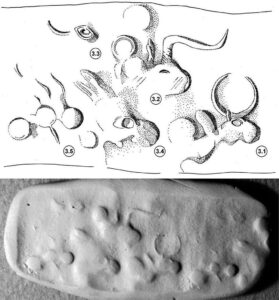
Cylindrical seal in white marble found at Konar Sandal South
Jiroft’s strategic position as an intermediary for lapis lazuli moving westward, might have complemented the routes through Central Asia, where Shortughai played a dominant role.
Broader Connections
The archaeological record at Shortughai reveals a fascinating progression, with early periods showing strong Harappan dominance to gradually incorporating more local Bactrian elements in pottery and stone tools over time (Francfort, 2016). This cultural blending suggests sustained interaction, peaceful coexistence, and even a degree of cultural absorption between the IVC and the Oxus Civilization (Bactria-Margiana Archaeological Complex, or BMAC), facilitated by such outposts.
Conclusion
Shortughai was far more than a distant trading outpost; it was a node in a complex system of symbolic, economic, and cultural exchange, a tangible representative of the Indus Valley Civilization in Central Asia. Through Harding’s insights, we view the trade of lapis lazuli with a different lens. It gives us a glimpse of ancient globalisation. The archaeological evidences point towards an interconnected trade network and demonstrate the complex and dynamic nature of Bronze Age interactions. While much remains to be uncovered about these ancient civilizations, the established connections, particularly those emanating from Shortughai, provide a crucial roadmap for future research.
References
1. Vidale, M. and Frenez, D., 2015. Indus Components in the Iconography of a White Marble Cylinder Seal from Konar Sandal South (Kerman, Iran). South Asian Studies, 31(1), pp.144–154.
2. Possehl, G.L.,2007. The Middle Asian Interaction Sphere: Trade and Contact in the 3rd Millennium bce. Expedition, 49(1), pp.1-3 .[online] Available at: https://www.penn.museum/sites/expedition/the-middle-asian-interaction-sphere/ [Accessed 27 Jun. 2025].
3. Rita P. Wright,2013. Connections and Complexity: New Approaches to the Archaeology of South Asia. Walnut Creek, CA: Left Coast Press.
4. Frenez, D., 2023. Indus Valley: Early Commercial Connections with Central and Western Asia. In: Asian History. Oxford University Press. Published online: 18 October 2023.
5. Vidale, M. and Eskandari, N.,2023. The Jiroft Civilization and the Indus Cultural Tradition: Materials for a Preliminary Assessment. In: Shah, A., Yatoo, M. and Dibyopam, A. (eds), Peopling and Cultural Spread: Studies in South Asian Archaeology in Honor of Prof. Vasant S. Shinde. New Delhi: Dev Publishers & Distributors.
6. Eskandari, N. and Shahdadnejad, E., 2023. A Lapis Lazuli Female Statuette “La Déesse-mère” from the Jiroft Civilization, South-East Iran (3rd millennium BCE). [online] Naghsh-e-Bazargan, pp.161–173. doi:10.22084/NB.2023.27921.2596.
7. Francfort, H.-P., 2016. How the twins met: Indus and Oxus Bronze Age Civilizations in Eastern Bactria. Shortughaï revisited forty years later. In: N.A. Dubova and E.V. Antonova, eds. Transactions of the Margiana Archaeological Expedition. Moscow: N.N. Miklukho-Maklay Institute of Ethnology and Anthropology, Russian Academy of Sciences and Altay State University, pp. 461–475.
Images:
1. Oxford Research Encyclopedias, 2023. Indus Valley: Early Commercial Connections with Central and Western Asia. [online] Oxford Research Encyclopedias: Asian History. Available at: https://oxfordre.com/asianhistory/display/10.1093/acrefore/9780190277727.001.0001/acrefore-9780190277727-e-595[Accessed 26 Jun. 2025].
2. Harappa.com, n.d. Rare White Marble Cylinder Seal from Jiroft. [online] Available at: https://www.harappa.com/blog/rare-white-marble-cylinder-seal-jiroft [Accessed 26 Jun. 2025].
3. Harappa.com, n.d. Queen Puabi of Ur’s Burial Shroud. [online] Available at: https://www.harappa.com/blog/queen-puabi-urs-burial-shroud [Accessed 26 Jun. 2025].