

By Saiee Katkar
Diwali, the festival of lights, carries deep and varied meanings across Indian traditions. For Jains, it commemorates the night when Mahavira attained nirvana, while in Hindu narratives, it celebrates Lord Rama’s return to Ayodhya after defeating Ravana. This article explores these perspectives, examining their historical roots, philosophical significance, and modern practices. By tracing Jain scriptures, medieval inscriptions, and cultural customs, it highlights how Diwali symbolizes both inner illumination and communal joy, demonstrating the festival’s enduring spiritual and cultural richness.
Introduction
As night falls during Diwali, countless lamps flicker softly across homes and temples, their warm light reflecting on walls, windows, and the faces of families gathered in quiet celebration. For the Jain community, this night holds profound spiritual significance, marking the moment when Mahavira attained nirvana, liberating his soul from the cycle of birth and death (Jaini, 2001). At the same time, many Hindu households celebrate the return of Lord Rama to Ayodhya after defeating Ravana, a story of courage, righteousness, and the triumph of dharma (Sharma, 2015).
On this night, two narratives coexist: one invites inward reflection, ethical living, and spiritual awakening; the other celebrates moral courage and communal joy. Together, they transform Diwali into a festival where inner enlightenment meets cultural celebration, and where the glow of lamps mirrors both the soul and society.
The Final Night at Pāvāpuri
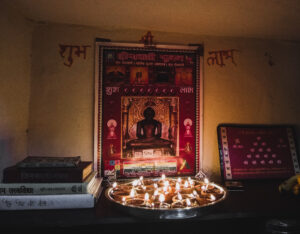
For Jains, Diwali is a sacred occasion rather than a purely festive one. According to the Kalpa Sutra and Uttarādhyayana Sutra, Mahavira spent his last rainy season at Pāvāpuri in Bihar, delivering his final sermons to monks, nuns, and lay followers (Jaini, 2001). During the night, his soul attained moksha, leaving the cycle of birth and death behind.
Devotees light lamps to honor the illumination that Mahavira’s teachings brought into the world. Each lamp represents knowledge dispelling ignorance, encouraging meditation, self- discipline, and ethical living (Shah, 1987). The light points inward, inviting reflection and moral renewal rather than outward celebration.
Lighting the Lamps: The Symbolism of Diwali in Jainism
Every Diwali night, Jain homes and temples glow with hundreds of lamps. Each lamp signifies the enduring radiance of Mahavira’s wisdom. The act of lighting lamps is symbolic of spreading knowledge and inner awakening.
Epigraphic evidence from Gujarat and Rajasthan records temple rituals from as early as the 10th and 11th centuries, where trustees and guilds donated ghee and wicks for mass illumination (IGNCA, 1998). Merchants would light lamps before closing their annual accounts, marking both spiritual and material renewal (Jain, 2010). In many Jain texts, such as the Acharanga Sutra, the fading of ignorance is described as allowing the soul to shine by itself.
Understanding Nirvana in Jainism
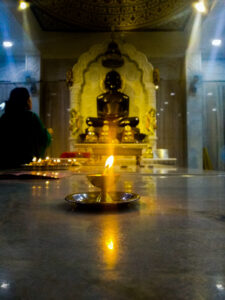
In Jain philosophy, nirvana or moksha signifies the purest state of existence, achieved when the soul is freed from karmic bondage. This is attained through the Three Jewels: right faith, right knowledge, and right conduct (Dundas, 2002).
Unlike many traditions where liberation is considered a divine gift, Jainism emphasizes individual effort and discipline. Mahavira’s life exemplifies this path through renunciation, meditation, and non-violence, leading to omniscience (kevala jnana). Diwali reminds followers that enlightenment is attainable through self-realization and ethical living.
Medieval Continuities: The Spread of Nirvan Divas
During the early medieval period, Jainism flourished across western and southern India, and observances of Mahavira’s Nirvana Day developed regional variations. In Shravanabelagola, Karnataka, inscriptions refer to collective lamp offerings and readings from the Kalpa Sutra during Diwali week (Settar, 1989). In Gujarat’s temple towns like Palitana and Girnar, pilgrims offered gold or silver lamps to mark the sacred night, believing it brought spiritual merit (Balbir, 2008).
These practices show how Mahavira’s Nirvana shaped Jain cultural identity, not merely as a ritual but as a calendar of ethical reflection and spiritual remembrance.
Modern Observance and Diaspora Practices
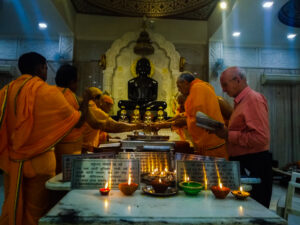
Today, Diwali remains one of the most sacred days in the Jain calendar. While India celebrates the festival with fireworks and feasts, Jains often begin the night in meditation and silence. Temples stay open late as devotees recite passages from the Kalpa Sutra, light lamps, and reflect on detachment and compassion.
Fasting, pratikraman (self-reflection), and community service are also common. In diaspora communities from Leicester to Los Angeles, Jain temples host discourses blending ancient philosophy with contemporary ethics, emphasizing sustainability, peace, and mindfulness. The core essence remains simple: the lamp burns not for wealth or victory, but for awakening.
Reflections on Shared Significance
Jain and Ramayana perspectives complement each other. Mahavira’s liberation emphasizes self-discipline, ethical living, and inner awakening, while Rama’s return celebrates virtue, courage, and communal harmony. Lighting a lamp becomes an act of mindfulness and celebration, reminding individuals of personal growth and connection to broader cultural values.
Diwali’s richness lies in its ability to hold multiple meanings at once, honoring both the inner journey of the soul and communal celebration. On this night, light becomes a symbol of knowledge, virtue, and shared human aspiration.
Conclusion
Viewed through both Jain and Ramayana lenses, Diwali emerges as a festival of profound illumination. Mahavira’s Nirvana teaches liberation through ethical living, while Rama’s return reminds communities of courage, virtue, and collective joy. Together, they reveal Diwali as more than a festival of lights; it is a night where spiritual reflection and cultural celebration meet, and where the glow of lamps mirrors both the soul and society.
Each lamp embodies hope, reflection, and the timeless aspiration to seek light within oneself and in the world around.
References
Balbir, N. (2008). Jaina Literature in Indian Languages. In K. A. Jacobsen (Ed.), Brill’s Encyclopedia of Hinduism. Brill Academic.
Dundas, P. (2002). The Jains (2nd ed.). London: Routledge.
IGNCA. (1998). Jaina Heritage: Art and Architecture. Indira Gandhi National Centre for the Arts.
Jaini, P. S. (2001). The Jaina Path of Purification. Motilal Banarsidass.
Settar, S. (1989). Inviting Death: Indian Attitude Towards the Ritual Death. Dharwad: Institute of Indian Art History.
Sharma, R. (2015). Ramayana and the Festival of Diwali: Cultural Narratives in India. New Delhi: Aryan Books International.