

By Ananya Vishnu

A rare digitized compilation of Khana’s sayings with Bangla translation
Introduction: In Rhythm with the Earth
In the fertile plains of Bengal, where the monsoon is both a life giver and a tyrant, there exists a body of wisdom that predates scientific journals and agricultural universities. It is not written in ink but recited in rhythm, a living almanac carried in the memory of farmers. This is Khanar Bachan or the sayings of Khana, a collection of folk aphorisms that has guided the region’s agriculture for centuries. More than mere proverbs, these couplets form a sophisticated system of knowledge and poetic science.
At its heart, Khanar Bachan is a masterclass in reading the land. It is an agronomy built on intimate observation, where the farmer is not a conqueror of nature but its keenest student. Khana’s voice guides the hand that sows and the eye that watches the sky. Her verses are precise, practical instructions tuned to the unique ecological frequency of Bengal. She speaks of the subtle signs: the behaviour of ants predicting rain, the colour of clouds foretelling a storm, the right lunar phase for planting gourds. A saying like, “Jodi borshe Agune, Raja jaan Magune” (If it rains in the month of Agrahayan, the king goes begging), is not a fatalistic prophecy but a sharp climatic observation linking winter rain to crop failure and subsequent famine. It is a risk assessment passed down through generations.(Ahmed & Akhand, 2023)
The Life and Legacy of Khana
Khana’s story, like most stories of women who knew too much, is cloaked in both legend and absence. Long buried beneath folklore and patriarchal edits, her story is one of a quiet revolution of a woman whose voice outlived the empire that tried to erase it. She is believed to have lived between the 9th and 11th centuries in early medieval Bengal. Though little remains of her life in the official record, legend tells us she arrived in Bengal with her husband Mihir, possibly from Sri Lanka, and stunned the royal court at Deulnagar by accurately correcting the court astrologer Baraha’s flawed predictions. In a dramatic revelation, she identifies Mihir as Baraha’s long lost son. Her intellect and insight earn her a place in the royal council which was an unprecedented position for a woman of her time. (Islam,2021)
But her rise is met with resentment. Baraha, threatened by her growing influence and wisdom belittles her presence with dismissive comments and veiled insults. Khana’s voice, however, continues to resonate with the people. She heals a queen through simple nature based advice, warns of an approaching famine, and helps prepare the kingdom using both celestial calculations and earthly knowledge.
As her popularity grows so does the opposition. When Khana accuses Baraha of plagiarizing her astrological insights, the confrontation escalates. Rather than face her intellectually, Baraha chooses brutality and so he orders his son, Mihir, to cut out her tongue. This act was not just personal it was symbolic, a deliberate attempt to silence a woman whose words held power.
Yet silence did not follow. In the days before her death, Khana recited her proverbs to the villagers, who memorized and passed them down for generations. These sayings, rich with environmental wisdom remain in circulation across eastern and southern India.(Ahmed & Akhand, 2023)
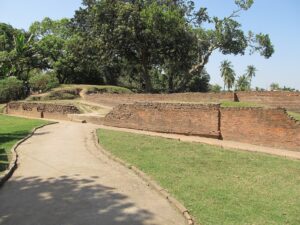
Khana-Mihir Mound is an archaeological site linked to the legend of Khana and Mihir at Berachampa.
Agricultural Knowledge in Khana’s Sayings
The genius of Khana lies in her holistic, self-sustaining vision of the farm. Long before “organic” became a commercial label, her bachans laid out a manifesto for a closed-loop ecosystem. She championed the alchemy of waste, turning everyday refuse into black gold for the soil- “Sana śana cāṣā bhāi, ṣār nā dile phasal nāi” (without applying manures to the crops good harvest would not be possible).The instruction is simple yet profound, establishing a direct causal link between soil health and yield. She prescribed the use of cow dung, kitchen ash, pond silt, and decomposed water hyacinth resources that are available to even the poorest farmer. This was not just about fertilising a plant, it was about nurturing the earth, ensuring that what was taken from the soil was returned to it, a philosophy of reciprocity that modern agriculture is only now beginning to learn.(Bandyopadhyay et al.,2017)
Her knowledge extended to the architecture of planting. Khana understood that space, air, and light were as crucial as nutrients. She told farmers where to place their trees and which trees should be near homes. She suggested avoiding neem and tulsi in close proximity to the house- “Nim nisindā, tẽtul, tāl, ghare pũtanā kana kāl” (Never plant trees like neem,Chinese chaste, tamarind and palmyra palm near your house) and warned against letting large trees grow near kitchens lest they block sunlight and trap moisture.She insisted on optimum spacing- “Hate hate chhoe na, mara jhanti roi na” (leaves of two adjacent palms should not touch each other and dried leaves should be removed), reminding us that even trees need breathing room, warning that tangled canopies invite pests and disease. She advises, “Pān putley shrāvaney;Kheye na furāy Rāvaney” (If betel plants are sown in the month of Shrāvana, the yield will be such that even with ten heads Rāvana would not be able to finish it). This is not just gardening; it is ecological design.
Among the many themes in Khanar Bachan, a striking feature is Khona’s keen observational wisdom used to predict environmental disruptions like floods. Her proverbs serve as early warning systems based on natural cues centuries before modern meteorology. For instance, “purbak āṣāṛ dakhinā bae, sei batsar bannā hae” warns that if the monsoon begins early with winds blowing from the south, it foretells a year of flooding. Similarly, “purbete uṭhile kāṛ, dāṇā dabā ekākār” suggests that spotting a rainbow in the eastern sky during the rainy season signals imminent flood. (Bhattacherjee & Sinha, 2023)
Her instructions on intercropping planting compatible species together demonstrate an innate understanding of symbiotic relationships, a method of natural pest control and soil enrichment that modern permaculture advocates. She taught that insect-ridden crops must be dusted with ash- “Dhorley pokā dibey chhāi; Er cheyea r upāy nāi” (If the crops are affected by insects, a farmer must spray ash over them). This is not superstition masquerading as wisdom; it is the kind of empiricism that grows from lived experience.
Perhaps most critically, Khanar Bachan is a calendar of the earth. It synchronises human activity with the great cosmic and seasonal cycles. There is a right time to sow jute and a right time to harvest paddy, a proper season for planting sugarcane and another for tending to betel leaf. Betel in Shravan, Taro by the riverside- “Nodir dhāre putley kochu; Kochu hoy teen hātuchu” (If you plant taro by the riverbank, the taro grows up to three hands long), bananas before planting a new orchard, every crop has its moment, every act its season. There is no artificial urgency in Khana’s world instead there is readiness, rhythm, and respectful waiting. It is agro-climatic science disguised as rhyme. By tying action to season generations of farmers have navigated the volatile climate of the Gangetic delta with a sense of foresight and preparation.(Nuri, 2022)
Though this knowledge has been challenged by the industrial scale and chemical dependency of modern farming, its relevance has not faded. In an age of climate crisis and ecological depletion, Khana’s words resonate with newfound urgency. They offer a blueprint for sustainability that is local, accessible, and proven by time. Her wisdom is not a relic of the past but a potential roadmap for a more balanced future, reminding us that the most profound technologies are often the simplest: a watchful eye, a listening ear, and a deep respect for the cycles of the natural world.
Concluding Thoughts: Preserving Oral Traditions in Modern Discourse

A modern TV adaptation exploring the life and legacy of Khana
Fittingly for an oral tradition, the preservation of Khanar Bachan has found a powerful ally in modern media. In recent decades, television serials, documentary films, and digital archives have begun to catalogue and dramatise these sayings. While these adaptations sometimes take creative liberties with the biography of the enigmatic Khana, they serve a vital cultural function. By translating the rhyming couplets into visual narratives and accessible online content, they are carrying this agricultural wisdom from the paddy fields to a new generation of listeners, ensuring that the voice of the soil continues to be heard in the digital age.
Beneath our feet lies a living archive the soil. It remembers every root that touched it, every monsoon it drank, every seed it once cradled into life. Long before textbooks and labs, we listened to it.
Our ancestors read its cracks like maps, its scent like signs. They knew when it was thirsty, when it was tired and when it needed to rest. Rooted in India’s Knowledge Systems are living traditions that remind us how to live with the earth and not just over it.
References
1. Ahmed, T. & Akhand, M.M., 2023. Khona: A Silent Voice of Female Leadership in Patriarchal Hegemony. Research Journal of English (RJOE), 8(4), pp.207. Available at: https://www.rjoe.org.in
2. Bandyopadhyay, M., Bhattacharya, S. & Chakraborti, K., 2017. Essence of Organic Agriculture in Khana’s Sayings. Journal of Agroecology and Natural Resource Management, 4(2), pp.145–148. Available at: http://www.krishisanskriti.org/Publication.html
3. Bhattacherjee, M. & Sinha, S., 2023. Sustainability Lessons in Traditional Bengali Proverbs. Ecocycles, 9(3), pp.78–89. https://doi.org/10.19040/ecocycles.v9i3.352
4. Nuri, M.A., 2022. Khanar Bachan: Bengali Folklore as a Storehouse of Sustainable Agricultural Wisdom. The International Journal of Humanities & Social Studies, [online] Available at: http://www.theijhss.com
5. Islam, A., 2021. Khana. [online] Banglapedia. Available at: http://en.banglapedia.org/index.php?title=Khana
Image:
1. Archive.org, 2019. Brihat Khanara Vachana (with Bangla Translation). Available at: https://archive.org/details/khanara_vachana [Accessed 30 Jul. 2025].
2. Wikimedia Commons, 2012. Khana-Mihir Mound – Berachampa. Available at: https://commons.m.wikimedia.org/wiki/File:Khana-Mihir_Mound_-_Berachampa_2012-02-24_2347.JPG [Accessed 30 Jul. 2025].
3. Colors Bangla, 2023. Khanar Bochon – Arabya Rajani TV Serial Information. Indian TV Info. Available at: https://indiantvinfo.com/colors-bangla-khonar-bochon-arabya-rajani/ [Accessed 30 Jul. 2025].