
By Anukriti Upreti
Sugar is an integral part of human life. In India, we find the mention of the term Iksu, Sugarcane in texts such as the Atharvaveda. The process of squeezing out sweet juice from a reed drew attention from Greek travelers like Megathenes, who believed that the juice was so sweet because it absorbed water from the soil, which cooks in the heat of the sun as the plant grows. (Gopal, 1964) The sugarcane pressing machines are called Mahajanta in Jatakas and the Shushrut and Charak Samhita mentions that there is a difference in the quality of juice when it is chewed between the teeth and when it is squeezed out in a press, thus highlighting the role of sugarcane press in the ancient India. The purest, crystallized form of sugar was called Sharkara, while we find other terms like gud, khand, ksudra gud varying in their purity. patalsharkara (pale red sugar) and karkasharka (white sugar) in Harshcharitra and sita in Amarkosha also refer to different types of sugar found in ancient India. As the method of making sugar diversified, the development of various articles from sugar also started.
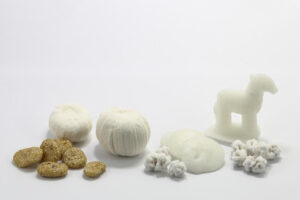
Khilone, Gatte and Batasha, sugar candies used in religious rituals. Image courtesy, Deccan Herald.
It is difficult to trace when the practice of making sugar toys, such as Khilone, Batase, and gatte, started. However, we have medieval references of them being used in Jash-e-Chiragan, the festivals of lights, Diwali celebrated in the Mughal time period. Historian Rana Savfi gives references of the celebration of Diwali from the Urdu text Bazm-e-Akhir (The Last Gathering) written by Munshi Faizuddin in 1885. The description goes like, “Orders are given for the fort to be illuminated. Kheele’n (puffed rice), batashe (candy), candy and khilone (sugar toys), sugar cane, lemon and mud houses are distributed from house to house by jasoliniyan (female guards) and female servants. At night, the mud houses made by the prince and princesses are filled with kheelei’n and batashe and diyas are lit in front of it. The raushan chowki, an ensemble of musical instruments, which included shehnai and drums is played in procession and the naubat (drum) starts playing in the Royal Naubat Khana.” (Safvi, 2017)
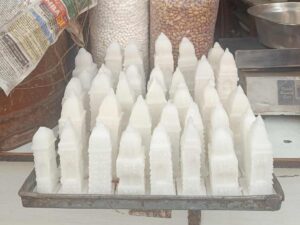
Khilone, made of sugar. Image courtesy The Patriot.
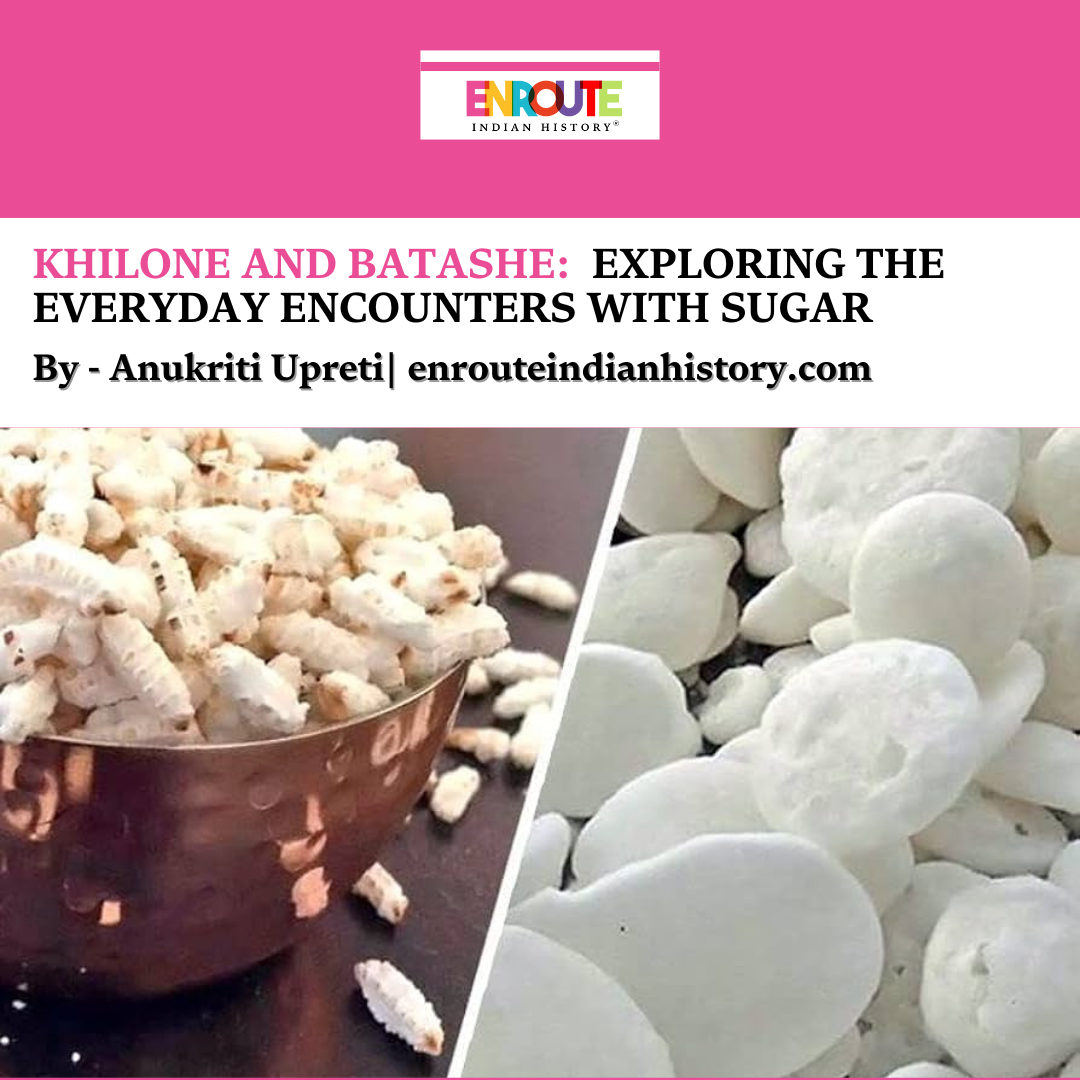
S. Nurul Hasan also gives reference to Batashe wali Gali at Chandni Chowk in his analyses of the Indian Cities. We still find some shops in Khari Baoli, a famous spice market located in Old Delhi. These shops get filled with tiny beautiful sugar shops from Dussehra to Diwali. As these toys are considered auspicious for the Diwali pooja, people buy them, especially on the occasion of Diwali. However, these shops are facing a threat with the coming of expensive and attractive sweets in the market, which have more sources of advertisement than these local sugar toy making workshops. Before going further, it is important to know how these beautiful sugar toys and candies are made.
Process of making Khilone and Batashe
73-year-old Gurbachan Singh, from Mishri Bazaar in Amritsar, in his interview with Deccan Herald says that the process of making colourful khilone is easy. It requires colors of your choice, sugar, and water. The sugar and water mixture is first boiled until a “not so liquid syrup” is prepared, and the colors are added thereafter. When the mixture is still hot, it is transferred to the wooden molds, where it quickly takes the shape of the mold and is then left to settle and dry (Sandhu, 2021). Different animals and birds, such as elephants, lions, ducks, and parrots, were made through this process, along with minars, huts, and Taj Mahalahal. Another type of sugar article highly used for worship and prasadam is batasha or sugar drops, which are made by the same process of preparing a syrup from sugar or jaggery; this syrup is then shifted into a machine with a nozzle that pours these sugar drops on a plane surface to give them an even circular shape.
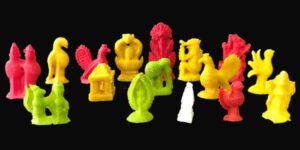
Panchadara Chilakalu from Andhra Pradesh. Image courtesy Kandra Food.
Regional Traditions Associated with them
These sugar toys are used in marriages, festivities, as gifts, and prasadam. Sugar toys like Khilone are used in Diwali; however, there are certain other practices associated with the articles made up of sugar. In West Bengal, we find various types of sugar candies like batasha, kadma, nakuldana, and math. We also find a tradition of Harir Loot where the priest throws handfuls of Batasha in the air and the devotees, considering it as a gift from God, try to collect as much Batasha as they can in their Saree of ‘Gamchha.’ In Chhattisgarh, Batahse ki mala holds prominence in Holi celebrations. This mala is prepared from colorful sugar drops symbolizing the sweetness and joy that the festival invokes among the minds of the people. People exchange them to show closeness and strengthen relations. Similarly, in Maharashtra, we find Battashacha har or shakhar gaathi, garlands made of sugar drops, in Gudi Parva. These mala or garlands are hooked to the upper end of the Gudi, the flag symbolizing a celestial tool against negative energies. In Andhra Pradesh, we find the sugar toys called Panchadara Chilakalu, mainly a parrot, which are used in Diwali and Makar Sankranti.
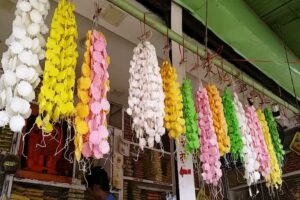
Batashe ki mala, Chhattishgarh. Image Courtesy. Etv Bharat.
Current Challenges Faced by Artists.
Although sugar toys and sugar drops are an integral part of rituals and festivals in many regions, the growing market of fancy sweets, increase in the prices of sugar, and changing demands of the people have threatened the age-old profession of Khilona and Batasha makers. In an interview with Gaon Connection conducted in Etah, Uttar Pradesh, Mohammad Yunus Faridi, a sugar toy artist belonging to the generational occupation, said, “About five years ago, the kaarigar of sugar toys were easily available, but now those are hard to find. Now, it has reduced to 400 kilos (kgs).” (interview, Gaon Connection, 2019) Another artist Islam Abbas says that earlier we used to have desi sweets like Khilone but now the market is full of fancy sweets which have affected our business.
Similarly, another sweet shop owner at Chandni Chowk recalled, “Years ago, you could’nt miss them. Every shop had these toys displayed for weeks before Diwali. Now, only a handful of stores stock them, mainly because they’re still needed for Diwali puja,”. The rising trend of sugar-free sweets and food is another reason for the declining tradition. As Haroon Ahmed, who now sells candles and decorative items, explains, “We don’t sell shakkar ke khilone anymore because people are afraid of sugar.” (The Patriot, 2024) These voices show that now people are shifting towards fancy expensive sweets rather than the mouthwatering edible sugar toys of the earlier times. However, the taste and the emotion of sweetness is still there in the minds of elderly people.
Nazimuddin, a resident of Old Delhi, fondly recalls his childhood: “We were seven siblings, and I used to save my pocket money to buy shakkar ke khilone for my sisters and the neighbourhood kids. Around Diwali, I would buy at least 30 toys to distribute in our haveli. We used to play with them and then eat them with sugarless tea. Now, kids don’t even know what they are.” ( Patriot, 2024). There are endless stories woven around these sweet Khilona and Batasha, which tell us that even if the art of making these sweet toys is on the verge of extinction, they will remain alive in the voices and narratives of everyday life.
References:
- Gopal, L. (1964). Sugar-Making in Ancient India. Journal of the Economic and Social History of the Orient, 7(1), 57–72. https://doi.org/10.2307/3596080
2. Yusra Nazim (2024). The fading tradition of shakkar ke khilone in Old Delhi’s Diwali celebrations. [online] The Patriot. Available at: https://thepatriot.in/reports/the-fading-tradition-of-shakkar-ke-khilone-in-old-delhis-diwali-celebrations-60015#google_vignette [Accessed 3 Nov. 2025].
3. Khan, M.S. (2023). Bitter times for sweet toys. [online] The Patriot. Available at: https://thepatriot.in/market/bitter-times-for-sweet-toys-42109 [Accessed 3 Nov. 2025].
4. Sandhu, R.S. (2021). Mouthwatering toys. [online] Deccan Herald. Available at: https://www.deccanherald.com/features/mouthwatering-toys-1047323.html [Accessed 3 Nov. 2025].
5. ranasafvi (2019). In the Mughal era, Diwali stood for Hindu-Muslim solidarity. [online] Rana Safvi. Available at: https://ranasafvi.com/in-the-mughal-era-diwali-stood-for-hindu-muslim-solidarity-2/ [Accessed 3 Nov. 2025].