
By Chanchal Kale
Nestled along the banks of the Noyyal River in the vibrant region of western Tamil Nadu, the towns and cities resonate with a rich history of industrial activity and global trade. Among them lies the quaint village of Kodumanal, a place that thrived as a bustling industrial and trade hub over two millennia ago. With a population of around a thousand, this modest village is located just 41 km southwest of Erode, the district capital. Archaeological studies suggest that Kodumanal dates back to between the 3 rd or 4 th century B.C.E. and the 3 rd century C.E.
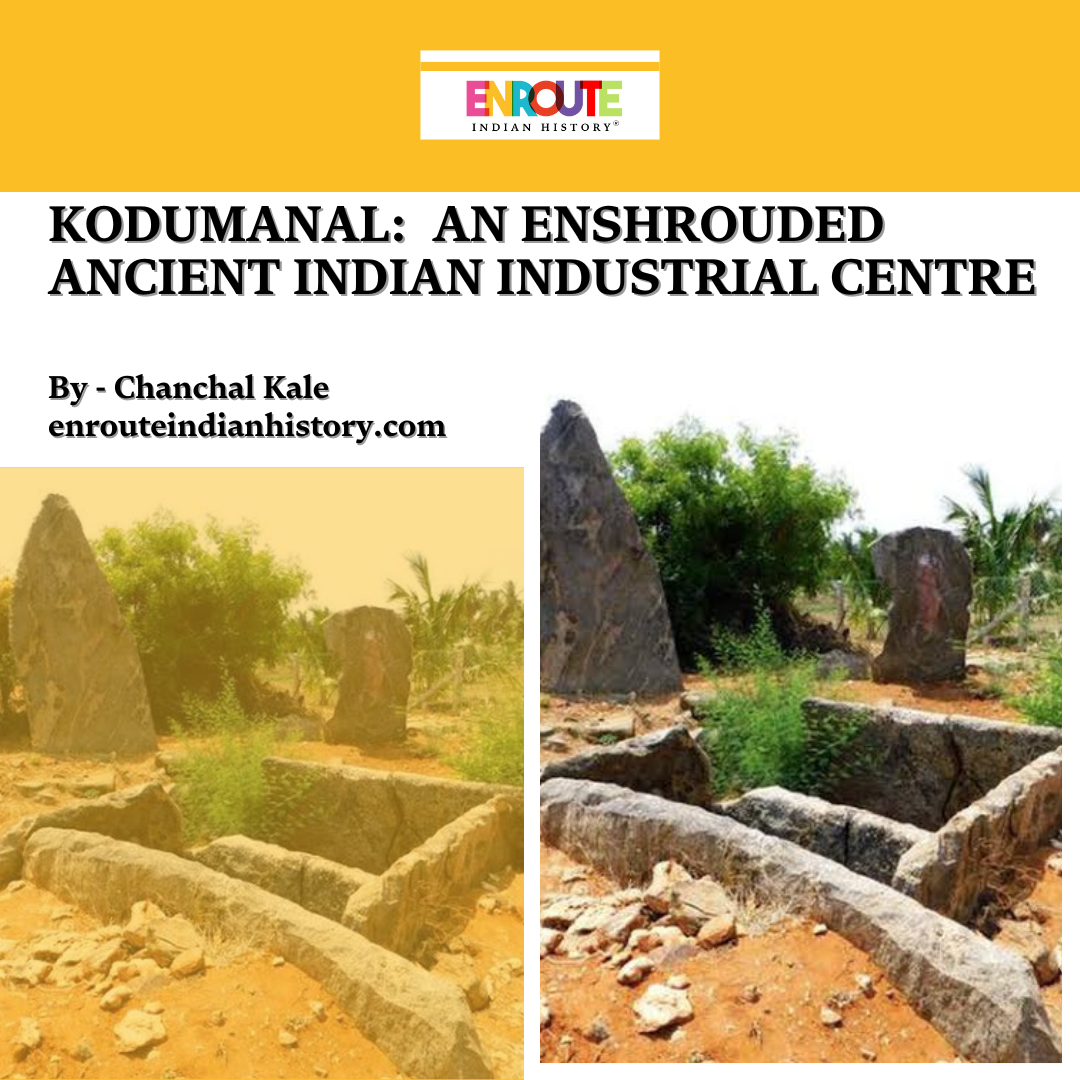
The intriguing past of Kodumanal first caught the eye of V. N. Srinivas Desikan in 1961, when he initially discovered its megalithic burial sites. Little did he realize that this seemingly inconspicuous village was a veritable treasure trove, containing a wealth of ancient artefacts and an impressive artisanal heritage. It was Professor K. Rajan who truly unlocked the site’s potential, unearthing compelling evidence of a significant industrial centre that once thrived there.
Economy
Kodumanal is a fascinating historical site that once thrived along the ancient trade route linking Karur, the Chera capital of the Sangam Age, and Musiris, the bustling port city on the west coast, traversing through the Palghat Gap. This vibrant location, celebrated in the epic Sangam literature Patirruppattu as a renowned bead-making centre, offers a captivating glimpse into the past. The discovery of enormous quartz beads in various stages of production demonstrates that Kodumanal was a hub for bead manufacturing, with exports reaching far and wide across the globe.
During excavations, a trench uncovered a remarkable circular bowl furnace with a diameter of 115 cm located on the southern edge of the habitation mound. Its distinct colouration, likely caused by high temperatures, hints at the advanced metallurgical practices of its time, as suggested by the researcher B. Raghunatha Rao. This discovery highlights the presence of an iron smelting industry that once flourished at the site.
Furthermore, the digs at Kodumanal revealed crucial insights into the creation of wootz steel through the crucible process in the Chera kingdom. Just 300 meters north of the iron smelting furnace, an intriguing oval-shaped furnace—surrounded by twelve smaller ones—was found buried at a depth of 125 cm. This setup served as a low-temperature zone, where crucibles from the main furnace would cool slowly, showcasing the sophisticated techniques employed by the artisans of the time.
Interestingly, the absence of potholes, the lack of a defined floor level, and the presence o potsherds without other cultural artefacts in the smelting area suggest that iron smelting occurred away from the core of the habitation, indicating a purposeful separation in their
industrial practices.
Nestled near rich deposits of magnetite ore and quartz, this site was strategically located to take advantage of the mineral wealth that the inhabitants skilfully exploited for their gain. Remarkably, mining and smelting activities continued in this region until the mid-19 th century, as documented in the memoirs of Francis Buchanan.
The presence of precious stones like carnelian and lapis lazuli, which were not sourced locally, points to extensive trading networks with distant lands. Additionally, findings of Roman coins at the site reinforce the idea of a vibrant trade relationship with the Roman Empire. Notably, the Periplus of the Erythraean Sea mentions “Ferrum-Indicum” (Wootz Steel) among the goods subject to duty in Alexandria, suggesting that this prestigious steel
was indeed imported from the East, with Kodumanal standing out as one of its key manufacturing centres.
Society and Culture
Kodumanal has unearthed numerous cultural artefacts demonstrating various aspects of society. A significant number of Tamil-Brahmi inscribed potsherds were collected from the lowest level of a 180 cm cultural deposit. Y. Subbrayalu, the principal investigator of the site, designated this lower phase as Megalithic due to its association with burial practices. However, according to the convention, the entire deposit should be classified as Early
Historic based on the presence of inscribed potsherds. K. Rajan, in his studies, has highlighted this issue and argued that the burial practices from the Megalithic period continued into Early Historic times. He challenges the division of the site into two phases—Megalithic and Early Historic—and instead asserts that the entire period should be regarded as Historic, with the continuation of Megalithic burial practices.
Furthermore, Kodumanal sheds new light on the nature of habitation and burial. The pottery recovered from the burials consists of black and red ware, black slipped ware and red ware. In contrast, the habitation site presents a different picture, with the majority of evidence consisting of Russet Coated Ware, which is not found in the burials.
Another intriguing finding is that, despite Kodumanal being a centre for quartz bead production, not a single burial has yielded a quartz bead; however, thousands of carnelian beads have been discovered. This suggests that the selection of grave goods was deliberate and often favoured by the elite, as K. Rajan notes. Overall, these burial practices indicate a religious or ritualistic significance associated with the interment of the dead family member.
Conclusion
The evidence uncovered during the excavations and the scholarly studies allows us to envision how the site thrived during its peak years. Kodumanal was an industrial town under the Cheras, known for manufacturing not only quartz beads but also wootz steel, which was in high demand and reached as far as Rome. The habitation and burial activities provide insight into the cultural life of the people living there at the time. As we explore its rich
history, Kodumanal reveals itself as more than just a village; it represents a significant chapter in India’s ancient history.
Bibliography
1. Rajan K. (2008), “Situating the Beginning of the Early Historic Times in Tamil Nadu: Some Issues and Reflections”, Social Scientist, Vol. 36, No. 1/2, pp. 40-78
2. Sasisekaran and Rao (1999), “Technology of Iron and Steel in Kodumanal: An Ancient Industrial Centre in Tamilnadu”, Indian Journal of History of Science
3. Athiyaman N. (1998), “Ethno-Archaeology of Stone Quarrying in Tamil Nadu (with special reference to Megalithic Architecture)”, Proceedings of the Indian History Congress, Vol. 59, pp. 972-981
4. Ida Ortner Kelly (2013), “Craft Specialization, Technology and Social Change: A Study of Material Cultures in Iron Age and Early Historic South India (c. 1200 BCE- 400 CE)”, A dissertation submitted in partial fulfilment of the requirements for the degree of Doctor of Philosophy at the University of Wisconsin, Madison
5. Varghese (2012), “Archaeological and Ethnographic Field Visit to the Kongu Region by the Pattanam Excavation Team”, Report by Rachel A. Varghese, Research Assistant, KCHR