
By Anukriti Upreti
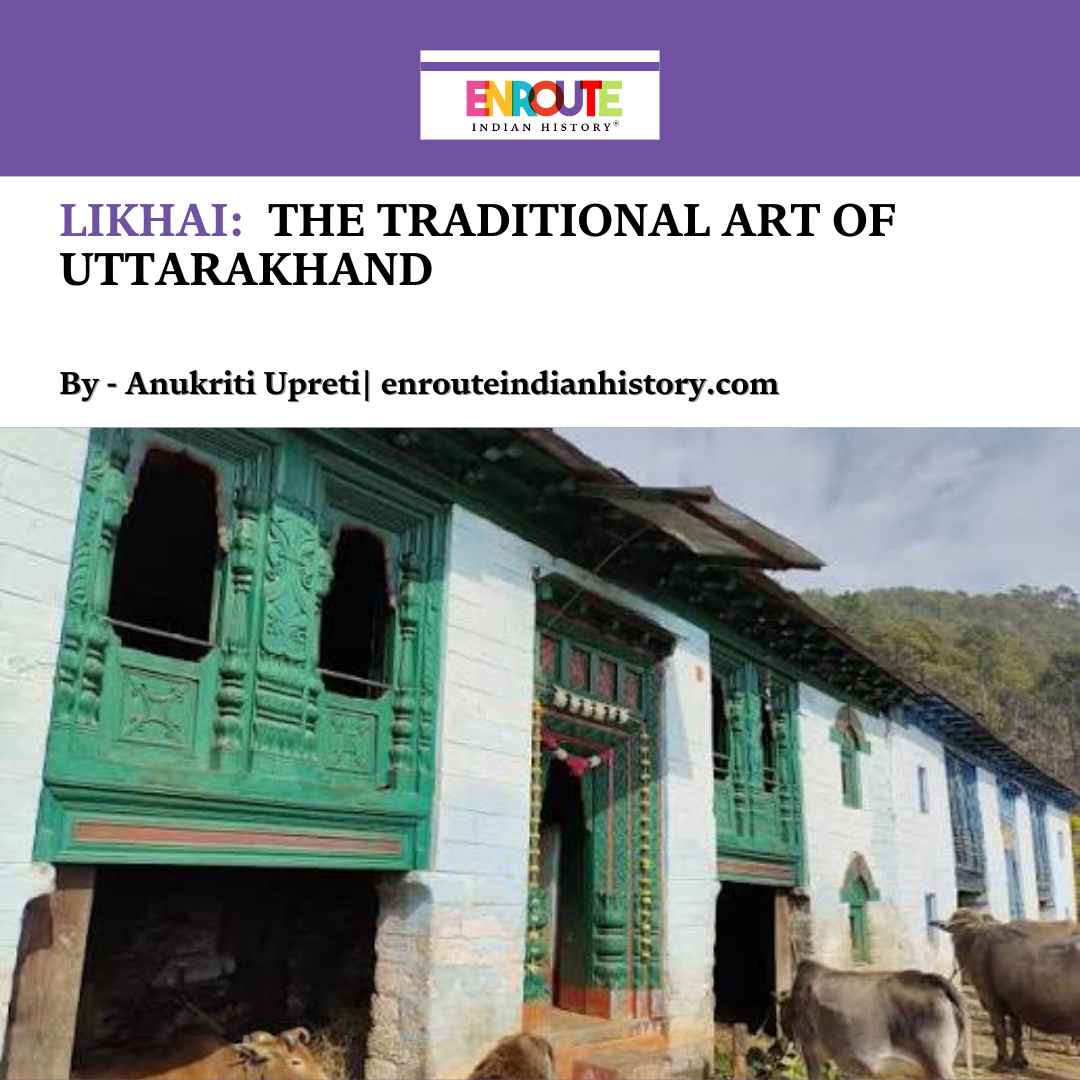
Craft reflects the lived realities of those who make it; it symbolizes their world and thus provides insights into the history of a particular region. Uttarakhand, a state famous for its religious significance and serene environment, also holds an age-old wood carving tradition called Likhai, which has become an artifact of the past due to its declining “relevance” in the “modern” world. The tradition gained importance during the rule of the Chand dynasty, which ruled the region from the 10th to the 19th centuries. People belonging to the dom caste were called to carve wooden doors and windows of the houses, thus making the craft a part of livelihood for both who made them and those who patronized those crafts. Woodcarvers created various motifs of gods and goddesses, as well as geometrical and floral designs, which held auspicious meanings and symbols for the locals.
Historical background and cultural interactions
Much of the information about this craft is from oral traditions; however, cultural interactions between Western India and Uttarakhand are evident from common surnames such as Joshi, Pant, and Pandey. Oral History suggests that the craft was introduced by immigrants of the Maratha wars who settled in the Himalayan regions. The portrayal of elephants, which are rarely found in the regions, also indicates cultural interactions between these regions. The Lala Bazaar of Almora and the Bageshwar market developed during the Gorkha period. We find beautifully carved houses in these regions which are 150-300 years old. In the Upper regions, we find Tibetan influence in the motifs and style of carvings. We also found some English designs on the doors of Forti village in Lohaghat. It is said that some English families, such as the Abotts, patronized these crafts in the region. Interestingly, all the traditional houses had these carved windows and doors with varying levels of intricacy, depending on the status of the household.

Almora market: People have used the wooden frames in their modern houses. Image courtesy Uttarakhand tourism
Methods and designs
The art of woodcarving begins with the selection of perfect wood. The artists prefer walnut trees as it is dense and fine grained making it best for minute carvings; old thick and straight trees are selected for the work. However, today only a few walnut trees are left; thus, people use Surai (Cypress) and Utees (Alder) trees for making doors and windows. In the Munsyari region, we still find many walnut doors framed by the Oar community (also called Shilpkars and designated as Scheduled Caste) (Rana,2020). In lower regions, such as Almora and Bageshwar, we find Chir pine and Tuni wood, which are used for their natural resistance properties.
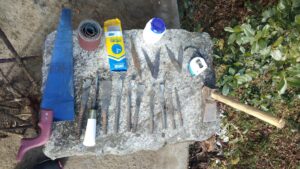
Image courtesy: Lalita Waldia, Voices of Rural India
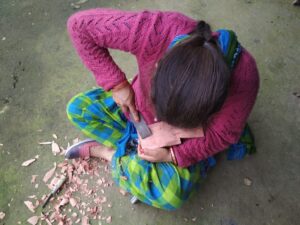
After selecting the wood, a stencil was prepared with the design, and the pattern was drawn on the wood. During carving, artisans first chisel out the excess wood, except for the design, leaving the pattern or motif as a raised surface. The edge of the design was not carved straight to the base but was tapered. The chisel is held at a specific angle to the wood surface, and the curved part of the chisel should be downwards. Chisels of different sizes are used depending on the level of detail required (Waldia, 2022). After the carving is done, the surface is polished with sandpaper, and natural oils are applied to prevent moisture and termites.
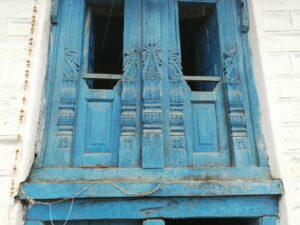
Image courtesy: Lalita Waldia, Voices of Rural India
Daina hoya kholi ka Ganesha he, daina hoya mori ka Narena he… This Garhwali prayer summons lord Ganesh and Vishnu (Narayan) who reside in the Kholi (doors) and Mori (windows) of the house symbolising the auspiciousness of these motifs for the locals. He is depicted in different postures in the carvings, including seated, standing, and dancing postures. Rajendra, an artisan from Munsiari, says that when craftsmen used to carve the idols, they put butter on them to welcome the deity and pray for a prosperous life in the new house, thus indicating a possible ritualistic function for the maker (Waldia, 2022).
Researcher and writer Manju Kak (1998) classified these motifs into four broad categories: the plant kingdom, human beings and the animal world, gods and deities, and geometric symbols and decorative designs. She further explains that the motifs were either passed down through generations or copied from textiles, carpets, and other objects brought by traders. During the seventeenth century, flowers and plants motifs gained importance along with the motifs of birds. Parrots, which symbolize Rati (erotic pleasure), are also depicted in the houses. Popular plant motifs include the lotus flower, foliage patterns, and leaf and tree patterns found on door panels and creepers on the decorative bands covering the doors and windows. (Kak, 1998). The traditional door of houses was often colored in shades of blue, which again holds symbolic importance, representing knowledge, tranquility, stability, and spiritual or therapeutic virtues. These doors were painted with indigo, which was cultivated in the regions, preventing termites and thus providing a long life to the door. (Sharma, 2021)
Why has this art become just a showpiece of the past?
Unfortunately, this tradition is now declining. State control over forest and wood, the Indo-China War of 1962, which stopped the interaction between Tibet and the upper Himalayan regions, particularly the Bhotiyas, and changing market demands have affected the lives of artisans. Moreover, as Kak says, wood carving was a lived experience for these artisans, and their notion of time was determined by the seasons, not the calendar. Their idea of space was influenced by forests and woods. All these things have changed now in the so-called “modern” world where people are looking for high paid jobs. The traditional mud and stone houses of the region have been replaced by cemented houses, where simple machine-carved doors and windows are used. In these changes, Likhai has lost its essence.
Attempts at revival: integrating the past with the present.
Now, the art has become an artifact from the past, and the tradition is now attracting researchers and some NGOs who are working on its revival. Himal Prakriti, a Munsiari based community organisation is working on training the locals in woodcarving. An article written by Trilok Singh Rana, a resident of Shankhdhura village of Uttarakhand, tells us how this art was used for generating employment during the tough times of COVID- 19. The pandemic affected the tourism industry, which was the sole source of livelihood for many local residents. During this time, this organization came up with an interesting idea of making carved mirrors, doors, and windows for local homestays. This initiative is also generating women’s employment, as earlier only men used to perform this activity, but now women are also actively participating in the work.
Local women making mor pithak, image courtesy voices of rural India
Besides doors and windows, we find various daily articles made of wood, such as mirrors, utensils, and a storage box called mor pithak, which was used to keep vermillion, sandalwood, and rice used for putting tikas on special occasions. This attempt by the locals has bridged the gap between the past (Likhai as a showcase element) and present (the art being integrated with the lives of the people). With the attempt of this craft studio, wood carving and articles made from this method are not only a show-case but are again becoming the lived experience of both who are making these articles and those who are using them.
References:
1. Waldia, Lalita. “Likhai: A journey through the craft of wood carving” The Jugaad Project, 5 April 2022, www.thejugaadproject.pub/likhai-wood-carving [Accessed: 7 Oct.2025]
2. Rana, T.S. and Ark, H. (2020). The Disappearing Craft of ‘Likhai’(Wood Carving) – Voices of Rural India. [online] Voices of Rural India. Available at: https://www.voicesofruralindia.org/the-disappearing-craft-of-likhai/ [Accessed 7 Oct. 2025].
3. Irani, J. (2017). Ganga Ram is the last surviving master craftsman of Kumaon’s fading Likhai woodwork tradition. [online] The Hindu. Available at: https://www.thehindu.com/society/the-old-man-and-the-tree/article18923895.ece [Accessed 7 Oct. 2025].
4. sharma M. (2021). Revisiting the Old Age Craft; Likhai: the Wood-Carving of Uttrakhand. Webology, pp.1896–1900. doi:https://doi.org/10.29121/web/v18i1/206.
5. Kak, M. (1998). Woodcarvers of Kumaon. India International Centre Quarterly, 25/26, 82–90. http://www.jstor.org/stable/23005532