
Love, Longing, and Landscape: The Divergent Visual Worlds of Layla–Majnun in Mughal Miniatures and Pahari Art
- December 11, 2025
By Ramyani Banerjee
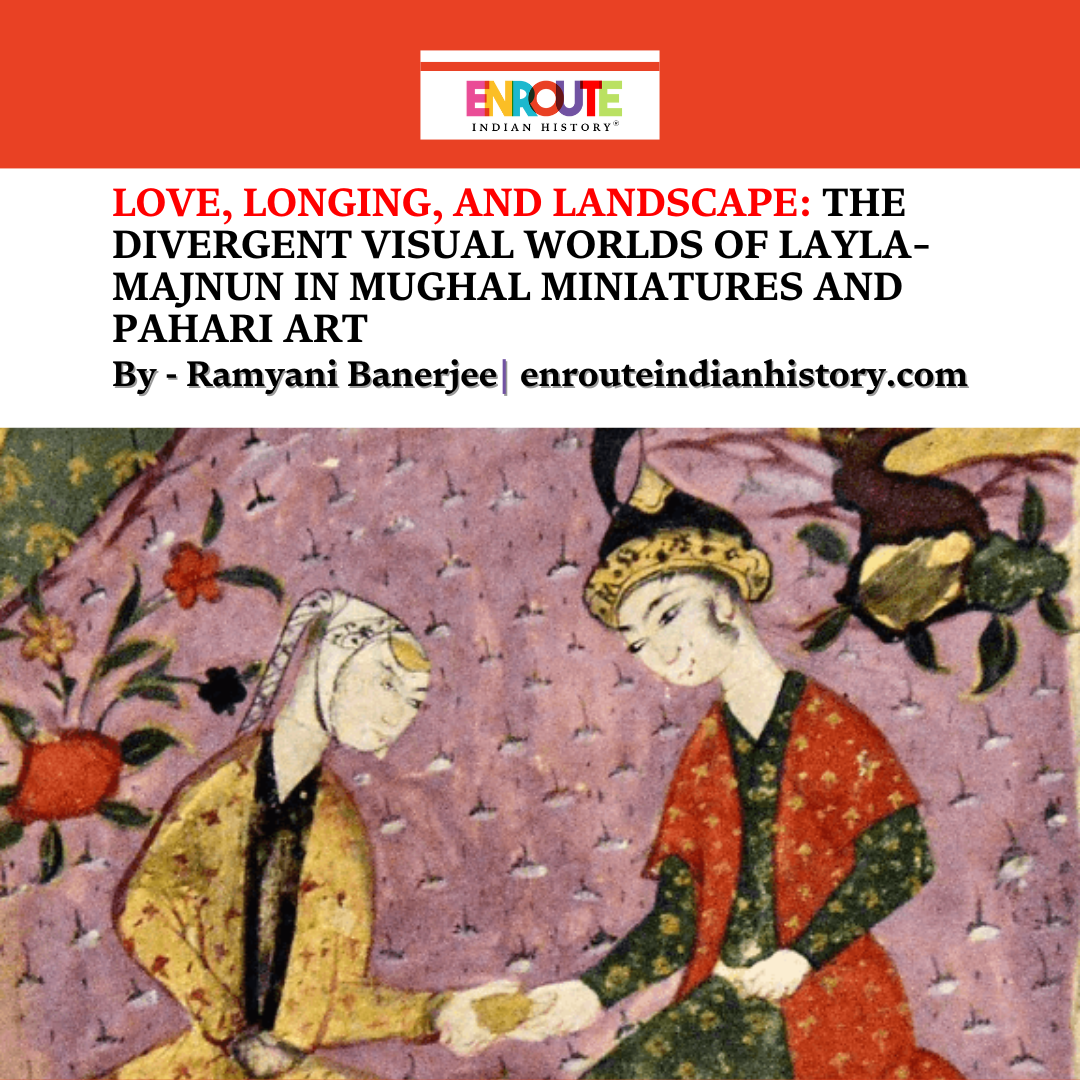
Unknown author. (no date) Layla visits Majnun in the wilderness [Watercolour, MS. Ouseley Add. 166, fol. 13b]. Bodleian Library, Oxford. Available at: https://commons.wikimedia.org/wiki/File:Bodleian_MS._Ouseley_Add._166_fol_13b.jpg (Accessed: 20 November 2025).
The Layla–Majnun narrative, originally emerged from the Arabic world, has long inspired artists across the Indo-Persian world to visualise the mystical dimensions of unfulfilled love. While Nizami Ganjavi’s version remains the canonical text, poets such as Amir Khusrow and Maktabi Shirazi reinterpreted the tale in South Asia, generating a rich continuum of literary and visual responses. Miniature paintings most frequently depict Majnun as an emaciated ascetic in the wilderness and Layla as a refined beloved enclosed within patterned interiors—an opposition that turns emotional distance into pictorial drama. Through delicate line work, rhythmic compositions, and luminous pigment, artists across centuries visualised themes of longing, spiritual dissolution, and transcendence. And this study analyses four representative paintings—from Mughal manuscripts of the late sixteenth century to Kulu and Kangra ateliers in the eighteenth century—to examine how the visual language of Layla–Majnun evolved as it travelled across courts, styles, and regions.
Out of various painting schools, this article focuses specifically on Mughal miniature painting and the Pahari schools because these two traditions represent the most stylistically divergent yet interconnected approaches to the Layla–Majnun theme. The Mughal atelier—cosmopolitan, experimental, deeply influenced by Persianate models and European prints—pursued naturalism, ethnographic detail, and spatial depth. By contrast, the Pahari ateliers of Basohli, Guler, Kangra, and Kulu reinterpreted the same subject with an emphasis on lyricism, emotional inwardness, decorative flatness, and symbolic landscape.
This juxtaposition is uniquely productive: Mughal and Pahari painters were working within shared narrative and Persianate frameworks, yet the aesthetic cultures, and workshop traditions that shaped their art differed radically. This makes the Layla–Majnun theme a near-perfect lens for studying how a single literary narrative can generate two contrasting visual worlds.
Layla and Majnun spend time together in the desert. From Khamsa (Five Poems) of Amir Khusrav Dihlavi, AD 1485, from Herat. This is a typical example of an original Persian miniature style. Source:- Wikimedia Commons, available at: https://commons.wikimedia.org/wiki/File:Layla_and_Majnunn_in_the_Desert_(CBL_Per_163.120).jpg (accessed 22 November 2025).
Why is Layla visiting Majnun the most common motif?
Among the many episodes in the Layla–Majnun story, Layla visiting Majnun in the wilderness emerged as the most widely represented motif because it offered artists the richest visual and emotional possibilities within the miniature tradition. Unlike scenes of courtship or companionship—which tend to unfold in restrained, interior settings—the wilderness encounter provided a dramatic contrast between two worlds: Layla’s refined, ornamented presence and Majnun’s ascetic, emaciated form. This duality aligned perfectly with Indo-Persian pictorial conventions that delighted in juxtaposing courtly elegance with raw, spiritualised nature. The scene also allowed for elaborate environmental detailing, which painters in the Mughal and Pahari ateliers used to display their mastery of naturalism and symbolic landscape. Most importantly, the motif captures the emotional and mystical tension at the heart of the story: Majnun’s self-annihilating devotion and Layla’s compassionate yet unattainable love.
This moment of encounter, where longing is intensified rather than resolved, resonated strongly with Sufi interpretations of divine yearning. As a result, artists repeatedly gravitated toward this scene as a perfect visual metaphor for unfulfilled love, spiritual transcendence, and the poetic aesthetics that had long shaped the Indo-Persian imagination.
Indo-Persian Conventions: The Lyrical Framework of Wilderness and Separation
Before turning to individual works, it is crucial to understand the Indo-Persian pictorial grammar that shaped early renditions of Layla and Majnun. Persianate miniature painting already privileged contrast: the ascetic male figure placed against rocky isolation, the noble beloved situated within patterned interiors. When carried to India under the Timurid and Safavid influx into Mughal ateliers, this grammar was enriched by the subcontinent’s diverse ecological and visual references. Mughal painters, trained in a workshop culture that relied on collaboration between line specialists, portraitists, and colorists, approached the Layla–Majnun theme with new tools: Indian mineral pigments yielding brilliant reds and blues, improved depth through overlapping planes, and ethnographic interest in local animals and Hindu ascetic body types. The result was a hybrid visual idiom—still Persian in its compositional skeleton but unmistakably Indian in texture, anatomy, and environmental detail.
Example 1: “Layla and Majnunn in the Wilderness” (Mughal, c. 1590–1600)
Among the finest surviving examples is a Mughal illustration attributed to the artist Sanwalah, painted around 1590-1600 for a manuscript of Amir Khusrau’s Khamsa. The painting displays a couple seated below a spreading tree—rocks, a streaming brook, and clusters of wild animals surround them—a setting emblematic of Majnunn’s madness and exile. The late-sixteenth-century Mughal miniature attributed to Sanwalah remains one of the most articulate depictions of the lovers in Indo-Persian tradition. At first glance, it seems to follow familiar Persian conventions—a high horizon line, rhythmic outcrops, diagonally flowing streams—but a closer analysis reveals Mughal naturalism infusing every element.
The composition hinges on a triangular structure: Layla and Majnun at the base, a central tree rising above them, and a horizon that climbs unusually high. This spatial strategy extends the eye upward, emphasizing spiritual ascent. But the Mughal innovation lies in the three-dimensional modeling of forms. The rocks are not merely flat color blocks, as in many Persian prototypes; they are contoured through tonal gradation, suggesting weathering and volume. The brook, painted with carefully articulated ripples, folds naturally around the terrain, creating a believable recession into space. This subtle illusionism marks a break from the strict flatness of earlier Persian painting. While the compositional layout is Persian, the perceptual experience—movement through spatial layers—is decidedly Mughal.
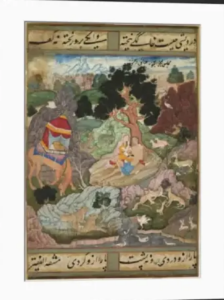
Layla and Majnunn in the Wilderness, c. 1590-1600 Print.
Source:- Mediastorehouse, Layla–Majnunn in the Wilderness with Animals, heritage image no. 19634981, Mediastorehouse, viewed 22 November 2025, https://www.mediastorehouse.com/heritage-images/layla-Majnunn-wilderness-animals-19634981.html
Majnun’s anatomy is striking: ribs sharply visible, limbs angular, skin darkened by exposure to sun and deprivation. The Mughal atelier’s interest in physiognomic accuracy shows here, echoing depictions of Indian yogis, sadhus, and the iconic “Starving Buddha.” Unlike Persian manuscripts, where Majnunn’s gauntness often appears stylized—thin yet idealized—the Mughal version pursues ethnographic realism. His ragged garments cling to bone, the inked outlines tightening around protruding joints. His body becomes both symbol and study, spiritualized yet grounded in observation. Layla, by contrast, appears firmly anchored in courtly refinement. Her garments retain a flowing Persian line, but the color saturation—deep lapis, brilliant vermilion—reflects Indian pigment preferences. The contrast between her refined physiognomy and Majnunn’s ascetic angularity is not moralistic; it is visual rhetoric, marking the lovers’ inhabitation of different emotional and material worlds.
Perhaps the most innovative layer of this Mughal work is its richly observed animal world. Whereas Persian precedents often feature camels, gazelles, or the occasional lion, the Indian setting adds monkeys, blackbuck, and local deer species. Each animal is rendered with tactile specificity: fur is speckled, hooves lightly shaded, faces attentive. These animals do not merely populate the wilderness—they temper Majnunn’s madness with companionship. Their calm grouping around the lovers creates a visual field of serenity, mirroring the Sufi idea of the wilderness as a site of spiritual equilibrium rather than chaos.
Mughal artists at Akbar’s court famously studied European engravings brought by Jesuit missionaries. Subtle echoes appear here: the tender, almost Pieta-like quality of Layla leaning toward Majnunn; the atmospheric dilution of background hills; and the soft modeling of faces. These details do not dominate the work, but they add another layer to the Indo-Persian hybrid vocabulary. Sanwalah’s miniature, therefore, is not simply an illustration of unfulfilled love—it is a workshop experiment in ethnographic realism, cross-cultural borrowing, and spatial exploration.
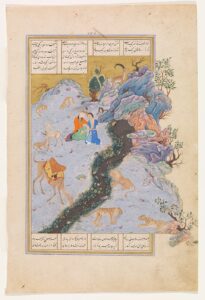
Example 2: “Layla Visits Majnunn in the Wilderness” (Akbari School, c. 1590s):-
This companion piece from the Akbari period further illustrates how Mughal ateliers transformed the Layla–Majnun iconography by intensifying spatial complexity, surface detail, and calligraphic integration. This painting displays Layla approaching an emaciated Majnunn, surrounded by a menagerie of Indian wild and domestic animals, blending narrative with symbolic space.
In this folio, the Nastaliq script does not simply frame the painting—it shapes its visual logic. Text bands at top and bottom act like architectural beams, compressing the pictorial space within a controlled rectangular stage. This interplay between written and visual storytelling is characteristic of Akbari manuscripts, where calligraphy becomes a compositional force. The painting is built in horizontal bands: a foreground dotted with shrubs and animals; a middle section where Layla approaches Majnunn; and a high horizon with patterned rocks. The layering creates both narrative direction and emotional pacing. Notice how the animals are placed in rhythmic clusters—three deer on one side, two goats on another. Their arrangement echoes poetic meter, visually enacting the rhythmic cadence of Khamsa verses. The rocks employ sinuous curves that guide the gaze across the surface, making the painting feel musical in its internal motion. Colours—earthy ochres, deep blues, and contrasting whites—underscore emotional intensity. Majnunn’s body is rendered with shadowing and sharp angularity, while the animals’ fur and feathers are given tactile detail.
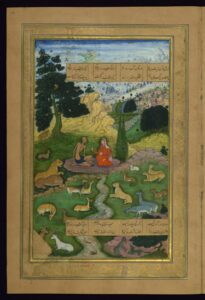
Layla Visits Majnunn in the Wilderness, Walters Art Museum, attributed to the artist Narsing, Mughal period, c. 1597–1598; Scribed by Muhammad Husayn Zarrin Qalam; from manuscript Khamsa of Amir Khusraw Dihlavi. Exhibited in Pearls of the Parrot of India: The Emperor Akbar’s Illustrated Khamsa (Walters Art Museum, Baltimore & Metropolitan Museum of Art, New York, 2005–06). Source:- https://art.thewalters.org/object/W.624.115A/
The landscape, however, remains somewhat stylized around the edges, pointing to an Indo-Persian hybrid aesthetic: blending Persian flatness with emergent Mughal perspective and volume. Majnunn, again, is portrayed with anatomical precision: thin but expressive hands, hollowed cheeks, and sharply contoured limbs. This anatomical realism draws on Indian ascetic iconographies (yogis, sadhus), rather than merely symbolic thinness. Layla’s garments, however, are patterned with Persian floral motifs, linking her visually to the refined interiors from which she emerges. This painting therefore becomes a study in contrast—between realism and abstraction, between ascetic wilderness and courtly finery, between spiritual dissolution and worldly grace.
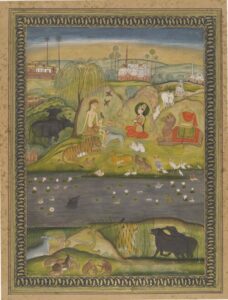
Example 3: “Layla visiting Majnunn”, Kulu (Pahari School), 1720:
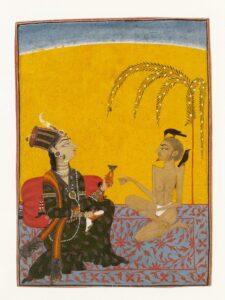
Example 3: Victoria & Albert Museum, “Layla and Majnunn,” unknown artist, opaque watercolour on paper, Kulu (Pahari school), ca. 1720, Victoria & Albert Museum collections, London. Source:- https://collections.vam.ac.uk/item/O73117/Layla-and-Majnunn-painting-unknown/
Pahari painting developed in small principalities in the Himalayan foothills (Kangra, Guler, Basohli, etc.) between the 17th and 18th centuries. By the early eighteenth century, the Layla–Majnunn theme spread into the Pahari region, where ateliers in Kulu, Basohli, and later Kangra reinterpreted it through completely different stylistic priorities. However, unlike Mughal painting, which pursued realism and environmental specificity, Pahari painting emphasized lyrical emotion, decorative flatness, and intricate surface details.
The most immediate visual marker of Pahari idiom is the flat saffron background. Unlike Mughal landscapes, which created spatial depth through recession, Pahari painters often collapsed space into planes of luminous color. This saffron field operates not as natural sky or ground, but as an emotional register—suggesting heat, intensity, and spiritual illumination. The composition places the richly adorned Layla opposite the emaciated, ascetic Majnunn, their gestures forming an intimate visual dialogue that embodies the spiritualised interpretation of their romance characteristic of Pahari miniature traditions. The delicate blue-grey horizon, and ornamental carpet foreground create a decorative flatness typical of the region’s painting, while the fine opaque watercolour work—seen in Layla’s patterned textiles, pearl-like jewellery, and the precise rendering of Majnun’s frail body—reflects the meticulous brushwork central to Pahari craftsmanship. In some Pahari Layla–Majnun paintings, a tree may droop in a sinuous curve, and a bird may sit nearby: these details heighten the impression of spiritual melancholy. The stylised willow tree and bird perched on Majnunn’s head further enhance the poetic tenor of the scene, echoing the school’s tendency to blend natural motifs with emotional symbolism.
Perhaps the most striking aspect is the silent conversation created through gestures. Layla’s hand extends toward Majnunn, slightly curved, gentle but hesitant. Majnunn’s posture—leaning inward, elbows tight to his body—reflects vulnerability. In Pahari aesthetics, gesture often replaces narrative detail; emotional states are conveyed through bodily curves, tilts, and finger positions. This painting thus interprets the lovers’ meeting not as an event but as a poetic moment suspended in time
Example 4:- “Majnunn in Solitude” (Kangra–Basohli, 18th century)
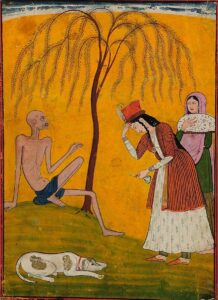
Majnunn in Solitude. Image Source:- Salar Jung Museum, Layla Majnunn: A Legendary Love Story in Artworks, Google Arts & Culture, accessed 20 November 2025, https://artsandculture.google.com/story/Layla-Majnunn-salar-jung-museum/2AUhkgUc9EmOCg?hl=en
Another Pahari interpretation—Majnunn visited by Layla, attended by a maid, carrying food and wine—embodies a different facet of hill aesthetics. Here, Majnunn sits in a sparse landscape rendered with soft greens and pale yellows. The stylization is gentler than in Basohli works, leaning toward early Kangra’s more naturalistic landscapes. Yet, the figures remain anchored in Pahari lyricism: almond-shaped eyes, smooth contours, and pastel modelling. Rather than using landscape as strictly a “real” place, Pahari painters often treat it as emotional or symbolic space. A barren tree, a bird perched on a branch, or a distant hill might all be visual metaphors for longing, separation, or transcendence. Layla’s arrival becomes almost ritualistic. Her posture resembles a respectful greeting, not dramatic rushing. The maid behind her balances the visual composition, forming a triangular arrangement characteristic of Kangra symmetry.
Elements of Pictorial Hybridity:
Indo-Persian Layla–Majnun works often begin with Persian template elements—high horizons, diagonally flowing streams, rhythmic rock formations. But Indian adaptations shift these structures: fauna becomes local, depth increases, landscapes gain volume, and rocks are softened or stacked in more naturalistic ways. Visual density increases as painters incorporate Indian foliage and ecologies.These animals are not purely decorative; they perform symbolic roles like companions, witnesses to Majnun’s solitude, or even moral foils. Mughal paintings tend toward saturated blues and earthy browns and painters integrate dense patches of Indian foliage and wildlife, filling space with delicate shrubs, native animals, and water—all in naturalistic detail. This collaborative model partly explains why Majnunn’s body, animals, and landscape often show different kinds of detail yet remain cohesive.
In case of Pahari painters, especially in schools like Kangra and Kulu, often collapse spatial depth into flatter, more decorative planes. Rather than lush three-dimensional wilderness, the backgrounds may be stylized hills, planar trees, or even single-color fields. In a typical Pahari Layla–Majnun painting (e.g., Kangra, circa 1775), Majnun may be seated under a tree against a relatively empty horizon, reducing spatial clutter and emphasizing the emotional bond. Rather than wild asceticism, Majnun sometimes becomes a poetic ideal, and Layla a graceful counterpart, both rendered in a soft, lyrical style. Pahari works embrace saffron, scarlet, emerald, and pink. Their paintings use natural pigments: indigo dyes (from plants), mineral greens (e.g., malachite), and other earth pigments. Palette choices become emotional registers, shaping the mood of each interpretation. Indian mineral pigments like ultramarine from lapis, indigo plant dyes, malachite greens, red iron oxides give Mughal and Pahari paintings a vibrancy that were different from purely Persian works.
Conclusion:
Mughal painters privileged worldliness, observation, and cross-cultural experimentation; Pahari painters privileged lyricism, emotional clarity, and symbolic design. This matters because Layla–Majnun corpus offers one of the clearest examples of how visual cultures travel, adapt, and hybridise without losing their symbolic power. In the end, Layla and Majnun’s visual afterlives illuminate a broader truth about Indo-Persian art: that its creativity lies not only in retelling stories but in reimagining how stories can be seen. Mughal naturalism and Pahari lyricism represent two complementary modes of envisioning love, longing, and transcendence. Together, they form a layered archive of emotional, technical, and spiritual experimentation—one that continues to shape how scholars understand the aesthetics of romance in South Asia.
REFERENCES:
1. Academy of Fine Arts and Literature (n.d.) Indian Miniature Paintings: The Pahari School. Google Arts & Culture. Available at: https://artsandculture.google.com/story/indian-miniature-paintings-the-pahari-school-academy-of-fine-arts-and-literature/OgXR_5UNK3EaIw (Accessed: 22 November 2025).
2. Aanya Yagnaraman (2024) ‘From Persia to India: The Historical Fusion in Mughal Miniature Paintings’, MeMeraki, 3 September. Available at: https://www.memeraki.com/blogs/posts/persian-influence-on-mughal-miniature-paintings (Accessed: 20 November 2025).
3. Archer, W.G. (1973) Indian Paintings from the Punjab Hills: A Survey and History of Pahari Miniature Painting. London: Sotheby Parke Bernet.
4. Kochhar, R. (n.d.) ‘An Interplay of Story, Text and Painting in an Akbari “Layla visits Majnunn in the Wilderness”’. Academia.edu. Available at: https://www.academia.edu/115525294/An_Interplay_of_Story_Text_and_Painting_in_an_Akbari_Layla_visits_Majn%C3%BBn_in_the_Wilderness (Accessed: 20 November 2025).
5. Mediastorehouse (n.d.) Layla–Majnunn in the Wilderness with Animals, heritage image no. 19634981. Available at: https://www.mediastorehouse.com/heritage-images/layla-Majnunn-wilderness-animals-19634981.html (Accessed: 22 November 2025).
6. Mughal Miniature Paintings: An Analysis (2023) HistoryMarg, November. Available at: https://www.historymarg.com/2023/11/mughal-miniature-paintings-analysis.html (Accessed: 20 November 2025).
7. Salar Jung Museum (n.d.) Layla Majnunn: A Legendary Love Story in Artworks. Google Arts & Culture. Available at: https://artsandculture.google.com/story/Layla-Majnunn-salar-jung-museum/2AUhkgUc9EmOCg?hl=en (Accessed: 22 November 2025).
8. Sharma, Maanikya (n.d.) ‘16 Layla and Majnunn’. Scribd. Available at: https://www.scribd.com/document/407672061/16-Layla-and-Majnunn (Accessed: 20 November 2025).