

RAVNEET KAUR
Since time immemorial, down to the present day, marriage has been sacrosanct in the Indian subcontinent. The most sacred of all rites of life for its people, in its traditions, philosophy, and across almost all its religions. Therefore, it is hardly surprising that marriage is mentioned, depicted and professed so vividly all around – from the Kalyanasundara (marriage rites of Lord Shiva and Goddess Parvati) at the Ellora Caves to their miniatures in bronze statutes.
The Pahari Miniatures of the Punjab Hills pay another tribute to the testament of marriage. The Pahari painting developed in Haripur-Guler around the 17th century, where the scenic hillscapes suffused their naturalism with the Mughal school of miniature and birthed something entirely new. Historian M. S. Randhawa has called the Pahari painting “an art both of line and colour”, and in contrast to the mist and mountains of East Asian art, it is “art flooded with sunlight and colour”. Vibrant colours, lively gestures and “daringly simple” compositions come together to create these Pahari paintings, the very embodiment of human love.
Each Pahari painting has its own regional flavour corresponding to the region of its development. These regions classify the Pahari painting into different substyles – Kangra, Chamba, Basohli, Guler, Bilaspur and so on. They showcase numerous themes – valour, heroism, devotion, worship, courts, battlefields, lovers’ trysts, married couples, scenes of family life – casting each phase and event of one’s life in their rhythmic hue. Though love, in its various facets, is often the theme of these paintings, it is not always so. Marriage and scenes of married life are abundantly found in Pahari paintings. Married couples – divine or imaginary – have found their rightful place in these works of art. Come, let’s take a look!
THE ROMANTICS: VISHNU AND LAKSHMI
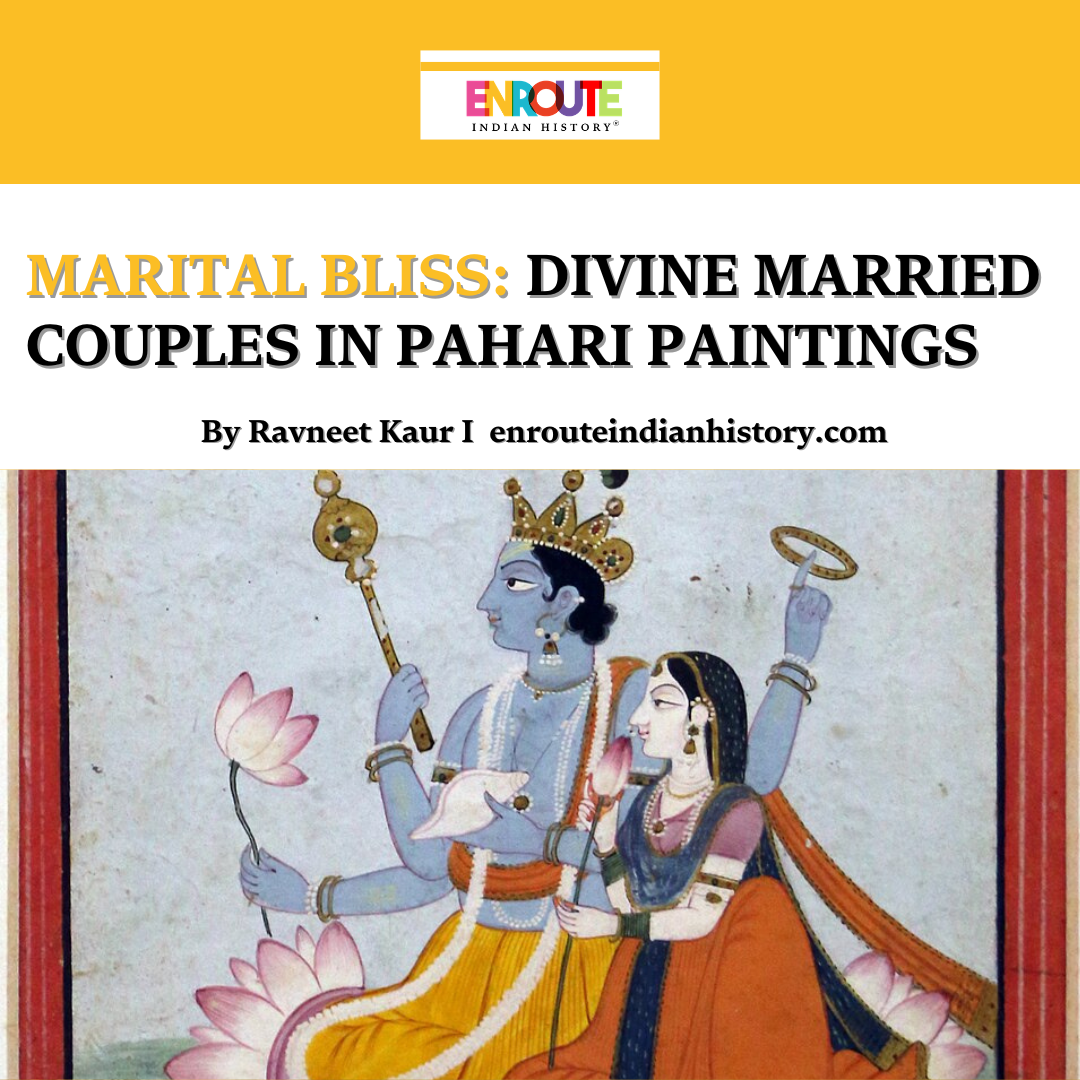
Lord Vishnu and his consort, Goddess Lakshmi, are depicted in various Pahari paintings. Lord Vishnu can be identified with his blue colour and his four attributes – a conch shell, a lotus flower, a Chakra and a mace. While Goddess Lakshmi, more or less, is always dressed in red, whether a Pahari one or a Raja Ravi Verma one. The couple is always together, sitting beside each other, and this in itself is the most distinct characteristic of their paintings. The couple is almost always alone, without any third party, except sometimes sitting on Garuda, Vishnu’s vahana. Otherwise, they are seated on a lotus flower (Painting 1) or on a yantra, a tantric device. A very significant detail when compared with other divine married couples.
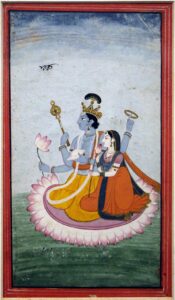
PAINTING 1: Vishnu and Lakshmi, Bilaspur, c. 1810
In Painting 2, the couple is astride Garuda, who holds their feet on his palms. Meanwhile, Vishnu and Lakshmi are gazing at each other with immense love and devotion, as if oblivious of everything and everyone around them. Lakshmi is holding and pulling Vishnu towards him, a very subtle but impactful and romantic gesture. The divine couple is touched with a human-like sensibility and feeling, and the whole painting exuberates a dreamlike lyricism for which the Pahari school is known.
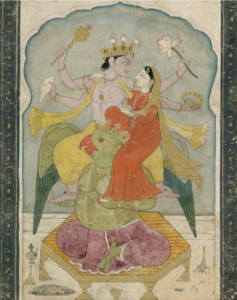
PAINTING 2: Vishnu and Lakshmi astride Garuda, Pahari Hills, c. 18th Century
THE COSMIC COUPLE: SHIVA AND PARVATI
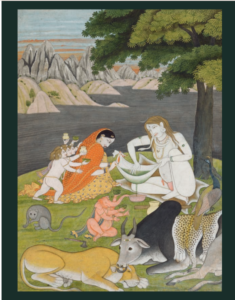
PAINTING 3: Holy Family Preparing Bhang, Guler, 1790-1800
The Cosmic dancer and destroyer Shiva and his wife Goddess Parvati, in stark contrast to Vishnu and Lakshmi, are almost always depicted along with their whole family – Kartikeya and Ganesha, their sons and Nandi, Mayura, Moshaka, their Vahanas (vehicles). Across multiple depictions, the celestial family can be seen relaxing, lounging or listening to third-party concerns. For example, in Painting 3, the family is making Bhang together. Parvati is smiling shyly, while Shiva is looking at a stubborn and demanding Kartikeya with a “father’s fond exasperation”. Ganesha is also partaking in the process while the four vahanas linger around. The whole scene is quintessentially domestic. This is how the married life of Shiva and Parvati is showcased mostly – surrounded by their children, family, the Himalayan backdrop, and grounded in domesticity.
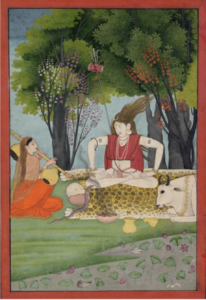
PAINTING 4: Shiva in a Passion Caused by Parvati’s Interrupting His Meditation, Guler, 1800-10.
In a rare painting from Guler, Shiva and Parvati are alone. It seems that Shiva was in deep meditation, but his meditation was disrupted by Parvati’s act of playing the Veena. The music was so melodious that Shiva came out of his trance, and even his snake slithered down and came to sit beside the Goddess to swing with the music. Moreover, the painting can also be interpreted as having ignited a passion in Shiva as his hair flares up. J. P. Losty, the Curator of Indian Visual Collections at the British Library, in his book Indian Paintings from the Ludwig Habighorst Collection, writes that the “God and goddess are often pictured along with their children enjoying family life on Kailasa, but as with all families, husband and wife can have fallings out over trifles, although artists rarely depicted them”. This Guler painting is indeed one of those rarities.
THE RAKSHASA VIVAH: KRISHNA AND RUKMINI
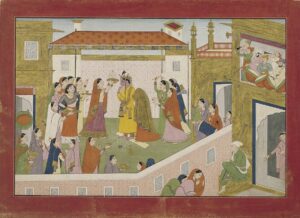
PAINTING 5: Illustration from an Abduction of Rukmini Series: The Marriage of Krishna and Rukmini, Pahari Hills, c.. 1800
According to Brahmanical texts, such as Manu Smriti and the Atharvaveda, there are eight types of marriages, of which the first four – Brahma, Daiva, Arsha, Prajapatya – are acceptable and the last four – Gandharva, Asura, Rakshasa, Paisacha – are not. Lord Krishna’s marriage to Rukmini, whom he abducted beforehand, is often classified as a Rakshasa marriage, wherein the daughter is not given in marriage by a willing father and is abducted by the bridegroom. The same happens here, though, according to tradition, Rukmini loved Krishna and had asked him to come and elope with her so that she could escape her arranged marriage to Shishupala.
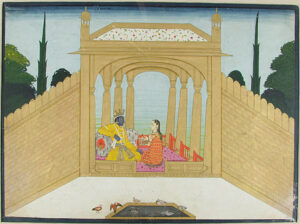
PAINTING 6: Krishna and Rukmini in a Garden Pavilion, Pahari region, c. 1760-70
Thus, collections of paintings titled ‘Rukmini Mangal’ show a happy conclusion to Rukmini Haran (Rukmini’s abduction) wherein Rukmini goes to Dwarka to marry the Blue lord. Painting 5 by the Kangra painter Phurkhu is one such example. Phurkhu is also known for the manipulation of interiors and exteriors, as in this painting.
Meanwhile, Painting 6 shows Rukmini and Krishna sharing a quiet moment sitting in the Garden Pavilion in leisure. Their marital depictions are certainly very different from Krishna’s trysts with Radha, which can be seen as a symbol of divine love in human form and are full of longing, adoration, attraction, attachment, rendezvous at night, embraces and eros. Krishna and Rukmini are never portrayed thus and are an embodiment of an ideal respectable married couple, well within their social milieu.
THE FORLORN LOVERS: NALA AND DAMYANTI
DP153165, 9/10/07, 3:07 PM, 16C, 7698×9792 (0+254), 100%, Rona Copywork, 1/15 s, R75.1, G38.1, B35.2
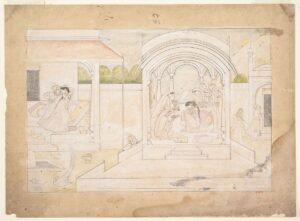
PAINTING 7: The Marital Bliss of Nala and Damayanti: Folio from a Nala-Damayanti Series
Attributed to Ranjha, Kangra (c. 1800-10)
In the Mahabharata, Nala and Damyanti go through numerous trials and tribulations before and after their marriage. The Svayamvara, Damyanti’s abandonment in the forest, Nala’s loss of memory, Damyanti’s ruse of a second marriage and their final reunion – all provide ample subject matter for painters’ imagination. However, the topic of most folios is Nala and Damyanti’s marriage and associated events, such as – their marriage rites, Nala returning from his marriage, Damyanti’s toilet before their nuptial night and her toilet after their nuptial night and so on. Painting 7 shows Nala and Damyanti’s nuptial night and Damyanti’s toilet afterwards.
Despite their tragic love story, the scenes of their conjugal happiness, perhaps the briefest phase of their tale, have remained the centre of the paintings of Nala and Damyanti. Looking at these folios, one really cannot help but wonder at the marital bliss of these forlorn lovers.
Married life and its many phases – the rites, the nuptial night, the quiet moments of calm, the moments of falling out, the devotion, the loving gazes, the fiery passion, children as tokens of this conjugal love, and the quaint domesticity of all these phases are abundantly visible in these Pahari paintings. Full of delicacy, rhythm and feeling, even the divinities are rendered with human fragility and emotions in their spheres of domesticity. This is the very heart and soul of the Pahari School of painting, to touch everything with its simple lyricism, romantic love and mysticism. Truly, the language of human love, and when the gods themselves are in its very raptures, how can we ever imagine coming out of its tangles?
BIBLIOGRAPHY AND REFERENCES
1. Pande, Rekha. Joshi, Neeharika. 2019. Representation of Women in Garhwal Miniature Paintings. Ars Artium: An International Peer Reviewed-cum-Refereed Research Journal of English Studies and Culture ISSN (Online): 2395-2423.
2. Kramrisch, Stella. 1975. Reviewed Work: Indian Paintings from the Punjab Hills: A Survey and History of Pahari Miniature Painting by W. G. Archer. Artibus Asiae, Vol. 37, No. 4 (1975), pp. 307-311 (5 pages).
3. Losty, J. P. Galloway, Francesca. 2018. Indian Paintings from the Ludwig Habighorst Collection. London.
4. Randhawa, Mohinder Singh. 1994. Kangra Paintings on Love. Publications Division, Ministry of Information and Broadcasting, Government of India.
5. Goswamy, B. N. 1975. Pahari Paintings of the Nala-Damyanti Theme : In the Collection of Dr. Karan Singh. Publications Division, Ministry of Information and Broadcasting, Government of India.
6. Kapoor Galleries on Instagram: Vishnu and Lakshmi astride Garuda, Pahari Hills, 18th Century. (https://www.instagram.com/p/Ce3xANSOhaQ/?img_index=2&igsh=MW12ODBycHJteHNsMg==)
7. Illustration from an Abduction of Rukmini Series: The Marriage of Krishna and Rukmini. Norton Simon Museum. (https://www.nortonsimon.org/art/detail/P.2001.15)
IMAGE CREDITS
1. PAINTING 1 – Vishnu and Lakshmi, Bilaspur, c. 1810. Wikimedia commons. (https://commons.wikimedia.org/wiki/File:Scuola_di_bilaspur,_vishnu_e_lakshmi,_1810_ca.jpg)
2. PAINTING 2 – Vishnu and Lakshmi astride Garuda, Pahari Hills, c. 18th Century. Kapoor Gallery Collections. (https://www.instagram.com/p/Ce3xANSOhaQ/?img_index=2&igsh=MW12ODBycHJteHNsMg==)
3. PAINTING 3 – Holy Family Preparing Bhang, Guler, 1790-1800. Losty, J. P. Galloway, Francesca. 2018. Indian Paintings from the Ludwig Habighorst Collection. London.
4. PAINTING 4 – Shiva in a Passion Caused by Parvati’s Interrupting His Meditation, Guler, 1800-10. Losty, J. P. Galloway, Francesca. 2018. Indian Paintings from the Ludwig Habighorst Collection. London.
5. PAINTING 5 – Illustration from an Abduction of Rukmini Series: The Marriage of Krishna and Rukmini, Pahari Hills, c.. 1800. Norton Simon Museum. (https://www.nortonsimon.org/art/detail/P.2001.15)
6. PAINTING 6 – Krishna and Rukmini in a Garden Pavilion, Pahari region, c. 1760-70. Harvard Art Museums. (https://harvardartmuseums.org/collections/object/216415)
7. PAINTING 7 – The Marital Bliss of Nala and Damayanti: Folio from a Nala-Damayanti Series, Attributed to Ranjha, Kangra (c. 1800-10). The Metropolitan Museum Collections. (https://www.metmuseum.org/art/collection/search/37994)