

:-By Ayush Tripathi
ABSTRACT
Delhi is one of the world’s oldest continuously inhabited cities and has a complex history that spans more than two millennia. The city shows layers of construction, destruction, preservation and reuse. These changes reflect how different rulers, states, and colonial powers viewed architectural heritage. This article examines four key periods: ancient, medieval, colonial and post-colonial. It looks at policies, techniques, motivations and contradictions related to monument preservation. By reviewing primary sources, archaeological findings, and historiographical methods, this study provides insights into unusual monument repairs and strict religious conservation methods. These gave way to a more organized approach to preservation that focused on nationalism and heritage.
The earliest signs of awareness about monument preservation in the Delhi area date back to the Mauryan period (322-185 BCE). The Ashoka pillar at Topra, which was brought to Delhi by Firuz Shah Tughlaq in 1356, reflects both ancient artistry and the medieval interest in preserving monuments. The Firuz Shah Tughlaq Pillar indicates that there was a consciousness about monument preservation during this time. The fact that these pillars have stood for two thousand years suggests that they have been maintained, although there are few written records to confirm this.
Archaeological digs at Purana Qila by B.B. Lal from 1954 to 1955 showed that lime mortar and brick were used to fix structural issues. This indicates a purposeful effort to repair fort walls, gates, drains and religious buildings. According to Lal (1955, pp. 23), this approach stands in sharp contrast to modern policies, where preservation of ancient sites often leads to their total destruction or major development changes.
The Tomara and Chauhan Rajputs (736-1192 CE) set important architectural standards in preservation practices through religious funding. Information about how temples were maintained comes from the Vishnu temple pillar, found near the Qutb complex and dated to 1052 CE based on inscriptions deciphered by John Faithfull Fleet (1888). The inscription reveals that King Vigraharaja IV set aside revenue from certain villages to maintain the temple, showing a clear example of preservation practices (Fleet, 1888, p. 195–197).
This pillar, currently at the Qutb complex, was moved there after being commissioned by Chandragupta II (375–415 CE). It showcases ancient Indian metalworking skills, which were naturally resistant to decay (R. Balasubramaniam, 2000, p. 2195). The Sanskrit inscription on the pillar, translated by Fleet (1888), does not mention any maintenance requirements, showing confidence in the pillar’s durability.

Iron Pillar, Qutub Complex, Source: Wikimedia Commons
The Reign of Delhi Sultans
When the Delhi Sultanate was established, preservation practices shifted significantly. There was systematic destruction of older buildings and selective preservation of important monuments. Qutb-ud-din Aibak’s construction of the Quwwat-ul-Islam mosque (1192–1198) exemplifies this change. The Persian chronicle Taj-ul-Maasir notes that 27 temples were demolished for materials for the mosque. However, the “Iron Pillar and ornate temple pillars” were intentionally preserved and included in the mosque’s design (Nizami, translated by Elliot and Dowson, 1867-1877, vol.2, pp. 219-220).
The practice of spolia (reusing architectural elements) served multiple purposes beyond just saving materials. It symbolized recognition of architectural skill and asserted new power, as explained in Finbarr Barry Flood’s analysis (2009, pp. 27-65). The ongoing preservation of the Iron Pillar showed Islamic respect for all architectural achievements, including those from other cultures, that illustrate technical skill (Flood, 2009, p. 45).
Sultan Firuz Shah Tughlaq (r. 1351–1388), in his autobiography Futuhat-i-Firuz Shahi, outlines a preservation philosophy not found in earlier medieval Indian texts. He stated, “I was very anxious about buildings which had fallen into decay during former reigns… I ordered repairs to be made to these ruinous edifices” (Tughlaq, translated by Elliot and Dowson, 1871, Vol 2, pp. 219–220). This reveals a strong commitment to preserving architectural heritage beyond immediate practical or religious motivations.
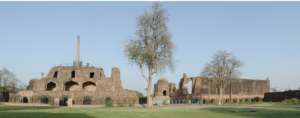
Ashokan Pillar brought from Topra at Firoz Shah Kotla Fort Complex, Source: Wikimedia Commons
Firuz Shah’s most noted preservation effort involved transporting two Ashokan pillars, one from Topra (Haryana) and another from Meerut to Delhi in 1356 and 1367, respectively. In the Tarikh-i-Firuz Shahi, Shams-i Siraj Afif (c. The Topra pillar, standing 13.1 meters tall and weighing around 27 tons, was excavated, wrapped in silk and cotton, and moved 200 kilometers on a specially designed 42-wheeled carriage. It was then re-erected in Delhi using counterweights and pulleys (Afif, translated by Elliot and Dowson, 1871, Vol. 3, pp. 358–359). Sunil Kumar (2007, pp. 195–198) views this as a display of engineering skill and a keen interest in antiquities. He also mentions that Firuz Shah hired scholars to decipher the Brahmi inscriptions on the pillars, which stands as an early example of epigraphic studies.
In addition to relocating monumental structures, Firuz Shah set up a repair system. The Futuhat mentions the restoration of “four mosques, twenty dargahs (Sufi shrines), thirty khanqahs (monasteries), two hundred sarais [rest houses], one hundred bridges, five hospitals, and one hundred public baths” across his realm (Tughlaq, translated by Elliot and Dowson, 1871, Vol. 3, pp. 382–383). An archaeological survey by Y.D. Sharma (1964) confirmed that repairs to Sultanate-era structures in Delhi employed late-14th century plastering techniques that used lime mortar along with finely crushed brick powder (surkhi) and jaggery to create a hydraulic cement with strong bonding properties (Sharma, 1964, pp. 78–82).
The sultan’s preservation efforts also involved hydraulic infrastructures. Firuz Shah focused on preserving hydraulic structures by commissioning the restoration of the Satpula dam, originally built under Muhammad bin Tughlaq, and the intricate canal system supplying water to Delhi. It seems specialist guilds were employed for this work. Stone masons (sangtarash) from Gwalior were known for their precise joinery without mortar. Lime workers (chunawale) from Hansi were skilled in waterproof plaster, and tile makers (kashiband) from Multan created decorative glazed tiles (Kumar, 2007, pp. 212-215). This choice of labor shows a clear understanding of local craft skills.
The Epoch of Mughals
During the Mughal period, new administrative structures emerged within the imperial system to manage the upkeep of monuments. The Ain-i-Akbari (c. 1596-1597) by Abu’l-Fazl describes the diwan-i-bayutat, or department of buildings. This department was responsible for maintaining royal buildings, gardens, and related structures. Notably, they maintained documents (raqam) that laid out the original construction blueprints needed for proper repairs (Abu’l-Fazl, translated by Blochmann and Jarrett, 1873-1894, Vol. 1, pp. 129-131).
Emperor Akbar (r. 1605-1627) ordered renovations to the Purana Qila after his conquest of Delhi in 1556. This fortress was originally constructed by Sher Shah Sur (1540-1545). The Akbarnama by Abu’l-Fazl notes that Akbar “commanded that the fortifications be strengthened and embellished while keeping the original design of the Afghan sovereign” (Abu’l-Fazl, trans Beveridge, 1897-1939, Vol. 2, p. 345). This instruction to maintain the ‘original design’ reflects the principles of authenticity in early restoration efforts.
Jahangir (r. 1605-1627), in his memoir Tuzuk-i-Jahangiri, describes a visit to the Qutb Minar in 1619, noting damage from lightning strikes alongside his order for immediate repairs using ‘white and red stone after the original’ (Jahangir, translated by Rogers and Beveridge, 1909-1914, Vol. 4). Investigations reveal that repairs during Jahangir’s time on the minaret’s fourth storey required more red sandstone from the costly Dholpur quarries, first utilized in the 13th century (Koch, 2006, pp. 234-236).
Abdul Hamid Lahori’s Padshahnama documents annual inspections (tamaruz) of imperial buildings during Shah Jahan’s reign (r. 1628-1658). These inspections included damage assessments and repair specifications, showcasing remarkable technical details. The reports are preserved in the British Library’s Persian manuscripts collection. One 1636 inspection report for Humayun’s Tomb states: “The plaster on top of the dome of the central chamber has come loose from the masonry due to rainwater infiltration. In seventeen places the alabaster inlay has fallen out. Recommendation: Remove disintegrated plaster, add a waterproof cover of lime-gypsum-egg white mixture, and reset marble pieces using copper dowels” (British Library Add. 6556, folio 78r, author’s translation).
These reports reveal specialized materials and diagnostic methods. Informed by these diagnostics, they demonstrate expert approaches and specific materials related to Asher’s studies (1992, pp. 203-209). Mughal protocols clearly separated preservation and repair categories, evident in structural repairs, known as imarat-i-pakka, and cosmetic restoration called jamali kar or ‘beautification work.’ Hereditary craftsmen guilds (pishkar) held specialized knowledge in Mughal-era restoration. Payroll records (waqai) from the reign of Aurangzeb followed this trend. Stone carvers mainly came from Rajasthan (Jaipur, Makrana), with family workshops linked to pre-Mughal times. Marble workers (sangtarash-i-marmar) from Agra specialized in pietra dura (inlay work), while plaster experts (gulkar) from Lahore excelled in arabesque molding (Alam, 1986, pp. 203-209).
Technical manuals from that era provide insights into preservation methods. The Arish-i-Mahfil (c.1650), an architectural treatise attributed to Qazi Ahmad, outlines mortar recipes for different climates. It includes a summer mortar with a higher lime ratio to deal with rapid drying, a monsoon mortar that incorporated organic additives like gum arabic and egg albumin for water resistance, and a winter mortar that used less water to avoid frost damage (Qazi Ahmad, manuscript Raza Library Rampur, folio 23v-24r, cited in Alfieri and Petruccioli, 2007, pp. 156-158).
Mughal emperors undertook significant preservation efforts, but some selective destruction occurred for religious and political reasons, mainly under Aurangzeb’s orders regarding Hindu temples. The chronicle Maasir-i-Alamgiri by Saqi Musta’idd Khan noted these actions. However, Richard Eaton (2000) argued in a detailed study that the policy was neither systematic nor purely religious, emphasizing that there was a stronger link between temple destruction and political rebellion than religious fervor. Eaton (2000, pp. 283-287) observed that many temples in Delhi remained undamaged throughout Aurangzeb’s reign, especially those with loyalty to the government.
Despite financial constraints, Aurangzeb also continued to maintain Mughal monuments. In 1679, after damage occurred to the Diwan-i-Khas of the Red Fort, Aurangzeb ordered that those responsible for marble theft be prosecuted. He also funded the repairs with money from the imperial treasury (Alam, 1986, p.195). This evidence suggests that Aurangzeb destroyed religious structures seen as politically threatening but still upheld the Mughal architectural legacy.
The political fragmentation and economic decline in the 18th century led to a further decline in monument preservation. Nadir Shah’s sack of Delhi in 1739 not only plundered the population but also caused extensive damage to its monuments. The Tarikh-i-Muhammadi by Muhammad Khawar Khan describes systematic looting of marble from imperial monuments, noting that “the Peacock Throne was dismantled and carried away, and marble from the palace floors prized up for transport to Persia” (Khan, 1747, manuscript British Library IOL Islamic 1636, folio 89r).
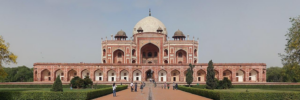
Humayun’s Tomb, Source: Wikimedia Commons
Monuments fell into disrepair under the next Mughal emperors, who had little authority. William Franklin, a British traveler, visited Delhi in 1793 and described Humayun’s Tomb as “greatly dilapidated, with large portions of the marble facings removed by thieves and gardens completely overgrown” (Franklin, 1793, p.178). Archaeological records support Franklin’s observations. A 1916 survey by Edward Lutyens documented extensive late-18th century damage, highlighting the systematic removal of marble from several monuments, including Safdarjung’s Tomb and parts of the Red Fort (Lutyens, 1916, pp.23-5).
The Era of British Raj
The British occupation of Delhi in 1803 led to extraordinary destruction of historical monuments for military and administrative purposes. Many Mughal buildings were demolished to create the cantonment within Salimgarh Fort. This destruction is openly documented in military reports. Lieutenant-Colonel David Ochterlony’s 1804 report states, “Several pavilions and chambers of exquisite workmanship have been dismantled to provide materials for barracks and officers’ quarters. The marble and red sandstone components are particularly well suited for our building purposes” (National Archives of India, Military Department Proceedings, 1804, no. 247, cited in Desmond, 1982, p. 45).
A prime example of early colonial exploitation is seen in Thomas Metcalfe’s residential compound near the Qutb complex (1828–1835). Metcalfe removed carved stones and architectural elements for reuse, turning ruined Mughal structures into picturesque homes. His estate plans (British Library IOL P/1275) show that about 15 medieval structures were systematically dismantled.
However, Metcalfe also commissioned paintings that documented the city’s monuments in the ‘Delhi Book’ (1844), revealing a growing interest in antiquity even as he participated in destruction (Metcalfe, 1844, British Library Add. MS 41300).
The peak of colonial indifference is exemplified by the East India Company’s 1848 decision to convert Humayun’s Tomb into a garden residence. Archaeological evidence recorded by R.E.M. demonstrates a lack of respect for the monument, treating it as a resource rather than a piece of history (Wheeler, 1946, pp.134-136).
The British retaking of Delhi after the 1857 uprising led to further destruction of monuments, framed as a military necessity and political revenge. Major General Archdale Wilson’s orders from September 20, 1857, called for the demolition of all buildings within 500 yards of the Red Fort’s walls. This resulted in the destruction of about 120 buildings, including mosques, havelis, and gardens. Wilson justified this action: “Every building capable of affording cover to an enemy has been razed; Delhi must be made defensible and native structures impede clear lines of fire” (Wilson, 1857, correspondence to Lord Canning, India Office Records L/MIL/3/1085, cited in Dalrymple, 2006, p.459).
The destruction included important monuments. The British tore down significant sections of the Jama Masjid and the entire Urdu Bazaar to make way for an open plaza for military parades. Contemporary accounts show evidence of cultural targeting. Colonel Edward Vibart noted in his diary, “The mosque might be beautiful architecturally, but it represents a rebel faith. Its dominating presence in the city has to be diminished” (Vibart, 1858, p.187). The British administration ensured the destruction of the mosque’s architectural context, despite some officials within the colonial regime resisting it.
Narayani Gupta’s detailed documentation (1981, pp.67–82) shows that the demolitions after 1857 eliminated 75% of pre-colonial buildings in the walled city. This was not just war damage but a systematic removal of urban structures that were politically risky or architecturally inconvenient. This left a profound psychological impact, with Delhi’s landscape militarized and visually disconnected from Mughal rule.
Ironically, the same imperial structure that destroyed monuments began to focus on their preservation. The Archaeological Survey of India (ASI), established under Alexander Cunningham’s leadership in 1861, started to systematically document Delhi’s monuments. In 1871, Cunningham wrote a report on the Delhi monuments, which formed the foundation for future conservation efforts. This included measured drawings, photographs, and records of 117 monuments. Cunningham also established the idea that monuments were “national property” needing protection from the state, arguing that “these buildings constitute the historical records of India’s past and must be preserved as archives” (Cunningham, 1871, p.2).
The Ancient Monuments Preservation Act of 1904 formalized this approach, creating legal measures for monument protection. The Act made unauthorized changes illegal and defined “ancient monuments” as any structure over 100 years old with “historical, archaeological, or artistic interest.” Importantly, the Act allowed the ASI to acquire monuments through compulsory purchase, removing them from private ownership (Government of India, 1904, section 3).
John Marshall, ASI Director-General from 1902 to 1928, enforced professional conservation standards based on European discussions on restoration. He rejected the Victorian habit of complete restoration, favoring a more cautious approach. In his 1923 circular on conservation principles, he wrote, “our duty is to preserve, not to restore. No historical layer was to be discarded. We consolidate what exists rather than reconstruct what is lost” (Marshall, 1923, Conservation Manual, p. This philosophy resonated with international conservation movements, especially the SPAB (Society for the Protection of Ancient Buildings) principles promoted by William Morris.
During the colonial era, new scientific methods and materials were introduced for conservation work. Marshall set up ASI chemical laboratories in 1907 to study traditional mortars and develop compatible repair materials. (Marshall, 1910: 7) “Laboratory studies of Mughal era chunam have shown that this mortar consists of 94% slaked lime, 4% marble powder, and 2% organic materials like jaggery, lentil flour, egg white, and yogurt.” To ensure consistency, ASI created a standardized ‘Marshall mortar’ that closely matched traditional proportions: 91% lime, 5% marble powder, 2% brick dust, and 2% jaggery” (Agrawal, 1992, pp.87–90).
Techniques for structural consolidation evolved significantly. Early colonial repairs used Portland cement, which caused severe damage due to its incompatibility with sandstone and its ability to retain moisture, leading to spalling. Major Robert Smith oversaw the 1829 repairs on Qutb Minar, using Portland cement, which resulted in significant damage that required subsequent removal (Sharma, 1978, pp.145-148). By the 1920s, ASI had adopted lime-based mortars and mechanical consolidation methods, such as stainless steel dowels for marble stabilization, non-ferrous cramps for stone jointing, and hydraulic lime in areas prone to water exposure.
Documentation standards improved greatly. The ASI required photographic surveys before and after interventions, drawn records of existing conditions, and inscriptional documentation. The documentation from the restoration of Humayun’s Tomb (1903–1909) under J.A. Page was notable: it included 247 measured drawings, 892 photographs, and technical reports on each intervention (ASI Annual Report 1909-1910, pp.67-124). This led to conservation standards that were reversible and based on material evidence.
The ASI established formal training programs to address the decline in traditional craftsmanship. The Mayo School of Industrial Arts in Lahore (1875) and Delhi Polytechnic (1919) offered courses in stone-carving and architectural restoration. However, Ram Nath’s study (1976) reveals tensions between the colonial push for standardization and traditional practices. British engineers encouraged mechanized stone-cutting for uniformity, while traditional craftsmen preferred hand-carving techniques that suited individual stones. This reflected the colonial belief that traditional knowledge was “inefficient” rather than empirically advanced.
However, ASI hired hereditary craftsmen mainly for ornamental works that required high expertise. Payroll records from the 1920s and 1930s show the involvement of sangtarash families from Agra, Bharatpur, and Rajasthan in the restorations of Red Fort and Humayun’s Tomb. These craftsmen used hereditary tools like hand chisels, wooden mallets, and abrasive grinding stones, along with traditional methods to cut jali screens, floral motifs, and Quranic inscriptions (Nath, 1976, pp. 203–210).
Colonial preservation was political, serving imperial legitimacy by linking to India’s ‘glorious past’. The Imperial Assemblage at Delhi in 1877 explicitly referenced Mughal traditions, with processions moving past restored monuments to highlight British claims to Mughal authority. Archaeological restoration became a way to symbolize British stewardship of Indian heritage against perceived indigenous ‘neglect’.
This ideology shaped preservation priorities. Structures built in the local style and religious shrines received little attention, while monuments linked to ‘high’ Mughal culture got significant funding. An analysis conducted by Guha-Thakurta (2004, pp. It highlighted a colonial view of history that prioritized ‘great civilizations’ over common religious architecture. Simultaneously, conservation sidelined living religious practices. The Ancient Monuments Act allowed ASI to prevent worship in protected monuments, framing them as ‘historical artifacts’ rather than active sacred spaces. This secularization sparked conflicts over mosques and temples. In the 1915 Jama Masjid controversy, protests erupted when ASI sought to limit mosque access for preservation, leading to a pause in those efforts (Gupta, 1981, pp. 142-145).
The construction of New Delhi as an imperial capital from 1911 to 1931 introduced new complications in preservation. Main architects Edwin Lutyens and Herbert Baker favored the wholesale destruction of ‘native structures’ as part of modern planning. Lutyens dismissed existing monuments, calling them “architecturally indigestible” and suggested they be removed from sightlines of the new capital (Irving, 1981, p. 245). However, pushback from nationalists and some British officials prevented major demolitions.
The compromise involved incorporating selected monuments into New Delhi’s layout. The Purana Qila, Humayun’s Tomb, and Safdarjung’s Tomb were preserved as ‘landscape features’ within extensive gardens that kept them separate from the surrounding urban area. This created artificially crafted heritage zones that were more about aesthetics than history. He calls this ‘museumification’, where monuments turn into decorative objects devoid of their original urban meaning.
Ironically, New Delhi’s construction involved practices similar to those seen in the medieval period. Contractors sourced building materials from ruined monuments, especially abandoned structures in Tughlaqabad. Official documents reveal that the Delhi Municipality approved stone quarrying from ‘archaeologically insignificant ruins’ to support New Delhi’s construction (Delhi Municipal Proceedings 1915, File No. 234/8, cited in Hosagrahar, 2005, p. 167). This allowed the destruction of non-monumental heritage, continuing colonial practices while claiming to support preservation.
Post-colonial and Contemporary India
Independent India inherited much of the colonial conservation framework. The Ancient Monuments and Archaeological Sites and Remains Act of 1958 replaced colonial laws but kept core principles: government ownership of protected monuments, criminal penalties for unauthorized changes, and ASI as the main conservation authority. The new Act also expanded protections to archaeological sites and defined ‘prohibited areas’ around monuments to prevent inappropriate development (Government of India, 1958, Section 20A).
In the early years of independence, conservation focused on nationalist symbolism. The Red Fort, where the Prime Minister spoke on Independence Day in 1947, received immediate restoration attention. From 1948 to 1954, under ASI’s M.S. Vats, efforts removed British-era military structures and attempted to revive Mughal gardens and pavilions. However, these ‘restorations’ stirred controversy, leading to significant reconstruction based on insufficient documentation. Conservation architects M.S. Randhawa and Mohammad Yunus criticized this work as ‘conjectural reconstruction’, arguing it violated archaeological evidence (Randhawa, 1958, pp. 45–47).
The Aga Khan Trust for Culture’s restoration of Humayun’s Tomb from 1997 to 2013 showcased post-colonial international cooperation in conservation. This project, involving ASI, the Aga Khan Trust, and global consultants, set new standards for conserving Indian monuments. Principal conservation architect Ratish Nanda articulated a philosophy of ‘preserving authenticity through minimal intervention, material compatibility, and reversibility’ (Nanda, 2007, p. 178).
The project revived traditional crafts through training programs. Master craftsmen from hereditary families, especially the Mistris from Gujarat and Agra-based sangtarash, trained younger artisans in stone carving, pietra dura inlay, and lime plastering. More than 450 craftsmen received training, addressing the loss of traditional knowledge (AKTC, 2013, pp. 89–94). This practical approach contrasted with previous classroom-oriented training, highlighting the importance of hands-on knowledge transfer.
Importantly, the project took a holistic view of conservation that included landscape, water systems, and surrounding urban areas. The restoration of Mughal gardens involved archaeological digging to find original water channels and planting patterns, replicating 16th-century garden layouts. This comprehensive method influenced later conservation projects in India, establishing ‘cultural landscape’ as a key part of monument preservation (Nanda, 2013, pp. 345–350).
Conservation efforts in 21st-century Delhi face many challenges, including pollution, urban sprawl, limited funding, and weaknesses in institutional capacity. The rapid deterioration from air pollution has pushed the need for new conservation strategies. Studies by Sharma et al. (2018) show that Delhi’s monuments weather 3 to 5 times faster than those in cleaner cities. Marble surfaces lose about 0.5 to 1.2mm of thickness each century due to acid rain and dirt buildup.
ASI’s budget constraints greatly limit conservation efforts. With around 3,700 protected monuments across the country and an annual conservation budget of about ₹450 crores for 2022–23, the average funding per monument is roughly ₹12 lakhs each year, which is not enough for significant work. The 174 ASI-protected monuments in Delhi compete for limited funds, resulting in postponed maintenance and emergency measures instead of proactive conservation (CAG Report, 2013, pp. 78–89).
Recent initiatives have highlighted heritage education as a long-term preservation strategy. ASI’s ‘Adopt a Heritage’ scheme, introduced in 2017, partners with private companies for monument upkeep, though critics say this turns heritage into a commercial venture and privatizes public spaces (Menon, 2018, pp. 123–129). School programs developed with INTACH (Indian National Trust for Art and Cultural Heritage) aim to teach conservation ideas to younger generations. These programs use interactive methods like heritage walks, documentation tasks, and oral history projects to connect students with living heritage (INTACH, 2016, pp. 89–95).
Community involvement has become an essential part of conservation. The Nizamuddin Urban Renewal Initiative from 2007 to 2018 introduced participatory methods, engaging local residents, shop owners, and religious communities in conservation planning. This approach sees monuments as ‘living heritage’ that integrates into daily life instead of viewing them as isolated artifacts. Participatory conservation balances social needs with physical preservation, though power imbalances between government groups, international donors, and local communities create ongoing tensions (Levi, 2015, pp. 234–247).
Social media and digital platforms have made heritage discussions more accessible. Citizen documentation efforts using smartphone photography and community-driven monitoring expose unauthorized changes and encroachments, putting pressure on authorities to act. However, this also leads to misinformation and heated debates regarding monument ‘ownership’ and religious identity (Tandon, 2020, pp. 345–356).
Across different periods, preservation practices mirrored power dynamics, cultural values, and resource availability. Destruction and preservation often occurred side by side: the same rulers who preserved imperial monuments also destroyed structures seen as politically dangerous; the same governments funding conservation also promoted urban development that threatened heritage sites. Understanding this complexity resists the idea of simple progress, revealing preservation as a contentious practice shaped by specific historical contexts. Ultimately, it requires us to think of heritage beyond just the physical structures, acknowledging monuments’ social meanings, lived experiences, and accessibility. Delhi’s monuments are not just buildings but living records of human hopes, creativity, and struggle, making their preservation crucial for cultural continuity and collective memory.
References
- Abu’l-Fazl (1596–1597) Ain-i-Akbari, translated by H. Blochmann and H.S. Jarrett (1873–1894), Calcutta: Baptist Mission Press.
- Abu’l-Fazl (1590s) Akbarnama, translated by H. Beveridge (1897–1939), Calcutta: Asiatic Society.
- Agrawal, O.P. (1992) Conservation of Manuscripts and Paintings of South-East Asia, London: Butterworths.
- Aga Khan Trust for Culture (2013) Humayun’s Tomb: Conservation and Restoration, New Delhi: Mapin Publishing.
- Alam, M. (1986) The Crisis of Empire in Mughal North India: Awadh and the Punjab, 1707-48, Delhi: Oxford University Press.
- Alfieri, B.M. and Petruccioli, A. (2007) ‘Building Materials and Construction Techniques in Islamic Architecture’, in Hattstein, M. and Delius, P. (eds.) Islam: Art and Architecture, Potsdam: H.F. Ullmann, pp. 150-167.
- Asher, C.B. (1992) Architecture of Mughal India, Cambridge: Cambridge University Press.
- Balasubramaniam, R. (2000) ‘On the Corrosion Resistance of the Delhi Iron Pillar’, Corrosion Science, 42(12), pp. 2103-2129.
- Comptroller and Auditor General of India (2013) Report on Preservation and Conservation of Monuments and Antiquities, New Delhi: Government of India.
- Cunningham, A. (1871) Archaeological Survey of India Report, Volume I, Calcutta: Office of the Superintendent of Government Printing.
- Dalrymple, W. (2006) The Last Mughal: The Fall of a Dynasty, Delhi 1857, London: Bloomsbury.
- Desai, Z. (2007) ‘The Qutb and Modern India: The Rewriting of History’, in Sengupta, I. and Chakraborty, D. (eds.) Cultural Heritage in India: Essays in Memory of Professor B.D. Chattopadhyaya, Delhi: Primus Books, pp. 178-203.
- Desmond, R. (1982) The India Office Library, London: India Office Library and Records.
- Eaton, R.M. (2000) ‘Temple Desecration and Indo-Muslim States’, Journal of Islamic Studies, 11(3), pp. 283-319.
- Elliot, H.M. and Dowson, J. (1867–1877) The History of India, as Told by Its Own Historians, 8 volumes, London: Trübner.
- Fleet, J.F. (1888) Corpus Inscriptionum Indicarum, Volume III: Inscriptions of the Early Gupta Kings, Calcutta: Government of India.
- Flood, F.B. (2009) Objects of Translation: Material Culture and Medieval ‘Hindu-Muslim’ Encounter, Princeton: Princeton University Press.
- Franklin, W. (1793) Military Memoirs of Mr. George Thomas, Calcutta: Government Press.
- Government of India (1904) Ancient Monuments Preservation Act, Act No. VII of 1904, Calcutta: Government of India Press.
- Government of India (1958) Ancient Monuments and Archaeological Sites and Remains Act, Act No. 24 of 1958, New Delhi: Government of India Press.
- Guha-Thakurta, T. (2004) Monuments, Objects, Histories: Institutions of Art in Colonial and Postcolonial India, New York: Columbia University Press.
- Gupta, N. (1981) Delhi Between Two Empires, 1803-1931: Society, Government and Urban Growth, Delhi: Oxford University Press.
- Hosagrahar, J. (2005) Indigenous Modernities: Negotiating Architecture and Urbanism, London: Routledge.
- INTACH (2016) Heritage Education and Communication Programme: Annual Report, New Delhi: Indian National Trust for Art and Cultural Heritage.
- Irving, R.G. (1981) Indian Summer: Lutyens, Baker and Imperial Delhi, New Haven: Yale University Press.
- Jahangir (1605–1627) Tuzuk-i-Jahangiri, translated by A. Rogers and H. Beveridge (1909–1914), London: Royal Asiatic Society.
- Joshi, K. (2019) ‘Administrative Challenges in Monument Conservation in India’, International Journal of Heritage Studies, 25(6), pp. 567-582.
- Khan, S.M. (c. 1710) Maasir-i-Alamgiri, translated by J. Sarkar (1947), Calcutta: Royal Asiatic Society of Bengal.
- Koch, E. (2006) The Complete Taj Mahal and the Riverfront Gardens of Agra, London: Thames & Hudson.
- Kumar, S. (2007) The Emergence of the Delhi Sultanate, 1192-1286, Delhi: Permanent Black.
- Lal, B.B. (1955) ‘Excavations at Hastinapura and Other Explorations in the Upper Ganga and Sutlej Basins 1950-52’, Ancient India, 10-11, pp. 5-151.
- Levi, S. (2015) ‘Community Participation in Heritage Conservation: The Nizamuddin Basti Project’, in Menon, A.G.K. (ed.) Cultural Landscapes and Urban Heritage, New Delhi: INTACH, pp. 234-259.
- Lutyens, E. (1916) Survey of Mughal Monuments of Delhi, unpublished manuscript, Royal Institute of British Architects Library.
- Marshall, J. (1923) Conservation Manual, Simla: Archaeological Survey of India.
- Menon, A.G.K. (1980) The Historic City of Nizamuddin: A Conservation Study, New Delhi: INTACH.
- Menon, A.G.K. (2018) ‘The Adopt a Heritage Scheme: Privatization of Public Heritage?’, Economic and Political Weekly, 53(21), pp. 123-129.
- Metcalf, T.R. (1994) Ideologies of the Raj, Cambridge: Cambridge University Press.
- Metcalfe, T. (1844) Delhi Book, British Library Add. MS 41300.
- Nanda, R. (2007) ‘The Humayun’s Tomb Restoration: A Model for Conservation in India’, Journal of Architectural Conservation, 13(2), pp. 175-192.
- Nanda, R. (2013) ‘Cultural Landscape Restoration: The Humayun’s Tomb World Heritage Site’, in Gujral, M. (ed.) Conservation of Heritage Sites in India, New Delhi: INTACH, pp. 345-367.
- Nath, R. (1976) History of Mughal Architecture, Volume II, New Delhi: Abhinav Publications.
- Patil, S. and Rao, K. (2019) ‘Digital Documentation in Heritage Conservation: Case Studies from India’, International Journal of Architectural Heritage, 13(4), pp. 456-472.
- Randhawa, M.S. (1958) Monuments of Delhi: Lasting Splendour of Mughal and Rajput Art, New Delhi: Publications Division.
- Sharma, J. (1978) Conservation Problems: Indian Monuments, New Delhi: ASI.
- Sharma, R.K., Tripathi, A. and Singhvi, A.K. (2018) ‘Impact of Air Pollution on Historic Stone Monuments of Delhi’, Environmental Monitoring and Assessment, 190(8), pp. 467-483.
- Sharma, Y.D. (1964) Delhi and Its Neighbourhood, New Delhi: Archaeological Survey of India.
- Singh, U. (2015) A History of Ancient and Early Medieval India: From the Stone Age to the 12th Century, Delhi: Pearson.
- Tandon, P. (2020) ‘Social Media and Heritage: New Forms of Engagement and Contestation’, South Asian Studies, 36(2), pp. 345-362.
- Tiwari, M.P., Agrawal, O.P. and Nanda, R. (2007) ‘Traditional and Modern Conservation Materials: A Comparative Study’, Studies in Conservation, 52(3), pp. 234-250.
- Tughlaq, F.S. (c. 1370) Futuhat-i-Firuz Shahi, translated by Elliot and Dowson (1871), in History of India as Told by Its Own Historians, Volume 3, London: Trübner, pp. 377-388.
- Vibart, E. (1858) The Sepoy Mutiny as Seen by a Subaltern from Delhi to Lucknow, London: Smith, Elder.
- Wheeler, R.E.M. (1946) Five Thousand Years of Pakistan, London: Royal India Society.