
By Anukriti Upreti
Suwa re Suwa Banakhandi Suwa Ja Suwa Gaupana Nyuta Diya… This is how women dressed in bright yellow sarees covering their heads with a beautiful Kumauni ritual cloth, Pichoda ask Suwa, Parrot to go and invite Lord Rama, Goddess Sita and every single person living in the village to the wedding function. Marriage or Vivah is considered one of the important samskaras of human life, symbolizing one’s entry into the grihasthasharam. There are different cultures and traditions around marriage, varying across different regions of the country. This study explores the traditions and beliefs associated with marriage in Uttarakhand. As the land is called Devbhumi, the land of Gods, we will understand how the lives of people living in the region integrate mythology, history, and geography through their traditions and rituals.
When the British came to India, they gradually began to understand the lives of the people they were ruling. To understand India’s diverse culture, which was so different from their own, they appointed various officials to prepare extensive surveys of the land, detailing every aspect of the common lives that they considered worth noting. The Himalayan Gazetteer of Edwin Thomas Atkinson, an Irish Historian and an ICS officer serving the British, is one such account dealing with the lives of Himalayan people. In this work, one finds a detailed mythological account dealing with the descriptions found in the Manaskhand and Kedarkhand of the Skanda Purana. These two sections deal with the Kumaun and Garhwal regions of Uttarakhand, respectively.
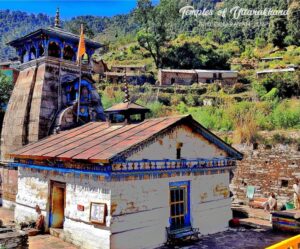
Triyuginarayan temple, Rudraprayag district of Uttarakhand. Image courtesy eUttaranchal.
The Legend of Shiv- Parvati Vivah:A Historical Perspective
The entire Shiv-Parvati vivah story is woven around the Himalayas. The Triyoginarayan Temple in the Rudraprayag district of Uttarakhand is considered as the place where the marriage took place. The Akhand Dhuni, a perpetual eternal flame at the temple is believed to have been burning since the marriage of Lord Shiva and Goddess Parvati. Situated at 1,980 meters above sea level, the temple attracts tourists from across the country owing to its historical and mythological significance. The temple is built in the North Indian Himalayan architectural style, like the Kedarnath temple, and belongs to Lord Vishnu. The original builder of the temple is unknown; however, E.T. Atkinson, in his Gazetteer, writes about the divine marriage and its relation to the temple. He gives a detailed description of the marriage beginning with the story of the great sacrifice of “kali” or “sati” who jumped into the sacrificial pyre of her father Daksh as he conducted the sacrifice without inviting her husband Lord Shiva. It is believed that, a long time after this incident a girl named Parvati, was born to king Himanchal and his wife Meena or Maina. This girl was blessed with divine powers and worshiped Shiva throughout her life. During the same time, the gods were expelled from Heaven by a demon called Tarakasura, as Lord Brahma had given him a Boon that not even Lord Vishnu could kill him, it became a problem for all the Gods to get the heaven back from the demon and they asked Lord Brahma for help. In response, Lord Brahma asked them to go to Lord Shiva and give him a proposal to marry his great devotee, Parvati as their son can kill the demon and help the Gods.
Following this, Gods requested Shiva to marry Parvati and Shiva asked Brahma to ask Himanchal for his daughter in marriage. For the preparation of marriage, Shiva said, “Call Vishwakarma, the workman of the Gods. Vishwakarma came and prepared all that was wanted and made a Golden image of Ganesha, which he told Shiva to adore, for it was from a neglect of Ganesha that Kali had been destroyed.” (Atkinson, 1981) That is why marriage in Uttarakhand always begins with Ganesh Pooja. It is believed that Mahadev smeared his body with ashes, adorned himself with snakes instead of jewels, took the trishul in his hands, wore a necklace of dead men’s skulls, and seated on a bull, he went off for marriage. At the confluence of the Garuri and Gomati, he informs Himanchal about the arrival of the marriage procession. After this the marriage began and king Himanchal gave his daughter Parvati to Shiva. It is believed that Shiva blessed king Himanchal that henceforth he would be honoured like Shiva in the whole universe.
Owing to the place where Shiva and Parvati married, Historian and Freedom fighter from Almora, Badri Dutt Pandey writes in his book “History of Kumaun” that “The people of Garhwal say that the marriage of Shiva and Parvati was performed near Triyuginarayan but in Manaskhand it is said near Vaidyanath”. (Pandey, 1993) Vaidyanath is the place where Shiva rested, and owing to his stay, the plants here turned into medicines, thus giving the name Vaidyanath. Today, we find the group of 18 temples in Baijnath (coming from Vaidyanath), Bageshwar district, built by Katyuri rulers between the 9th and 12th centuries, located on the confluence of Garur Ganga and Gomti rivers.
Nanda Rajjaat Yatra: Legend, Mystery and Narratives
Another interesting story related to Parvati and Shiva is the Nanda Rajjat Yatra. According to some local legends and JagarsGoddess Nanda is the daughter of King Himanchal and Queen Meena (Mainawati). This shows that Goddess Parvati and Goddess Nanda are the same goddess. However, the Nandadevi mahamatya of Manaskhand says that Nanda devi is the divine soul of the girl born to Nandagop (Foster father of Lord Krishna) who was killed by Kans. This divine energy came to the Nandaparvat of the Himalayas. The yatra celebrates the return of Goddess Nanda from her maternal home in Nauti village of Karnaprayag to her husband Lord Shiva’s home at Mount Kailash. The pilgrimage is held every 12 years during the Bhadrapada month of the Hindu calendar and begins with the Nanda Ashtami. It takes around 19 to 22 days to complete the 280 km long yatra which goes through dense forest and remote villages and ends at the Homkund from where the four horned lamb Chausingha Khadu which is a significant animal for the whole ritual, is left free to climb mount Kailash as a symbol of return of Goddess Nanda to Lord Shiva’s home.
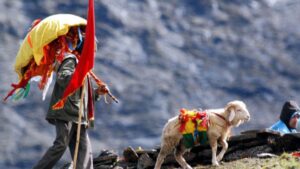
Nanda Rajjaat Yatra. Image courtesy Jagaran. com
There are different variations of the story of Nanda Devi, which make a historical study of the topic difficult and lead to debates among historians regarding Nanda Devi and the Nanda Rajjaat Yatra. Historian Shiv Prasad Dabral states that it dates back to the 7th century. The dominant opinion is that Garhwal ruler Ajay Pal, who is often credited with combining different small principalities of the region and giving it a collective identity in the form of Garhwal (made from a collection of different ‘Garh’) in c. 1515. It is suggested that he combined all the small pilgrimages of the Garhwal region into a long Nanda Rajjaat yatra.
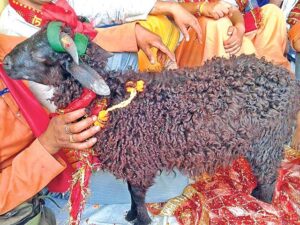
Four horned Lamb born in Chamoli which will be used in 2026 Nanda Rajjaat Yatra. Image Courtesy: Hindustan times.
Thus, looking at these two stories and traditions from the ‘abode of Gods’ Uttarakhand tells us that these myths were not only a part of earlier stories but they continue to shape the lives of the people. Today, Nanda Devi has various forms, but the belief remains in the hearts of the people. Every year, the Triyoginarayan temple conducts marriages, as people believe that marriage conducted in the land of Shiva and Parvati will bless them with an auspicious married life. These stories and myths, although changing with every single locality within the world of mouths, strengthen the beliefs and faith of the people, shape their narratives, and thus influence their everyday lives.
References:
1. Badarī Datta Pāṇḍe (1993). History of Kumaun.
2. Atkinson, E.T. (1980). The Himalayan Gazetteer.
3. Chandra Singh Negi (2013). In the Garb of Nanda Devi Raj Jaat : a Cultural Treatise of Western Himalaya. Deradun (Uttarakhand): Winsar Publishing Co.
4. Internet Archive. (2022). Nanda Devi Mahatmya Skand Puran Manas Khand : https://www.facebook.com/essenceofastro : Free Download, Borrow, and Streaming : Internet Archive. [online] Available at: https://archive.org/details/nanda-devi-mahatmya-skand-puran-manas-khand [Accessed 2 Dec. 2025].
5. Incredible India. (2025). About Triyuginarayan Temple Kedarnath: Triyuginarayan Temple Photos, History & Significance. [online] Available at: https://www.incredibleindia.gov.in/en/uttarakhand/kedarnath/triyuginarayan-temple [Accessed 2 Dec. 2025].