
By Anukriti Upreti
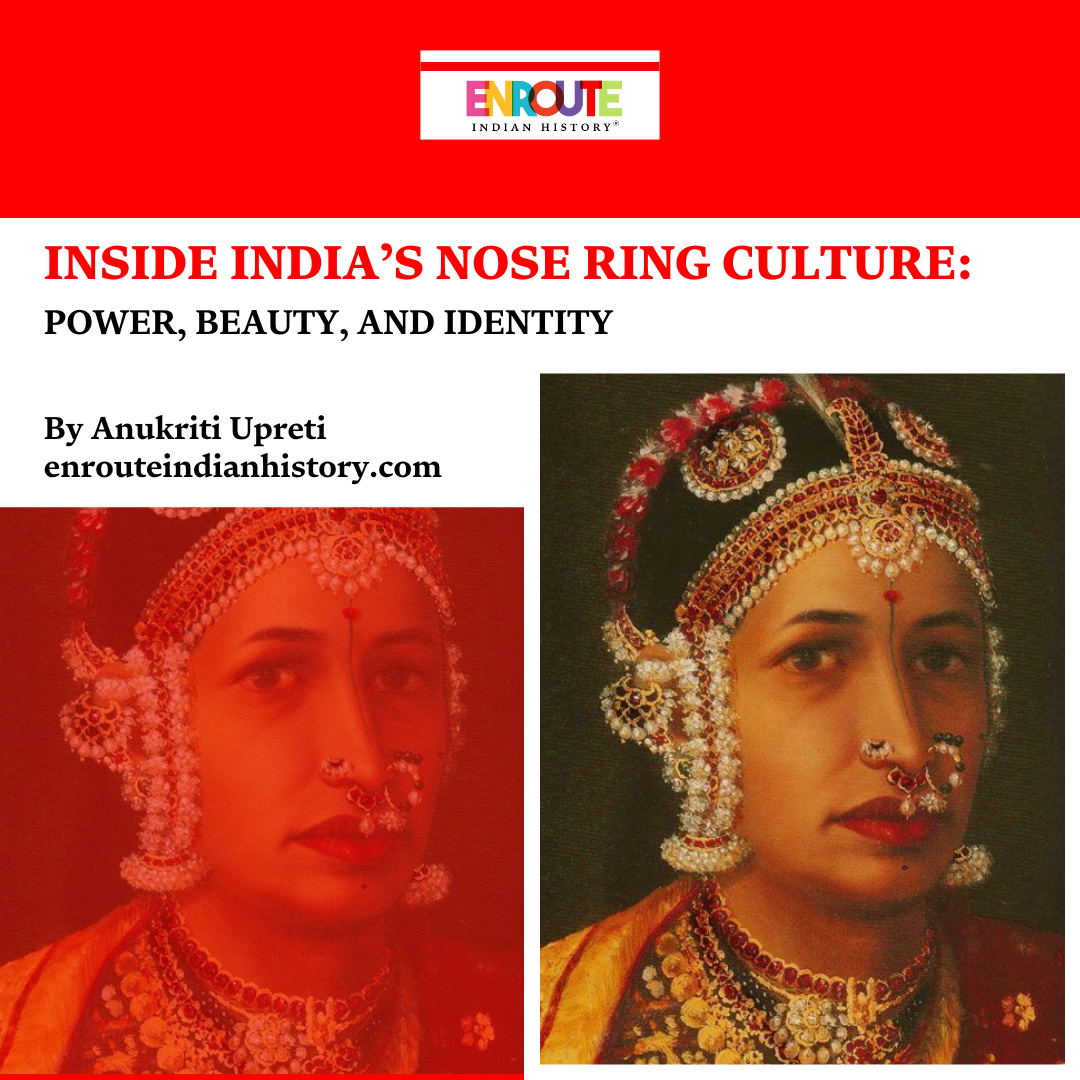
Jewels and ornaments are the representation of their society. Their designs, craftsmanship and the gems and stones used in producing them tells a lot about the social status, cultural interactions and trade and exchanges between people. Here, we have tried to look at one such ornament, Nose Ring popularly called as Nath in India. There are different types of Nath found in different parts of the country. The earliest evidence of nose piercing comes from the Middle East and dates back roughly 4,000 to 5,000 years ago. Some scholars like P.K. Gode traces it back to the 1000 AD and suggests that it was a result of cultural interactions between the Hindus and the Muhammedans . We have the Biblical Old Testament mentioning a word called Shanf in Hebrew which may translate to “nose ring.”
Nath is considered as a marital ornament in many parts of India. It is considered good for women’s reproductive health and mostly worn in the left nostril, however in South India nose rings are worn in right nostril and in certain areas like Andhra Pradesh and Karnataka it is worn in both the nostrils along with a Bulaq worn in the septum. Nose rings are beautifully crafted and in certain areas like Rajasthan, Punjab and other states in North Western India it is highly influenced by the architectural styles of Rajputs and Mughals. The form of nose rings also differed from upper class to lower class people where high class elite women used to wear Gold plated, heavily embellished nose rings while lower class women used to wear silver and metal alloy Nose Rings.
In Rajasthan the royal women wore a special kind of nath called motiwalla which was heavily laid with pearls and gemstones, they were made through various jewel making techniques such as Kundan kari, filigree, enamelling (meenakari) and included motifs like floral patterns, peacocks, lotuses, vines, and geometric borders and sometimes depicted Rajput architecture such as jali like structures.
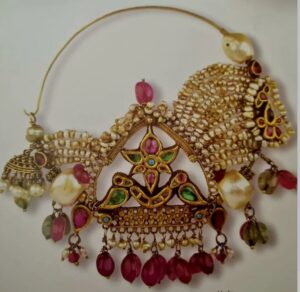
Motiwalla nath. Image Courtesy Victoria and Albert Museum.
Waltraud Ganguly writes that this Nath belongs to the Sindh region. The Nath is made of gold pearls, rubies, emerald and glass. She compares the gem- crowned vault with the Mughal and Rajput architectural styles. There are other types of Motiwala Nath one of such Nath depicts a parrot symbolising matrimonial happiness where the ruby eye at the left of the ring is typical of Sindh. Ganguly also mentions that it was a practice to cut these rubies from the nose ring and sell them for personal benefits. These Nath were usually wired by copper to hold the rubies and gems in place.
From South India we get simple and smaller Nath. In Karnataka simple hook shaped Nath, mostly worn in the right nostril were prevalent. From Tamil Nadu we get a gold nose ring with a peacock design of red stones and one central green stone and semi- circular structure surrounded by pearls. The Nath were made in a Kundan setting and were generally smaller than the North Indian Nath. Ganguly writes that “The peacock is a symbol of heaven, of beatitude and happiness. Besides that, it is the mount of Kartikeya (Murugan) who is particularly worshipped in South India” thus highlighting the symbolic importance of the Nath.
We get magnificent jewel work from Gujarat where simple and large nose rings were made through metal alloy wirework. These Nose rings were made of simple cheap metals but the intricate coiling work made them special for us. One such work is a nose ring ornamented with coils of wire which are wrapped round the core wire of the nose ring. In some places we get triangular shaped embellishments in the nose ring. According to Dr Ganguly, nose rings of this type were worn by the nomadic Garasia -Rabari young girls and women. Another kind of Nath known as Viti were worn by Ahir farmers, these Nath were made of gold and look like a hollow gold tube, these were either worn in septum or in the left nostril.
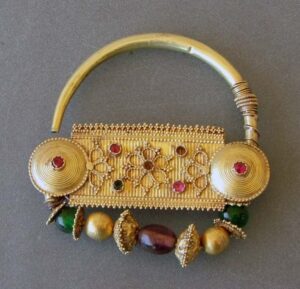
Tribal Nath, Image Courtesy Victoria and Albert Museum.
The above specimen is from the tribal region of Madhya Pradesh. This kind of large Nath embellished with large red, green and purple glass stones are also found in Sindh region and Gujarat. Some Meghwal women in Ludiya who belong to the weaver community near the border with Pakistan in Kutch District, Gujarat also wear such nose rings. The delicate gold work at the centre and the two circular disk structures having red glass stone adds to the beauty of the Nath. The lower portion has an amethyst along with gold carved chakris showing great craftsmanship of the jeweller.
From Sindh region we get another magnificent Nath famous for its large size and heavy glass work. These Nath were called sheesha Nath.
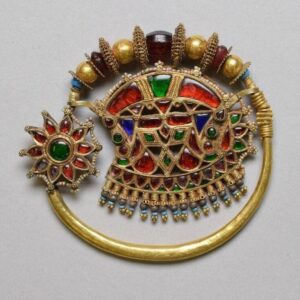
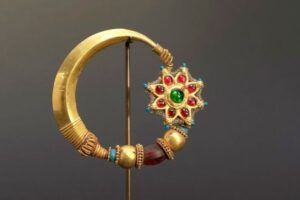
Sheesha Nath. Image courtesy Victoria and Albert Museum.
The red and green glass work enhances the beauty of the Nath. The small beads at the end attached with gold coils show a perfect combination of different gem stones and beads, the Floral design with red and green glass (two red glasses are missing), rests at the nose while wearing the ornament thus giving a beautiful look to the wearer.
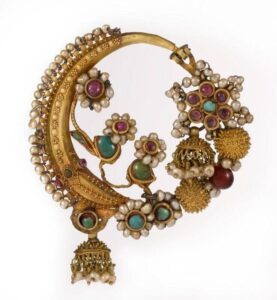
Besar Nath. Image courtesy Victoria and Albert Museum.
The above Nose ring, or Besar, from Himanchal Pradesh is a good combination of gold, turquoise, ruby or garnet, pearls and lac with silver wire. It is made through extensive wirework and granulation having a gold crescent-shaped fish design decorated with floral patterned granulation and a fringe of pearls and the stones are set on a bed of red lac within a gold wire bezel mounting. The Bulbul work, floral pearl, and use of turquoise and red stones increase the beauty of the ornament.
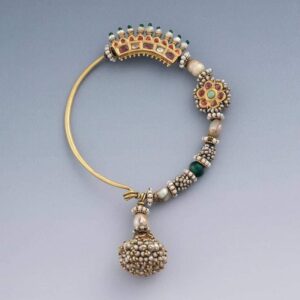
Nath from M.P. Image Courtesy Victoria and Albert Museum.
This Nath is from Madhya Pradesh having heavy wire decoration. “The lower part of the hoop is decorated with irregular pearls, a green tourmaline bead and a gold rousette set with glass beads” (Mathur and Chaturvedi, 2023). The gold-wired bunch of pearls at the end gives a beautiful touch to the nose ring.
The above-mentioned Nose rings are selected from various regions of India which shows how their size, shape and material use differs according to the geographical regions and the status of the wearer. Moreover, the intricate designs, use of different gemstones, glasses and metals in making these nose rings tells us about the craftsmanship and the importance of Gems and Jewels in everyday life of people ranging from Royal groups of Rajasthan to the tribes of Gujarat. Their study also tells us about the symbolic importance of beads, gems and the motifs.
One important feature of the Nose ring is that it still constitutes an important part of the society and culture. In modern times we see various emerging trends of Nose rings, one such initiative of designing nose rings and working for the revival of traditional art and culture considering the modern demands is Mookuthi, a Chennai based artisanal nose ornament brand founded by Sarath Selvanathan. The brand blends gold, precious gems, and indigenous craft techniques used by artisans from across the country and currently it holds a good collection of Nose rings which are in great demand especially amongst the youths.
References:
• Chaturvedi, N. (2023) ‘Cultural and Historical Implication of Museum Collection: Representation of Regions and Tribes in the Nose Rings of Amrapali Museum of Jaipur, India. ShodhKosh: Journal of Visual and Performing Arts, 4(1), 410–428. doi: 10.29121/shodhkosh. v4.i1.2023.353
• Thomas Holbein Hendley (2009). Indian Jewellery. Delhi: B.R. Pub. Corp.
• Victoria and Albert Museum. (2025). The family of art, design and performance museums · V&A.
• Ganguly, W. (2015). Nose Rings of India.
• Gode, P.K. (1960). Studies in Indian Cultural History.
• Mookuthi. (2025). Mookuthi | Artisanal nose ornaments from Madras. [online] Available at: https://www.mookuthi.com [Accessed 7 Sep. 2025].