
RAVNEET KAUR
SPIRITUALITY OF THE STONES: ADWAITA CHARAN GADNAYAK
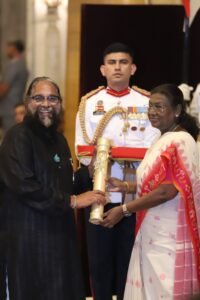
Gadnayak receiving the Padma Shri from the Honorable President of India, Shri Draupadi Murmu. Padma Awards Ceremony 2025. https://www.padmaawards.gov.in/padmaawards/Gallery
“Stones are the oldest members of our planet. Every stone has its own vibration and is connected with the magnetic field. That is why in the temple, people hug and kiss the stone idols of deities. They are attracted to the stones that are there ….”
Adwaita Gadnayak received the Padma Shri earlier this year for his contributions to the field of sculpture. Gadnayak, born in 1963 at Dhenkanal, Odisha, completed his graduation in Fine Arts in sculpture from B. K. College of Art & Craft, Odisha in 1989; Post graduation in Fine Arts (sculpture) from College of Art, New Delhi, 1992 and went on to Slade School of Fine Arts, London (1995) for further education. After his return to India, he continued his work in the field and received the National Lalit Kala Akademi Award for the same in 1993.
Gadnayak, with his appreciation of the close relationship between stones and spirituality in Indian traditions, applied European conventions of sculpture to his work and out of the fusion and amalgamation of the two emerged something distinct. He served as the Director General of the National Gallery of Modern Art (NGMA) from 2016 to 2022.
Some of Gadnayak’s most significant and widely known works are the – National Police Memorial Cenotaph (2018), Mahatma Gandhi’s Salt March Statue at Rajghat outside National Gandhi Museum, the Statue of Subhas Chandra Bose at National War Memorial Complex and work at the Hriday Kunj. Gadnayak is known for his signature use of black granite stone throughout his life. His other projects include the restoration of historic places, renovation of Jaipur House and use of digital resources. He has also been recognised at International Art Forums like the Venice Biennale.
An innovative blend of indigenous art forms and a leading edge in technology has marked Gadnayak’s work, and this is what sets him apart.

The National Police Memorial Cenotaph. Wikipedia Commons. https://commons.wikimedia.org/wiki/File:Adwaita_Charan_Gadanayak.pdf
THE WONDER OF WORDS: ACHYUT RAMCHANDRA PALAV
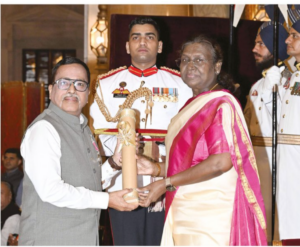
Palav receiving Padma Shri from the Honorable President of India, Shri Draupadi Murmu. Padma Awards Ceremony 2025. https://www.padmaawards.gov.in/padmaawards/Gallery
“Art was my favourite subject, and it was evident since my young age that I will pursue a career in it. The fascination about letters and the interest in scripts, styles, fonts was always there. Even as a child, I was curious about their shapes and types. For me, the transition from good handwriting to stylised writing to calligraphy came naturally.”
So replies Palav on being asked as to why he chose calligraphy in an interview by Free Press Journal. Born in 1960 inMumbai, Palav completed his higher studies from the Sir J. J. Institute of Applied Art, Mumbai, in 1982 under the mentorship of R. K. Joshi, a prominent typographer and calligrapher. Palav regards Raghunath Krishna Joshi as a major influence in his life and work, who was a pioneer in the world of Indian typeface design and had designed the core Indian fonts used in Microsoft Windows.
Achyut Palav, as a Calligrapher, is noted for his unconventional use of tools and materials in his calligraphy, such as toothbrushes and spatulas. Elaborating on the subject, he says -“I have used many traditional tools like steel pens, Boru and experimented by altering their sizes and using them on different surfaces. Apart from that, I have also used everyday objects like toothbrushes, syringes, and rags for the unique dimensions they create. The understanding of the text and meaning of words helps me choose the tool.”
Apart from his creative curiosity as a child, Palav’s work stems from the resolve to preserve Indian calligraphy. He notes that India is regarded as one of the three greatest calligraphic centres of the world, apart from the Arab countries and China, but it is a neglected art, more or less, these days. Thus, Palav’s efforts to preserve and disseminate calligraphy through workshops, educational programmes and art festivals. Previously, he has also been invited by various state governments for calligraphy projects.
Due to his dedication to the art of calligraphy and, more importantly, its preservation and dissemination, he has been felicitated by the Padma Shri in the field of arts this year.
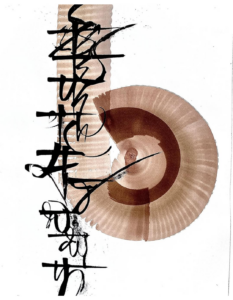
A specimen of Palav’s work. https://www.instagram.com/p/CnBNtP1v7G7/?igsh=cW1vcDN5NGp3NHFr
THE TALE OF THE SHADOWS: BHIMAVVA DODDABALAPPA SHILLEKYATHARA
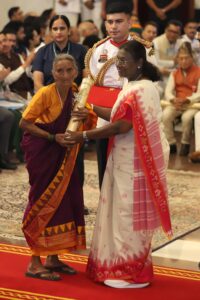
Shillekyathara receiving Padma Shri from the Honorable President of India, Shri Draupadi Murmu. Padma Awards Ceremony 2025. https://www.padmaawards.gov.in/padmaawards/Gallery
Ninety-six-year-old Bhimavva Shillekyathara has been honoured with the Padma Shri as a puppeteer. Shillekyathara practices the art of Togalu Gombeyaata, which translates as “a play of leather dolls” in Kannada, and is a form of shadow puppetry. Shillekyathara was born in 1929 in the district of Koppal, Karnataka. Belonging to a family of practitioners of the same craft, by the age of fourteen, she took up the art form herself as an artist.
Togalu Gombeyaata combines shadow puppetry with folktales called Janapada Kathegalu, epics like the Ramayana, Mahabharata and Puranas, and makes use of drama, prose and song. The puppet figures are made of animal skin, like cattle and goats and are used to cast shadows on a screen during the play. Togalu Gombeyaata specifically pertains to the state of Karnataka, though variations exist, and has historical roots and artistic parallels with the shadow puppetry of Andhra Pradesh and Telangana, known as Tholu bommalata.
Togalu Gombeyaata has been mentioned in the eleventh-century text Tilakmanjari and in Karnataka received patronage under several dynasties from Rashtrakutas and Hoysalas to the Sultanate of Bijapur and the Bahmani Kingdom. However, this art of shadow puppetry is a dying art form. Shillekyathara comes right herein. She dedicated almost eighty years to working and preserving this centuries-old art form. In the face of limited means, lack of a steady and stable source of income, assisted by dwindling audiences, Shillekyathara continued. She travelled extensively, village to village and in towns, and despite it all, persisted.
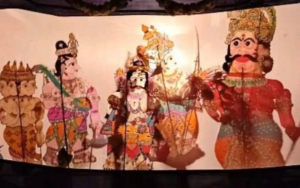
A scene from a Togalu Gombeyaata play. India Tourism, Bengaluru. Ministry of Tourism, Government of India. https://www.instagram.com/reel/CqpJdyxAYl2/?igsh=dDYzdGIzaTl1aWZz
ONE DOT AT A TIME: PARMAR LAVJIBHAI NAGJIBHAI
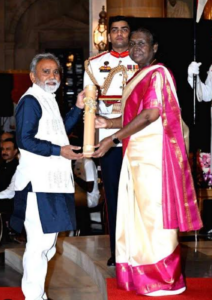
Nagjibhai receiving Padma Shri from the Honorable President of India, Shri Draupadi Murmu. Padma Awards Ceremony 2025. https://www.padmaawards.gov.in/padmaawards/Gallery
Parmar Lavjibhai Nagjibhai is a weaver who has been recognised for his weaving of Tangaliya – a seven-hundred-year-old Gujarati hand weaving technique native to the Dangasia community of Surendranagar. Though a lot is not known about Nagjibhai’s earlier life, he is a weaver from the Dangasia community and has worked for over forty years in preserving and promoting the Tangaliya technique, particularly working with younger generations to pass down the craft.
The Tangaliya is characterised by an extra-weft pattern of raised dots, and it gives it an appearance of embroidered beadwork. Tangaliya is derived from the Gujarati word tangalio, meaning “lower body”, and refers to the traditional use of the woven cloth as the lower garment for women. The Tangaliya weave is also called daana weaving, as the raised dots resemble grains. Originally, the weave was done on gheta wool, but now merino wool, acrylic, viscose and cotton, due to cheap availability and shifting trends, are used.
Nagjibhai has been recognised by the Government of India for his preservation efforts of the Tangaliya weave, which otherwise is a dying craft today. He exhibited the weave at various exhibitions across the country and collaborated with sellers to market it. A Common Facility Centre was opened to train the younger generation and to help struggling weaver families in the craft. Weavers are employed in the centre and thus have provided them with a sustainable livelihood. Technical assistance and market support are also provided. Nagjibhai has played an instrumental role in these proceedings all along and has been duly honoured for the same
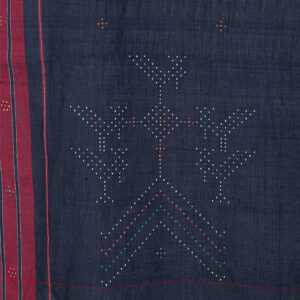
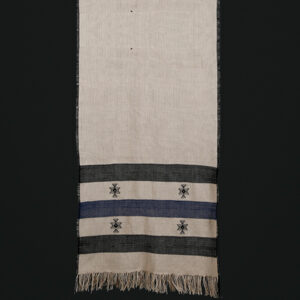
Tangaliya Weave. Directcreate. Craft Tangaliya Weaving https://share.google/Uep5YRDUs4L0iPqop
THE ARTIST BEHIND THE MASK: REBA KANTA MAHANTA
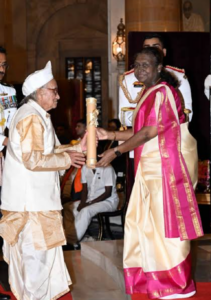
Mahanta receiving Padma Shri from the Honorable President of India, Shri Draupadi Murmu. Padma Awards Ceremony 2025. https://www.padmaawards.gov.in/padmaawards/Gallery
Reba Kanta Mahanta is a Sattriya artist and a traditional bamboo mask maker. He is an accomplished practitioner of Sattriya dance, Ankiya Bhaona and mask-making traditions of the state. He has been awarded the Padma Shri as a renowned bamboo mask maker for traditional dance forms.
Mahanta was born on 19 April 1935 in Sivasagar, Assam. He participated and was trained in the performances of Ankiya Bhaona, Sattriya dance, Khol playing and Nam Prasanga from his childhood. While he himself is an acclaimed Sattriya dancer, he is known for his traditional bamboo mask-making for the dance form. His masks have been procured by reputed national and international museums for display in their halls.
For his contribution in the field of mask masking, he has been a recipient of the Sangeet Natak Akademi Award in 2014, and Bishu Prasad Rabha, awarded by the state of Assam in the field of dance, music, art and literature, in 2015. The Sattriya Kendra, Guwahati, of Sangeet Natak Akademi, has also financed a three-year project on mask-making under Mahanta in his home. In 2003, Mahanta designed the tableau for Assam in the Annual Republic Day Parade, which received the second position. In 2008, he received the Shilp Guru Award for his work as a social worker in promoting women’s education.
Described variously as humble and soft-spoken, the one trait that marks all accounts of Mahanta is his love and dedication to his art, as somehow all his words revert back to art itself.
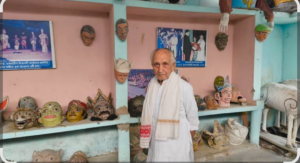
Mahanta with his masks. https://share.google/y32Yof9opq0kUD8gH
THE PAINTER-ART HISTORIAN MASTERO: RATAN KUMAR PARIMOO
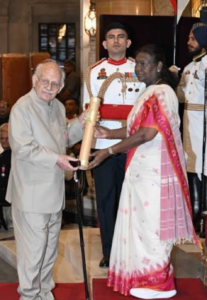
Parimoo receiving Padma Shri from the Honorable President of India, Shri Draupadi Murmu. Padma Awards Ceremony 2025. https://www.padmaawards.gov.in/padmaawards/Gallery
“Of all my roles, I value my work as a painter the most”
Says Ratan Kumar Parimoo, a painter, art historian, pedagogue and former director of the Lalbhai Dalpatbhai Museum, Ahmedabad. Originally from Kashmir, Parimoo shifted to Vadodara at the age of fifteen to accomplish his dream of becoming an artist, even though he recalls that neither he knew much what it would take nor the times as back then “the role of the artist was not very clear” but nonetheless he muses that destiny brought him at the right place back then and to the Raisina Hills earlier this year.
Parimoo joined the Maharaja Sayajirao University of Baroda and was among the founders of the Baroda Group of Artists, a group of experimental artists formed in 1957. He spent eight years in the Fine Arts Faculty as a student, then as a temporary lecturer, and later went to the United Kingdom under the Commonwealth Scholarship. Upon his return, he became the Head of the Department of Art History and Aesthetics and continued as a professor. Thus began his career as an art historian and pedagogue, which was somewhat already taking shape all along. Parimoo worked on the cave arts of Ajanta, Ellora; miniature paintings of Jain, Rajasthani, Pahari and Mughal traditions; and artists like Abanindranath Tagore. Parimoo’s noted work is Art of Three Tagores- From Revival to Modernity (2011).
As a painter, Parimoo’s earlier career was marked with more usage of traditional elements, while his later career is tilted towards abstractionism. He also says that his later works “have a lot to do with dreams, imagination and mythology”. As a member of the Baroda group, Parimoo was at the heart of the experimental, abstract and modern art movement, which defined the trajectory of Indian modern art in the 1960s and further ahead. And it is to their art and tenacity that we pay reverence today.
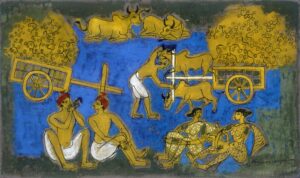
Village Life by Parimoo. 1956. Watercolour on cloth. Asia Art Archive. Collections | Search | Village Life | Asia Art Archive https://aaa.org.hk/en/collections/search/archive/ratan-parimoo-archive/archive/ratan-parimoo-archive/object/village-life
REFERENCES & BIBLIOGRAPHY
1. The man who brought flourish to Indian typefaces. MINT. https://www.livemint.com/mint-lounge/ideas/the-man-who-brought-flourish-to-indian-typefaces-111679583263075.html
2. From Lalbaug To The Padma Shri: Achyut Palav On His Lifelong Journey With Letters And The Art Of Calligraphy Free Press Journal https://www.freepressjournal.in/lifestyle/from-lalbaug-to-the-padma-shri-achyut-palav-on-his-lifelong-journey-with-letters-and-the-art-of-calligraphy
3. Saffronart – https://www.saffronart.com/artists/achyut–palav
4. Exploring the South Indian Tradition of Shadow Puppetry. https://sarmaya.in/spotlight/tholu-bommalaata-stories-in-light-and-shadow/
5. Governor invites Padma Shri Bhimavva to Meghalaya Raj Bhavan. The Hindu. – https://www.thehindu.com/news/national/karnataka/governor-invites-padma-shri-bhimavva-to-meghalaya-raj-bhavan/article69251683.ece
6. MAP Academy – https://mapacademy.io/article/tangaliya-weaving/
7. Ministry of Textiles – https://www.instagram.com/p/DFUywVWPbxx/?img_index=1&igsh=MWF0ZTVsY3l5N2pnaA==
8. The man behind the mask Rebakanta Mahanta, recipient of the Sangeet Natak Akademi Award, 2014, explains how his passion for mask-making took shape. https://www.thehindu.com/features/friday-review/the-man-behind-the-mask/article7971897.ece
9. “Assam: Bishnu Rabha Award for Reba Kanta Mahanta, Laitjonam Devi”. NORTHEAST NOW. Retrieved 26 May 2023.
10. ASIA ART ARCHIVE
https://aaa.org.hk/en/collections/search/archive/ratan-parimoo-archive-art-values-lalit-kala-akademi-seminar-1975/sort/title-asc
11. Of all my roles, I value my works as a painter the most: Ratan Parimoo https://timesofindia.indiatimes.com/life-style/spotlight/of-all-my-roles-i-value-my-works-as-a-painter-the-most-ratan-parimoo/articleshow/118664443.cms