

Patrons and Preservers: How India’s Royals Are Rescuing a 1,000-Year-Old Art from Oblivion
- October 10, 2025
By Ananya Vishnu
From Akbar’s Ateliers to Jaipur’s Workshops: The Birth of a Timeless Craft
The story of Araish and Ala Gila begins in the 16th century, with the development of fresco art in India under the patronage of Mughal Emperor Akbar that fused Persian fresco traditions with Indian sensibilities (Singh and Kishore, 2023). The artisans perfected Ala-gila —a technique where pigments were pressed into wet lime plaster, creating frescoes that mirrored Italy’s Renaissance art but with a distinctly Indian soul. Unlike their European counterparts, Indian artisans polished the plaster to a marble-like sheen, embedding colors so deeply that they survived monsoons and marauders. This innovation traveled to Rajasthan’s courts, where it became synonymous with royalty.
Araish’s magic lies in its alchemy: slaked lime, marble dust, and organic binders like jaggery and gum are layered over weeks, then burnished with agate stones until walls gleam like liquid pearl. The Amber Fort’s 400-year-old Araish-clad chambers, still cool in Rajasthan’s 45°C summers, stand as silent witnesses to its brilliance.
Why Araish Defies Time (and Cement)
In an age obsessed with speed, Araish is a rebellion. While cement cracks within decades, lime plaster grows stronger, absorbing carbon dioxide to self-heal through autogenous crystallization . Medieval structures made using lime mortar, like Karauli’s Rawal Palace, have survived earthquakes and erosion for nearly a millennium. Extensive fresco work at Sheesh Mahal, Nagaur Fort, Rajasthan is a statement of age old beauty too. Yet, this wisdom is fading: decentralized lime kilns produce a modest amount annually, dwarfed by cement factories churning out tens of thousands of tons.
The Cultural Heritage Training Camp is challenging this decline. Here, practitioner and master artisans teach participants how to revive traditional art forms like Ala-Gila and Araish among others. Participants learn to mix lime with khad (jaggery) for elasticity and burnish layers into seamless walls—a process demanding patience modern construction rarely affords. Luxury hotels like Jaipur’s Rambagh Palace now integrate Araish into renovations, pairing its breathability with modern amenities. The royals’ camp is creating a new niche: eco-conscious architects seeking sustainable alternatives.
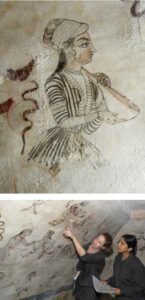
1.Salt Efflorescence, Sheesh Mahal
Salt crystallization causes powdering/flaking of paint layers. Courtauld Institute analysis identified traditional araish plaster beneath, now compromised by moisture.
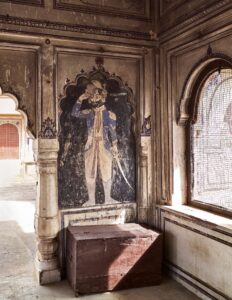
2.Detail of Mughal-Rajput fusion frescoes, Agra artisans’ work.
Pigments like crushed lapis lazuli (blue) and wet-plaster gulkari showcase a hybrid of techniques.
The anatomy of Araish
Ancient Sanskrit texts like the Vishnudharmottara Purana third to fifth century AD and Mayamata and Silpa Ratna from 16 century AD give information about detailed specifications of lime mortars and their application. Regrettably, much of this traditional knowledge has been lost over time, primarily due to its discontinuation in contemporary construction practices (Bais, 2007). Araish’s process is a dance of precision.
In accordance with current practice walls are first layered with Thappi (coarse lime plaster) and Lohi (fine plaster), then finished with Araish’s marble-lime blend. Natural pigments—vermilion from Sindoor, indigo from Neel, gold leaf—are pressed into wet plaster, their chemistry fusing with lime to outlast synthetic paints. Artisans time their work to winter’s humidity, avoiding summer’s aridity that risks cracks.
The result? Walls that regulate temperature—cool in summer, warm in winter—and resist water without toxic additives. At Samode Palace, frescoes painted on Araish in the 18th century retain their vibrancy, while cement-bound murals elsewhere flake within years (Sinha, 2007). Yet, Araish’s labor intensity (a single wall takes weeks) clashes with cement’s “quick-fix” allure.
The shift to cement isn’t just a cultural loss—it’s an ecological misstep. Lime production emits less CO₂ than cement and requires no industrialized kilns, empowering rural economies. Rajasthan’s lime clusters Ramgarh, Jhunjhunu and Sikar still employ ancestral kiln techniques, but their survival hinges on demand. Scholars like Sangeeta Bais argue that lime has historically been a durable and versatile construction material, as evidenced by centuries-old Indian structures that have withstood natural calamities and weathering. Meanwhile, cement traps moisture, breeds mold and escalates maintenance costs.
The Jaipur royals’ Cultural Heritage Training Camp bridges this divide. By certifying artisans and standardizing Araish for modern codes, they’re proving heritage techniques can meet contemporary needs.
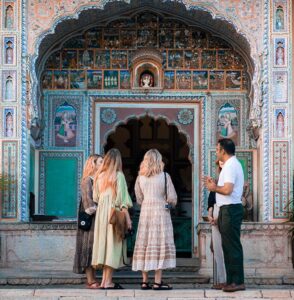
3.Vibrant 19th-century fresco walls, Samode.
This section reveals original mineral pigments and araish plaster craftsmanship, typical of Rajasthan’s aristocratic havelis.
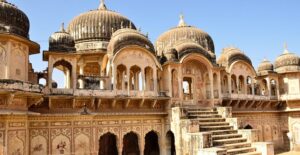
4.Two 19th-century chhatris atop a Masonic structure, Ramgarh.
Founded in 1791 by the Poddar family, these cenotaphs feature ala-gila frescoes on inverted lotus pinnacles, accessed via a monumental staircase. Octagonal pillars reflect the town’s legacy as a hub of Shekhawati art and wealth.
Conclusion
Under the patronage of Jaipur’s Royals, lime dust and marble powder breathe new life into a dying art. By championing Traditional Indian art forms, India’s royal families aren’t clinging to the past—they’re redefining luxury as something timeless, sustainable, and deeply rooted in identity. As the world grapples with climate crisis, their quiet revolution offers a blueprint: sometimes, the future lies in our past.
References:
1. Bais, S. Why Use Lime? INTACH UK Trust, 2007.
2. Sarda, Keyur, and Sandeep Virmani. Hunnar of Lime. Technical inputs by Professor K.S. Jagadish, content structure by Gaurav Dinodia, and creative design by Annie Aggarwal. Published by Community Empowerment Unit, Hunnarshala Foundation for Building Technology and Innovations, 2020.
3. Sinha, Juhi. Beyond the Dunes: Journeys in Rajasthan. Penguin Books, 2007.
4. Census of India 2011: Rajasthan, Series-09, Part XII-B, District Census Handbook, Sikar. Government of India, 2011.
5. Indira Gandhi National Centre for the Arts. Workshop on Arayash—An Indigenous Wall Painting Technique. Conducted by Prof. Bhawani Shankar Sharma at IGNCA, 2014.
6. Martin, Charlotte. “Cultural Identity, Conservation Approaches, and Dissemination: Conserving the Wall Paintings of Nagaur Fort, Rajasthan, India.” In Proceedings of the ICOM Committee for Conservation. Lisbon: Critério Artes Gráficas, Lda., 2011.
7. Singh, Aprajeeta, and Nand Kishore. “Growth of Paintings During the Akbar Era.” International Journal of Creative Research Thoughts (IJCRT) 11, no. 7 (July 2023).
8. Eires, Rute, Aires Camões, and Said Jalali. “Ancient Materials and Techniques to Improve the Earthen Building Durability.” Key Engineering Materials 634 (2014): 357–366. https://doi.org/10.4028/www.scientific.net/KEM.634.357.
9. “Indulge in the Grandeur of Rajputana Hospitality at the Sawai Man Mahal in Jaipur.” Architect and Interiors India. Accessed May 20, 2024. https://www.architectandinteriorsindia.com/projects/indulge-in-the-grandeur-of-rajputana-hospitality-at-the-sawai-man-mahal-in-jaipur.
Images:
1. Courtauld Institute of Art and Mehrangarh Museum Trust. In Charlotte Martin, “Cultural Identity, Conservation Approaches, and Dissemination: Conserving the Wall Paintings of Nagaur Fort, Rajasthan, India,” ResearchGate (2011). Accessed May 23, 2025. https://www.researchgate.net/figure/Salt-efflorescence-on-the-paintings-in-the_fig3_234109529.
2. Wallander, Björn. Architectural Digest India. Accessed May 24,2025. https://www.architecturaldigest.in/story/karauli-city-palace-is-an-anthem-to-the-centuries-old-design-practices-of-rajasthan/.
3. Samode Haveli. Samode, Rajasthan.https://samode.com/samode-haveli-gallery/
4. Rajasthan Tourism Department. Rajasthan Tourism Official Website. Accessed May 21,2025. https://www.tourism.rajasthan.gov.in/content/rajasthan-tourism/en/tourist-destinations/shekhawati.html.