
:- by Yusra Naqvi
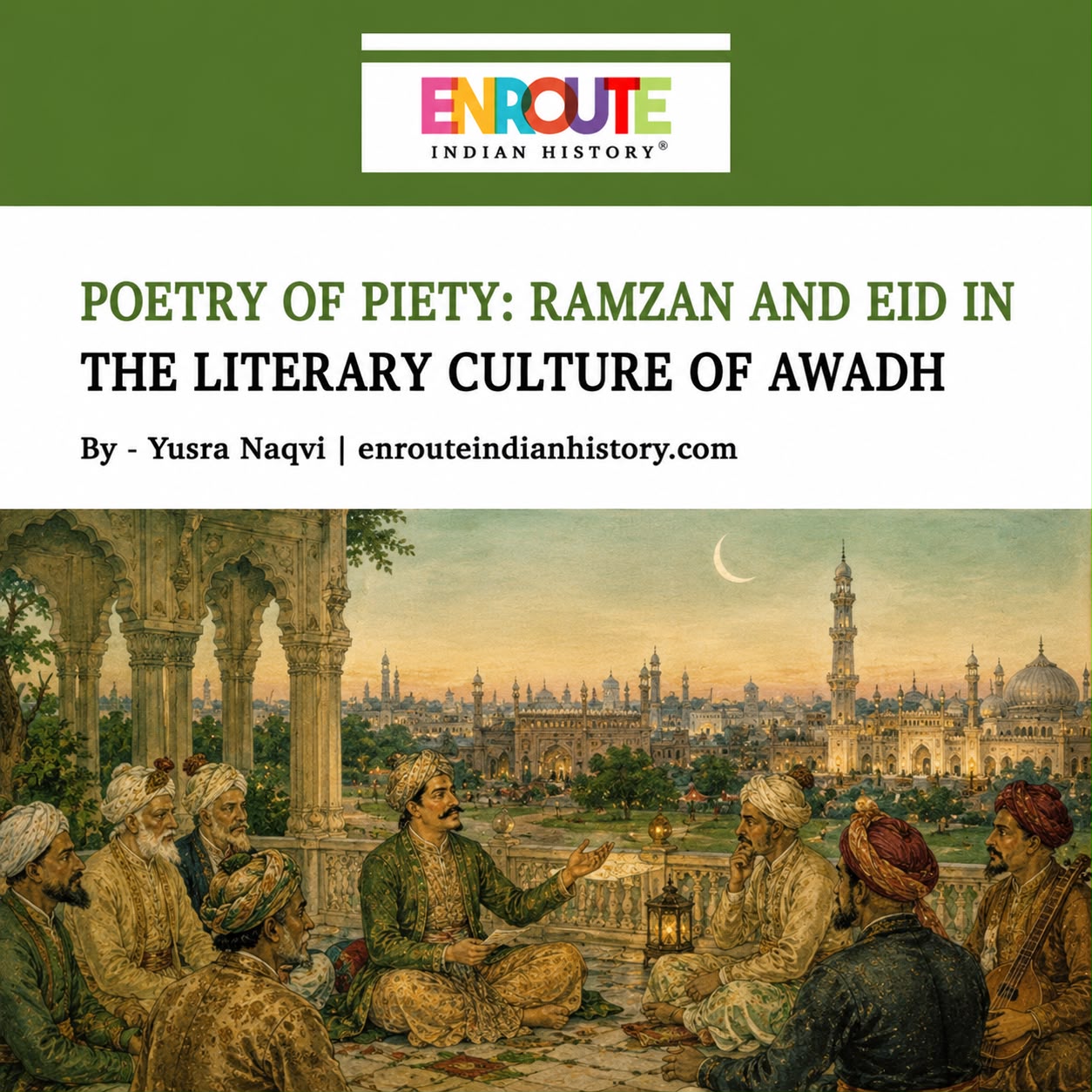
The region of Awadh, especially the cities of Faizabad and Lucknow, emerged as one of the most vibrant centres of Indo-Islamic literary culture during the eighteenth and nineteenth centuries. After the political decline of the Mughal court in Delhi, many poets, scholars, and writers migrated to Awadh under the patronage of the Nawabs. This made Awadh a flourishing hub of Persian and Urdu literature. This article examines how these poets expressed their ideas about the occasions of Ramzan and Eid. It argues that the literary expressions surrounding these occasions combined religious devotion with the refined aesthetic culture of Awadh’s Ganga-Jamuni tehzeeb. Thus, Eid became not merely a religious festival but also a literary motif that reflected the spiritual and social life of the region.
Ramzan, the Islamic month of fasting, has long inspired devotional poetry in Persian and Urdu literary traditions. In the imagination of the poets of Awadh, Ramzan was portrayed as a period of introspection, purification, and spiritual growth. With the patronage of the Nawabs, Lucknow developed into a major center for Urdu poetry and literary refinement. Within this milieu, poetry became a principal medium through which social life, courtly etiquette, and religious devotion were reflected. The culture of the court encouraged gatherings such as mushairas (poetic symposiums), where poets often recited verses and experimented with themes of love, ethics, and spirituality. Within this environment, religious festivals were not only observed through ritual but also celebrated through poetry, music, and public gatherings.
The structure of the Urdu ghazal, which relies on layered metaphors and symbolic language, allowed poets to articulate spiritual longing and divine love through imagery drawn from everyday life. Literary scholar Francis Pritchett notes that the ghazal historically served as a flexible medium capable of expressing both romantic and mystical sentiments, allowing poets to blend sacred and worldly themes within the same poetic framework. Poets frequently depicted Ramzan through references of fasting (roza), prayers, and the anticipation of the crescent moon marking the arrival of Eid. The poetry often invoked metaphors of restraint or hunger not merely as physical experiences but as symbols of moral purification. The fasting body became a metaphor for the disciplined soul seeking closeness to the divine.
A nineteenth-century Awadhi poet, Nazm Tabatabai, writes:
Aa gaya phir ramzān kya hoga
(Ramzaan has arrived again, what will happen now?)
Haa.e ai pīr-e-mughāñ kya hoga
(Alas, what will become of the wine drinkers now?)
Bāgh-e-jannat meñ samāñ kya hogā
(What will the atmosphere of the Garden of Paradise be like)
Tu nahīñ jab toh vahañ kyā hogā
(If you are not there, what will that place be?)
The couplets use classical Urdu poetic imagery where Ramzan represents spiritual discipline and abstinence. Mughāñ refers to tavern-keepers or wine-drinkers in classical Persian-Urdu poetry, symbolising worldly pleasure and indulgence. In Sufi poetry, wine does not merely refer to drinking, rather it represents mystical ecstacy, spiritual intoxication, or rebellion against rigid orthodoxy. In the last two lines, the tone becomes romantic and mystical, where the poet claims that even if paradise exists, its beauty would be meaningless without the beloved.
If Ramzan represented introspection and spirituality, Eid symbolises joy, renewal, and merry-making. Awadhi poets frequently depicted Eid as a moment when spiritual devotion culminated in collective celebration. Poetry about Eid often describes the sighting of the crescent moon, the gathering of families, and the festive atmosphere of the city. Poets used vivid imagery to portray scenes such as crowded markets, newly stitched garments, and the aroma of festive dishes. Eid also reflected the region’s composite cultural ethos. Public celebrations often included elaborate gatherings where poetry, music, and food formed integral components of festivity.
Nazeer Akbarabadi, an eighteenth-century poet, migrated from Delhi to Akbarabad (Agra) after Nadir Shah invaded Delhi in 1739. He became popular by writing ‘natural poetry’ on anything interesting he observed in his surroundings. The rejoices and festivities on the day of Eid are depicted by him in these lines:
Aisi na shab baraat, na bakhrīd ki khushī
Jaisī har ek dil meñ hai iss iid ki khushī
Roze ki khushkiyoñ se haiñ jo zard-zard gaal
Khush ho gaye vo dekhte hi iid ka hilaal
Poshaakeñ tan meiñ haiñ zard, sunahri, safed, laal
Dil kya ki has raha hai tan ka baal-baal
Aisi na shab baraat, na bakhrīd ki khush Jaisī har ek dil meñ hai iss iid ki khushī
Nazeee’s poetry is particularly valuable for understanding popular celebrations in North India. In these lines, he shares a personal emotion and the inner joy experienced during Eid:
Yuuñ lab se apne nikle hai ab bār-bār aah
(A sigh escapes from my lips again and again)
Kartā hai jis tarah ki dil-e-be-qarar aah
(Just as the restless heart continues to sigh)
Ham iid ke din bhi rahe ummīd-vār aah
(We remain full of longing even on the day of Eid)
Ho jī meñ apne iid ki farhat se shād-kām
(Yet our hearts rejoice at the happiness of Eid)
Khubāñ se apne liye sab ne dil ke kaam
(Everyone finds delight in the company of the beautiful beloveds)
Dil khol khol sab mile aapas meiñ khaas-o-aam
(People, both noble and common alike, meet one another freely)
Āghosh-e-khalq gul-badanoñ se bhare tamaam
(The arms of people are filled with embraces of rose-bodied beloveds everywhere)
The opening couplet introduces aah (sigh) to convey the emotional complexities of celebration. It reflects the emotions attached to Eid after the completion of Ramzan, suggesting that the festival of Eid had been longed for. The last couplet is particularly significant as it emphasises how everyone meets freely- both the elite (khaas) and the common people (aam). Nazeer often highlighted the participation of ordinary people in festivals, which distinguishes him from many court poets who primarily focused on aristocratic life.
Several other poets associated with Awadh contributed to the development of this poetic tradition. Among them, Mir Taqi Mir is significant for his melancholic aura. He attaches a profound depth to these lines:
Sahr-e-gah-e-iid meñ daur-e-subū thā
(At the dawn of Eid, the wine cup circulated everywhere)
Par apne jaam meñ tujh bin lahū thā
(Yet in my own cup, without you, there was only blood)
Ghalat tha aapse ghāfil guzarna
(It was wrong of me to pass by you in heedlessness)
Na samjhe ham ki is qālib meñ tū thā
(I did not realise that you were present within this very body)
The poem is situated in the dawn of Eid, which is traditionally associated with joy, prayer, and celebration after the month of fasting. However, Mir, in his essential element, subverts this festive expectation. Instead of joy, the poet expresses melancholy and emotional suffering. This contrast between collective celebration and personal sorrow is a recurring style in Mir’s poetry. While the world celebrates Eid, the lover remains trapped in longing and grief.
An important aspect of poetry from Awadh is it’s reflection of the region’s syncretic culture. Historians have emphasised that the Nawabs encouraged artistic and social practices that brought together diverse communities, creating a shared cultural space where festivals and artistic forms developed. Poetry about Eid and Ramzan depicted universal emotions of joy, reunion, longing, as well as grief.
Poetry in Awadh, therefore, reflects deep interconnection between religion, culture, and literary creativity in the regions’s history. Poets greatly contributed to a literary tradition in which the sacredness of Ramzan and the joyous celebrations of Eid were woven into the emotional fabric of the Urdu verse. Further, the poetic imagination demonstrates how religious experience, the participation of communities, and food sharing customs can be transformed into art and expression.
References:
- Farouqui, Shamsur Rahman, Early Urdu Literary Culture and History, Oxford University Press, 2001
- Pritchett, Francis W, Nets of Awareness: Urdu Poetry and it’s Critics, University of California Press, 1994
- Mukhtar, Ahmad, Migration of Persian Literati from Delhi to Awadh, SOCRATES Journal, 2016
- Naim, C.M, Translating Mir Taqi Mir, Annual of Urdu Studies, vol. 18, 2003, pp 1-26
- Akbarabadi, Nazeer, Kulliyat-e-Nazeer Akbarabadi, edited by Maulvi Abdul Haq, Anjuman Taraqqi-e-Urdu, 1951.
- Mir, Taqi, Kulliyat-e-Mir, edited by Zill-e-Subhani, Anjuman Taraqqi-e-Urdu, 1968