

Race against Time: How Scientific Methods are being used for Preserving the Fading Frescoes of Ajanta Caves
- December 11, 2025
By Ramyani Banerjee

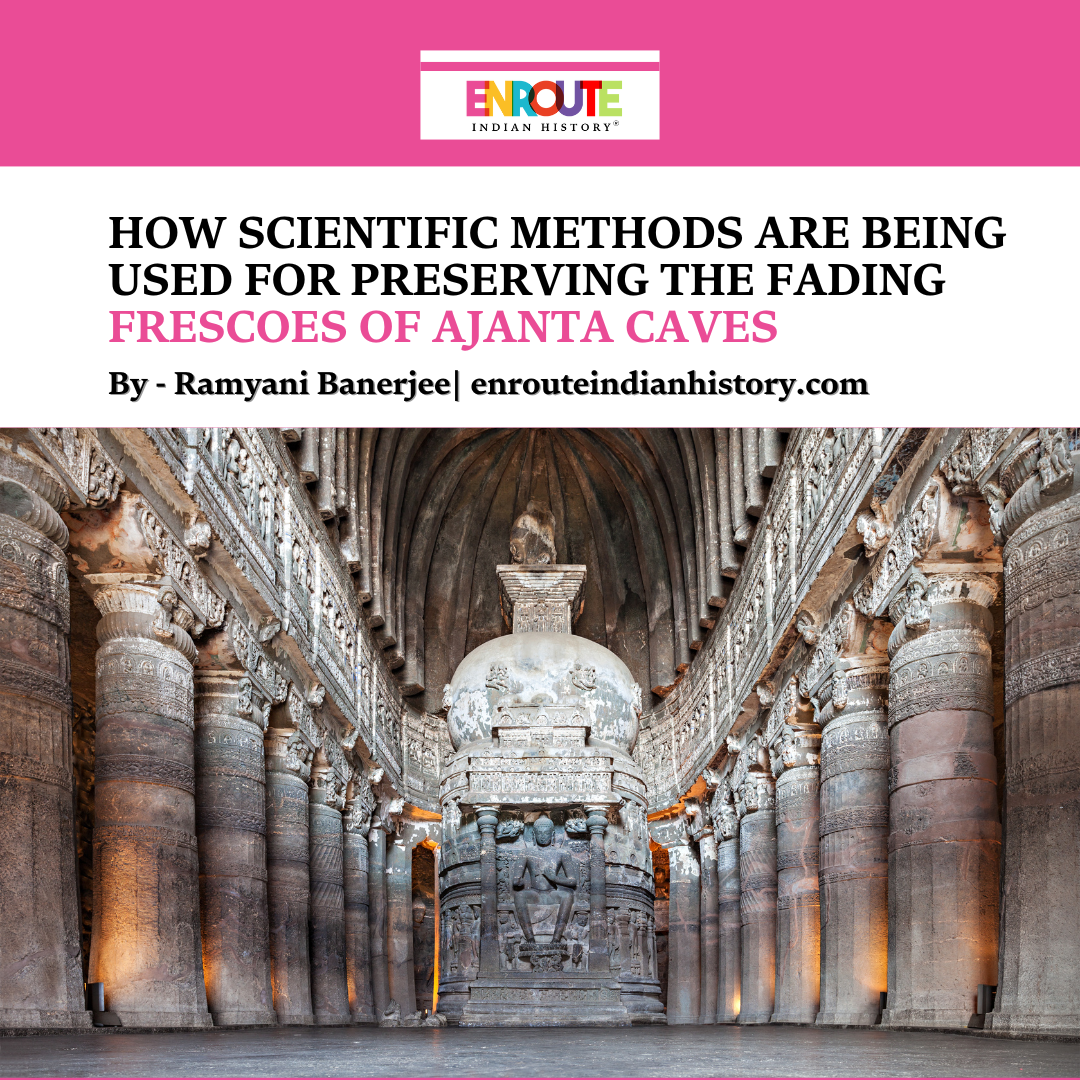
Image source: Muduli, S. (2020) Cave painting at Ajanta Caves, Aurangabad, India [Photograph]. Available at: https://www.researchgate.net/figure/Cave-painting-at-Ajanta-Caves-Aurangabad-India_fig2_378362989 (Accessed: 18 October 2025).
High above the winding gorge of the River Waghora in Maharashtra, India, the Ajanta Caves stand as a testament to human artistry two millennia old. Carved into a 75-metre rock face, around 30 Buddhist monasteries and prayer halls date from the 2nd century BCE to about late 5th and 6th century C.E. Inside them lie some of the finest surviving murals of ancient Indian art — vivid, expressive wall-paintings that depict the Buddha’s past lives, dramatic Jataka tales and everyday life in the Vakataka era. Yet time, nature and human impact, both have taken a toll. Therefore, the mission now is more than discovery and documentation — it is rescue. This article takes a close look at how science and technology are being marshalled behind the scenes to conserve, restore and digitally preserve the Ajanta murals, and highlights what this tells us about heritage conservation in the modern age.
The Problem: Fragile Murals in a Harsh Setting:-
From the moment they were carved on the cliffs, the Ajanta caves have been in a perpetual struggle against time and the elements. The rock-cut interiors of Ajanta, once sheathed in lime plaster and brought to life with tempera—a technique where pigments are mixed with a water-soluble binder for quick drying and firm adhesion—have endured centuries of trial. Exposed to damp monsoons, fluctuating humidity, and the slow erosion of time, these murals, carved directly into living rock, continue their struggle against nature’s persistence and the passage of ages. Moreover, the on-site conditions are also challenging. High temperature and humidity, growth of moss, insect and bat activities, bird nests and general human stress are major ongoing threats. Among them, infiltration is especially harmful: when water seeps through the rock it reaches the painted plaster and causes flaking, peeling, salts crystallising, micro-cracks and eventual detachment of the pigment layers. Even light plays a double-edged role—where sunlight touches, colours fade; where shadow lingers, hues remain intact.
Ironically, human efforts to preserve these masterpieces once hastened their decay. For example, the Italian experts hired by the Nizam of Hyderabad, meaning well, coated the walls with varnishes. But this left a greasy, altered surface, which has aged differently from the original pigments; and ended up causing significant damage. Thus, Ajanta became a paradox of beauty and fragility—an irreplaceable cultural treasure suspended between natural decay and imperfect human care.
Further expanding on this, M. Singh’s 2012 research, Conservation and Restoration Research on 2nd BCE Murals of Ajanta, offers a fascinating glimpse into the painstaking science behind saving India’s oldest surviving wall paintings in Caves 9 and 10. Beneath layers of soot, varnish, and centuries of neglect, Singh’s team uncovered murals painted on an almost impossibly delicate lime plaster—barely half a millimetre thick—using natural mineral pigments such as yellow ochre, red ochre, and lime white. Portable X-ray fluorescence (Energy-Dispersive X-ray Fluorescence, a non-destructive analytical technique used to determine the elemental composition of a material) and Fourier Transform Infrared Spectroscopy (This technique is used to identify organic and some inorganic compounds based on how they absorb infrared light) confirmed what time had concealed: the colours were inorganic, but the damage was deeply chemical. Over the past century, multiple coatings of shellac, copal, mastic, and polyvinyl acetate—once thought to protect the art—had seeped into the plaster, oxidised under light and heat, and turned brittle, leaving the surfaces greasy, discoloured, and perilously fragile. Removing them was like performing surgery on history itself. To meet this challenge, conservators devised a hybrid strategy: controlled solvent cleaning, combined with tailor-made micro-emulsion systems capable of dissolving degraded polymers without forcing residues deeper into the porous lime. This approach, tested in Cave 10, allowed the team to gently lift away decades of chemical debris while preserving the ghostly thin pigment layers beneath. Infrared imaging revealed outlines invisible to the naked eye, guiding each movement of the brush as conservators navigated varnish crusts, soot, and even hardened bat excreta. Alongside this micro-level work, larger protective measures were introduced—wire-mesh barriers to keep out birds and bats, meticulous monitoring of temperature and humidity, and photographic documentation under controlled light to prevent further thermal stress. Their findings highlight how interdisciplinary heritage science—combining chemistry, spectroscopy, climatology, and art history—has become indispensable to preserving Ajanta’s ancient artistry against the corrosive forces of time and environment.
The Response: A Multidisciplinary Scientific Program:
Under the auspices of the Archaeological Survey of India and supported by heritage-science teams, a very concentrated effort has been made to apply modern conservation science to Ajanta. The measures fall broadly into structural stabilization, micro-conservation of the paintings themselves, environmental control and access management, and digital preservation.
a) Structural & Environmental Stabilization
One of the first challenges in preserving the Ajanta caves is creating a stable “container” for the fragile paintings within. Conservation teams have approached this with a careful blend of structural reinforcement and subtle modern interventions. Support pillars have been installed to shore up vulnerable sections, cracks in the walls are meticulously filled to stem water seepage, and lighting has been redesigned to shield the art from harsh sunlight. In some caves, delicate cane-work shades and fibre-optic illumination now replace direct rays, allowing visitors to admire the murals under soft, controlled light—minimizing heat, ultraviolet damage, and even the invisible moisture introduced by human presence.
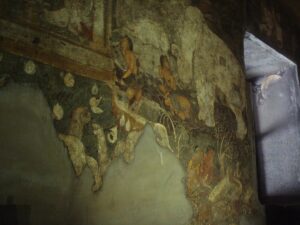
Archaeological Survey of India (2014) Ajanta Cave Painting, Picture 6 [photograph]. Available at: https://commons.wikimedia.org/wiki/File:Ajanta_Cave_Painting,_Picture_6.JPG (Accessed: 18 October 2025).
b) Micro-conservation: Pigments, Plaster & Mortar
The survival of the Ajanta murals hinges on a delicate, layered architecture: rock face, plaster, and pigment. Once the structural integrity of the caves is secured, conservation scientists step in with a sophisticated arsenal of chemistry, imaging, and materials science. Studies suggest that the original plaster—a blend of lime and earth—may have been reinforced with organic fibers, rice husks, and seeds. By carefully analyzing this ancient mortar, restoration teams have devised cleaning and consolidation techniques that are fully compatible with the historic materials. Old varnish layers and resin coatings, remnants of earlier, less refined interventions, are now being gently lifted using organic solvents and micro-emulsion cleaning methods. In particularly water-sensitive areas, hydrophobic consolidants like Cyclododecane (CDD) create a temporary protective barrier, preventing moisture from penetrating while keeping pigments intact.
These chemical approaches are paired with cutting-edge imaging technologies: digital image analysis, infrared reflectography, and other non-invasive tools reveal hidden structural layers, pigment deterioration, and traces of past repairs—all without physically disturbing the murals. A documented account of Ajanta’s restoration history highlights how, in 1999, the Archaeological Survey of India’s team combined infrared light, micro-emulsion cleaning, and advanced Japanese conservation techniques to uncover intricate details long hidden beneath the marks of time and earlier interventions. Today, these interventions allow conservator-scientists to pinpoint where plaster is detaching, how salts are forming, which pigments are vulnerable, and precisely how treatments can be applied—all while preserving the murals’ original genius.
c) Digital Preservation and A.I Documentation
Alongside the painstaking work of physical conservation, a parallel innovation is also quietly unfolding: the digital preservation of Ajanta’s painted surfaces. In a groundbreaking collaboration, an Indian firm, Sapio Analytics, and a cultural-heritage NGO have deployed AI-driven “pixel-level scanning nanotechnology” to capture the murals in astonishing ultra-high definition. This technology not only recreates missing fragments virtually but also secures the entire archive in fortified digital vaults, including the Arctic World Archive in Svalbard, Norway. This undertaking serves multiple purposes: A stable long-term archive, in case the physical originals deteriorate, a powerful research tool for scholars to probe faded details and reconstruct lost imagery, and an immersive platform for public engagement—through virtual galleries, augmented-reality experiences, and high-resolution images that bring the ancient world to life for audiences everywhere.
d) Visitor Management and Access Control :
Even the finest conservation science can falter without accounting for one stubborn variable: people. Hundreds of visitors, prolonged dwell time, flash photography, mobile torches, respiration and heat all raise humidity and carbon dioxide— which accelerate the decay of these paintings. To counter this invisible enemy, the Archaeological Survey of India has tightened its grip. Some cave zones are now strictly off-limits; flash photography and mobile torches are banned. Guided tours have replaced free wandering, and outside the caves, new causeways help channel tourist traffic along the gorge, easing the strain on fragile interiors. Along with these, legal protections like the Ancient Monuments and Archaeological Sites & Remains Act of 1958, with buffer zones that are shielding the site and nearby forests, strengthen this defense. Together, these measures act as Ajanta’s quiet guardians—granting the ancient rock walls a chance to breathe, recover, and endure a little longer against time’s relentless march.
Challenges and Limitations
Conserving Ajanta is still a monumental challenge, one that demands far more than the controlled routine of a museum setting. The physical destruction is slow but real; every crack, every drip of water, every footfall of a visitor adds risk. The toll is visible: many figures are incomplete—eyes and limbs lost, damaged pigments, or entire sections vanished. Secondly, the funding and manpower to carry out detailed microscale conservation inch-by-inch is substantial. Complicating matters further is the legacy of previous interventions: early 20th-century restorers performed overzealous “touch-ups,” leaving modern conservators to carefully undo these layers without harming the fragile original. And all this occurs under the constant presence of visitors—thousands drawn to the caves each year—requiring a delicate balance between accessibility and preservation. Digital archiving can surely immortalize images, but it cannot substitute for the living, breathing material reality of these masterpieces.
Conclusion: Why does it Matter?
The conservation of Ajanta is not only about art-history or tourism — it carries a much broader significance. These murals are unparalleled ancient iconographic records of Buddhist narrative art in South Asia, alive with sweeping figural compositions, dramatic shading, and a color palette that shaped generations of Indian painting. Secondly, if one looks at the science of conservation being applied here, it is undeniable that this work is on the frontier of heritage preservation: through diagnostics, digital archiving, minimal intervention and long-term environmental strategies. The Ajanta case acts as a testing ground and exemplar for other rock-cut, open-site heritage monuments worldwide. But the work remains urgent. The challenge is not just to restore what was lost, but to safeguard the living site for centuries more. In that sense, the story of Ajanta is not just a story of art—it’s a story of surviving.
BIBLIOGRAPHY:
1.Ajanta Heritage Centre, 2025. A New Approach to Preserve and Promote Indian Culture, Art, and Heritage. Available at: https://ajantahc.com/a-new-approach-to-preserve-and-promote-indian-culture-art-and-heritage [Accessed 18 Oct. 2025].
2. Double Dolphin, 2015. Photography Inside Ajanta Caves: Tips and Tricks. Available at: https://double-dolphin.blogspot.com/2015/12/photography-inside-ajanta-caves-tips-and-tricks.html [Accessed 18 Oct. 2025].
3. DAG World, 2025. Rediscovering Ajanta. Available at: https://dagworld.com/rediscovering-ajanta.html [Accessed 18 Oct. 2025].
4. MAP Academy Encyclopedia of Art, 2022. Ajanta Murals. [Online]. Available at: https://mapacademy.io/article/ajanta-murals/ (Accessed: 19 October 2025).
5. Prasad Pawar, 2025. Restoration. Available at: https://prasadpawar.com/index.php/restoration/ [Accessed 18 Oct. 2025].
6. Rooftop App, 2025. Ajanta Cave Paintings: 5 Measures Taken in Their Conservation and Restoration. Available at: https://rooftopapp.com/blogs/ajanta-cave-paintings-5-measures-taken-in-their-conservation-and-restoration/ [Accessed 18 Oct. 2025].
7. Singh, M. and Arbad, B.R. (2012) ‘Conservation and Restoration Research on 2nd BCE Murals of Ajanta’, International Journal of Scientific and Engineering Research, 3(10), pp. 1-8. [Accessed 18 Oct. 2025].