

By Arnav Kala
The Rajputs were a warrior caste with varying origins who emerged as the ruling elite in the northern regions of the Indian sub – continent during the Early Medieval period(600 CE to 1200 CE) after the decline of the Gupta empire and a period of waves of invasions from Central Asian nomads such as the Sakas, Kushans(Yuezhi) and Hunas. Their origins are debated, with speculations attributing their ancestry to be from indigenous Abhiras, Vedic Kshatriyas, Central Asian nomads who assimilated in Northern India, or a mix of castes and classes who arose to power during an unstable time period in the subcontinent. By the 11th and 12th Centuries, Rajput dominance in Northern India had been well established as several different clans ruled powerful kingdoms, such as the Chahamans(Chauhans) in East Punjab, Northern Rajasthan and Delhi, Gahadavalas(Rathods) in the Ganges valley in modern day Uttar Pradesh, the Parmars in Malwa and the Tomaras in Gwalior. Rajput kingdoms, feudal states, confederacies and migrations also later emerged in the Northwest, Western and Eastern parts of South Asia.
During the same era, new religious sects that had come to prominence during the Classical Age of India such as Shaivism, Shaktism and Vaishnavism became well established as opposed to Vedic and Upanishadic thought which lost their importance outside of ritualistic worship due to the rise of the Bhakti movement which was against ritualism and social stratification along with the Vedanta philosophy propagated by Adi Shankaracharya. This led to greater integration of cults and regional beliefs within mainstream Hinduism, leading to a fusion of regional and cultural traditions with the teachings of later Brahmanical didactic texts such as the Puranas and the Epics Mahabharata and Ramayana.
One of the evident traditions that can be found that likely first emerged from this time period is that of kul devatas and kul devis, or clan deities. Such deities are believed to watch over one’s clan and are often the object of one’s devotion. In Rajput royal families, these deities were revered and often became popular amongst the subjects of the kingdom they ruled. Vice versa, in different regions, different cultural traditions influenced the religious traditions of ruling dynasties, often those who had migrated to a region from a different one, or those who had come to power through intermarriage.
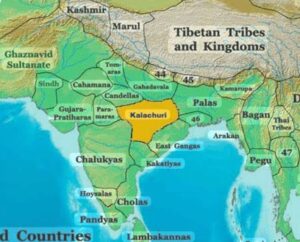
Eklingji – Guhila dynasty, Mewar
The Guhila dynasty is believed to have been founded by Bappa Rawal in 728 CE who was ninth in line from Guha according to the fifteenth century Ekalinga Mahatmya. The Guhila dynasty were Suryavanshi Rajputs who reigned as rulers of Mewar from the eighth century CE till the thirteenth century CE, and venerated Eklingji as their kul devata due to the patronage given and the temple built by the founder of the dynasty.
The origin of the Guhila dynasty adopting Eklingji as their kul devata is deeply connected to popular Hindu sects and beliefs of the time. A number of legends and the Ekalinga Mahatmya, Bappa Rawal was forced into forest exile after his father Nagaditya was slain in conflict with the Bhils. It is said that during his exile, he met a travelling Shaivite ascetic by the name of Harita Rasi, who took him under his tutelage. Inscriptional and numismatic evidence show the link between Bappa Rawal and the Shaivas of his time as well as the claim of antiquity of the Eklingji temple. A gold coin from his reign was found to be inscribed with the words Sri Voppa, along with a trident, a Shiva linga and an image of a bull and the image below shows a man prostrating with large pierced ears, which is likely to have been a representation of his initiation into the Nath Siddhas. The feature of the large pierced ears has been long associated with the Nath Siddhas, however chronologically it is much more probable that his ear boring ceremony was performed by a Pasupata, which is further supported by the name of his initiator: Rasi was a common ending name among the Pashupatas. This suggests that the custodianship of the temple likely passed down to the Nath Siddhas before being handed over to the Ramanandis in the sixteenth Century.
Following his initiation, it is believed that Bappa assumed the title of Rawal, derived from the Sanskrit term raja – kula. This title is believed to have been a commonly used clan name by the Pasupatas by the eighth century, who were absorbed into the Nath Sampradaya by the thirteenth century. The clan deity Eklingji rose to popularity and became a revered deity across the kingdom of Mewar and southern Rajasthan. This shows the prominence of Shaivism during the early medieval period, and how different Shaivite sects influenced the religious beliefs of the time.
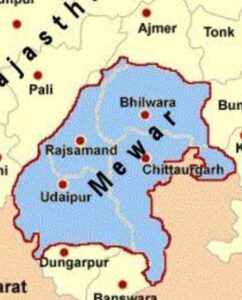
Rajrajeshwari – Panwar dynasty, Garhwal
The Panwar dynasty of Garhwal is believed to have been founded by Kanak Pal in 688 CE. The Panwar dynasty reigned as rulers of Garhwal from Kanak Pal’s accession to the throne in the 7th Century CE till 1949 when the 60th king of the dynasty, Manabendra Shah acceded to the Republic of India. They venerated the goddess Rajrajeshwari as their kul devi. The origins of the worship of the goddess deity are unclear, however her traits are like other forms of the goddess Durga or Shakti, who is worshipped across several parts of the country. Her symbol as the clan deity of the Panwars is likely linked to the story of their origins and migration in Garhwal. They are considered to be Agnikula Rajputs.
It is believed that Kanak Pal was a prince from the Paramara dynasty of Malwa who had travelled to Garhwal in order to fulfill his pilgrimage duties when a local chieftain, Bhanu Pratap of Chandpur Garhi, entered an alliance with him and marrying his daughter off to him and making him the heir of his fiefdom. This marriage alliance created the Panwar dynasty, however for the next few centuries they likely remained as vassals of the Katyuris, who ruled a large extent of territory from the sixth century CE till the twelfth century CE in most of modern day Uttarakhand and Western Nepal, which is associated with being the home of the Khasa ethnicity. This cultural and religious fusion of migrants from the plains with local Khasas during the reign of the Katyuris who patronised brahmanical practices created unique religious customs, traditions and practices, which may have led to the worship of deities such as Rajrajeshwari Devi.
The Rajrajeshwari Devi temple is considered to have been built by the king Ajaypal, who united all minor 52 minor principalities or garhs under his rule and established the kingdom of Garhwal, when he shifted his capital from Chandpur Garhi to Devalgarh near the Alakananda valley. Like Eklingji, it is considered to be an important site for the Nath sect or sampradaya. The customs and traditions associated with the temple are well documented.
The biannual Navratri is celebrated in the Saka calendar months of Chaitra and Ashwin which is common around the country, but unusually, also two more known as gupt Navratri in the months of Magha and Asadh. These are not considered major events, as only a small – scale arti is performed by the pujari(priest) of the temple in the morning and evening without the need of elaborate rituals or sacrifices. It is believed that the deity possesses the pujari of the temple in order to communicate with the people of the village and those of the lineage who revere her as their kul devi. Her worship is considered to be incomplete without the worship of the deity Bhairav, considered to be a form of the god Shiva. This is not because the kul devi is considered to be his consort, but because the deity Bhairav is considered locally to be the protector deity who punishes wrongdoers on behalf of the goddess and guards her territory from evil forces. Another deity, Chaukri devi is considered to be the goddess’s companion. According to local belief, a local king known as Hemchand ruled the area around the village of Kandara in Rudraprayag district(as a vassal to the Panwars) and had built another Rajrajeshwari devi temple.
Previously, animal sacrifices such as those of buffalos on the tenth day of the worship to Bhairav were also routine as part of the puja processions, along with mystical practices regarding bhoot pret(ghosts and evil spirits). However, these have reduced over time due to efforts by authorities to reduce superstitions and malpractices. Other important elements include the musical instrument pairing of dhol – damaun which is played during the entire worship during nine days, as well as the Vedic element of havan in which the sacred items of mango wood and fig tree are used along with ritual baths.
Such deities were believed to keep the royal family’s kingdom protected from outside or unwanted elements, and have been a key part of local as well as royal traditions.
Nanda Devi – Chand dynasty
The Chand kings of Kumaon (present-day Uttarakhand) revered Nanda Devi as their protective lineage goddess (kul devi). The royal association is materially legible in Almora, their hill capital from the 17th century: within the old palace-temple precinct stands the Nanda Devi shrine complex whose core masonry and iconographic program crystallised under late-Chand rulers, especially Udyot Chand (r. 1675–1698 CE). Local district records and archaeological surveys note that the Chand rajas established and embellished the Nanda precinct and that the town’s annual Nanda Devi Mela, which is still the signature civic festival, has remained tied to this royal patronage for about four centuries.
Historically, the cult of Nanda spans both Kumaon and Garhwal, but the Chand court localised her as a tutelary “warrior-guardian” of Almora and the wider polity. Art-historical notes on the Almora Nanda temple describe late-medieval Nagara-style spires, a surrounding field of sculptural panels (including kirtimukhas, saptamatrka motifs, and martial imagery), and satellite Saiva shrines (e.g., Udyot-Chandeshwar) within the same sacral campus, signs of a consciously royal Shakta-Śaiva synthesis.
Narratively, Nanda is read as a regional form of Parvati/Gaura, the “daughter of the mountains,” whose marriage to Shiva becomes a template for ritual movement between natal and affinal homes. Anthropological work on the Nanda Raj Jat, the once-in-twelve-years “royal pilgrimage” (raj jat) in neighboring Garhwal, shows how this goddess is imagined to revisit her maita (natal village) before returning to her divine husband. Classical ethnographies (and later studies) document the emblematic four-horned ram leading the procession, the women’s songs, possession episodes, and the strong imprint of older hill polities, features that explain why courts like the Chands emphasized her as a dynastic protector. While the Raj Jat is organized from Garhwal, Almora’s “Almora-ki-Nanda” joins ritually, underscoring a pan-Kumaon/Garhwal Nanda sphere within which Chand royal devotion sits.
Custom and festival practice make this lineage tie tangible. In Almora’s Nanda-Sunanda festival (around Bhado/Aug-Sep), craftsmen fashion temporary wooden-banana-pith effigies (dolis) of the goddess pair and processions snake through the bazaar to the Nanda shrine; and martial idioms such as drums, banners, warrior invocations link civic identity to the old rajashraya (royal shelter). District gazette material and art-history compilations anchor the Chand-era origins and later renovations, while ethnographies explain why goddess-as-daughter and goddess-as-queen motifs are so central to Kumaoni social memory.
Conclusion
The above three case studies show the history and customs associated between two prominent Rajput royal families with their respective clan deities. One shows the influence of popular sects within mainstream influence during the early medieval era, and the other shows the integration of the culture of a royal family with that of their subjects of a predominantly different ethnicity, and the last one shows how cross – regional cultural and religious links affect royal household practices.
The kul devata of the Guhila dynasty, Eklingji, shows how Shaivism and its various sects received patronage from prominent royal families of its time. The patronage provided by the royal family of Mewar influenced the local populace which affected their religious beliefs to a large scale during a turning point in Indian history from a religious standpoint, as the Bhakti movement took sway over the Indian subcontinent. The Guhilas of Mewar were one of many Rajput royal families within India to adopt such customs during this era.
On the other hand, the kul devi of the Panwar dynasty of Garhwal, Rajrajeshwari, is an example of the spread of mainstream Hinduism on a wider scale and its integration with regional cults and practices after major religious movements such as the spread of Vedanta philosophy in the hills of Uttarakhand and other regions previously considered to be mlechha lands by Adi Shankaracharya. The influence of the Nath sect is likely linked to the Malwa origin of the Panwar royal family whereas the traditions linked with the worship of the clan deity are mostly derived from the local populace of Khasiyas.
The kul devi of the Chand dynasty of Kumaon shows how not only the belief of the common populace of the region over which a royal family rules influences their religious beliefs and practices, but also how neighbouring regions and their customs also connect local beliefs across different cultures and royal families.
These are three examples of the history of the religious customs of Rajput dynasties, with one showing the influence of the royal family on its subject populace, and vice versa in the other where the local ethnicity’s religious traditions and intermarriage influenced the royal family.
References
1.https://www.researchgate.net/publication/230577594_Religious_Movements_in_Medieval_India
2. https://books.google.com/books?id=pQuqAAAAQBAJ&pg=PA120
3. Worship in Transition An Encounter with the Rājrājeshwarī Devī of the Garhwal Himalaya: Vineet Gairola and Shubha Ranganathan
4. Sax, William S. “The Royal Pilgrimage of the Goddess Nanda.” (scholarly article/book chapter; by a leading Himalayan anthropologist)
5. Sax, William S. “Village Daughter, Village Goddess: Residence, Gender, and Politics in a Himalayan Pilgrimage.” American Ethnologist 17(3), 1990.