

P. Sanjay
Ross Island, which is currently known as Netaji Subhash Chandra Bose Island in Andaman & Nicobar archipelago, which once used to be a magnificent administrative headquarters of the British colonial regime. The land was solely managed by the colonialists for around 80 years, where the island became self-sufficient with all its amenities with residential quarters, churches, barracks and official establishments. But now the island is in ruins, it remains abandoned with the demolished buildings and dilapidated walls. Let’s dive deep into the history and heritage of Ross Islands and also the haunting features of the islands that makes the island scary.
Andaman & Nicobar Islands, a name which reminds us about the cellular jail. A place where our freedom fighters were imprisoned in the kalapani’s jail. The jail of kalapani or ‘Black Water’created a sense of fear and was infamous because of it. However, the usual belief links kalapani to the sanskrit word “kaal”, meaning time or death. Thus it symbolises the water of death – a place from which only the fortunate could return. Indian revolutionaries and freedom fighters were sent to this island to undergo severe punishment where thousands of people were deported to Andaman, of which many even remain unnamed(Dr Rashida Iqbal). The eerie essence of the Andaman Islands persists across time, standing as a quiet reminder of the sorrows and mysteries embedded in their past.
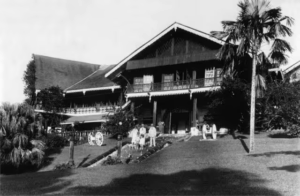
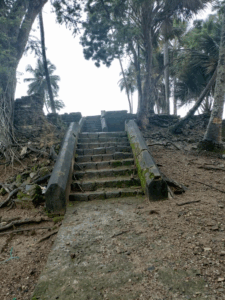
Commissioner’s House at Ross Island, and the present remains of the commissioner house, Source: eternalandamans.com
The first exploration by Captain Archibald Blair and Colonel Colebrooke, who meticulously surveyed the Islands and submitted the report in June 1789. By 1790, the settlements were established, cleaning the forest in Chatham Island and Ross Island. Blair brought people to settle down and he also constructed a structure in Ross Island which was designated as a hospital for the settlers. Initially the Island seemed healthy and comfortable for the people but later till 1795, there were numerous casualties and degrading health of the settlers led to the abolishment of the settlement in 1796. For the next 60 years it remained without settlement till 1858.
Just after the first war of Independence, with the proposal of establishing a penal settlement Andaman Committee was formed on 20th November, 1857 which was expected to find an appropriate place for the establishment of the penal settlement.After the exploration of whole of the islands again, there was no other place suitable than Port Blair. Chatham was the administrative headquarters and then it was changed to Ross Island with a proposal by Dr. James Pattison Walker. Ross Island, located at the mouth of the port, effectively controls the entrance. Apart from being located in a favourable condition, the Island had a perennial water source as compared to Chatham Island.
Even though Ross Island occupied a limited space, the British utilized it effectively, turning the whole island into an amazing destination teeming with leisure and enjoyment. The social and cultural life on the Islands revolved around the gymkhana, officers’ mess and club, the Ladies’ shooting club, hockey, rugby, golf, cricket, swimming, tennis, theatre, and last but not least the waltz, fox-trot and the Fancy Dress Dance(Vaidik, A). All the Government offices and other facilities such as a bazaar, bakery, stores, water treatment plant, church, printing press, secretariat, hospital, cemetery, and garrison were situated. It included all the facilities that the Britishers got in their homes.
Even the Cellular Jail that was planned to be constructed at the Atlanta Point, so as it was situated just opposite to the Ross Island. The clear view of the jail from the Ross, held a significant value for the necessary surveillance and for preventing the prisoners from running. It was also feasible to call out the troops in need of help as an alarm could be quickly signalled from the jail to Ross. Ross Island, just a small piece of land covering a small area of just 31 hectares serving as a prime location for the Britishers to rule the overall islands. The island that was also referred to as the Paris of the East is now in ruins. By the near of Independence everything changed, well what happened to these islands that it really became horrible ?
The Island was destroyed by the earthquake of 1941, most of the buildings were damaged and it became almost impossible to continue to live there. The Headquarters was changed to Port Blair and a year later there was the Japanese occupation of the Islands for three years from 1942-45 made the conditions worse. The Japanese were indifferent about the Ross Island and very least attention was given to the former headquarters of the islands. The only thing they left was the Japanese bunkers all around in the Ross. The island remained in ruins for the next 80 years. In 1945, the allied forces reclaimed the island, and shortly thereafter, the entire penal colony was permanently dissolved. Currently, it is governed by the Indian government.
For many years, a little-known island covering less than one-third of a square mile was the location of the torment of countless convicts and political detainees amid a lavish British colonial settlement. Currently, the jungle has reclaimed Ross Island, enveloping its horrifying history in thick plant life. Massive knots of Ficus roots wrap around the crumbling structures of luxurious bungalows and have overtaken a ballroom where couples once danced. Located around 800 miles from the shores of mainland India, the island in the Indian Ocean is now enveloped in haunting solitude and dense greenery.
The well known stories of Ross Island is that the stories will start with the island being haunted. People claim that the island has spirits of the colonial officers wandering around the Island who died there. The remains of the soldier barracks, the commissioner’s residence, the Presbyterian Church, and the club for subordinates now exist as haunting, roofless shells. The cemetery is also present in the islands which were used to bury the children and officers who died there. They are engulfed by trees, whose extensive roots wrap around the buildings, spreading over the ruins like enormous hands that conceal what used to be a picturesque island. The Island and its remains posits a silent testimony to the freedom fighters who were brought and were subjected to all sorts of inhumane treatment and tortures to achieve freedom. It is an example of haunting, spooky ruins yet a historical understanding.
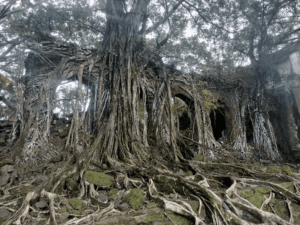
Troops Barrack of Ross Island. Source: by the Author
References
Iqbal, Dr Rashida. The Story of Cellular Jail. Notion Press, 16 May 2025.
Vaidik, A.. Imperial Andamans: Colonial Encounter and Island History. United Kingdom, Palgrave Macmillan UK, 2010, pp. 71-72.