

By Anusha Khan
Every Delhi Story Begins with Stone
Every story of Delhi begins with stone. Some were raised in conquest, others in devotion, but all, in time, have fallen back to dust. South of the city, in Mehrauli, those stones still speak. Here stands the Qutb Minar, taller than any human memory; the quiet tombs of Balban and Jamali-Kamali; and a labyrinth of baolis, mosques, and gardens stitched together by time.
This is where Delhi began. And, in many ways, this is where it keeps beginning, through every act of restoration, every layer of lime plaster, every mason’s hand brushing centuries of moss from a forgotten arch. Mehrauli is not merely the oldest part of the city; it is its pulse, the place that keeps reminding Delhi how to live with its past.
To restore Mehrauli is to ask an impossible question: how do you conserve a ruin that still breathes? How do you hold on to history without silencing it? The answer, perhaps, lies not in preservation alone, but in care, in the slow, patient art of tending to a city that has always known how to repair itself. It is a lesson that begins, fittingly, with one of Delhi’s earliest conservators and caretakers: Sultan Firoz Shah Tughlaq, the first great restorer of this landscape.
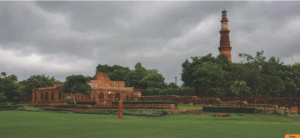
courtesy of DDA report
The First Restorer: Firoz Shah and the Politics of Repair
Long before conservation became a bureaucratic discipline, it was a moral act. Firoz Shah Tughlaq, who ruled from 1351 to 1388, understood this instinctively. When lightning struck the Qutb Minar in 1369 and its upper storey crumbled, he rebuilt it, adding two new tiers in red sandstone and marble, capping the top in gleaming white stone, and inscribing his name alongside those of Qutb-ud-Din Aibak and Iltutmish. The surrounding precinct was strengthened against further erosion. Yet Firoz Shah’s vision of repair went far beyond a single monument.
Firoz Shah saw preservation as a duty of kingship, an act of stewardship over both people and the past. He established one of Delhi’s earliest public works departments to supervise the maintenance of old structures and oversee the construction of new ones. His Futuhat-i-Firozshahi records his restorations as a pious deed in the service of God.
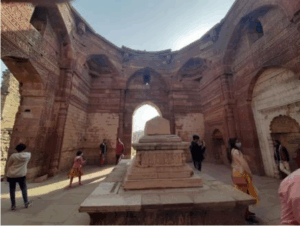
Tomb of Iltutmish, courtesy of Simran Kaur, thesis.
His greatest achievements stood at the meeting point of utility and devotion. He restored the silted royal reservoir of Alauddin Khalji, the Hauz-i-Alai, cleansing it and renaming it Hauz Khas. Around its rejuvenated waters, he built a madrasa and his own tomb, turning the act of restoration into a statement of faith and learning. He repaired the tombs and mosques of Iltutmish and Alauddin near the Qutb complex, ensuring that Delhi’s earliest rulers were not swallowed by decay.
His concern extended beyond Mehrauli. Firoz Shah revived Muhammad Tughluq’s half-ruined city of Jahanpanah, founded a new capital at Firozabad with the massive Firoz Shah Kotla fort, and undertook ambitious infrastructure projects: digging new canals from the Yamuna to Hissar and Agra, and restoring old waterways for irrigation. He built mosques, caravanserais, and madrasas, endowing them with stipends for scholars.
Even his welfare initiatives reflected his belief in restoration as a moral duty. Through departments like the Diwan-i-Kherat, he provided dowries for orphaned brides and financial aid to the poor, acts that extended his ethos of repair from stone to society.
For Firoz Shah, ruins were not dead stones but moral reminders: they testified to the impermanence of power and the endurance of devotion. His hands shaped Delhi not only through new buildings but through the care of old ones. That spirit endures in the work of those who today conserve Mehrauli’s ruins. The same instinct—to listen to the stones, to touch history without rewriting it—animates the architects, masons, and planners of the Delhi Development Authority (DDA), the Archaeological Survey of India (ASI), and INTACH.
From Neglect to Renewal
For much of the twentieth century, Mehrauli was forgotten. The Qutb Complex, polished and protected, drew crowds; the rest of the area lay in silence. Tombs sank beneath wild vegetation, walls cracked, wells dried. Locals grazed cattle among nameless ruins, and each monsoon washed away a little more of Delhi’s old city. By the early 2000s, Mehrauli had become a landscape of ghosted architecture, its stones alive only to those few who knew where to look.
The turning point came with the Delhi Development Authority’s conservation-management plan, drawn up in collaboration with the ASI and INTACH between 2019 and 2025. Over eighty monuments, spread across two hundred acres, were mapped and categorized. Twelve unprotected structures were “adopted” for conservation, and a massive campaign began to reclaim the park from neglect. Balban’s Tomb, Jamali Kamali, Rajon ki Baoli, Quli Khan’s Tomb, and dozens of smaller mosques and graves slowly returned to visibility. The DDA called the initiative “a revival of heritage as a gift to the city.”
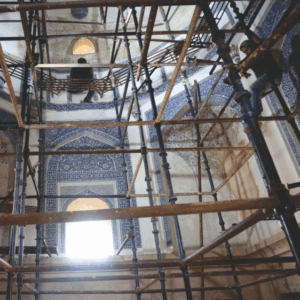
Quli Khan’s Tomb, DDA report
Work began with the most basic but essential acts of care: removing invasive vegetation, desilting old drains, and clearing centuries of rubble. Teams documented every structure through photogrammetry before laying a single hand on stone. Foundations were revealed, cracks filled with lime-surkhi mortar—a traditional blend of slaked lime, brick dust, and jaggery—and damaged stones replaced with hand-cut Delhi quartzite. Layers of cement from earlier repairs were scraped away, allowing the monuments to “breathe” again. The process was deliberately slow. Conservation here was done carefully by experts.
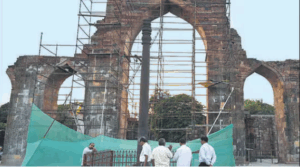
courtesy of Hindustan Times
Clearing the pathways between ruins, restoring the water channels that once linked the stepwells, and planting native trees like amaltas and neem reconnected Delhi’s people with their own memory. Visitors began to stroll again through the park’s winding trails; joggers paused beside Balban’s arches; students sketched the tombs in the afternoon light. Mehrauli was once again becoming what its builders had once dreamed of, a living, breathing archive and a symbol of their power.
Balban’s Tomb: The First Arch Breathes Again
Hidden amidst the wilderness of Mehrauli Archaeological Park stands Balban’s Tomb, built around 1287 CE. It is easy to miss, low, austere, stripped of ornament. Yet it marks one of the most extraordinary moments in Indian architectural history: the first true arch and possibly the first dome built on Indian soil.
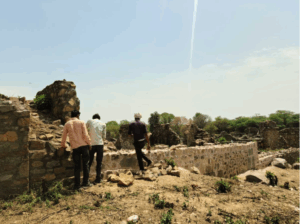
restoration around Balban’s Tomb, The Patriot
Just a hundred metres east of the Jamali Kamali mosque, this modest ruin was rediscovered in 1946 during an archaeological survey. Scholars now believe it may once have been a Dar-ul-Amaan—a “House of Refuge”—constructed seven years before Balban’s death, a place of sanctuary before it became his resting place.
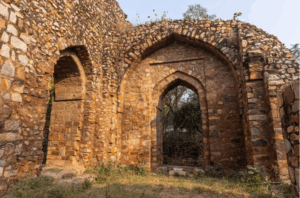
Dar ul amaan, DDA
When the Archaeological Survey of India began its multi-phase restoration in 2023, the monument was half-buried under decades of neglect. Wild trees choked its arches, debris filled its chambers. “This area was previously packed with vegetation,” one ASI official told The Patriot. The work began with the quiet labour of clearing by hand. Foliage and rubble were removed manually to avoid vibration damage, and the foundations were consolidated using lime concrete and coarse stone packing.
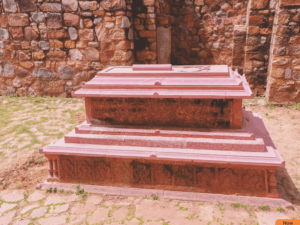
Balban’s tomb after restoration, DDA
The second phase focused on the tomb’s defining feature: its arches. Missing voussoirs were recarved from local Delhi quartzite; joints were re-pointed with lime mortar; and the colonial-era Portland cement was painstakingly chiselled away. The third phase restored the upper portions: repairing broken staircases, stabilising walls, and improving drainage and access.
A new red-sandstone pathway now leads to the site, bordered by neem and amaltas trees. A low, unobtrusive wall offers protection without enclosure. Plans include subtle lighting, benches, and signages, ensuring that visitors can approach the monument without disrupting its solitude. The project, undertaken at a cost of two crore rupees, is expected to conclude by late 2025.
To stand inside the tomb today is to feel it inhale again, not perfectly, but with the fragile rhythm of a body tended back to health. The ASI’s team has chosen restraint over reconstruction: the weathering remains visible, the cracks not hidden but healed. Restoration, here, means dignity, not disguise. The first arch of India breathes again, quietly, deliberately, as if aware of its own survival.
Jamali Kamali: Restoring Memory, Preserving Intimacy
A short walk away, beyond a thicket of trees, lies Jamali Kamali, one of Delhi’s most enigmatic monuments. The site consists of two structures built between 1528 and 1529 CE: a mosque and an adjoining tomb that hold the graves of the Sufi poet Jamali and his mysterious companion Kamali. The two names are inseparable, whispered together in legend and poetry.
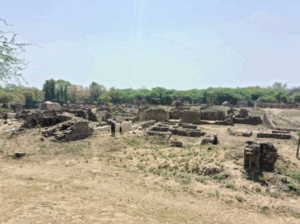
ruins around the area, DDA report
Jamali, known formally as Shaikh Jamali Kamboh, was a celebrated poet and Sufi scholar who served under the Lodis and the Mughals. His verses, filled with mystical yearning, found favour even in the court of Babur and Humayun. Kamali’s identity, however, remains uncertain, described variously as a djinn, disciple, or beloved. Their shared tomb has long stirred curiosity, inspiring both reverence and rumours of queer love.
When the Archaeological Survey of India began restoration work, they found the site veiled in dust and neglect. The ceiling paintings—once vivid with stars and floral arabesques—had dulled beneath soot. Conservators began by gently cleaning the painted surfaces with mild organic solvents, re-touching the flaking pigment with lime putty and marble dust. The old plaster was removed and replaced with gach, a traditional gypsum-lime mixture. Missing sandstone slabs were recut, and a thin waterproof lime-concrete layer was laid over the roof to protect it from seepage.
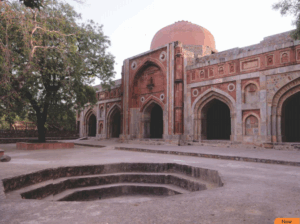
after restoration, DDA report
In the mosque next door, lime plastering and pruning strengthened the domes and arches. Where earlier repairs had used cement, craftsmen now relied on historical materials—lime, surkhi, and marble dust—to ensure breathability.
Yet what was truly revived here was the atmosphere. Inside, the restored ceiling glows softly, its stars gleaming once more in the filtered light. The twin graves lie side by side, surrounded by the geometry of devotion. The mosque façade, with its red sandstone and marble inlay, once again catches the late afternoon sun. Standing there, one feels not only the weight of history but the intimacy of faith: a love and companionship that has survived half a millennium.
To conserve Jamali Kamali is to acknowledge that monuments carry emotion. Restoration, in this sense, becomes remembrance: a way of honouring how love, devotion, and poetry once lived together under the same arch.
Rajon ki Baoli: Water as Memory
Built by Daulat Khan Lodi around 1506, this four-tiered baoli once held cool, clear water where masons rested after their labour—the rajon from whom it takes its name. For centuries, its descending corridors offered shelter from Delhi’s heat, the hum of conversation echoing off stone, the rhythm of dripping water forming its own quiet prayer.
By the time conservation began, the baoli had long fallen decadent. The well was clogged with silt and algae; its parapets had collapsed, and its arches were veined with cracks. Engineers and conservators began by desilting the tanks and clearing the storm-water inlets that once fed the structure. Collapsed parapets were rebuilt, arches strengthened with lime-surkhi mortar, and stone steps re-pointed by hand. Cracks were stitched with stainless-steel pins to prevent shear, a modern touch hidden within ancient craft.
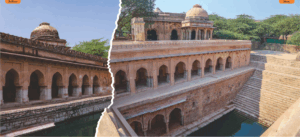
Rajon ki Baoli before and after restoration, DDA Report
The DDA’s hydrology team took on the task of reviving the site’s natural water system. The original catchment gradient—where rainwater once ran from the ridge into the well—was mapped and cleaned. Restored storm-water channels now guide the monsoon runoff back into the baoli as they did five hundred years ago. The lime plaster on the upper pavilions was polished with jaggery and bael fruit pulp, lending it a gentle sheen that recalls the glow of wet stone.
Rajon ki Baoli is a living reminder of Delhi’s relationship with water. Within its colonnades, carved niches and chambers once offered rest to travellers and masons alike. A small mosque and a twelve-pillared tomb still stand beside it, their glazed tiles faintly reflecting the light from the well. From its roof, one can trace the shape of the four staircases descending into the earth, a geometry of faith and function. When the first monsoon after restoration arrived, the water returned to its depths, reflecting the sky like a mirror held by time.
Adaptive Reuse: A Cafe among Ruins
Conservation in Mehrauli today goes beyond preserving stone; it reimagines how people live with history. The clearest example is Quli Khan’s Tomb, transformed in the nineteenth century by Thomas Metcalfe into his country lodge, Dilkhusha. Once overgrown and weathered, the tomb and its enclosure have been restored with frescoes and traditional materials. The adjoining waterbody—once part of Metcalfe’s garden landscape—has been desilted and revived, its edges planted with native reeds and trees.
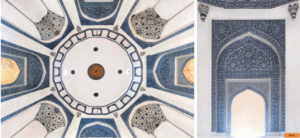
Quli Khan Tomb after restoration, DDA Report
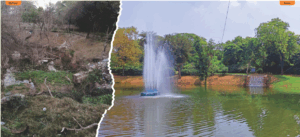
the lake before and after, DDA Report
Fragments of Metcalfe’s additions survive: fireplaces, recessed baths, and gateways, now conserved by the DDA and INTACH. Three of his gateposts have been stabilised, one serving as the new entrance to the Archaeological Park. The site functions today as an interpretation centre, narrating Mehrauli’s layered history from Sultanate to colonial times.
Nearby, the Unknown Circular Monument, long a mystery, has been adapted into a small cafe and viewing deck. Its reversible wooden flooring and removable fittings allow visitors to rest beneath its sixteenth-century dome without damaging the structure. From here, one looks out across the revived pond and the restored tomb-lodge—an image of the city learning to share space with its own ruins. To drink coffee beneath an old dome is not irreverence but continuity. In Mehrauli, restoration now means balance, between sanctity and use, between memory and everyday life.
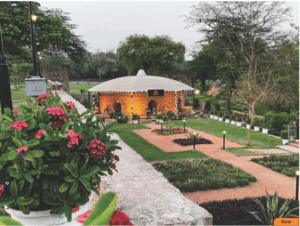
the cafe, DDA Report
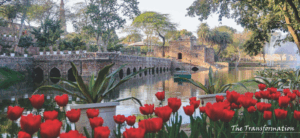
Metcalfe Boathouse, DDA Report
The Qutb Complex: A Continuum of Conservation
At the northern edge of Mehrauli stands the Qutb Complex, the anchor of this entire landscape. Here, layers of Delhi’s architectural memory lie within sight of one another: the Quwwat-ul-Islam mosque, Iltutmish’s tomb, Alauddin Khalji’s madrasa, the Iron Pillar, and the Minar itself—each the work of a different century, each repaired and reimagined by the next.
The Archaeological Survey of India’s 2023 restoration of the Quwwat-ul-Islam mosque’s twelfth-century archway continues a lineage of care stretching back seven hundred years. Using copper dowels, stainless-steel pins, and hand-cut sandstone, conservators reassembled the fractured arch piece by piece. Lime-surkhi mortar was applied in delicate layers, and micro-vegetation was removed manually rather than chemically to preserve the patina of age.
This meticulous work echoes Firoz Shah Tughlaq’s fourteenth-century reconstruction of the Qutb Minar after lightning struck its top, and Major R. Smith’s nineteenth-century repairs under the British. Scholars like Soma Mondal Ghorai note how such continuity creates a dialogue between science and craft—where laser scanning and photogrammetry coexist with the ancient lime kiln. Each generation adds its own layer of care, its own gesture of preservation, whether by hand, by chisel, or by code.
The Qutb Minar itself—patched, polished, occasionally broken—remains Delhi’s tallest metaphor for endurance. Around it, the smaller monuments breathe again under new lime plaster, their stones cleaned and joints reset. Together, they remind us that conservation in Delhi has never been a single act but a conversation, one that began with the Sultanate and continues, still, beneath the same red sandstone sky.
Listening to the Stones
From Firoz Shah’s humble repairs to the ASI’s digital documentation, Delhi’s history of conservation is really a history of attention. Each generation has returned to these stones with its own tools and anxieties—chisels giving way to scanners, lime kilns to laboratories—but the impulse remains the same: to keep the city’s memory intact.
In Mehrauli, that memory breathes again. Balban’s arches have found their rhythm, Jamali Kamali its intimacy, Rajon ki Baoli its water, and Quli Khan’s tomb its second life. Even the café beneath an old dome belongs to this continuum—a reminder that the past does not survive by silence alone.
To restore is not merely to repair. It is to listen: to the flaking plaster, the settling earth, the faint echo of prayer. Delhi’s restorers, from sultans to surveyors, have all shared that act of listening. And so the city endures, as a living palimpsest, where time itself is under restoration.
References
Bukhtiyar, Idrees. “Balban Tomb, Jamali-Kamali Monuments to Undergo Complete Restoration This Year.” The Patriot, 9 July 2024, https://thepatriot.in/heritage/balban-tomb-jamali-kamali-monuments-to-undergo-complete-restoration-this-year-52929.
Delhi Development Authority. “Archaeological Park: DDA Report on Mehrauli Archaeological Park.”
Ghorai, Soma Mondal, Neha Kapoor, Archana Tiwari, and Shweta Puri. “Historical Perspective of the Sultanate Period Monuments and Their Conservation Using Biotechnological Tools.” 2022.
Parvez Sultan. “Restoring Over a Hundred Years of History.” The New Indian Express, 29 Dec. 2019, https://www.newindianexpress.com/thesundaystandard/2019/Dec/29/restoring-over-a-hundred-years-of-history-2082126.html.
Saini, Simran K. MA Dissertation: Urban Regeneration and Heritage Tourism with Respect to Sites in Delhi, India. UCL Institute of Archaeology, 2022.
Standage, Kevin. “The Forgotten Tomb of Ghiyas ud-Din Balban.” Kevin Standage Photography, 9 Jan. 2025, https://kevinstandagephotography.wordpress.com/2025/01/09/the-forgotten-tomb-of-ghiyas-ud-din-balban/.
Iconic Balban Tomb to See Multiphase Restoration. The Patriot, Updated 28 Oct. 2023, https://thepatriot.in/heritage/iconic-balban-tomb-to-see-multiphase-restoration-48651.
Archway of 12th-Century Qutub Mosque Restored in Delhi. The Patriot, Updated 28 Oct. 2023.