

RAVNEET KAUR
“Some recite the glory the Supreme Being in melodious voice; some with musical instruments and some by reading the scriptures, but the Lord is not pleased by these activities without the purity of mind”
~ Guru Granth Sahib: 450
According to a Janamsakhi, when Bhai Mardana, Guru Nanak’s longtime companion and Rabāb player, was breathing his last, the Guru inquired about his last wish. Bhai Mardana said that all he ever wants is – to stay with Guru Nanak, in death as in life, to accompany him in all his Udaasis (journeys), here, beyond and everywhere. To this, Guru Nanak replies that – whenever anyone would sing their creations, Guru Nanak would be the word and Bhai Mardana the raag, and as the verses and melody cannot be separated, they too would never be parted.
Guru Nanak and Bhai Mardana were companions since early in their lives, and once the Guru started on his Udaasis (journeys), Mardana followed him everywhere, playing and tuning the Rabāb to Guru Nanak’s verses. Music has divine relevance and a significant place in Sikh worship, with the Janamsakhi being one example, as it moves beyond musical companionship to a spiritual connection and a record for posterity. And the vehicles of music – the Saaz or the musical instruments- occupy a special place in the Sikh musical tradition.
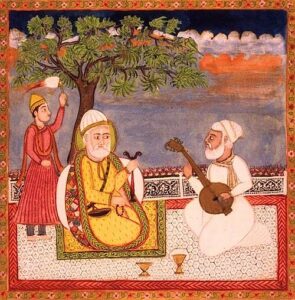
Guru Nanak (middle, seated), Bhai Bala (left, standing), and Bhai Mardana (right, seated), 19th Century Manuscript, MSS Panj.
Ancient Indian texts, such as the Mahābhārata, divide musical instruments into four categories – Tanti (stringed instruments), Avnadh (Percussion instruments), Sushir (wind instruments) and Ghan (Idiophone instruments). The Sikh religious musical tradition – Gurmat Sangeet – classifies musical instruments into five, namely – Tatt (string), Bit (leather), Ghan (metal), Sushir (wind) and Mukhar (clay).
Originally, the Shabad Kirtan was performed with string and percussion instruments, starting the tradition with the First Guru and Bhai Mardana’s Rabāb (Plucked Lute). Bhai Gurdas, the transcriber of the Adi Granth, writes in his Varan – “With the accompaniment of mridang and rabāb, the praises (of Baba Nanak) are sung in every home. Central Asian in origin, the rabāb and its variants are played across West and South East Asia. A Rabāb is carved out of a single piece of wood and has a head covering a hollow bowl as a sound chamber. It has three melody strings, two or three drone strings and up to fifteen sympathetic strings and is made from a mulberry tree trunk and animal skin, like goats.
There are several stories in the Janamsakhis about how Bhai Mardana started playing the rabāb. According to one, it was Bebe Nanaki, Guru Nanak’s elder sister, who gifted a rabāb to him at the start of one of the journeys. Another says it was Firanda who presented him one, as the name of the Punjabi variant of the rabāb is Firandia rabāb, in contrast to the Seni rabāb of North India. Though some scholars of musicology like Baldeep Singh disagree with this narrative. Bhai Mardana is thus credited with laying the foundation stone of the Rababis in Sikh Musical tradition. Bhai Mardana’s son, Sajada served the second Guru, Guru Angad, at Khadur Sahib as a Rababi and thus formed a whole tradition of rabāb players at Sikh congregations and the Guru’s durbars (courts). The Rababi tradition continued with Muslim musicians, often called Bābe Ke, meaning those of Baba Nanak.
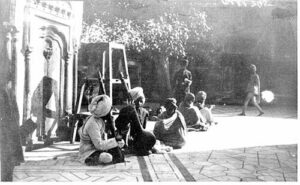
Rababis near Sri Harimandir Sahib (The Golden Temple), 28 January 1903
The Rababi tradition dealt a huge blow during the Partition of Punjab and the subcontinent in 1947. The majority of the Rababis, being Muslims, migrated to Lehnda Punjab (Western Punjab), Pakistan, and the tradition withered due to a lack of patronage. While the Gurudwaras of Charda Punjab (Eastern Punjab), India, were left desolate without the rababis. The Eight Chaunkis, which were performed by eight groups of Sikh musicians (rāgīs) and seven groups of Muslim rabābis, were replaced by all fifteen kirtan sessions being performed by Sikhs.
From the rabbi rabāb, flowed a whole tradition of Tat Vad, stringed instruments accompanying Shabad Kirtan. The Sārandā (Waisted Bowed luted), a bowed instrument originating in the Indian Subcontinent, was next in line. Sārandā had origins in folk music and was widely played in Punjab, the neighbouring Baloch region, Bengal, Assam and other parts of the North East. Scholar Tara Singh, in his book Guru Amardās Raga Ratnākar (2008), argues that Sārandā was promoted by the third Sikh Guru, Guru Amardās. According to other narratives, it was Guru Arjan, the fifth Guru, who introduced the thirty-six-stringed instrument in the Kirtan. Guru Arjan is also credited with promoting and incorporating Tānpūrā, a long-necked and four-stringed instrument resembling a Sitar, which was in vogue back then.
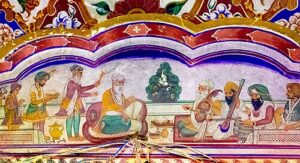
Fresco depicting a Sikh ragi jatha musically performing using traditional instruments in the presence of Guru Amar Das
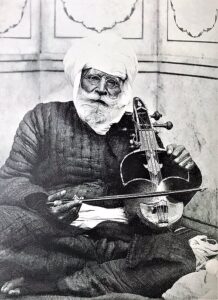
Ragi Sham Singh playing a Sārandā
A major Saaz was Tāūs, meaning ‘peacock’ in Farsi (Persian), as its sound box or resonator is shaped like a peacock. It is a bowed stringed instrument and thus played with a bow. Unique to it are its twenty metal frets, as older bowed Indian instruments like Sārandā, Sarangi, Ravanhattha and Kamayeha did not have frets. Fascinatingly, its sound is very similar to a peacock’s cry. The majority of the musicologists, like Bhai Baldeep Singh, believe that the sixth Guru, Guru Har Gobind, invented the peacock-shaped saaz himself, while others question the credibility of the claim. However, it is agreed by all that it was Guru Har Gobind who introduced, if not invented, the Tāūs in the Sikh musical tradition.
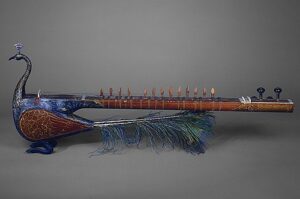
A Tāūs
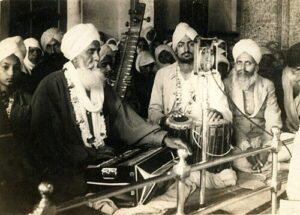
Bhai Jawala Singh Ragi playing Harmonium (vaaja), Bhai Gurcharn Singh on Jori, and Bhai Avtar Singh on Taus at Gurdwara Dehra Sahib, Lahore, ca.1935
Among the most beloved of Sikh musical instruments is the Dilruba, ‘one who captures the heart’ in Farsi. When the Sikh warrior-saints asked the tenth Guru, Guru Gobind Singh, for a lightweight instrument, as they were engaged in several battles during that period and were constantly on the move, the Guru came up with the Dilruba. Directly inspired by the Tāūs, it has a long neck, four main strings, twenty to twenty-two sympathetic strings and is played with a bow. Herbert A. Popley in The Music of India (1921) writes – “[Dilruba] was modified by removing the peacock-shaped sound box of the Tāūs and inserting the Sarangi like sound box”. This Sarangi like sound box is made of wood, covered with animal skin and hollow from the inside. The Dilruba also has nineteen frets and a larger bridge compared to other stringed instruments.
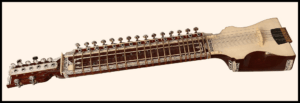
A Dilruba
There are several other stringed instruments which are traditionally played in Kirtans, such as Israj, Sitar, Dotara (lit. two-stringed) and so on.
The Percussion instruments were the other major instruments in traditional Sikh musicology. Pakhawaj, a barrel-shaped two-headed drum and the Nagara, a large drum, are some of these. The Nagara is not only used for devotional prayers but also in Gatka (the Sikh martial arts), battles and war cries.
The most significant of all is the – Jōrī. The Jōrī or Jodi, meaning ‘pair’ in Punjabi, is a percussion instrument made of two individual drums, which was invented in the court of Guru Arjan. There are two theories of its origin – first, that Guru Arjan invented the Jōrī when the two bards, Bhai Satta and Bhai Balwand, wanted to separate Pakhawaj into two instruments; second, that Bhai Satta and Bhai Balwand themselves invented the saaz while serving in the Guru’s court for the said reason. The Jōrī is very frequently mistaken with the Tābla, its look-alike, but the two instruments produce completely different sounds; unlike the latter, the Jōrī does not make a sharp sound.
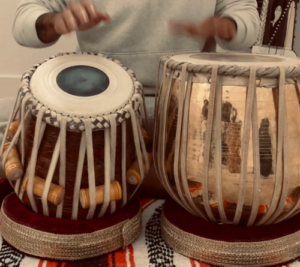
Jōrī
Tragically, these Saaz(es) of the Gurus are diminishing – they are no longer played in Kirtans, in Gurudwaras or elsewhere, and are replaced by other instruments, and only a handful of traditional players remain due to changing times, while very few of the newer generation are learning them. Rarely would the present-day Sikhs of the Gurus come across and witness the melody of the Rabāb, Tāūs or Dilruba.
The replacements of the traditional stringed and percussion instruments are, namely – the Harmonium, called Vaaja in Punjabi and the Tābla. The Indian Harmonium, inspired by the European one, was introduced and widely adopted by the Sikhs during the 18th-19th centuries. Considered easy to play and learn, it was incorporated in Kirtans and became the nail in the coffin of native Sikh instruments. Scholars and musicians alike also argue that it is unsuitable not only for Sikh raga music but also for Hindustani classical music, and these technical controversies also led to the Harmonium being banned from the All India Radio from 1940 to 1971. The Tābla, too, though native to the Indian soil, was not traditionally a part of the Shabad Kirtan music and over time took over the Jōrī.
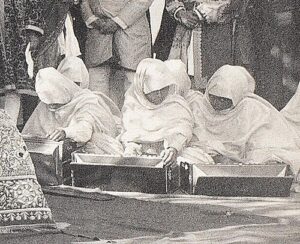
Female Ragis playing Harmonium c. 1911
In the past few decades, there have been several debates surrounding Sikh devotional music and its character, with some arguing that the Sikhs do not seem “to have devoted much attention to preserving a fixed form or character for their music, being open to the influence of what was popular or current at different times”. Religious singers like Chris Mooney Singh argue that “Gurbani should be sung in its original, pure and pristine form … handed down to us by the Gurus and thus free from the stranglehold of the harmonium that has given birth to film music only”. While others like Dya Singh, who has blended devotional music with blues, jazz, folk, Australian indigenous, country and Western music, hold that Sikh religious music needs a “revolution” for universality and appeal, especially for the newer generations.
There have been several attempts, individual and collective, at S too – the Rabab Revival Project and the Aduti Gurmat Sangeet Samelan (a Conference) in 1991. The Shiromani Gurudwara Parbandhak Committee also made efforts in the early 2000s to revive the traditional musical instruments. All in accordance with achieving the “original and correct intonated musical kirtan performances” and reviving the almost lost inheritance of the Gurus.
It really is a lament that Guru Nank, who would exclaim upon every revelation – “Mardaneya! Rabab chhed, bani aayee hai” ([Mardana, play the rabab, bani (sacred composition/verse) has occurred to me’], has his Bani separated from Mardana’s Rabāb today.
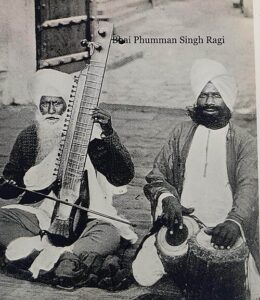
Bhai Phumman Singh Ragi playing a Tāūs and a Sikh court musician of the Nizam of Hyderabad playing Jōrī
BIBLIOGRAPHY & REFERENCES
1.Singh, Gurnam. 2014. Sikh Music. The Oxford Handbook of Sikh Studies. Ed. Pashaura Singh, Louis E. Fenech. Oxford University Press.
2. Singh, Pashaura. 2006. Sikhism and Music. Sacred Sound: Experiencing Music In World Religions. Ed. Guy L. Beck. Ontario. Wilfrid Laurier University Press.
3. Soni, Fenilkumar. Sant, Vishwas Vijaykumar. 2025. Peacock and Bow: The Story Behind the Origins of Taus, Dilruba and Esraj. Naad-Nartan: Journal of Dance & Music. Vol 13. S
PHOTO CREDITS
1. Painting of Guru Nanak (middle, seated), Bhai Bala (left, standing), and Bhai Mardana (right, seated), from a 19th-century manuscript, MSS Panj. D4 (Folio 8v), at the British Library, London. (https://en.wikipedia.org/wiki/Sikh_music)
2. Photograph titled ‘Lute [rabab/rebec] Players [rababis] near the Golden Temple’, taken on 28 January 1903. Kept in the Gertrude Bell collection of Newcastle University.
3. Fresco depicting a Sikh ragi jatha musically performing using traditional instruments in the presence of Guru Amar Das from Asthan Baba Bikram Singh Bedi, Kanak Mandi, Amritsar, c.1863–1879 (https://en.wikipedia.org/wiki/Sikh_music)
4. Photograph of the Sikh ragi Sham Singh, who performed kirtan music at the Golden Temple complex for 70 years (https://en.wikipedia.org/wiki/Sikh_music)
5. A Tāūs (https://en.wikipedia.org/wiki/Taus_(instrument)
6. Photograph of Bhai Jawala Singh Ragi playing accordion (vaaja), Bhai Gurcharn Singh on Jori, and Bhai Avtar Singh on Taus at Gurdwara Dehra Sahib, Lahore, c.1935
7. A Dilruba (https://ragajunglism.org/ragas/instruments/dilruba/)
8. Jōrī (https://en.wikipedia.org/wiki/Jori_(instrument)
9. Sikh women musicians playing the vāja (harmonium), detail from a photograph of the wedding of Kunwar Paramjit Singh of Kapurthala and Maharani Brinda Devi Sahiba of Jubbal, 2 February 1911
10. Photograph of Bhai Phumman Singh, a ragi (Sikh religious musician) of Takht Hazur Sahib with tāūs (a bowed, fretted lute) and a court musician of the Nizam of Hyderabad (https://en.wikipedia.org/wiki/Sikh_music)