

:- By Ayush Tripathi
The kingdom of Kamarupa, as described in the Kalika Purana (around the tenth century CE) and supported by the Kamarupa inscriptions, stretched from the Karatoya River in the west to the hills near the Chinese frontier in the east. It covered the whole Brahmaputra valley and sometimes extended into areas of present-day Bhutan, Bangladesh and northeastern Bengal. The kingdom was bordered in the south by the Dhaka-Mymensingh region and in the north by the Himalayan foothills. This large territory, called Pragjyotisha (meaning the Land of Eastern Astronomy, a nod to its ancient religious culture), rather than Kamarupa in royal inscriptions, was ruled by three main dynasties: the Varmanas (around 350-650 CE), the Salasthambas (around 655-900 CE), and the Kamarupa Palas (around 900-1100 CE). Each dynasty left its influence on the landscape and archaeology is just beginning to document this impact.
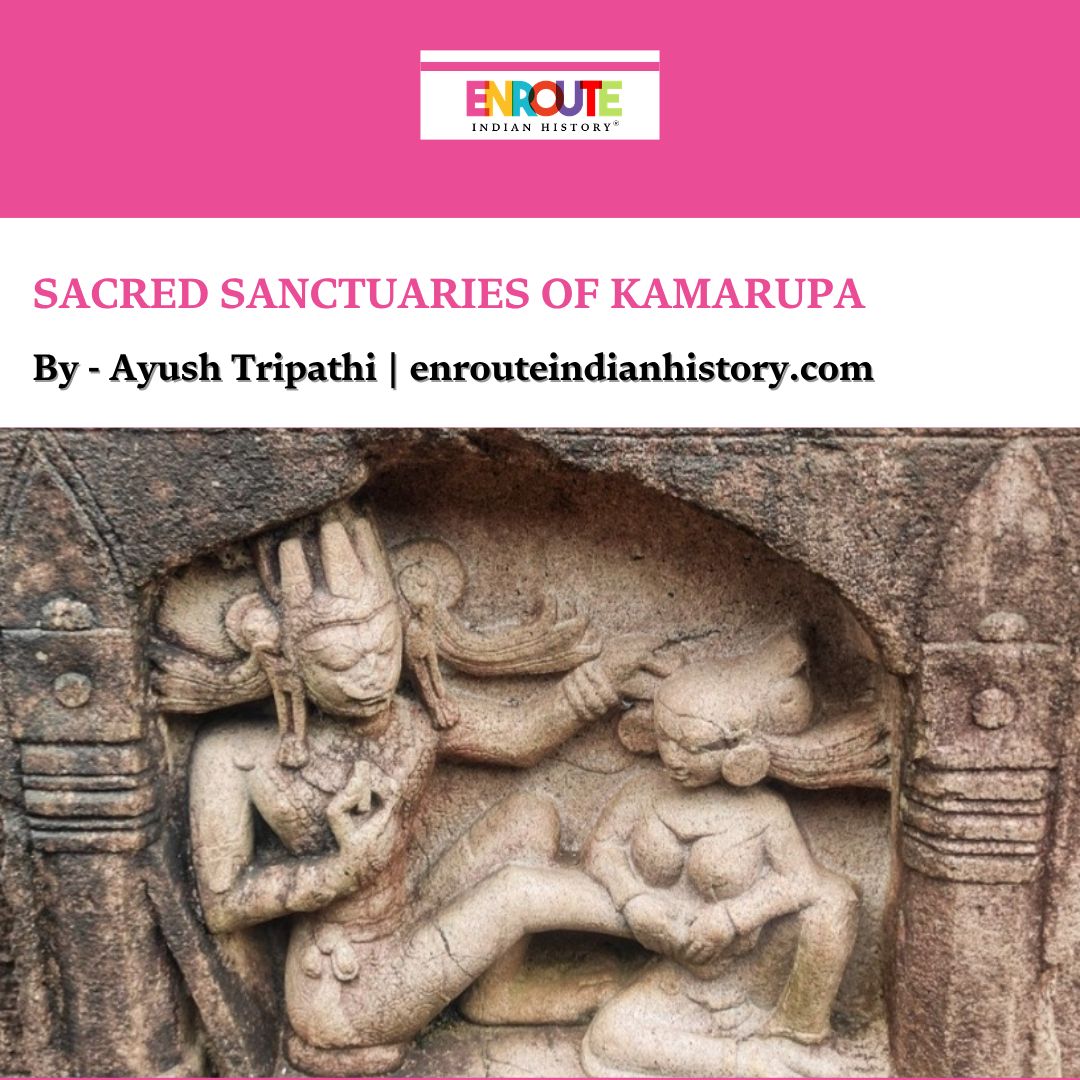
Rock carving from Deopahar temple ruins depicting divine couple [Photo credits: The Travelling Slacker]
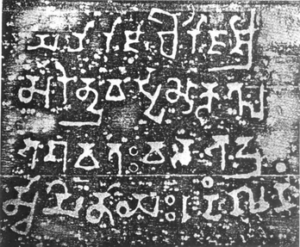
Umachal Rock Inscription [Photo credits: Wikimedia Commons]
The Umachal rock inscription is a significant finding for historians studying Assam. It is the earliest known epigraphic record found on Assamese ground. Carved into the Precambrian gneiss on the northeastern slopes of Nilachal Hill, this site above Guwahati is well-known today for the Kamakhya temple. The inscription was discovered in 1955 by R.M. Nath, who was then the Principal of the Assam Civil Engineering Institute in Gauhati. Nath, known for his earlier article ‘Antiquities of the Kapili and Jamuna Valleys’ (Journal of the Assam Research Society, Vol. 5, 1937), recognized the importance of his find near the Umachal Ashram in the Kalipur Kadamtal area of greater Guwahati. The inscription is shallowly engraved and consists of four incomplete lines, with some sections damaged or missing, including the upper part of the first line and parts of the right-hand ends. It measures approximately 12-15 inches long and 3 inches wide.
The script used is the eastern version of the Gupta Brahmi script, which was also used in inscriptions from the imperial Gupta dynasty in their central region of Magadha. Here, it adapted to the language and needs of a royal court on the frontier. The text is written in formal Sanskrit prose. The epigraphic corpus of Kamarupa, which includes about forty copper-plate grants and rock edicts dating from the fifth to the early thirteenth century CE, shows a gradual evolution of script from this early Gupta-derived form to transitional Nagari and eventually proto-Assamese script. The Umachal inscription is the earliest example in this progression, making it crucial for understanding the development of writing in northeastern India.
The text of the Umachal inscription, reconstructed from the remaining portions, is a dedicatory record.
The important portion reads:
maharajadhiraja-sri surendravarmana-krtam bhagavatah-valabhadra svaminaya-idam-guham
Meaning: “This cave was made by the Maharajadhiraja Sri Surendravarman for Lord Balabhadrasvamin.”
The inscription credits King Surendravarman with the construction and blessing of an artificial cave or shrine (guha) dedicated to the deity Balabhadrasvamin. Balabhadra (Balarama), who is Krishna’s elder brother, is an important Vaishnava deity. The fact that this early Kamarupa inscription celebrates a Vaishnava site is significant. It shows the religious diversity of the Varman dynasty’s culture, usually seen as primarily Shaiva but clearly accommodating and supporting Vaishnava traditions as well. The title maharajadhiraja suggests that Surendravarman was asserting full royal independence instead of being a vassal.
Identifying Surendravarman with Mahendravarman of the Varman dynasty (around 470-494 CE), a connection proposed in the Kamarupa Sasanavali and accepted by many scholars, places the inscription in a period when Kamarupa shifted from being a Gupta tributary to an independent state. Varman king Mahendravarman conducted two Ashvamedha (horse sacrifice) rituals, which symbolized supreme royal power and proclaimed independence from all overlordship. The use of the maharajadhiraja title in the Umachal inscription supports this claim to independence. Surendravarman/Mahendravarman was a king who no longer recognized Gupta authority and was asserting the full sovereignty of the Pragjyotisha-Kamarupa state.
Related to the inscription, the rock-cut cave, now officially known as the Umachal rock cave, was found in February 2010 during surveys in the Kalipur Kadamtal area. The cave measures 6.26 meters long and 5.02 meters wide, with a central height of 1.48 meters. It includes rock-cut niches, floral decorations, and geometric designs carved into its interior walls. The angular letter forms and styles of the inscription, analyzed by epigraphers, align with fifth-century Gupta writing. The craftsmanship of the artisans behind both the cave and the inscription reflects the high skill required to carve into the dense gneiss of Nilachal Hill.
Temple Of Dah Parvatiya
In the village of Dah Parvatiya, about six kilometers west of Tezpur on the south bank of the Brahmaputra in Sonitpur district, there stands a stone doorframe that has withstood the test of time. It has survived the collapse of the temple it once decorated, the construction of a new temple over its remains, and the destruction of that second temple in the devastating earthquake of 1897. Today, it is under the care of the ASI and is recognized as Monument of National Importance No. N-AS-61, celebrated as the finest and oldest example of sculptural art in Assam.
The site includes an elevated earth mound, within which buried structures from the original sixth-century temple complex rest. Archaeological digs have revealed a layered history. The earlier layer belongs to the Gupta-period stone temple from the fifth to sixth centuries CE. On its ruins, a later Shaiva brick temple was built during the Ahom period (the Ahom kingdom, which dominated upper Assam from the thirteenth century, often constructed new temples at sites of existing sacred significance). When the Ahom temple fell in the 1897 earthquake, it unintentionally exposed and preserved parts of the earlier Gupta temple underneath, including the well-known doorframe.
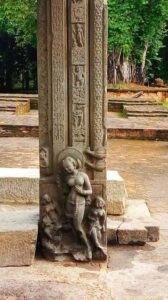
Rock carving depicting river goddess on the gateway of Dah Parvatiya temple ruins [Photo credits: Inheritage Foundation]
Recorded brick dimensions from the site, 15 inches by 11.5 inches by 2.5 feet for the fifth-century construction, match typical Gupta-period brick-making practices in eastern India. The stone elements, including the doorframe, jambs, lintel, and a Gupta-type pillar now displayed at the Planters’ Club in Tezpur, were reserved for the most architecturally important and symbolically meaningful parts of the temple. This followed the mixed brick-and-stone construction method commonly used in Gupta and post-Gupta temple architecture across northern and eastern India.
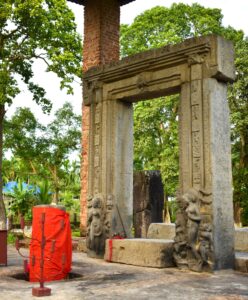
Dah Parvatiya Shiva Temple [Photo credits: Wikimedia Commons]
The ASI began formal archaeological work at Dah Parvatiya under R.D. Banerji in 1924. This campaign also included the Annual Report of the Archaeological Survey of India’s entry for Dah Parbatiya (published 1925, pp. 98-99). Banerji and his colleague J.F. Blakiston cleared the mound and documented what has become the most talked-about surviving element of the site: the stone doorframe, which at that time was partially buried and hidden under debris from the 1897 earthquake’s destruction of the Ahom temple. The excavation revealed the doorframe’s full size and design and uncovered an early Gupta-type pillar that was moved to the Planters’ Club in Tezpur. The campaign’s most important contribution was documenting the foundation of the Gupta-period temple, revealing the base of a garbhagriha (sanctum sanctorum) measuring about 8.925 feet (2.720 m) by 8.33 feet (2.54 m). This was surrounded by a circumambulatory passage leading to a rectangular colonnaded mandapa (hall) and a smaller mukhamantapa (front hall) to the east. In the garbhagriha, a stone kunda or vedi (altar) measuring 2.418 feet (0.737 m) by 2.66 feet (0.81 m) with a depth of 5 inches was found, offering a rare look at the temple’s original liturgical setup. A second ASI campaign in 1989-90 conducted further digging and documentation, enhancing the structural analysis and uncovering more ceramic and terracotta items.
R.D. Banerji’s work at Daparvatiya, along with his survey of the Bamuni Hills ruins east of Tezpur (detailed in his ASI Annual Report for 1925-26), established the groundwork for later studies on Kamarupa’s Gupta-period artistic heritage. Banerji suggested that the remains of an ancient stone building found in the Deputy Commissioner’s office compound in Tezpur in 1906 might have once been part of a palace from Kamarupa’s time. During that construction, many carved and sculptured stones were discovered. Most were later moved to the grounds of European officers and the Tezpur Planters’ Club for decoration. Unfortunately, this spread of artifacts hindered the scientific record.
The surviving stone doorframe of Dah Parvatiya is a single piece measuring about 5.25 feet (1.60 m) in height and 1.25 feet (0.38 m) in width on the door jambs, which are the vertical posts. The lintel is larger than the jambs and extends slightly on either side. It is carved from local sandstone and shows a level of detail in the carving that takes time to fully appreciate.
The door jambs are divided into sections. In the lower parts, carved in high relief, are the well-known figures of the river goddesses Ganga and Yamuna. They are positioned on the right and left jambs, respectively, standing gracefully with divine halos behind their heads, each holding a garland in both hands. Smaller attendants are carved beside them with remarkable detail. These figures of the river goddesses are part of a well-established Gupta temple tradition. Ganga, associated with the sacred Ganges and often depicted riding a crocodile, and Yamuna, linked to the Yamuna River and shown on a tortoise, were placed at temple doorways as symbols of purification and good fortune. Their presence at Dah Parvatiya, far from their main cultural area in the Gangetic plain, reflects the strong adoption of pan-Indian Brahmanical iconographic traditions at the Kamarupa court.
The upper parts of the jambs feature four vertical decorative bands carved in various patterns, including creeping vines, lotus stems, human figures, and ornate rosettes.
The lintel is the most complex part of the frame. It has five chaitya-windows, which are horseshoe-shaped arched openings typical in Buddhist and early Hindu architecture. Three windows are large, and two are small. In the rightmost window sits a four-armed male figure on a throne. One arm holds Shiva’s damaru, or hourglass drum. Two of his arms are damaged, and he is carved above waves. The central window depicts the most significant image: a Shaiva figure known as Lakulisa, which means ‘Lord with the Staff’. He is shown with a rope tied to his leg and is flanked by two suparna figures, bird-man hybrids. Lakulisa was the founder of the Pashupata school of Shaivism, one of India’s earliest and most influential Shaiva philosophical traditions. His central position on the lintel suggests that the Dah Parvatiya temple was at least partly connected to the Pashupata tradition.
Above the lintel, two garuda figures are carved holding intertwined serpent tails. This adds the Vaishnava aspect of Garuda, the divine eagle-vehicle of Vishnu, to what is mainly a Shaiva composition. This blending of iconographic elements, where Shaiva and Vaishnava motifs coexist within the same architectural design, is typical of early medieval temple art across India. It reflects the theological flexibility of the time, rather than a confusion of identities.
R.D. Banerji’s comparative study, backed by later scholars, places the doorframe within the Gupta-period temple art tradition found in North India, represented by the temples at Bhumra and Nachna Kuthara in present-day Madhya Pradesh. It also identifies close decorative similarities with early Orissa temple architecture. The Inheritage Foundation describes the style as Nagara architecture, specifically the Rekha-Deul variant. This indicates that Dah Parvatiya is the earliest surviving example of the Nagara temple type in the Brahmaputra valley, a style that would later dominate Kamarupa throughout the Salasthamba and Pala periods.
Archaeologist K.N. Dikshit observes that Assamese art shares closer connections with the schools of Bihar and Orissa than with contemporary Pala art from Bengal. This makes sense given the strong cultural links between Mithila and Kamarupa. This observation applies broadly, but it is especially true for Dah Parvatiya. The temple’s decorative themes, which include Ganga-Yamuna iconography, the Lakulisa figure, chaitya-window designs, and creeper and lotus adornments, belong to the early phase of the tradition. Here, Gupta conventions were directly translated into the Kamarupa context while retaining a high fidelity to the original style.
In contrast, later sites like Bamuni Hills near Tezpur, dated by Banerji to the seventh-eighth century CE and by subsequent scholars to the ninth-tenth century CE, and Madan Kamdev near Guwahati, excavated by the Archaeological Directorate of Assam under Dr. Pradeep Sharma from 1977, attributed to the tenth-twelfth century CE and linked to Kamarupa’s Pala kings Ratna Pala, Indra Pala and Go Pala, show that the Kamarupa school developed further toward the Pala style of Bengal and Bihar. This is evident in the figures, which exhibit sinuous elongation, elaborate ornamentation, and complex multi-armed designs typical of late Pala sculptural work. The tradition from Dah Parvatiya to Madan Kamdev to Deopahar illustrates a consistent artistic evolution over seven centuries, from the Gupta foundation to the mature Kamarupa-Pala flourishing.
Deopahar : Flying Nymphs and Fallen Stones At God’s Hill
Deopahar gets its name from the Assamese words ‘deo’ (god or spirit) and ‘pahar’ (hill), translating to the Hill of the Gods. The nearby Karbi people referred to it as ‘Deoparbat’ and ‘Deopahar’, while ancient texts called it “Haithali Parbat” (the Hill of Peace). An Assamese folklorist might recognize in ‘deo’ a notion of supernatural force. In fact, one legend linked to the Ahom king Suhunmung Dihingia Raja (1497-1539) claims that a spirit (deo) appeared on the hill and influenced the king’s decision to build his fort at Numaligarh nearby.
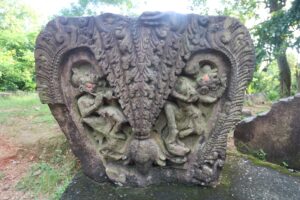
Rock carving from Deopahar temple ruins depicting one deity playing flute and the other dancing [Photo credits: Wikimedia Commons]
The historical documentation for Deopahar is limited compared to the standards of classical Indian writings, but what exists is revealing. An ancient copper plate from the Kamarupa kings connects the location to ‘Joyscandavar in Happaka’. Scholars have linked ‘Joyscandavar’ to ‘Jorasandha’, relating the site to the legendary kingdom of Jarasandha from the Mahabharata. This connection is common in Assam’s archaeology. The whole area is rich with Puranic and epic stories, and local traditions often associate Brahmaputra valley sites with figures from the great epics. The Satsari Buranji, an Ahom chronicle, mentions a Maidam (royal burial mound) of a Sutiya king named Khunta raja near Deopahar, placing it within the context of Sutiya history and confirming its lasting sacredness into the medieval period.
Deopahar entered formal archaeological records because of a British tea planter named Thomas Guardthei, who first documented and communicated the importance of the ruined stone temple on the hill. The colonial tea industry, which transformed the ecology, economy, and population of the Brahmaputra valley starting in the 1840s, brought British planters into regular contact with areas that had not been systematically studied for antiquities. Guardthei’s work at Deopahar illustrates how colonial observers without formal archaeological training but driven by curiosity contributed valuable documentation of sites across Assam. He noted that the temple’s stone blocks were joined by iron hinges, a construction method he found unusual and complex. This observation has since been confirmed as one of the site’s notable technological features.
The main monument at Deopahar is the ruined stone temple, with its Precambrian granite blocks now largely scattered across the hilltop. Some blocks remain in their approximate original positions, while others have tumbled down. The temple was built on a solid stone floor, a technique that sets it apart from the brick temples typical in the Brahmaputra valley and highlights both the area’s geological resources and the technical skills of its builders. The stone blocks at the temple’s base were secured to each other and to the floor with iron hinges, remnants of which are still visible. This technique, which immediately captured Guardthei’s attention, is recorded at several early medieval temple sites across India but is distinctive enough in Assam to make Deopahar significant.
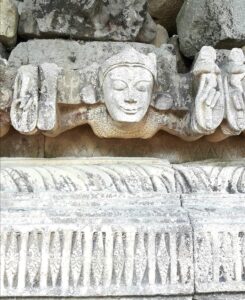
Rock carving from Deopahar temple ruins depicting deity holding lotus flowers in his hands [Photo credits: Wikimedia Commons]
The temple ceiling features a large slab carved with a Vidyadhara, a celestial being of intermediate divine status, holding a scarf and a necklace with both hands within an elaborate lotus design. This decorative scheme has a high level of elegance, consistent with early medieval temple ceiling decoration. The door jambs are intricately carved with dense foliate patterns, including flowers with drooping petals, creeping vines interwoven with animal images, and female guardians adorned with coronal crowns and large leaf-shaped earrings, all expertly crafted from Precambrian granite. This artistry showcases the exceptional skill of the artisans involved. The overall artistic style, as described by archaeologist G. Bhuyan and in the records of the Directorate of Archaeology, Government of Assam, reflects later Gupta and post-Gupta traditions, adapted and transformed by the Kamarupa school.
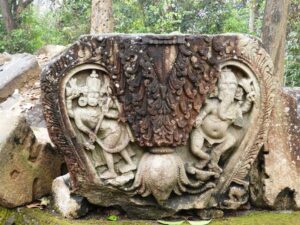
Rock carving from Deopahar temple ruins depicting Ganesha [Photo credits: Wikimedia Commons]
The detailed architectural style of the temple, examined in Bijoy Sarmah’s research article ‘A Historical Study of the Archaeological Remains of Deopahar, Numaligarh’, places it between the tenth and eleventh centuries CE. Some sources prioritize the sculptural style over architecture and suggest an earlier date in the eighth or ninth century, aligning with the broader trend of Salasthamba-period temple construction in the valley. However, they also acknowledge that the most intricate sculptural work aligns with the mature phase of the tenth to eleventh century.
It remains uncertain whether the original builders left the Deopahar temple incomplete or if it faced a catastrophic structural failure. The prevailing view, supported by local tradition and accepted by scholars, attributes its current fragmented state to the Great Assam Earthquake of June 12, 1897. This earthquake was one of the strongest ever recorded, with an estimated magnitude of about 8.0 (some assessments suggest higher) and caused widespread damage across the Brahmaputra valley, collapsing brick buildings and triggering landslides that permanently changed river courses. A stone temple on an exposed hilltop, constructed with iron-hinged granite blocks on a solid floor, would have been very vulnerable to seismic activity, likely causing the iron fixings to break and sending the structure sliding and tumbling across the hilltop, resulting in the destruction seen today.
Before or shortly after this event, the Shivalinga that served as the main object of worship in the temple was relocated to a new shrine at the base of the hill. This new shrine became the Baba Than temple, also known locally as Babathau, established in the nineteenth century. It is now an active place of worship next to the archaeological site. This shift of the main cult image is a significant detail. The living religious practices of the site moved downhill, leaving the hilltop as a historical monument while the faith community continued their traditions in a new, safer building.
The sculptural program at Deopahar is its most significant and lasting contribution to art history. Archaeologist G. Bhuyan called it “one of a kind,” highlighting the unique local art of Assam that thrived in the tenth century CE. The sculptures are carved from Precambrian granite and show the distinctive style of the Kamarupa school at its peak. They blend the graceful figural conventions of the Pala school of Bengal and Bihar with local preferences for bolder outlines, more dynamic poses, and a keen interest in detailed ornamentation. As noted in the Studocu compilation on Assamese art and architecture, the local stone supports the idea that the sculptures were made in Kamarupa by artists trained in Pala styles.
The most well-known sculpture from Deopahar is Apeshwari, an Apsara with three heads. This sculpture is considered one of the most beautiful works on the site. Now housed at the Numaligarh Shiva Temple instead of on the hilltop, it demonstrates the Deopahar workshop’s skill in depicting flying celestial figures, a common subject in the site’s sculptures. The triple-headed Apsara is a rare form that combines the celestial nymph concept with more complex cosmological symbolism. Her pose, movement, and decoration showcase the Kamarupa school at its finest, fully familiar with the broader artistic language of the time while still maintaining a distinct local style.
In addition to the apsaras, the sculptures include a wide variety of Vedic-Puranic deities and narrative themes. Among the Shaiva figures are Dwarpal Shiva (Shiva as door guardian), Fangananm Shiva, Sridhar Rudra, Tripuraswar (the conqueror of the three cities, one of Shiva’s martial titles), and Tripura-Surbadhar. The Hara-Gauri Rashlila compositions, which depict Shiva and Parvati in the cosmic dance of love, draw from the Bhagavata Purana tradition. Images of Pranayam Dhyan (meditative breathing postures) highlight the site’s connection to Shaiva yogic practices. Sarpadevata (serpent deity) imagery indicates the ongoing worship of native serpent deities alongside Vedic-Puranicbeliefs, a characteristic of early medieval Assamese religious culture. Kirtimukhas and Kalamakaras decorate architectural elements, their protective energy safeguarding the sacred space.
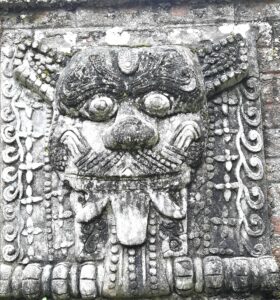
Rock carving depicting Kirtimukha from Deopahar temple ruins [Photo credits: Wikimedia Commons]
The Vaishnava aspect of the program includes Lakshmi-Narayana (Vishnu with his consort Lakshmi) and various depictions of Vishnu himself, noted for their detailed rendering of multiple arms and attributes typical of high-quality Kamarupa Vishnu representations. Ganesha appears as the deity of auspicious beginnings. Yama (the god of the dead), Surya (the sun), and Shani (Saturn) depict the planetary and cosmological aspects of Vedic-Puranicbelief. The presence of both Surya and Shani at Deopahar aligns with the Navagraha tradition found in early medieval Kamarupa. N. Handique’s research (History Carved in Stone: The Sculptural Masterpieces of Deopahar) has identified seven temple door lintels with Navagraha depictions at various sites in the Brahmaputra valley. This establishes that Kamarupa’s Navagraha panels display distinct regional features while still having clear iconographic links to similar works from Bihar, Bengal and Odisha, confirming the site’s involvement in wider eastern Indian artistic networks.
The narrative panels depicting scenes from the Ramayana, the Mahabharata, and the Bhagavata Purana are some of the most impressive features of the Deopahar program. The panels showing Ram and Ravana, Sugriva, and other characters from the Ramayana series, along with Mahabharata scenes, place Deopahar among a select group of sites in northeastern India where such epic narratives are carved in stone. This makes it, as one commentator noted, a potential site where both great epics are depicted together. The Bhagavata Purana scenes, especially the Hara-Gauri Rashlila, link the sculpture to the devotional literature of the time, confirming a well-educated, theologically-savvy artistic community. Images of gods and goddesses dancing on elephants, as well as male and female dancers, create a program that merges the cosmic with the festive, the meditative with the martial, and the celestial with the earthly, reflecting the artistic goals of early medieval Indian temple art.
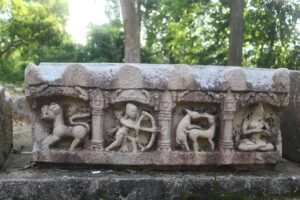
Rock carving (from Deopahar temple ruins) depicting deer hunting scene from Mahabharata [Photo credits: Wikimedia Commons]
Art historians like A. Bhattacharjee, N.P. Choudhury, and R.D. Choudhury have thoroughly studied early medieval Assam. They identify a unique artistic style they call the Kamarupa school, marked by the blending of local artistic sensibilities with the Gupta artistic tradition as it was received and transmitted through workshops in the Brahmaputra valley. The monumental remains from the Daparvatiya site near Tezpur, generally dated to the fifth or sixth century CE, exemplify this school in its earliest, Gupta-influenced form, showing a direct influence from the Sarnath school of Gupta art. By the ninth and tenth centuries, particularly at Sri Surya Pahar and Deopahar, the school absorbed strong Pala influences from Bengal and Bihar while keeping its regional characteristics.
The terracotta tradition evident at Sri Surya Pahar belongs to a broader eastern Indian terracotta craft culture, with production centers documented in Paharpur, Mainamati, and elsewhere in the Bengal-Bihar area. The molded tiles featuring lotus medallions, Kirtimukhas, Apsaras, and geometric designs found at Sri Surya Pahar closely resemble materials from these sites, confirming that the Goalpara area participated in a wider regional decorative tradition. Additionally, some ceramic types from the Sri Surya Pahar excavations, like button-knobbed lids and incurved bowls similar to knife-edged wares from the Gangetic plain, suggest connections to the larger northern Indian ceramic tradition.
The stone sculptures at Deopahar, known for their depiction of flying figures, narrative composition, and intricate architectural ornamentation, showcase the Kamarupa school in a style that relies less on terracotta and more on grand stone sculptures. Visitors have noted parallels with Madan Kamdev, another early medieval stone temple site in Assam. The Doiyang-Dhansiri valley, where Deopahar is located, has yielded a collection of early medieval stone sculptures, forming a significant regional artistic network.
Kamarupi Heritage In Contemporary Times
All three sites face unique but related conservation challenges. The Umachal inscription, carved into exposed rock on the heavily populated slopes of Nilachal Hill in one of India’s fastest urbanizing cities, is at significant risk from air pollution, weathering, and insufficient protective measures. The News Mill’s December 2023 report confirmed that the lack of signage and maintenance has rendered this earliest epigraphic record of Assam virtually invisible to most residents of Guwahati, a city whose cultural identity is deeply connected to the heritage of the Nilachal Hills.
Dah Parvatiya faces common conservation issues for sites where the main surviving element, the doorframe, is exposed to the full force of the Brahmaputra valley climate. This includes monsoon humidity, biological growth, and acid rain effects from the region’s increasingly polluted atmosphere. The ASI’s protective enclosure around the site limits unauthorized access but does not tackle the environmental degradation of the exposed stone. At Deopahar, as highlighted in the BSSP journal’s conservation strategies paper, the tin roof over the main structure serves as an emergency measure rather than a proper conservation solution. The scattered stone blocks on the hilltop, along with the build-up of leaf litter, superficial deposits, and growth of lichens and fungi during the monsoon, represent ongoing deterioration that has not been systematically evaluated or addressed. The elephant corridor status of the Deopani Reserve Forest, while an encouraging ecological designation, complicates the conservation efforts for managing a protected archaeological site within an active wildlife zone.
The archaeological study of Kamarupa’s material heritage is, by all accounts, still in its early phases. The ASI’s Guwahati Circle has made important advancements at various sites across the Brahmaputra valley. The Directorate of Archaeology, Government of Assam, keeps a substantial inventory of protected sites. However, the extent of undocumented, unexcavated, and unstudied sites is vast, as anyone who reviews the protected sites list from the Directorate of Archaeology can confirm.
Bibliography
- Barman, Bratatee. Early Medieval Archaeological Landscape of Assam. Village-to-village surface survey, Goalpara district, 2017.
- Barua, K.L. Early History of Kamarupa: From the Earliest Times to the End of the Sixteenth Century. Guwahati: Bani Mandir, 1933.
- Bhattacharjee, A. Icons and Sculptures of Early and Medieval Assam. Delhi: Inter India Publications, 1978.
- Chakrabarti, D.K. The Oxford Companion to Indian Archaeology. Oxford: Oxford University Press, 2006, pp. 103, 118, 128.
- Choudhury, N.P. Historical Archaeology of Central Assam: From Earliest Times to the 12th Century AD. Delhi: B.R. Publishing Corporation, 1985.
- Choudhury, N.P. Lord Shiva and Shiva Icons in Assam. 1996.
- Choudhury, R.D. Art and Archaeology of the Brahmaputra Valley of Assam, Pre-Ahom Period. Guwahati: Spectrum Publications, 2013, pp. 65, 91.
- Gait, Edward. A History of Assam. Calcutta: Thacker, Spink and Company, 1906.
- Handique, Nilabh Nayan. History Carved in Stone: The Sculptural Masterpieces of Deopahar.Academia.edu, 2025.
- Indian Archaeology: A Review. Seasons 1992-93 through 1999-2000. New Delhi: Archaeological Survey of India.
- Nath, R.M. Antiquities of the Kapili and Jamuna Valleys. Journal of the Assam Research Society 5, nos. 1-2 (1937): 14-57.
- Nath, R.M. Background of Assamese Culture. Guwahati: Dutta Baruah, 1948.
- Sarmah, Bijoy. A Historical Study of the Archaeological Remains of Deopahar, Numaligarh. Sampriti VI, no. II (September 2020): 667-679.