
P. SANJAY
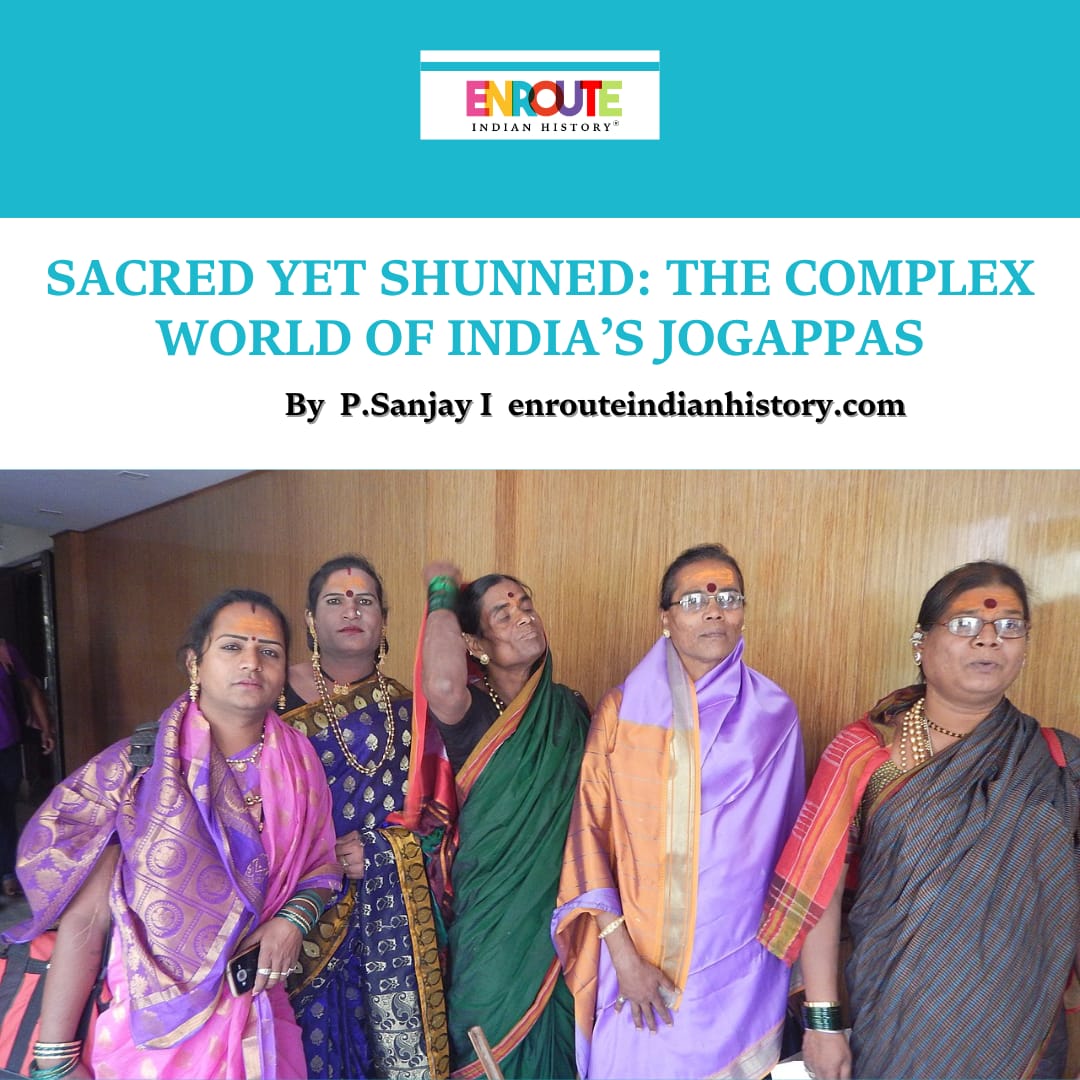
Jogappas, one such transgender community among the transgenders like hijra, Sakhi – Bekhi, Aravani, that stands unique. The community is found in the Northern part of Karnataka and parts of Maharashtra. They are transgender women—individuals who were assigned male at birth but identify and live as women. Usually in sari, having a big vermillion bindi on the forehead, with bangles and anklets and a muthu in their necks. They roam around the village and carry musical instruments like a Chaundaka/Chowdiki or Ikanada and sing songs in a particular way in honour of Yellamma which they consider as a binding duty. They also perform a certifiable art from Jogati Nritya, a special dance performed only by the community while begging and asking for alms.
The legitimacy that the Jogappas derive from their mythical association with the goddess Yellamma provides them with a sense of divine support, which, in turn, finds resonance among the people. The legend of Yellamma varies across regions, but a widely known version identifies her as Renuka, the wife of the sage Jamadagni, one of the revered Saptarishis. Each morning, Renuka would go to the river and craft a pot out of wet clay on the riverbank, with the water remaining intact due to her purity and chastity.
However, one day she became distracted upon witnessing two Gandharvas, which stirred sexual desire within her. As a result, she lost her concentration, and the clay pot failed to form despite repeated attempts. When she returned home without the pot, Jamadagni immediately discerned what had occurred. Enraged, he ordered his five sons to behead Renuka. Four refused, but the youngest, Parashurama, obeyed. Pleased by Parashurama’s obedience, Jamadagni offered him a boon, and Parashurama asked for his mother’s life to be restored. Granting the request, Jamadagni also cursed the other four sons, stripping them of their masculinity for what he perceived as cowardice.
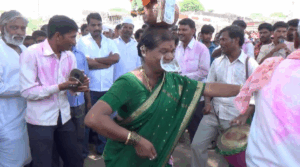
A crowd gathers to watch Jogathi Nritya (Source: Aneka Jogappa – Gender, Identity, and the Politics of Exclusion.
There is another version of the story as well where Renuka was given shelter by a Dalit woman named Matangi. She gave her food, water and took care of her during her lowest phase. It was a dalit woman who took care of the goddess rather than goddess taking care of its people. Though the exact origin of the connection of Yellamma with the identity of Jogappa is unclear, it somehow connects to the four cursed sons of Jamdagni.
Even today in the Saundatti Yellamman Temple, in Belagaum district where Yellamma Jatre takes place twice a year. As per the ritual calendar, the full moon – day of the month of October – November and January – February are important as it marks the change in the marital status of Yellamma. Jogappas and Devadasis converge at the shrine of the temple in order to celebrate the glory and unite on this auspicious day.
Jogappas are a unique example on how divinity can define the gender of an individual. Gender itself is expressed by actions and continuous performances (Butler, 1990). But these actions are associated with the spiritual connection with the god, as the gender converts are seen as chosen by the goddess itself. If Yellamma catches someone, then there’s no choice but to change gender. Transgenderism is framed as a divine decision as the experiences of Jogappas say that some kind of illness will follow them, Yellamma will come in dream until the individual submits themselves to the goddess. The state of powerlessness of the Jogappas against the divine sanctifies their gender transition (Swarupa Deb and Aniket Nandan, 2024). Also the identity of being genderless as they possess both the gender, they are considered supra-gender, beyond the binary of gender identities.
Dedication of Jogappa is a complex process as the conversion can be willing or forceful as well. Individuals dedicate themselves to the deity because of their changing behaviour but they are also dedicated by families. Families facing financial problems, or going through bad times often see that dedicating their son to Yellamma would solve problems, while dedicating the child they engage with negotiations with the god to solve their problems. Jogappas that are accepted by the family have comparatively a higher social status than the self – dedicated Jogappas because of the family support. Self – dedicated Jogappas are seen as converted to fulfill their sexual desires and are taking shelter of the god just because of the acceptance by society and financial support.
Those who become Jogappas without the family approval have had feminine feelings since childhood. Effeminate mannerisms from a young age, liking the company girls, the urge to wear sari and embody themselves with femininity of identity are depictions of associating themselves to the divine. If a man wears sari, the god doesn’t spare him and then refusing to wear the sari would be punished by Yellamma. The conversion of an individual into Jogappa includes a range of rituals and practices. The temple priest initiates the ritual by making offerings to the goddess. The body is anointed with turmeric, bathed and then wears the sari, symbolizing the rebirth into the identity of a Jogappa.
A nuptial thread with mutthu is tied by the priest or an elder Jogappa. It is a necklace which is similar to the marriage practice symbolizing the marital connection with the deity. Getting married is a kind of possession to the goddess, bounding to the goddess itself. There are different types of mutthu worn by Jogappas with respect to their marital status. Jogappas are restricted from involving in sexual practices as it is considered impure. The strict norms and customs abstains Jogappa from having sex but some of them get into sex work because of financial constraints. Breaking gender roles is also accepted by society but breaking the sexual orders or norms is unacceptable. As biologically a man having a sex with man is unacceptable by society.
Emasculation/castration is discouraged among Jogappas and those who chose to undergo it are marginalized within the marginalization. They suffer from demotion in status and are not allowed in pujas and functions. Those who undergo emasculation are usually fined by the head of the community or else excluded.
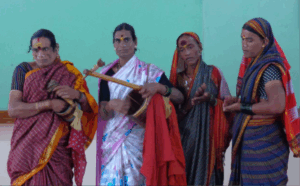
Jogappas with their musical instruments called Chowdiki (Source: Aneka, Jogappa – Gender, Identity, and the Politics of Exclusion)
Recent representations of Jogappas through digital and print media, awareness about the community are spread. Manjamma Jogathi popularised the Jogati Nritya, got a Padma Shri award in 2021. Her contributions to the folk art forms took her to great heights and positions. A concert titled ‘Performing the Periphery’ by Carnatic singer T M Krishna and the transgender Jogappas was an eye opener where Jogappas with their unique instruments performed before an urban audience. Their unique folk art tradition is getting recognition and also praised across the country.
The spiritual connection and the divine origin of their sexuality brought little respect and support to them but on a broader perspective they have remained marginalized and ostracized. The HIV discourse always prevails as one of the stigma to the community. They financially suffer because of lack of opportunities and usually live on the jogwa (alms in the name of the god). Their financial vulnerability also forces them to become sex workers.. They also face difficulties in getting accommodation. Their Temple remains the only shelter if not accepted by the family members. Their dichotomy of experiences as to an extent the temple protects them from oppression but at the same time puts restrictions on Jogappas on expressing their sexuality through disregarding emasculation and sexual practices.
REFERENCES
Menon N (2005), ‘How Natural is Normal: Feminism and Compulsory Heterosexuality,’ Gautam Bhan and Arvind Narrain (ed) Because I have a Voice: Queer Politics in India, New Delhi: Yoda Press
Merkle-Schneider, Sarah. “Contested Bodies: Negotiating Trans*femininity and Devotion in Rural South India.” Asian Ethnology, vol. 83, no. 1, 2024, pp. 39–60. JSTOR, https://www.jstor.org/stable/48782660 Accessed 23 June 2025.
Aneka. (2014). Jogappa – Gender, Identity, and the Politics of Exclusion. Aneka. https://in.boell.org/sites/default/files/jogappa_gender_identity_and_the_politics_of_exclusion.pdf. Supported by: Heinrich Böll Foundation.
Gonsalves, S. 2022. A Constructed Sexuality: Re-Discovering the Jogappas of South and West India. Skylines of Anthropology, 2: 1, pp. 45-57.
Dutta, S., Khan, S. and Lorway, R. (2019) ‘Following the divine: an ethnographic study of structural violence among transgender jogappas in South India’, Culture, Health & Sexuality, 21(11), pp. 1240–1256. doi: 10.1080/13691058.2018.1555718.
Swarupa Deb and Aniket Nandan, ‘Transgressing Gender with Religious Sanction: The Case of the Jogappas (Scroll, 26 Aug 2024)