

RAVNEET KAUR
“[Calcutta] is not only the handsomest town in Asia but one of the finest in the world”
~ Louis de Grandpré, French Naval Officer,
A Voyage in the Indian Ocean and to Bengal Undertaken in the Years 1789-1790
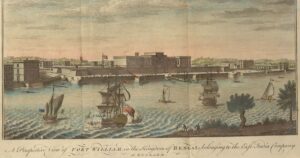 A Perspective View of Fort William by Jan Van Ryne. 1754. Wikipedia Commons. (https://commons.wikimedia.org/wiki/File:%22A_Perspective_View_of_Fort_William%22_by_Jan_Van_Ryne,_1754.jpg)
In the high noon of the Company’s rule, the artists painted a wealth of scenes – trade, warfare, military, diplomatic posturing, royals and their courts and scenes of everyday life and the common people. Naval scenes were a favourite and almost every painter has spent some time stroking ships and ports to perfection on his canvas. Calcutta was the most favoured muse of these painters and its port on the Hooghly, its trade, coolies and boatmen are amply depicted.
The artists who worked for the EIC enthusiastically painted the Indian colony, its ‘exotic’ inhabitants, everyday scenes of life and so on. The different genres of Company paintings fulfilled different purposes. Some were to capture the geography and topography of the country as exploration of uncharted territories, to gauge their usefulness and then to exploit the natural resources, was an aim of the Company. Flora and fauna were painted with the same eye. The depictions of Indians were carefully labelled and categorised into different castes for British classification. All were reduced to mere categories of cultural taxonomy.
In midst of this, military, commercial and naval scenes reflected the prowess and hold of the British and were frequently painted. Let’s take a look at a few of these before they sail away!
THE EAST INDIAMEN
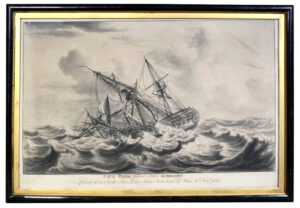
The Triton by John Hood. 1769. Shapero. (https://shapero.com/products/hood-john-a-fine-pair-of-marine-drawings-depicting-east-india-company-ships-94104)
John Hood’s Pair of Ships in the High Seas are two paintings of two East Indiamen, the name of some Company vessels, namely – Triton and Durrington. Both were sizeable merchant ships employed by EIC between colonies and territories and trades in tea, silk, porcelain, spices, cotton and sometimes slave labour. Durrington was under Captain Richard Crabb on a voyage to Mocha in 1749. Triton was captained by Gilbert Slater and as in the painting survived a storm in 1752 with two broken masts. John Hood was a marine artist who specialized in large pen and wash drawings of shipping scenes and was known for his use of Indian ink.
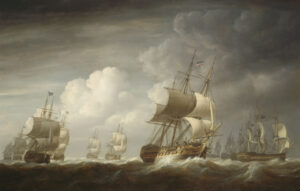
A Fleet of East Indianmen at Sea or The Hindostan by Nicholas Pocock. 1803. National Maritime Museum, Greenwich, London. (https://www.rmg.co.uk/collections/objects/rmgc-object-12589)
Another is A Fleet of East Indiamen at Sea or The Hindostan by Pocock. ‘The Hindostan’ was a large East Indiaman of 1248 tonnes, built in 1796, which was under the convoy of Commodore George Millett. In the painting, it can be seen on a return voyage from China in 1802.
CALCUTTA: THE MUSE
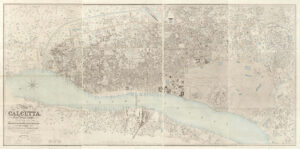
Map of Calcutta from actual survey in the years -1849. Simms, F. W., Thuillier, H. L., Smyth, R. & J. & C. Walker. The Library of Congress. Columbia Centre for Archaeology. (https://archaeology.columbia.edu/magnifying-the-miniatures/kolkata/)
By 1570, the Portuguese had shifted their factory from Satgaon, which had become inaccessible for sea-going cargo ships, and moved to Hooghly. The Portuguese developed it into a huge city and called it porto piqueno (Dasgupta, 2000). When the Portuguese were thrown out of Hooghly by the Mughals in 1632, Dutch and English factories dominated the scene. The East India Company purchased three villages from the Mughal Empire, namely – Kalikata, Gobindapur and Sutanuti – creating colonial Calcutta and its nucleus. After their victory in the Battle of Plassey (1756), the British solidified their control over Calcutta. From thence, the EIC reoriented the Calcutta port to its needs and directed its trade towards China and ultimately Europe. Throughout the 18th Century the port continued to grow and thrive. Calcutta’s importance as a city and port was inevitably linked with the consolidation of British power in Bengal.
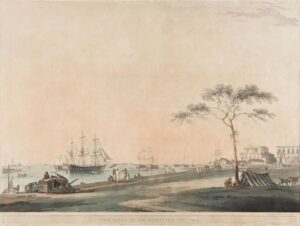
View Taken on the Esplanade, Calcutta by Thomas Daniell and William Daniell. 1797. DAG Collection. (https://share.google/7NV9v6ycpqFBKtyKg)
In 1772 Calcutta became the capital of the EIC, a magnet for all, high and low alike. As the seat of administration and due to residential needs of the Company officials, additions were made of Calcutta and a ‘distinctive pattern of urban morphology’ developed. Fort William, a European style fort was built, along with an open Esplanade along the Calcutta Port, a central business district, peripheral military and manufacturing zones with segregated residential areas for Europeans and Indians (Kosambi, Brush, 1988).
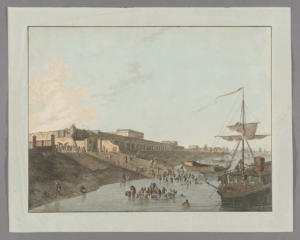
Views in Calcutta: The Old Fort Ghaut by Thomas Daniell. Columbia Centre for Archaeology. (https://archaeology.columbia.edu/magnifying-the-miniatures/kolkata/)
The English artists Thomas Daniell and his nephew William Daniell toured and painted the scenes of India in the 1700s. They published their book of paintings as Oriental Scenery: One Hundred and Fifty Views of the Architecture, Antiquities and Landscape Scenery of Hindoostan. They worked primarily in Calcutta and are known for their picturesque paintings. They painted ‘views’ of the city and published it as Views of Calcutta between 1786 and 1788, a collection of twelve paintings. William Hodges, the first landscape painter to work for EIC in India, remarked that the views showcased “the mixture of European and Asiatic Manners which may be observed in Calcutta”. (McAleer, 2017).
Some of the Views are – Calcutta from the River Hooghly, the Esplanade Row, the Old Fort Ghaut, the New Constructed Buildings of Chowringhee, and A View of Calcutta. The Daniells used the technique of handtinted engraving on paper. The paintings were also engraved and coloured with the help of Indian artists.
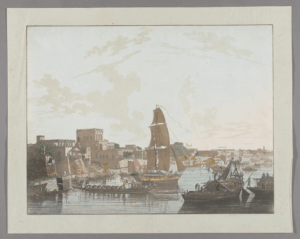
Views in Calcutta: Calcutta from the River Hooghly by Thomas Daniell. Columbia Centre for Archaeology. (https://archaeology.columbia.edu/magnifying-the-miniatures/kolkata/)
THE PORT CITY
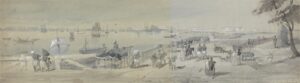
Town and Port of Calcutta by Charles D’Oyly. 1812. Artvee. (https://artvee.com/dl/town-and-port-of-calcutta/)
All of these paintings bear a testimony to Calcutta as a focal point of, both, EIC’s stronghold and the artists’ delight. At the centre of all of this is Calcutta’s port and its identity as a port city. The Esplanade on the banks of Hooghly river, the East Indiamen in Daniells’ paintings, the country boats and the boatmen, the loading and unloading at the dockyard – the markers of the hustle and bustle of a thriving port city and naval enterprises.
Calcutta was the last of the three port cities, other being Bombay and Madras, to be founded by the EIC but eventually became the largest (Kosambi, Brush, 1988 ). Throughout the eighteen and nineteen centuries, there was expansion of imports and exports in textiles, agricultural and semi-manufactured products at the Calcutta port and it produced an export surplus which was much larger than that of either Bombay or Madras.
The Company painters aptly captured the port city and enforced the port’s vitality for the city visually which already was a reality on the ground, or may we say on the sea. In the book Picturing India, John McAleer points out that “scenes like these captured and conveyed so powerfully in the graphic work of these artists played a big role in making the Company’s commercial and political activity in India – half the world away from Britain – a reality for viewers”. This was the dual purpose these paintings served – giving the faraway workings of the EIC a tangible edge for the British audience and at the same time reinforcing British prowess over the seas and colonies.
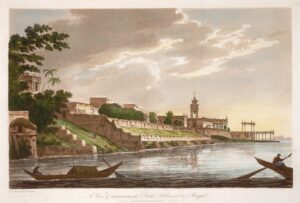
A View of Chinsura, the Dutch Settlement, in Bengal by William Hodges. 1781/82. Print. Wikipedia Commons. (https://commons.wikimedia.org/wiki/File:A_View_of_Chinsura_the_Dutch_settlement_in_Bengal;_by_William_Hodges,_1787.jpg)
BIBLIOGRAPHY & REFERENCES
- Kosambi, Meera. Brush, John E. Three Colonial Port Cities in India. Geographical Review, Vol. 78, No. 1 (Jan., 1988), pp. 32-47 (16 pages). (https://www.jstor.org/stable/214304?seq=1)
2. Dasgupta, Biplab. Trade in Pre-Colonial Bengal. Social Scientist, Vol. 28, No. 5/6 (May – Jun., 2000), pp. 47-76 (30 pages). (https://www.jstor.org/stable/3518180?seq=1)
3. McAleer, John. Picturing India: People, Places and the World of the East India Company. 2017. University of Washington Press.
4. Calcutta Port. Banglapedia. (https://en.banglapedia.org/index.php/Calcutta_Port)
5. A fine pair of marine drawings depicting East India Company ships. Shapero. (https://shapero.com/products/hood-john-a-fine-pair-of-marine-drawings-depicting-east-india-company-ships-94104)
6. Chaudhari, Zinnia Ray. For 18th century painters, Indian port cities Calcutta, Bombay and Madras held a very special place. Scroll. (https://share.google/Wkklbcgl4gPn4erKd)
7. Nair, Eisha. Hidden Figures: Colonial artists and Calcutta as muse. Sarmaya. (https://share.google/XbxnDXGf8RIRwKZYN)
8. Grandpré, Louis de. A Voyage in the Indian Ocean and to Bengal Undertaken in the Years 1789-1790. Internet Archive. (https://archive.org/details/b22041084_0002)
PHOTO CREDITS
- A Perspective View of Fort William by Jan Van Ryne. 1754. Wikipedia Commons. (https://commons.wikimedia.org/wiki/File:%22A_Perspective_View_of_Fort_William%22_by_Jan_Van_Ryne,_1754.jpg)
2. The Triton by John Hood. 1769. Shapero. (https://shapero.com/products/hood-john-a-fine-pair-of-marine-drawings-depicting-east-india-company-ships-94104)
A Fleet of East Indianmen at Sea or The Hindostan by Nicholas Pocock. 1803. National Maritime Museum, Greenwich, London.
3. Map of Calcutta from actual survey in the years -1849. Simms, F. W., Thuillier, H. L., Smyth, R. & J. & C. Walker. The Library of Congress. Columbia Centre for Archaeology. (https://archaeology.columbia.edu/magnifying-the-miniatures/kolkata/)
4. View Taken on the Esplanade, Calcutta by Thomas Daniell and William Daniell. 1797. DAG Collection. (https://share.google/7NV9v6ycpqFBKtyKg)
5. Views in Calcutta: The Old Fort Ghaut by Thomas Daniell. Columbia Centre for Archaeology. (https://archaeology.columbia.edu/magnifying-the-miniatures/kolkata/)
6. Views in Calcutta: Calcutta from the River Hooghly by Thomas Daniell. Columbia Centre for Archaeology. (https://archaeology.columbia.edu/magnifying-the-miniatures/kolkata/)
7. Town and Port of Calcutta by Charles D’Oyly. 1812. Artvee. (https://artvee.com/dl/town-and-port-of-calcutta/)
8. A View of Chinsura, the Dutch Settlement, in Bengal by William Hodges. 1781/82. Print. Wikipedia Commons. (https://commons.wikimedia.org/wiki/File:A_View_of_Chinsura_the_Dutch_settlement_in_Bengal;_by_William_Hodges,_1787.jpg)