
By Anukriti Upreti
Instruments are the voices of culture and societies, which make them; thus, they evolve and change with social interactions and cultural exchanges. One such musical instrument, which has many variations in the world representing its ambiguous origin, is the Santoor. The santoor is a trapezoidal box-like instrument typically made from walnut or maple wood. The frame has 40 to more than 100 strings made of steel, copper, or brass. The metal strings are stretched across several movable wooden bridges and connected to the sides of the frame with pins on the left side and tuning pegs on the right. The bridges are made of rosewood accompanied by bone on which the strings are placed in groups of three. In this way, hundred strings are laid over 25 bridges, and each group of four strings is tuned to one note. Giving a magnificent and complex look to the instrument, it is tuned accordingly with a device called Dokur in Kashmir. The instrument is played by striking the strings with wooden mallets called mezrab in the middle portion of the instrument, producing a melodious sound.
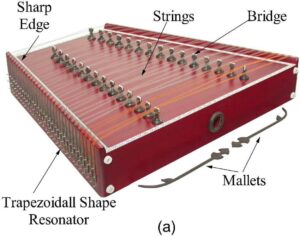
Image description of Santoor musical instrument. Image courtesy www. researchgate.net
Origin of the instrument
The origin of the Santoor is uncertain, but the widely accepted theory is that it originated in Iran. However, we also find references to the instrument Shata Tantri veena, a 100-stringed instrument that resembles Santoor in the ancient Sanskrit texts from India. Scholars such as Gifford have argued that the term santoor is a Persian adaptation of the Arabic word ‘santir, ’ which is derived from the Greek word psaltry (to pluck), thus referring to an instrument played by plucking the strings with a hammer-like structure. The first representation of such an instrument is found in a 12th century manuscript The Psalter of Queen Melisande, where King David is shown playing the instrument (Gifford, 2001) . According to Gifford, Santoor arrived in India from Iran or Iraq with increasing contact with the Persians. However, Day related Santoor with another instrument, Qanun, and attributed the invention of the Indian Qanun to the sage Katyayana. Due to these varied influences, we find many instruments across the world similar to the santoor, but their playing techniques, number of strings, tone, shape, and size make them different. In India Santoor became a major instrument in Sufi music called Sufi kalaam and folk music in Kashmir. Later, in the 20th century, it was introduced in the realm of classical music and Bollywood.
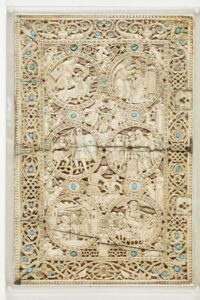
Image of The Psalter of Queen Melisande. King David is playing an instrument like Santoor. Image courtesy Wikimedia commons.
Sufi Music and Santoor
The santoor was used to accompany ‘Sufi Mousique’, an amalgam of music from Central Asia, Persia, and India that developed during the 15th century. The soothing sound of the instrument reflects peace and tranquility, thus creating a beautiful atmosphere when played along with other instruments like Saaz-i-Kashmir, Kashmiri Sehtar, Rabab, and Tabla. The Santoor player often acquires a major position among others as the music generally starts with an instrumental prelude called Shakal, which gives the background of the music. The Shaqal gives a base of the Maqam (the composition) and is generally played on the Santoor for half a minute to about two minutes, after which the mausiqui starts. During 1940’s and 50’s the best known sufiyana musicians in Kashmir valley were Mohammad Abdullah, Tibel Baqal and Mohammad Qaleen Baaf, who are known to be masters of santoor playing, of the time. Until then, the Santoor had not been used in Indian classical music.
Besides, the Sufiana Gharana is significant in producing both the masters of Santoor as well as developing the instrument over time. For these musicians, music was both a profession and worship, and they specialized in both instrumental and vocal styles. Prof. S.N. Sopori, the veteran musician and musicologist of Kashmir, while teaching the Santoor, extended the bridges of the Santoor from 25 to 28 in consultation with his father Pandit S.C.Sopori. He also shifted the Pancham (swar Pa) of Mandra Saptak from right to left and created a Pancham at the Tar Saptak. (Kashmir Herald, 2001) This modified the instrument for playing various musical embellishments like Tantrakari Ang of Sitar. Later, his son Pandit Bhajan Sopori made invaluable contributions to making the instrument more versatile. He extended the bridges by developing the mandra saptak (lower octave) and taar saptak (higher octave) and replaced the traditional wooden stand used for Santoor with a tumba or guard to manage the pressure techniques he introduced to the instrument and to have a clear higher octave. He also included sympathetic strings, known as taraab, to enhance the resonance and tonal quality of the instrument.
Thus, the Sopori baaj style of playing was invented, and the santoor he developed has 43 bridges and 100 strings, thus the tone generated by it satisfies the requirement of the ragas of the hindustani classical music system. In this way we find a beautiful blend of Hindustani classical music with the sufi ideologies where the Raga became the manifestation of Sufi meditation and the tala (beats) became the mantra while Layakari and Chandrakari are comparable to the highest stages of ecstasy in Sufi terminology. (Karmir Herald, 2001).
How Santoor entered into classical music
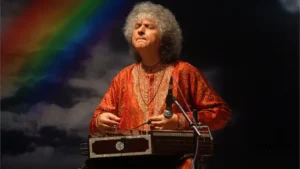
Pt. Shiv Kumar Sharma playing Santoor. Image courtesy Getty images
The work of giving Santoor pan-India and worldwide significance is generally attributed to the legendary Santoor maestro Shiv Kumar Sharma. In the early 1950s, at the urging of his father, he began introducing the instrument into classical music. Until then, the santoor was alien to Hindustani classical music. In 1955 Sharma gave his first performance of Hindustani music in Santoor, he received a mixed response from the audience and many criticized him saying that Santoor does not have the ability to deal with the nuances of Hindustani music. These criticisms led to various modifications and transformations made by Sharma to make the instrument more apt for dealing with ragas and musical embellishments such as meend (glissando). The santoor we hear most in Indian classical music today is the style of Pandit Shivkumar Sharma and his son Rahul, with 31 bridges and over 90 strings, and a range of three octaves. Sharma also played for many movies like Silsila and Chandini thus, bringing the instrument to bollywood.
Current status
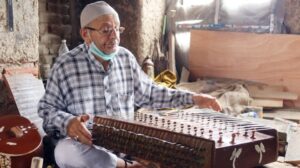
Ghulam Mohammed Zaz, the only traditional Santoor maker left in Kashmir. Image courtesy BBC news. (2025)
This wonderful, mystic instrument having a long history of cultural interactions, social voice and melodies today faces a challenge against the changing demands and interests of Music. The young generation is inclined towards “modern” hip- hop and electronic music says a music teacher in his interview with BBC. The traditional art of making Santoor is at the verge of extinction in Kashmir, as Ghulam Mohammed Zaz is the last traditional Santoor maker left in the region. Zaz says that the art of making instruments is like a prayer and he will make the instrument until his last breath. “Making a santoor is a slow, deliberate process. It starts with selecting the right wood, aged and seasoned for at least five years. The body is then carved and hollowed for optimal resonance, and each of the 25 bridges is precisely shaped and placed”. Maestros like Sharma and Bhajan Sopori have played the Santoor made by this family but their art is now dying which is a serious concern for all of us who cherish music. It is our duty to preserve classical and folk music as they are the voices of people, they have their own stories and emotions and thus, these instruments represent a long history still living in the lives of people.
References:
1. Kashmirherald.com. Vol.1 (2001). Available at: https://www.kashmirherald.com [Accessed 21 Sep. 2025].
2. Shamus-ul-Nisa (2017). Santoor and Sehtar – Traditional Instruments of Kashmir. International Journal of Advanced Educational Research, 2(5), pp.346–348.
3. Gorlinski, V. (2012). Santoor | Persian, Strings, & Hammering. [online] Encyclopedia Britannica. Available at: https://www.britannica.com/art/santoor.
4. Santura Sangita. (n.d.). Santoor: history, description of the instrument. [online] Available at: https://en.santurasangita.com/santour.
5. Siddiqi, J. (2025). The Santoor: from Sufi folk to the Classical stage – Darbar. [online] Darbar. Available at: https://darbar.org/the-santoor-from-sufi-folk-to-the-classical-stage/ [Accessed 21 Sep. 2025].
6. ipassio. (n.d.). Santoor | Santoor Instrument – ipassio Wiki. [online] Available at: https://www.ipassio.com/wiki/musical-instruments/string/santoor.
7. Bhat, B.F. (2025). The last custodian: A Kashmiri artisan’s battle to save a musical legacy. [online] 27 Jul. Available at: https://www.bbc.com/news/articles/cp34x44g2xwo.