

By Advaitaa Verma
Kutch, located in the westernmost part of India, is a region characterized by its arid desert climate, strong winds, and susceptibility to seismic disturbances. The region lies in a high- seismic zone, making it one of the most earthquake-prone areas in India. The region has experienced multiple devastating earthquakes, with the most notable being the 2001 Gujarat earthquake, which caused extensive damage to modern buildings but left many traditional Bhunga structures intact (Gazetteer of Bombay Presidency Vol. V, 1880).
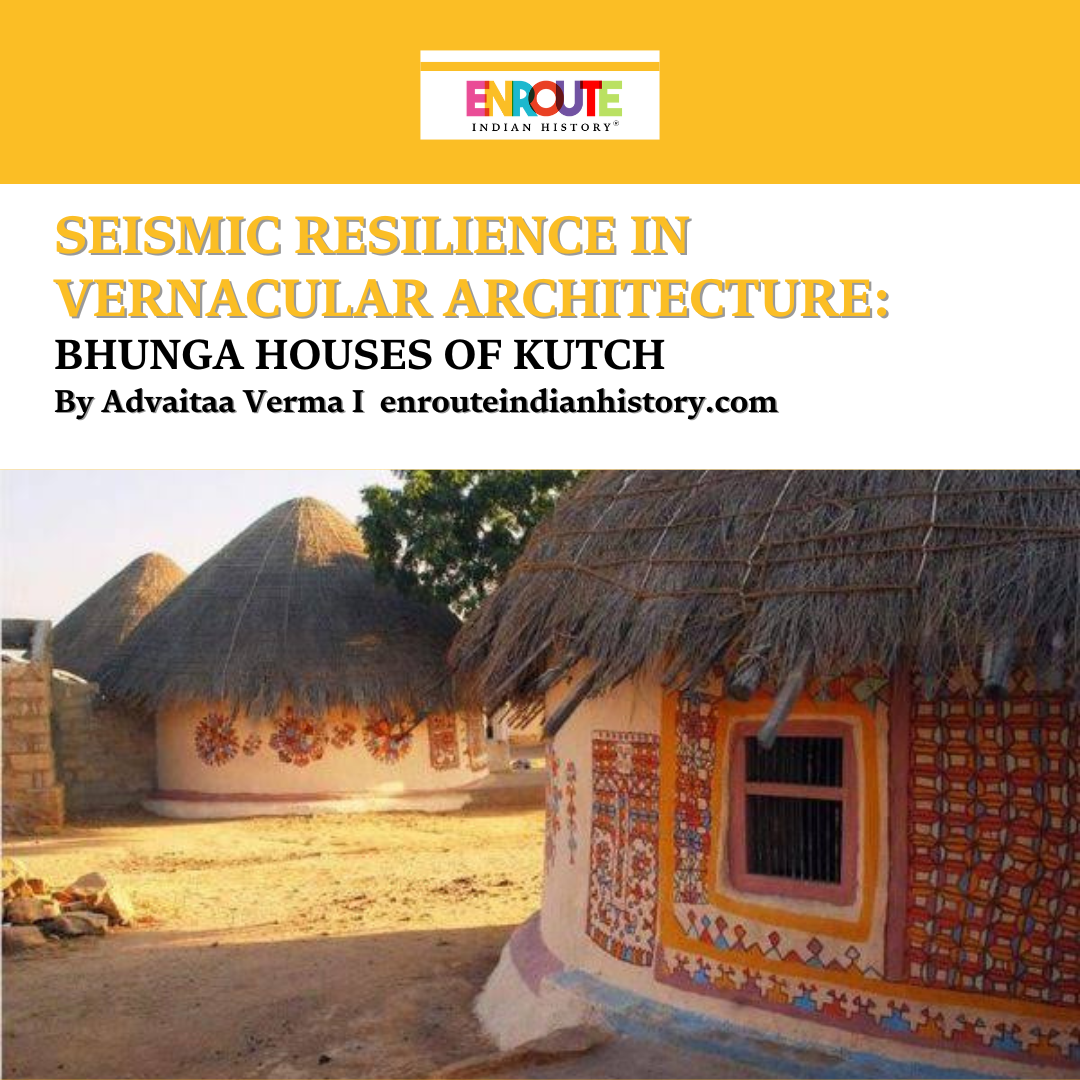
The Meghwal community, traditionally known for their textile, leatherwork, and painting skills, have developed an architectural style that harmonizes functionality, aesthetics, and seismic resilience (Mogha & Sharma, 2023). The Bhunga, a circular mud house, is a hallmark of Kutch’s vernacular architecture. These structures, adorned with intricate Lippan mirror work and geometric motifs, reflect the cultural identity of the Meghwals (Likhinya, 2024). The Bhunga houses are constructed in such a way that they can withstand these natural calamities and also provide thermal comfort in extreme winter conditions (Gupta & Mazumdar, 2016). The Meghwals have perfected the art of constructing these houses using locally available materials such as mud, lime, cow dung, and bamboo, ensuring that their homes remain resilient yet environmentally sustainable (Mogha & Sharma, 2023). Furthermore, the tradition of Bhunga construction is deeply intertwined with the community’s way of life, reflecting their adaptation
to Kutch's unique geographical and climatic challenges. The article traces the idea and construction technique involved in making the Bhunga houses that are earthquake resistant and are structurally efficient. The article highlights the role of women in decorating these houses and incorporating the traditional technique into modern architecture.
Structural Features: Bhunga Houses
This region has historically been affected by devastating earthquakes, with the 2001 Gujarat earthquake serving as a critical case study. While modern reinforced concrete structures suffered extensive damage, many Bhunga houses survived due to their flexible and shock-absorbent design. The resilience of Bhunga houses in earthquake-prone regions lies in their distinctive architectural and construction techniques (Gupta & Mazumdar, 2016). Key structural attributes include:
● Circular design: The cylindrical shape of the Bhunga allows for even distribution of seismic forces, reducing the chances of structural collapse during earthquakes. In the case of rectangular or square shape, due to the rigid corners the structures are prone to stress concentration during an earthquake, resulting in a collapse.
● Low Height and Thick Walls: Bhunga houses are constructed with low heights, reducing the center of gravity and making them more stable during an earthquake. Their thick walls, ranging from 30 to 45 cm in width, are composed of locally available mud and clay, providing excellent thermal insulation, keeping the interior cool during the extreme heat of Kutch’s summers and warm during the colder months.
● Flexible Bamboo and Wooden Roofs: The conical thatched roof structure, supported by bamboo, and wooden beams, plays a crucial role in the flexibility and adaptability of Bhunga houses. This type of roof has a lighter load compared to concrete or stone roofs, reducing the force exerted on the walls during seismic movement. Thus, keeping the structure from collapsing.
● Natural Material Composition: Organic materials such as mud, cow dung, and lime are used in making Bhunga houses. Such materials can enhance the elasticity and durability of the walls, absorbing the shocks of an earthquake. Unlike modern concrete, they are brittle in nature and are prone to cracking under stress. Lime acts as a stabilizer, ensuring that the structure remains intact for a long period of time.
● Minimal Openings: Numerous openings in a structure are considered to be weak points, where stress accumulates and leads to structural failure. The structural integrity of Bhunga houses is ensured by minimal openings, these houses have small windows and compact doorways. This helps in keeping the structures stable during earthquakes.
● Interlocking Mud Blocks: Traditional Meghwal construction techniques include compacting mud layers with natural binders, forming interlocking blocks that add to the overall stability of the walls. The method of applying successive mud layers also reduces the risk of cracks propagating through the structure, making Bhunga houses more durable in the face of earthquakes (Gupta & Mazumdar, 2016).
Art in Residential Areas
Beyond their structural significance, the Bhunga houses served as canvases for Meghwal artistry, which reflected the deep-rooted cultural expressions and social traditions. The community intricately decorated the exteriors and interiors of Bhunga houses with unique designs, transforming these simple homes into vibrant expressions of identity and craftsmanship. Some of the interesting and unique Meghwal community artistic features are listed below:
● Lippan Kaam: It is a signature element of Bhunga houses and also a famous Kutchi artwork. Lippan is a mud-relief work, decorated with mirrors; traditionally crafted by Meghwal women. This artwork is not only for decorative purposes, but also serves practical functions such as reflecting light within the interiors to brighten living spaces
(Likhinya, 2024).
● Geometric and Floral Motifs: These patterns, often created using white clay, natural pigments, and mirror inlays, symbolize prosperity, nature, and spirituality. The designs serve as a medium for storytelling and cultural continuity. Women draw inspiration from folklore, mythology, and daily life, ensuring that each Bhunga house remains a living testament to Meghwal heritage (Likhinya, 2024).
● Natural Pigments: Meghwal women use pigments derived from minerals, plants, and ochre to create colorful murals and intricate patterns. These eco-friendly materials not only enhance the aesthetic appeal of Bhunga houses but also contribute to sustainable living practices (Likhinya, 2024).
Traditional Technique into Modern Architecture
The region of Kutch is located in a high seismic zone, and is considered one of the most earthquake-prone regions of India (Gazetteer of Bombay Presidency Vol. V, 1880). The coming generations want to live in modern houses and leave behind the traditional Bhunga houses. The problem with modern-day architecture is that these houses cannot take the load of an earthquake and might collapse, as seen during the 2001 earthquake. As discussed, Bhunga houses are constructed in such a way that they can withstand the stress of an earthquake. So, incorporating the traditional construction techniques of Bhunga houses into modern architecture in Kutch can be the solution to collapsing modern-day architecture, and can be achieved through several approaches:
● Hybrid Construction Techniques: Using Bhunga’s circular layout and thick mud walls alongside modern materials like steel frames or bamboo composites to enhance strength while maintaining flexibility during earthquakes.
● Sustainable Material Integration: Utilizing locally sourced materials such as mud, lime, and cow dung for insulation, alongside eco-friendly modern alternatives like compressed stabilized earth blocks (CSEB) and rammed earth walls.
● Adaptive Roof Designs: Retaining the conical thatched or bamboo-supported roofs but reinforcing them with lightweight steel or tensile roofing materials for durability and better load distribution.
● Energy-Efficient Designs: Integrating Bhunga-style passive cooling techniques, such as thick walls, minimal openings, and thermal mass materials, to reduce energy consumption in contemporary houses (Choudhary, 2016).
Conclusion
During the devastating 2001 Gujarat earthquake (magnitude 7.7), while modern concrete buildings suffered severe damage, Bhunga houses demonstrated remarkable resilience. The circular form, lack of rigid joints, and use of elastic organic materials played a crucial role in their survival. Several post-earthquake studies have confirmed that Bhunga houses experience less lateral stress compared to rectangular buildings.
The Bhunga houses of the Meghwal community represent an exemplary model of sustainable and earthquake-resistant architecture. Their circular design, use of indigenous materials, and artistic embellishments reflect a deep understanding of the environment and cultural heritage. As the world grapples with climate change and increasing seismic risks, lessons from these vernacular structures can inform contemporary sustainable architecture. Despite their architectural brilliance, Bhunga houses are facing threats from modernization and rapid urbanization. Factors such as the availability of concrete housing and changing socio- economic aspirations have led to a decline in traditional construction. However, efforts by heritage conservationists, NGOs, and sustainable architecture movements aim to revive and promote this earthquake-resistant housing style as a model for resilient rural architecture.
References
1880. Gazetteer of the Bombay Presidency Vol V. Cutch, Palanpur and Mahi Kantha. Government Central Press, Bombay.
Choudhary, A.., 2016. Approach to sustainable architecture through vernacular practices: a case study of dwelling in villages of Madhya Pradesh and Gujarat.
Gupta, J. and Mazumdar, S., 2016. Study of local Bhunga houses in Kutch adapting to desert climates in a sustainable way, with reference to modern green building norms followed in India. Arch Time Space People, pp.34-40.
Likhinya, K.V.S., 2024. Reviving Vernacular Crafts in India Through Additive Manufacturing.
In The Routledge Handbook of Craft and Sustainability in India (pp. 181-191). Routledge India.
Tipnis, A., 2012. Vernacular traditions: Contemporary architecture. The Energy and Resources Institute (TERI).
Mogha, A. and Sharma, N.R., 2023, July. A Study On Traditional Motifs And Techniques Of Dhabhla And Its Changes Of Kutch Region. In International Conference on Emerging Trends in Design & Arts (Vol. 4, No. 2SE, pp. 72-77).
Vaghela, K. and Kotak, T., 2019. Dwellings Post Bhuj-2001 Earthquake. Earthen Dwellings and Structures: Current Status in their Adoption, p.225.