
Shadows before the Light: How Bhoota Chaturdashi Bridges the Living and the Dead
- December 11, 2025
By Ramyani Banerjee
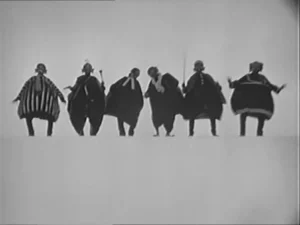
The fat-bellied ghosts from Satyajit Ray’s Goopy Gyne Bagha Byne.
Image Source:- Ray, Satyajit, director. Goopy Gyne Bagha Byne. 1969, YouTube, www.youtube.com/watch?v=x-s-9hp5bIQ. Accessed 11 Oct. 2025.
On the eve of Diwali, when most of India pulses in anticipation of firecrackers, sweets, Lakshmi pujas, and collective celebration, a quieter—but no less potent—ritual unfolds in Bengal. This is Bhoot Chaturdashi, a night long whispered about in Bengali homes and folk memory, when the barrier between the living and dead becomes thin. If Diwali is a celebration of light’s triumph, Bhoot Chaturdashi is its necessary prelude—a moment to face the darkness before dispelling it. Think of it as Bengal’s own version of Halloween, but older, deeper, and woven with mythic and tantric threads that stretch back centuries. This essay follows that journey—from ancient legend to household ritual—uncovering how Bhoot Chaturdashi stands at the luminous threshold between death and renewal.
The Pan-Indian Framework: Naraka Chaturdashi and the Triumph of Light over Darkness
To understand Bhoot Chaturdashi, one must first step into the wider festive landscape of India—where this Bengali night finds its popular pan-Indian counterpart in Naraka Chaturdashi, celebrated also as Chhoti Diwali, Kali Chaturdashi, or Roop Chaturdashi. Falling on the fourteenth day (Chaturdashi) of the waning moon (Krishna Paksha) in the month of Kartika (or Ashvina in some traditions), the day glows with deep mythological significance.
According to the Puranas, the fearsome demon Narakasura once unleashed havoc across heaven and earth—plundering kingdoms, imprisoning maidens, and defying the gods themselves. It was on this very night that Lord Krishna, (aided by his consort Satyabhama), stormed Narakasura’s capital Pragjyotishpuram and killed him. Their triumph was not merely a battle won, but a restoration of harmony: light conquering darkness, purity cleansing corruption, and souls released from suffering. To this day, people across India celebrate by lighting oil lamps, performing aarti, and sharing sweets that echo the sweetness of deliverance.
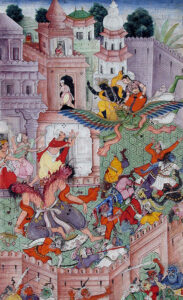
Krishna Cleaves the Demon Narakasura with His Discus. Razmnama, ca. 1585–1590, opaque watercolor and gold on paper, Mughal Court, New Delhi, India. Edwin Binney 3rd Collection. Wikimedia Commons, https://commons.wikimedia.org/wiki/File:Krishna_Cleaves_the_Demon_Narakasura_with_his_Discus.jpg. Accessed 11 October, 2025
Yet, in Bengal, this night assumes an altogether different hue. Here, the Chaturdashi before Diwali transforms into Bhoot Chaturdashi—the “Night of Spirits.” The victory over a demon expands into a quiet communion with the unseen: the ancestral, the spectral, the half-forgotten presences believed to linger just beyond the lamplight. Homes are lit with fourteen earthen lamps, not merely to ward off darkness, but to guide these spirits—benevolent or wayward—back to the warmth of remembrance. So in Bengal, it becomes a negotiation between the living and the dead, between myth and memory, between fear and faith.
How did Bhoot Chaturdashi originate?
In Bengal’s rich folk imagination, tantric practitioners have long been perceived as mediators between human and spectral realms. The presence of bhoot (spirits) within everyday ritual life is not an anomaly but an organic part of Bengal’s landscape. Within this continuum, Bhoot Chaturdashi can be understood as a domesticated echo of older cosmological beliefs that sought to reconcile ancestral and spectral forces. Over centuries, these local spirit-oriented customs gradually intertwined with the broader Hindu festival calendar, particularly aligning with the Naraka Chaturdashi narrative. Today, the day preceding Kali Puja is marked as Bhoot Chaturdashi, which is now observed in close proximity to the mythic tale of Narakasura’s fall. Yet, the night carries its distinct regional texture—infused with Shakta and Tantric undertones.
Kali Puja, the climactic celebration of the Mother Goddess’s fierce and protective form, often finds its ritual prelude on this very night. And it is deeply rooted in Shakta esotericism, reflecting the mystical and ritualistic engagement with the divine feminine and the liminal realms of existence. So, while Kali puja embodies the principle of confronting darkness and transience, Bhoot Chaturdashi complements this by acknowledging the presence of ancestral spirits and restless souls, emphasizing the Shakta belief in the permeable boundary between the living and the dead. Lighting lamps to ward off ancestral spirits and eating fourteen types of greens symbolize both the continuity of folk belief and the Tantric idea of transforming darkness into divine power. Thus, Bhoot Chaturdashi becomes not merely a festival of ghosts, but a threshold—where devotion, fear, and illumination converge.
While direct written records of Bhoot Chaturdashi are very scarce, early Orientalist observers such as Sir William Jones, who explored Hindu lunar calendars in works like The Lunar Year of the Hindus, took note of comparable ritual patterns in Bengal’s festive cycle. His reflections on lunar observances opened pathways for later scholars to trace how regional festivals align with the phases of the moon. Over the nineteenth and early twentieth centuries, ethnographers and Bengali social thinkers documented local practices—such as the lighting of fourteen earthen lamps, and warding off malevolent forces on the eve of Kalipuja—yet these were frequently relegated to the category of “superstition.” Even if textual evidence remains fragmentary, the continuity of ritual is visible in the enduring rhythms of Bengal’s life: the telling of ghost stories, the ritual cleaning of homes, and the symbolic illumination of darkness before the night of the goddess Kali, which together affirm a living cultural memory passed down through generations.
Bengali Landscapes of the “Bhoot”:
To grasp Bhoot Chaturdashi fully, one must immerse in the Bengali folk world—where ghosts (bhoot or preta) are active agents in everyday life. In popular tales and oral traditions, these spirits appear in many forms: Petni, unmarried female ghosts with unfulfilled desires; Shakchunni, once-married women who linger; Mechho Bhoot, water-linked spirits drawn by fish; Gechho Bhoot, spirits of trees; Nishi, the night-spirit that mimics a loved one’s voice; Brahmaditya, a Brahmin’s wandering ghost; Skondhokata, the headless ghost; Mamdo Bhoot, the Muslim ghost; among others. Such figures seem woven so closely into everyday storytelling, literature, and media that they linger in cultural memory as near, if unseen, companions. Bhoot Chaturdashi, then, is a ritual that sits at the threshold between the world of the living and that of spirits, a night when ancestral souls are imagined to pass among the living, and when dark or malevolent energies are thought to move more freely. Its ritual logic is dual: welcoming for forebears, protective against harm.
A hallmark of the night is the lighting of fourteen oil lamps, often clay diyas, placed around the home—doorways, windows, corners, and thresholds. This “choddo prodip” (“fourteen lights”) is often said to honor fourteen generations of ancestors, who are believed to visit and bless their descendants. The lamps are thought to guide these spirits home while warding off lurking darkness, sometimes even associated with appeasing Yama, the god of death, or keeping malevolent spirits at bay.
“Choddo Shaak”: Consuming Green Leaves as Purification
On this day, it is common for Bengali families to prepare a meal—or at least part of it—using a mix of fourteen different leafy greens, often called choddo shaak. Each variety is thought to carry its own symbolic or medicinal significance, and the act is sometimes described as a way to purify the body and make it less receptive to spiritual disturbances. It can also serve to connect the living with the rhythms of the earth, fertility, and vegetation, even as they honour the presence of the dead.
Stories occasionally link the practice to a tale of a careless Brahmin whose home, left unclean, attracted spirits; in seeking to purify his house, he used fourteen greens and may have unwittingly begun the ritual. Many religious households also observe a purificatory oil bath, or Abhyanga Snan, ideally before sunrise while the Chaturdashi tithi is still in effect, sometimes under the moonlight. Using fragrant oil, the bath is seen as a way to protect oneself from harm, remove spiritual impurities, and prepare for the festival. Because the lunar moment is central, the timing is carefully followed, with the ritual believed to be most effective while Chaturdashi persists, before the onset of Amavasya or the main Diwali day. In this way, the observance of Bhoot Chaturdashi blends time, material practices, and cosmic attention into a closely choreographed ritual space.
Why is Bhoot Chaturdashi important?
Bhoot Chaturdashi is a night unlike any other. Unlike many Hindu festivals that are anchored in scriptures, it has no scriptural anchor, no Purana or Smriti that decrees its ways—it lives in whispered stories, in homes, in the rhythms of ordinary life. And yet, it carries a quiet authority. On this night, the dead are not distant memories—they are invited home. Lamps flicker in every corner, greens are laid out, and the air is filled with subtle, earthy scents. The house becomes a threshold where the living and the dead meet, where longing and fear coexist. Darkness is held in careful balance. Every shadowed nook is acknowledged, every flicker of flame a small act of protection and attention. The night itself becomes a ritual chamber, a place where the uncanny is invited, observed, and tended. Just as Naraka Chaturdashi symbolizes cleansing—destroying the demonic, freeing the captive—Bhoot Chaturdashi enacts purification on domestic, bodily, and spiritual registers. Calling forth fourteen generations of ancestors is a gentle reminder that the family is more than the living. Life threads through the past, and by lighting a lamp for each forebear, the living honor that presence. It is a gesture of hospitality, of recognition, and of continuity. Bhoot Chaturdashi is deeply Bengali: it welcomes the night, the shadow, and the uncanny into the home.
Conclusion:
Across continents and centuries, the night of the dead has always returned—under different names, in different guises. In China’s Ghost Festival (Zhongyuan Jie), lanterns are floated on rivers to guide wandering spirits toward peace; in Mexico’s Día de los Muertos, marigolds, candles, and sugar skulls transform cemeteries into radiant bridges of remembrance; in Southeast Asia’s Hungry Ghost Month, offerings of food and incense appease restless souls seeking solace. Bengal’s Bhoot Chaturdashi belongs to this same global constellation of liminal rituals, where light mediates between the living and the lost. Yet its intimacy is distinct: the flicker of choddo prodip is not staged in grand public spaces but in quiet domestic corners, where families commune with fourteen generations of ancestors. While other cultures externalize the festival—turning death into spectacle—Bengal turns inward, transforming the home itself into a sacred threshold where memory, fear, and devotion share the same flame.
REFERENCES:
1. Chaturvedi, Amit. “Bhoot Chaturdashi: All About West Bengal’s Version of Halloween.” NDTV, 29 Oct. 2024, www.ndtv.com/offbeat/diwali-2024-diwali-traditions-bhoot-chaturdashi-all-about-west-bengals-version-of-halloween-6900488.
2. Majumder, Trisha. “What Is Bhoot Chaturdashi? The Legends of the Indian Halloween.” SheThePeople, 29 Oct. 2024, www.shethepeople.tv/festivals-of-india/what-is-bhoot-chaturdashi-halloween/.
3. Banerjee, Riksundar. “Bhoot Chaturdashi – a Tradition That Flows with Perception.” The Telegraph India, 23 Oct. 2022, www.telegraphindia.com/my-kolkata/lifestyle/the-lighting-of-14-lamps-eating-choddo-shaak-and-more-history-and-traditions-that-make-bhoot-chaturdashi-halloween-a-changing-tradition/cid/1893843.
4. Chadha, Pavneet Singh, et al. “The Spirits Descend on Earth: Ahead of Diwali, Celebrating Bhoot Chaturdashi in India.” The Indian Express, 11 Nov. 2023, indianexpress.com/article/explained/explained-culture/diwali-bhoot-chaturdashi-narakasura-9022815/.