

By Prishnika Mazumdar
Stars and constellations have influenced rituals, architectural structures, the fate of dynasties and much more in India. Historically, astronomy has played an important role in guiding the orientation and construction of temples, monuments, and observatories in India. The placement of stars and planetary alignments were studied and integrated into architectural planning to create structures that aligned with cosmic cycles. Among these structures, many megalithic formations, such as those in Brahmagiri, Nilurallu, Nilaskal and Byse, show clear astronomical orientations.
Astronomy in India
The placement of celestial bodies and their study have held an important place in India since ancient times. For example, around the 8th century BCE, sage Yajnavalkya calculated that the Sun and Moon were each approximately 108 times their diameters away from Earth. This figure is remarkably close to current scientific estimates (Mandal, 2020, p. 2297). Even devotional texts like the Hanuman Chalisa encoded advanced astronomical concepts, which calculated the distance between Earth and Sun as 153.6 million km. Again, this is nearly identical to today’s accepted average of about 149.6 million km (Mandal, 2020, p. 2297). Having known this rich history of astronomical calculations, we can focus our attention on the astronomical aspects of three megalithic sites in South India.
Influence of Astronomy on Megalithic Formations
The megalithic culture in South India refers to an archaeological tradition that was characterised by the construction of large stone structures. This was mostly done for funerary purposes during the Iron Age (approximately 1200 to 200 BCE). Megalithic monuments are typically dated from 1200 BCE to 300 CE. These monuments are of different types. For example, dolmens are flat stone slabs laid over upright stones to form a burial chamber, cairn circles are piles of stones arranged in circular formations over graves, menhirs are tall, upright stones often placed alone or in rows, and urn burials consist of large pottery vessels used to contain the ashes or bones of the deceased. These are commonly found across Karnataka, Andhra Pradesh, Tamil Nadu, and Kerala. They were often accompanied by grave goods like iron tools, Black and Red Ware pottery, beads, and sometimes animal remains. This points towards a society that was settled and agro-pastoral and also one that was complex and socially stratified (Darsana, 2021; Rao & Marathe, 1989).

Over time, interest in South Indian megaliths has expanded beyond typology and burial practices to explore their visual, social, and astronomical significance. Many of these sites, particularly in regions like Nilaskal, Byse, Brahmagiri, and Nilurallu, reflect alignments with celestial phenomena such as solstices and equinoxes. This tells us that megalithic communities were aware of astronomical cycles and included this knowledge in their cultural and ritual practices. Such alignments marked seasonal transitions, and they may also have served calendrical functions (Darsana, 2021; Rao & Marathe, 1989). The following section expands on the utilisation of astronomical knowledge in the making of these structures and their functions in the prediction of celestial events.
The Megalithic Sites
The megalithic structures of South India, while primarily burial-related, also inform us about astronomical sophistication. Among these, the sites of Brahmagiri, Nilaskal, Byse, and Nilurallu are of interest to us for their alignment with celestial events.
Brahmagiri in Karnataka
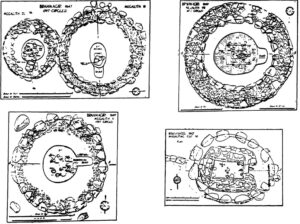
Brahmagiri is located in the Chitradurga district of Karnataka. The site has emerged as one of the most thoroughly studied megalithic sites with astronomical significance. The site comprises 32 stone circles made of granite boulders, each with diameters ranging from 6 to 11 meters. What sets Brahmagiri apart is the regular orientation of these stone circles along the cardinal directions of north, south, east and west. Through field surveys and solar observations, it has been found that the lines drawn from the centre of each circle through the entrance stones aligned precisely with sunrise and sunset directions on solstices and equinoxes. A solstice marks either the longest or shortest day of the year in a hemisphere. This happens when the sun’s apparent position in the sky reaches its highest or lowest point relative to the equator. This leads to the longest day of the year on the summer solstice and the shortest day on the winter solstice. On the other hand, an equinox is a point where day and night are of roughly equal length globally. An equinox happens twice a year when the Earth’s axis is tilted neither toward nor away from the Sun (Rao, 1993).
This level of precision in alignment suggests that the Brahmagiri megaliths functioned as a form of calendrical device. The layout could help communities track seasonal changes important for agrarian planning. The knowledge required to align these structures implies a sophisticated understanding of solar cycles and horizon-based observational astronomy (Rao, 1993).
Nilurallu in Andhra Pradesh
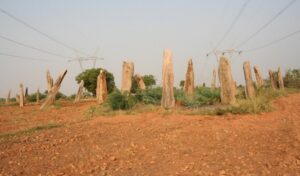
While Brahmagiri’s circles represent an established tradition, the Nilurallu alignment at Murardoddi in Andhra Pradesh consists of massive menhirs, each 12 to 16 feet in height, arranged in nearly square patterns. Unlike many other sites that are primarily sepulchral (burial-related), Nilurallu is explicitly non-sepulchral and exhibits strong astronomical orientation.
Researchers documented alignments of the standing stones with sunrise and sunset on equinoxes and solstices. Rows of stones were found to be oriented in directions corresponding to solar events, with equinox sunrises aligning close to azimuths of 89° and sunsets around 270°, and solstice-related alignments following diagonals consistent with the sun’s azimuthal range during the year (Rao et al., 2011). An azimuth is a horizontal angle measured clockwise from the north.
Besides, the shadows of the structures also tell us a lot. During specific times of the year, shadows of taller menhirs fall directly on adjacent stones, creating a sundial-like effect capable of measuring not just the day of the year, but also time intervals during the day. This dual use of direct solar alignment and shadow-based timekeeping suggests that Nilurallu may have served as a more advanced calendrical and temporal apparatus (Rao et al., 2011).
Nilaskal and Byse in Karnataka
Further west in Karnataka, the megalithic sites of Nilaskal and Byse present a different architectural typology, referred to as “avenue monuments.” While smaller in scale than Nilurallu, these sites also give evidence of astronomical orientation. Nilaskal features over 100 granite menhirs, many broken or submerged, with some as large as 6 meters in height. Byse, meanwhile, has 26 menhirs, 13 of which are still standing, often arranged in pairs or triplets (Menon, 2012).
The significant finding here is the solstitial and lunar alignment of many of these stones. By statistically comparing expected versus actual alignments, researchers have concluded that the arrangements are unlikely to be coincidental. At Byse, a total of 19 alignments were identified that corresponded with solstitial sunrise and sunset positions. In several instances, three-stone alignments seemed to “frame” these celestial events, effectively creating linear sightlines from multiple standing stones (Menon et al., 2012).
A particularly fascinating feature is that, unlike European megalithic observatories such as Stonehenge, which typically feature a central observation point, the Indian avenue sites operate through distributed sightlines. Observations could be made along various alignments depending on the season and celestial event (Menon et al., 2012).


In conclusion, the megalithic sites of Brahmagiri, Nilurallu, Nilaskal, and Byse present evidence of astronomical awareness in megalithic societies of South India. The alignments observed at these sites suggest the integration of cosmic rhythms in their architecture. And yet many other megalithic sites remain understudied, and newer ones continue to emerge across peninsular India. As archaeological methods develop and become more interdisciplinary, these sites present great potential for further exploration.
References
1. Mandal, A.K., 2020. Astronomy in Ancient India: An Introspective Study. International Journal of Advanced Research in Engineering and Technology, 11(11), pp.2293–2300. Available at: https://iaeme.com/Home/issue/IJARET?Volume=11&Issue=11 [Accessed 18 Jul. 2025].
2. Darsana, S.B., 2021. A study of South Indian megalithic culture – contributions from Deccan College. Bulletin of the Deccan College Post-Graduate and Research Institute, 81, pp.17–26.
3. Rao, M. and Marathe, A., 1989. South Indian megalithic culture: database and its applications. Historical Social Research / Historische Sozialforschung, 14(4), pp.17–23. Published by GESIS – Leibniz Institute for the Social Sciences.
4. Menon, S.M., Vahia, M.N. and Rao, K., 2012. Stone alignment with solar and other sightlines in South India. Current Science, 102(5), pp.683–684.
5. Rao, N.K., 1993. Astronomical orientations of the megalithic stone circles of Brahmagiri. Bulletin of the Astronomical Society of India, 21, pp.67–70.
6. Rao, N.K., Thakur, P. and Mallinathpur, Y., 2011. The astronomical significance of ‘Nilurallu’, the megalithic stone alignment at Murardoddi in Andhra Pradesh, India. Journal of Astronomical History and Heritage, 14(3), pp.211–220.
Image Sources
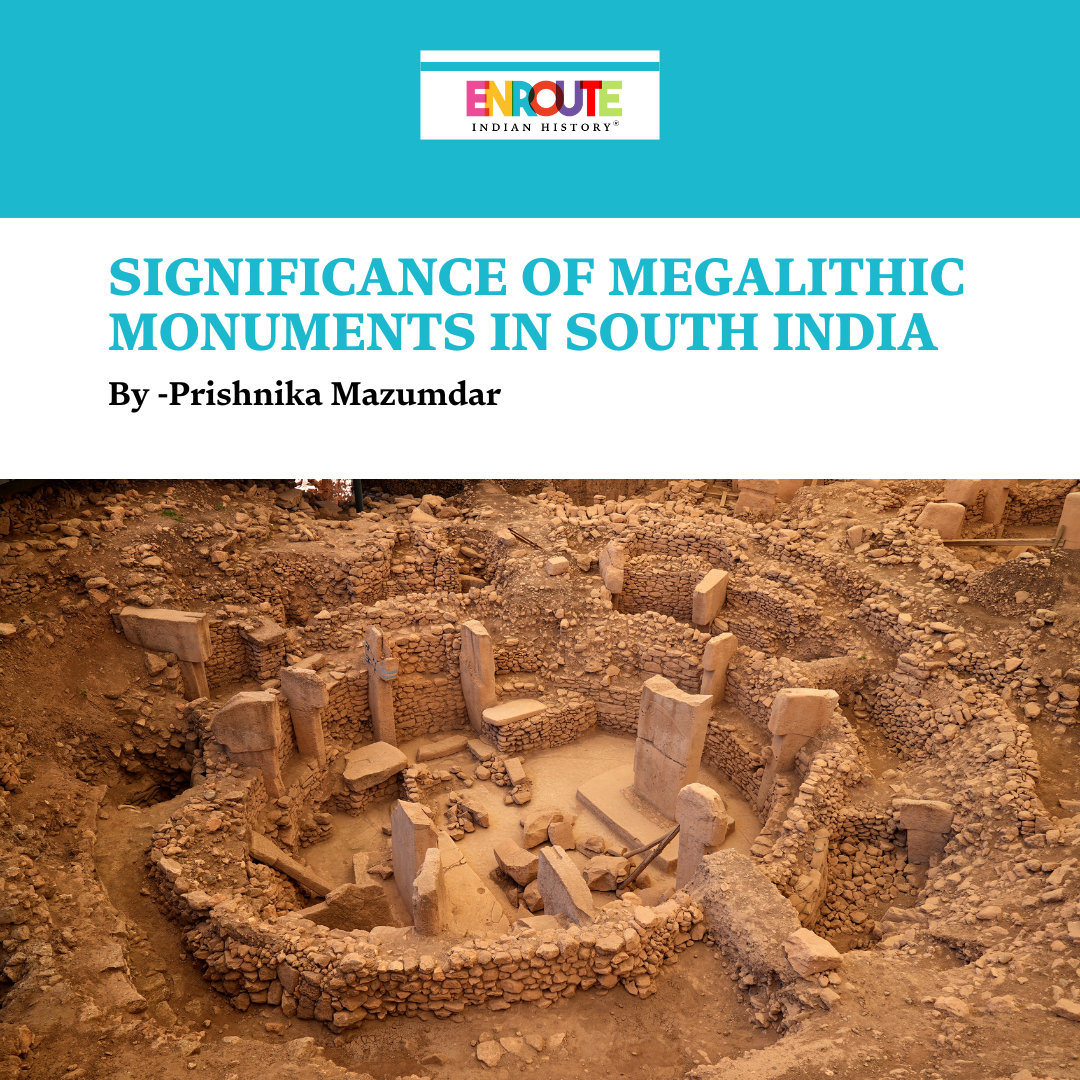
1. Representative image of Menhir.
Wikimedia Commons, 2008. Ballinagree. Available at: https://commons.wikimedia.org/wiki/File:Ballinagree.jpg [Accessed 20 Jul. 2025].
2. Megalithic circles in Brahmagiri.
Rao, N.K., 1993. Astronomical orientations of the megalithic stone circles of Brahmagiri. Bulletin of the Astronomical Society of India, 21, pp.67–70.
3. View of the Megalithic site of Nilurallu.
Rao, N.K., Thakur, P. and Mallinathpur, Y., 2011. The astronomical significance of ‘Nilurallu’, the megalithic stone alignment at Murardoddi in Andhra Pradesh, India. Journal of Astronomical History and Heritage, 14(3), pp.211–220.
4. Megalithic site of Nilaskal.
Menon, S.M., 2022. The Megaliths of Peninsular India and Their Possible Connection with Astronomy. Bangalore: National Institute of Advanced Studies.
5. A view of the Megalithic site of Byse.
Menon, S.M., 2022. The Megaliths of Peninsular India and Their Possible Connection with Astronomy. Bangalore: National Institute of Advanced Studies.