
By Arnav Kala
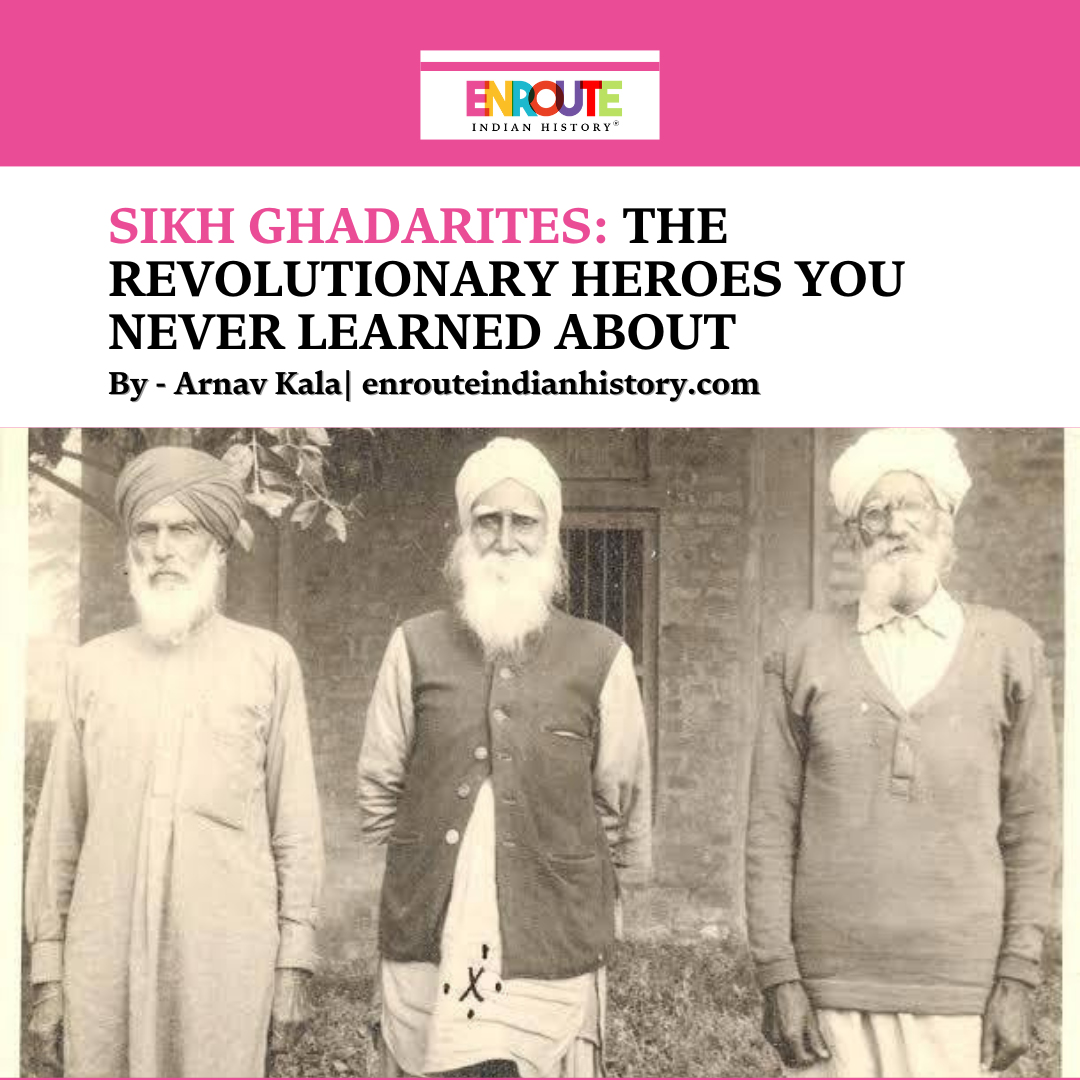
The Ghadar movement (from the Hindustani word ghadar, meaning “mutiny” or “revolt”) started in 1913 on the Pacific coast of North America. It arose among Punjabi immigrants, many of whom were Sikhs who worked in lumber camps, farms and railways in the United States and Canada. It quickly became a transnational organisation dedicated to overthrowing British rule in India. The story of the Ghadar Party connects migration, racial exclusion, diasporic institutions (most notably gurudwaras), print culture and international politics during the First World War. It shows how ordinary immigrant labourers, confronted with racial hostility and legal marginalisation, helped build a revolutionary network whose aims and actions resonated across continents.
Origins: migration, exclusion, and politics
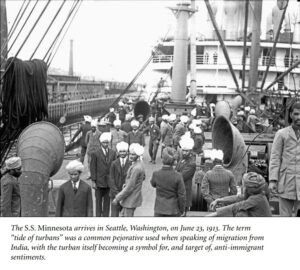
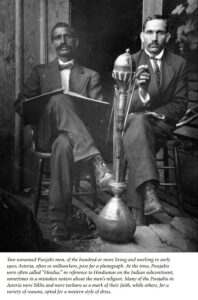
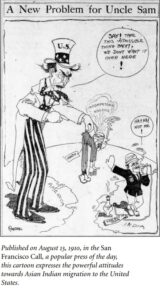
Between the late nineteenth and early twentieth centuries, Punjabis began to emigrate in notable numbers to the Pacific coast of North America. They found work in timber towns, on farms, and in railway construction. These migrants faced racial discrimination, restrictive immigration laws, and segregated labour markets. That double bind of exploitation in India and exclusion abroad shaped a political consciousness that combined grievances about working-class conditions in North America with opposition to colonial rule in India. Historian Johanna Ogden and other scholars have traced how particular local contexts, such as the logging towns of Oregon and the settlements around Fraser River in British Columbia, helped produce a sense of solidarity that was then channelled into radical politics.
Formation and organisation
In November 1913 a group of Indian expatriates established the Hindustan Ghadar Party in San Francisco (and affiliated centres grew across the West Coast, including Vancouver and Astoria). The party was multi-confessional and included Sikhs, Hindus, and Muslims, however Punjabi Sikhs were numerically prominent because of migration patterns. The movement organised around a few clear instruments: a newspaper (the Hindustan Ghadar), public meetings, fundraising among immigrant communities, and political education in gurudwaras and meeting halls. The Ghadar flag and the party’s pamphlets circulated rapidly through diaspora networks, giving the movement a capacity to reach readers and sympathisers both in North America and in India.
Ideology and aims
The Ghadarists advocated armed struggle to end British rule. Unlike mainstream constitutional nationalists, they explicitly promoted revolutionary action and the mobilisation of Indian soldiers and workers to start insurrectionary movements in India. Their rhetoric mixed republican fantasies, secular nationalism, and appeals to peasants and soldiers. Literary devices such as vigorous poetry, exhortatory pamphlets, and personal testimony were central to mobilising support. The movement’s leadership was eclectic as expatriate intellectuals, political exiles, immigrant workers, and students collaborated in shaping a militant but populist programme.
Activities during World War I: plans, missions, and repression
The outbreak of World War I created what many Ghadar leaders saw as an opportunity. The British Empire’s involvement in the war, combined with soldiers’ deployment from India to other theatres, suggested a moment when insurrection at home might succeed. The Ghadar Party organised plans for returning recruits who would travel back to India and agitate within the army and civilian populations. It also explored contacts with foreign powers hostile to Britain. In some documented instances, German diplomatic and intelligence channels were approached for support. These international manoeuvres, and the Ghadarites’ determination to ship men and materials to India, alarmed imperial authorities. The result was intense surveillance, arrests, and famous trials (often labelled the “Hindu Conspiracy” or the Ghadar trials). Many activists were prosecuted in both North America and India.
Notable personalities and martyrdom
Several individuals became central to the Ghadar narrative. Lala Har Dayal is often credited as an intellectual founder who inspired early organising among students and the diaspora. Sohan Singh Bhakna was an early president of the party and an important organiser. Kartar Singh Sarabha became a symbol of youthful sacrifice after his arrest and execution in India for revolutionary activities. In the Canadian context, Mewa Singh Lopoke, a Ghadar affiliate, assassinated an immigration inspector, W. C. Hopkinson, whom he and others saw as persecuting Indian activists. Mewa Singh’s subsequent execution made him a martyr for Sikh communities in Canada and beyond. These personalities exemplify the mixture of political calculation, local grievance, and personal sacrifice that animated the movement.
Diasporic institutions as political infrastructure
Gurudwaras, Punjabi mutual aid societies, and immigrant meeting halls were not merely spiritual or social sites, they also served as hubs for political organisation. These institutions provided space to disseminate the Hindustan Ghadar, to collect funds, to organise travel, and to recruit and train men. The Komagata Maru incident (1914), in which a ship carrying Indian passengers was denied entry to Canada and later forced to return to India, also sharpened diasporic anger and drove several community leaders toward revolutionary politics. Scholars emphasise how everyday sites of immigrant life became political infrastructures for the Ghadar movement.
Repression, trials, and the limits of the movement
Imperial counter-measures were robust. British intelligence and colonial courts pursued Ghadar activists with the help of North American authorities which led to the arrests of leading figures, and the movement’s planned uprisings in India were largely thwarted. The wartime environment and heightened security meant that many Ghadar efforts were intercepted before they could establish large, coordinated insurrections. Still, some uprisings and mutinies, although limited and eventually suppressed, did occur in India, inspired in part by Ghadar propaganda and returning activists. The legal cases in North America (including sensational federal trials) and the repression in India left the organisation weakened, yet the movement’s ideology and memory endured, feeding later anti-colonial activism.
Transnational connections and international diplomacy
The Ghadar Party’s activity illustrates how anticolonialism in the early twentieth century was genuinely transnational. Ghadarites operated across the Pacific and Atlantic worlds, coordinating with sympathisers in Southeast Asia, Europe, and the Middle East. Their attempts to gain German support during WWI show how colonial subjects sometimes sought the aid of Britain’s imperial rivals. This international dimension complicates narratives that confine India’s freedom movement to internal, India-based actors, showing instead a network of migrants, exiles, and international backers. Scholars who study global radicalism note that Ghadar was part of a broader pattern of migrants in foreign lands drawing on host-country politics, émigré networks, and wartime rivalries to challenge imperial authority.
Memory, historiography, and contemporary significance
Although the Ghadar Party played a significant role in the ecosystem of revolutionary nationalism, its story has been unevenly remembered. In Punjab, memorials and commemorative practices celebrate Ghadar martyrs and in San Francisco and parts of Oregon and British Columbia there are plaques and local histories that recall the movement’s birth. Yet mainstream histories of India’s freedom struggle have often privileged constitutionalist and mass-mobilisation narratives. Recent scholarship has tried to correct that imbalance by emphasising diasporic contributions and the multi-locational character of anti-colonial politics. Renewed interest in the Ghadar movement has also come from community historians, archival projects, and digital repositories that make primary materials (newspapers, trial records, letters) accessible on a larger scale.
Why the Ghadar story matters today
First, it expands the geography of anti-colonial struggle, demonstrating that the fight for India’s independence was not only waged in Indian cities and countryside but also in immigrant quarters on other continents. Second, it unsettles simple binaries that migrants were not merely victims of racism abroad but active political agents with ambitions for their homeland. Third, the Ghadar movement shows how diasporic communities can become nodes of political contestation when transnational grievances converge with local oppression. Finally, contemporary debates about migration, citizenship, and transnational political activism can draw lessons from the Ghadar experience, which includes how host societies’ exclusionary policies can politicise immigrant communities in unexpected ways.
Conclusion
The story of the Sikh Ghadarites and the wider Ghadar movement is an essential chapter in the history of anti-colonialism. It demonstrates how the Indian freedom struggle was global in reach and complex in means that included combining print propaganda, migrant organising, daring plans to foment insurrection, and courageous individual actions that sometimes ended in imprisonment or death. The movement’s legacy is both inspirational and sobering as it testifies to the capacity of marginalised communities to imagine radical alternatives, while also reminding us of the heavy costs of political repression.
References
1. Johanna Ogden, Ghadar, Historical Silences, and Notions of Belonging: Early 1900s Punjabis of the Columbia River, Oregon Historical Quarterly (PDF).
2. The Ghadar Party: Freedom for India, Pluralism Project (introductory PDF on movement origins and organisation).
3. “The Ghadar Movement” (Socialist Studies — accessible paper outlining aims and activities)
4. A Forgotten Revolution: Understanding the Ghadar Movement’s Global Dimensions (Rice University repository — essay on wartime strategies and international contacts).
5. Oregon Encyclopedia / Oregon Historical Society articles on East Indians of Oregon and the Ghadar Party (context on local immigrant life and politics).
6. UFV (University of the Fraser Valley) booklet: Interpreting Ghadar: Echoes of Voices Past (conference booklet with accessible summaries and bibliographies).
7. Harish K. Puri and other monographs and articles collected in various institutional repositories on the Ghadar movement (survey essays and primary documents).