
By Anusha Khan
The Empire Awakes to Sound
At daybreak in Akbar’s court, power announced itself with a striking sound. The kettledrums thundered from the naqqarakhana, reverberating across palace walls and spilling into the streets. Abul Fazl, describes how “at dawn the musicians blow the surna to wake those who are asleep; a little later the naqqaras commence, when all musicians raise the auspicious strain.” These drums formed part of a complex timetable of empire, where the city’s day could not begin until the emperor’s music had sounded it into being.
The paintings of the Akbarnama make this world visible. When Akbar entered Delhi, long trumpets arc above the city gates, their sound imagined as ushering him in. In folios of battle, fortress drummers pound from the towers even as chaos erupts below. The artists place them deliberately: music is not background but a symbol of sovereignty, as essential as elephants, banners, or swords.
But what kind of politics is this, where music becomes a clock, a proclamation, a command? Was the drumbeat a comfort—proof of order—or was it intrusive, a reminder that even time itself belonged to the throne? The naqqarakhana bound the people into a rhythm that was both cosmic and political, both awe-inspiring and inescapable.
Music, however, was more than discipline. It was woven into the very fabric of Mughal court culture. As the Indo-Persian chronicles remind us, Akbar, Jahangir, and Shah Jahan were all described as great patrons of Hindustani music. Terms like raga, kalawant and dhrupad appear in Persian chronicles without any explanation of their meaning, signifying their entry into everyday vocabulary of the Mughal court. By the end of Akbar’s reign, Hindustani music had become so natural to the courtly elite that it spoke for itself. Miniature paintings reinforced this truth, showing Indian instruments and ensembles as central to imperial life.
This essay listens for those sounds—in chronicles, in paintings, in instruments—to hear how the Mughal court itself was sounded into being.
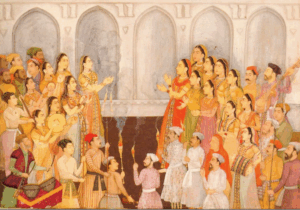
female musicians at Aurangzeb’s wedding; Beach and Koch 1997.
Patronage and Order: Akbar’s Musical World
Music lived in Akbar’s court, shaping him as surely as the empire he governed. Abul Fazl writes that he had mastered the science of music to a depth that even trained musicians rarely reached. He was a skilled player of the nakkarah and knew deeply the science of music. That a chronicle composed to exalt his kingship should highlight his skill as a singer tells us that music was part of the fabric of sovereignty.
The emperor trained under Lal Kalawant, one of the great masters of his time. He could distinguish ragas by ear and took delight in testing musicians on their subtlest turns of melody. The Ain-i Akbari catalogues this world with the same bureaucratic detail it gives to armies and revenues. Abul Fazl names musicians, notes their origins—Hindustani, Irani, Turani, Kashmiri—and describes their ranks. Music appears not as a diversion but as an institution. Performers were ranked according to talent, assigned salaries, and in some cases elevated to amir status, the same rank granted to military commanders. What kind of empire counts ragas alongside regiments? Perhaps one that understood culture not as luxury, but as part of governance itself. To rule an empire, Akbar seems to have believed, was also to orchestrate it.
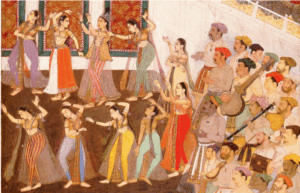
Shajahan’s birthday celebrations; Beach and Koch 1997
Instruments of Fusion: Indian and Persian Soundscapes
Akbar’s court was designed to embody power as well as cultural synthesis in sound. At the center of this orchestration was the bin (vina), the long-necked Indian zither, most famously played by Tansen. In both texts and paintings, the instrument appears as the backbone of the ensemble. The bin symbolised the empire’s classical depth and refinement in Akbar’s court.
Beside it often stood the rebab, a Central Asian lute that Andrew Grieg notes gradually acquired Indian qualities. Its sharper tone set against the bin’s resonance created a blend of Timurid past and Indian present. Was this a political metaphor? a demonstration that two traditions could resonate in harmony under imperial order?
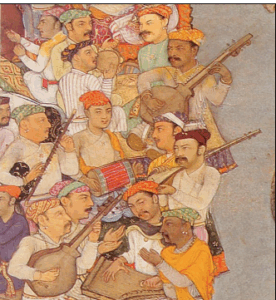
male dhol and kanjari players; Beach and Koch 1997
Other instruments added layers to this soundscape. The nai, a vertical flute of the Islamic world, appears in paintings alongside daf and rebab, marking its role in ceremonies and festivals. The chang, a Persian harp, rippled with delicate tones; the daf and dhol kept rhythm at rituals; the shehnai marked weddings and triumphs; and the long karnai trumpets pierced the air, punctuating moments of imperial authority.
Miniatures also show female musicians at weddings and mehfils, hands poised on vina and drum, accompanying singers and dancers. Their presence reminds us that the creation of Mughal music was not only a male pursuit but a shared act, with women shaping the refinement of the court’s culture.
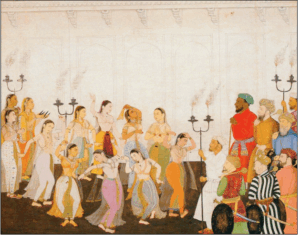
wedding of Dara Shikoh; koch 1997
Taken together, these ensembles represented harmony. Of course, such harmony was not without tension. Musicians carried rival traditions, distinct tunings, even competing claims to authority. Yet, under the eyes of the court they become metaphors for Akbar’s vision of sulh-i kul, “peace with all.” The court ensemble itself became a metaphor for empire: different voices brought together, tuned into harmony under the emperor’s gaze.
Music in Image: Paintings as Sonic Archives
If Abul Fazl’s descriptions are the written record of music at court, the Akbar Nama paintings are its visual echoes. They invite us to imagine sound. Musicians appear in more than thirty folios, placed in the heart of action, their instruments painted with such care that one can almost hear them.
Take the folio of Prince Salim’s birth. Courtiers gather in solemn attention, but look closer and musicians lean into their instruments, their lips parted as if the prince’s very first cry was joined by the music of the empire. At royal weddings, shehnais curl into the air and trumpets blare from the gates, their sound not trapped in miniature but seeming to spill outward to greet us as viewers. Even in the midst of violence in one painting of an assassination attempt on Akbar fortress drummers continue their pounding in the background. The emperor may be under attack, but the rhythm of sovereignty does not falter.
Earlier illustrated manuscripts in Akbar’s library, like the Tutinama, folded music into their visual storytelling. In one tale, the parrot Tuti insists that a man’s character can be judged by his reaction to music. The accompanying illustration corresponds to it: singers lift their hands in song, surrounded by an ensemble of bin, chang, daf, flute, naqqara, and cymbals. Whether or not such a group ever played together is less important than what the painting suggests that music, like character, was a test of truth.
Bonnie Wade also reminds us that the paintings themselves carry traces of synthesis. Their style combines indigenous Indian forms, pre-Mughal Indo-Persian conventions, and Safavid Persian techniques. This fusion in pigment mirrors the fusion in sound: just as the rebab met the bin in duet, Persian brush met the Indian line on the same page. The meeting of visual languages becomes another archive of the same cosmopolitan spirit that animated Akbar’s music.
Why such insistence on music in paint? Why place musicians at births, marriages, battles, even moments of mortal danger? Because in the Mughal imagination, music was one of the scaffolding of the empire. A wedding without shehnai, a battle without drums, would have been unthinkable. In painting, as in life, music was inseparable from the empire.
To listen to the Mughal court is to hear sovereignty in many registers. The booming kettledrums of the naqqarakhana announced order at dawn and dusk, making the emperor’s presence vibrate through the city itself. The vina and rebab, the chang and shehnai, played together in ensembles that mirrored the empire’s vision of harmony-in-diversity. But what do we do with these sounds now? How do we listen to an empire that no longer exists, when all we have are chronicles, paintings, and fragments of memory? Can we recover the vibration of a drum that announced sunrise four centuries ago? Or the exact raga that once made Jahangir forget time itself?
Perhaps the answer lies not in recovering the exact notes, but in recognising what music meant to the Mughals. It was ritual, it was spectacle, it was intimacy, it was knowledge. It measured time, staged politics, and unsettled hearts. To study Mughal sovereignty, then, is not only to read edicts or measure armies, but to listen: to the rhythm of drums across a city, to the blending of vina and rebab in a hall, to the single human voice that could bring an emperor to tears.
References
Brown, Katherine Ruth Butler. Hindustani Music in the Time of Aurangzeb. PhD diss., SOAS University of London, 2003.
Kaur, Manpreet. “The Contribution of Mughals in the Field of Music (1526–1707).” Research Review International Journal of Multidisciplinary, vol. 11, no. 1, Jan.–June 2023, pp. 34–45. ISSN 2320–7175.
Sen, Geeti. “Music and Musical Instruments in the Paintings of the Akbar Nama.” Marg, vol. 36, no. 4, 1985, pp. 25–36.
Wade, Bonnie C. “The Meeting of Musical Cultures in the 16th-Century Court of the Mughal Akbar.” The World of Music, vol. 32, no. 2, 1990, pp. 3–26.