
P.Sanjay
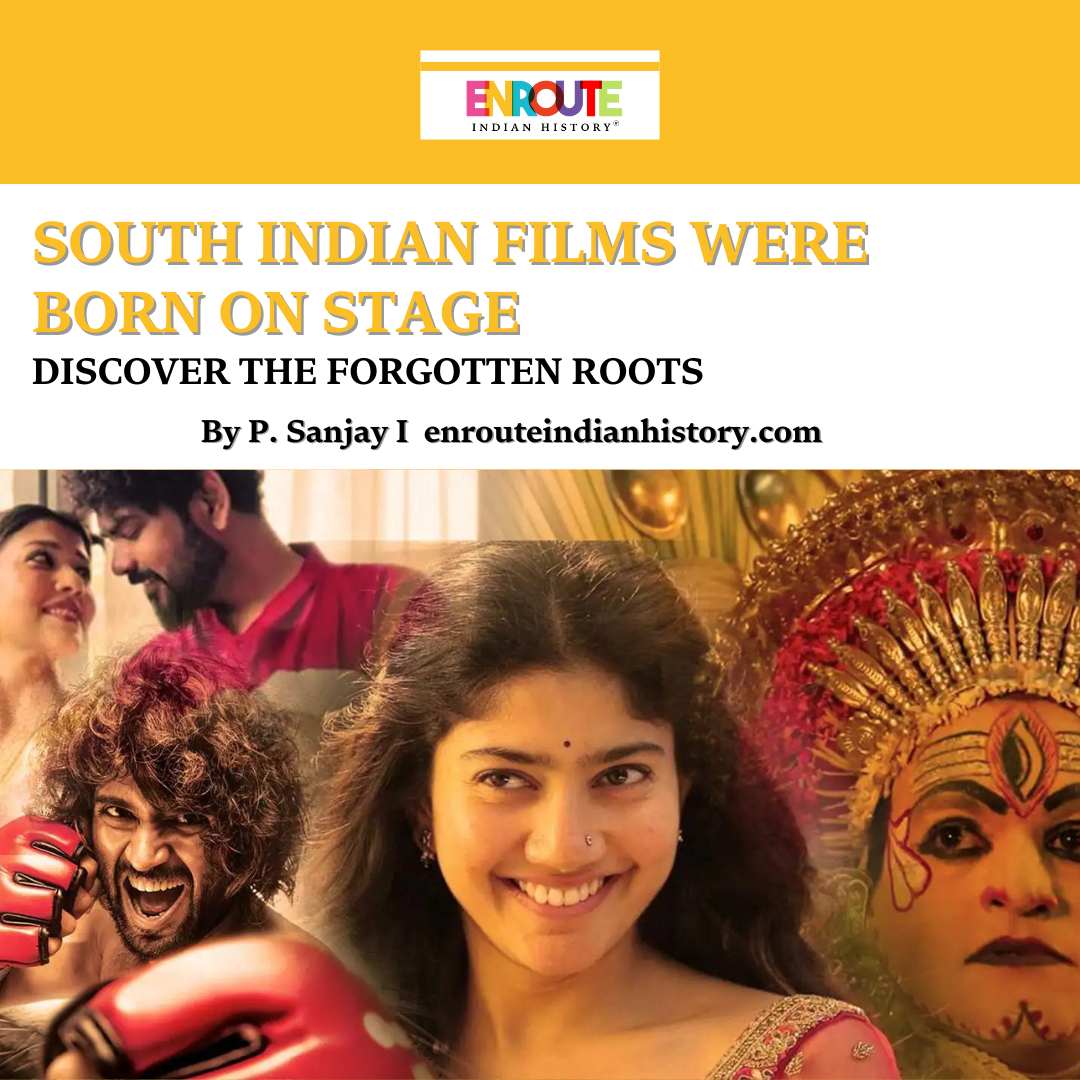
This paper looks into the movies of South India which brings the theatre art into the urban spaces. From the rudimentary stages to the big screens these traditional theatre art have caught the eyes of a large number of audiences. This article focuses on four movies – Jama (2024) – a tamil movie which is based on therukoothu; Vanaprastham (1999) – a Malayalam movie which portrays the richness of Kathakali; Veera Chandrahasa (2025) – which is a drama movie solely based on Yakshagana traditional art of Karnataka.
Packing bags in the summer holidays, leaving these urban cages and flying to the peaceful countryside. Summer vacations will always remain as a relief from the stressful life. The time one spends with their grandparents, the post-harvest season with a range of temple festivals and rituals which keeps villagers engaged with the village commune and their practices which inturn accompanied by rich theatre art traditions. These traditional theatre and ritualistic dance differs in each region with certain similarities. “Therukoothu” in Tamilnadu, “Yakshagana” and “Theyyam” in Karnataka and “Kathakali”, “Chakyar koothu” and “Koodiyattam” in Kerala are some of the examples of theatre art and ritual dance.
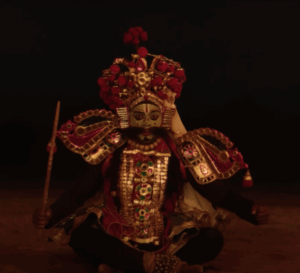 Kalyanam performing Arjuna in the movie “Jama” (Source: Divo Music, Youtube).
Folk theatre is the theatre of the masses which eloquently reflects the beliefs, traditions, culture and the rituals of the rural folks. It’s not the usual stages we often see in today’s urban scenario; instead the rural audience normally sits on the ground on three or all four sides of the acting area, usually a single rectangular platform on a circular clearing in the middle. The audience is at liberty to see the performance in their comfort; they can stand, sit, recline or choose whatever stance or manner in which they wish to see the performance. Folk theatres now have been transformed to big cinema screens. Urban spaces have evolved into an elitist culture where rural folk art has lost its relevance and limits itself to the countryside.
This article speaks about the movies of South India which brings the theatre art into these urban spaces. From the rudimentary stages to the big screens these traditional theatre art have caught the eyes of a large number of audiences. This article focuses on four movies – Jama (2024) – a tamil movie which is based on therukoothu; Vanaprastham (1999) – a Malayalam movie which portrays the richness of Kathakali; Veera Chandrahasa (2025) – which is a drama movie solely based on Yakshagana traditional art of Karnataka.
Starting with the movie Jama (2024) – which literally means a drama troupe, directed by Pari Elavazhagan based on real life incidents. There is this fear that Indian cinema will turn out to be a major reason for the vanishing of the Indian Folk Theatre but movies like Jama seek the attention of the audience to bring them back on screens. The story centres around Kalyanam, who is the artist in the troupe and plays women characters of Draupadi and Kunti and other male characters are performed by Thandavam, who leads the troupe and lords over his actors like a dictator. Kalyanam’s only wish was to get back the Jama under him as earlier it was under his father and to play the character of Arjuna. After struggling too much, Kalyanam performs the Arjuna character which impresses the whole audience. This is how he introduces himself through the unique dialogue delivery –
“It’s me the son brought up by Lord Indhiran”
“King Arjunan stands in front of you.”
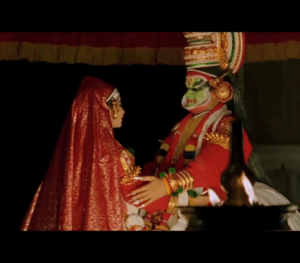
Subhadraharanam in the movie “Vanaprastham”
The movie also questions the patriarchal approach of society as it portrays masculinity in a different way. When the woman says that she fell in love with her husband (therukoothu artist) because of the female roles he played. Therukoothu also represents the social reality of the society as a dialogue between the artist and the audience. The Kattiyankaran who is not at all related to the narrated story, he is an important character in the play as he makes the story contemporary and includes the contemporary context.
Vanaprastham(1999) is also the story of an artist who is associated with Kathakali directed by Shaji N Karun. Kunhikuttan, who is a well revered artist in Kathakali, someone who even impresses the king and gets reward. On stage, he is celebrated, adorned god-like with deep respect and honour but his sorrow comes into existence as soon as his makeup fades away. Kunhikuttan’s father refused him as soon as he was born because of his mother belonging to a lower caste, he stays in a loveless relationship just because of his daughter, his mother always remains silent. Nothing gives him happiness except the art he performs “Kathakali”.
During his performances, Subhadra (the Maharaja’s neice) fell in love with the Arjuna character that Kunhikuttan plays. She was herself confused with Kunhikuttan playing Arjuna and the real Arjuna. As Subhadra is a playwright, she earnestly wants to write a play portraying Arjuna abducting Subhadra (Subhadraharanam). A romantic relation between these two produces a child that Subhadra claims to be the son of Arjuna rather than Kunhikuttan adding insult to injury. Kunhikuttan stops playing the character of Arjuna and expresses his anger by playing demonic characters in the plays and consumes alcohol. He for one last time performs with his daughter playing the role of Subhadra that too to make her feel how it feels without the loved ones. At the end, when Subhadra reads one of the discarded letters by Kunihuttan, she realizes her mistake, but till then it was too late as a message reaches her that Kunhikuttan had died. Throughout the movie, metaphors have been used at many scenes and carefully looking into the details.
Apart from the story, the movie also depicts the economic realities of the theatre artists as how they live in pitiful conditions. They live in such poverty that tearing of the Chenda(drum) is a disastrous event as they didn’t have money to change the leather of the drum, rather they borrowed another chenda for the performance. When one of the members of the troupe gets affected with cancer, he performs in front of the king and asks him to provide treatment for the vocal accompanist as reward which also shows their support for the troupe members. It also challenges the caste system, as Kunhikuttan goes to Kashi and performs rituals for the death of his father which he is expected not to perform because of being born to a mother belonging to a lower caste.
The last movie Veera Chandrahasa (2025) – Directed by Ravi Basrur, portrayed the Yakshagana art form as close to reality in silver screens. The movie portrays the story of Chandrahasa which is described in Mahabharata. It is a traditional story of Mahabharata where an orphan lad, who becomes a warrior of the Kuntala Kingdom, actually belongs to a royal lineage. Dushtabuddhi (minister) who wants to take control of the Kuntala kingdom sees him as a barrier. He tries to kill Chandrahasa in various situations but he fails. The story gets a twist as Chandrahasa marries the daughter of Dushtabuddhi. Later, Dushtabuddhi realises his mistake but it’s not where the suffering of Chandrahasa ends but starts. The movie ends here, but the story does not. Veera Chandrahasa Part – II will be released.
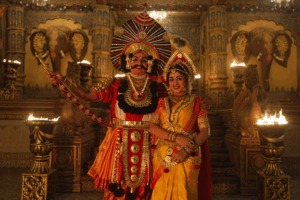 Chandrahasa and Champakamalini from the movie “Veera Chandrahasa”
Wearing the costume of Yaksha (demi – god) and interpreted the story through song (gana) and dance. Hence, name Yakshagana (“Songs of the Demi – Gods”). There are two prominent schools of Yakshagana, “Thenkuthittu” and “Badaguthittu”, where Veera Chandrahasa is the collaboration of both the styles. Traditionally, after the harvest time the performance blossoms into the open air as Bayalatta. The Yakshagana stage is set before the village temple. After the puja in the evening, approaching darkness envelopes the audience, gas lamps are lit. With gods implored, the junior Bhagavata (narrator), clowns, and musicians enter the stage area. The musicians with their instruments like chenda, either mridanga or maddala drums; cymbals or gongs; and either harmonium or mukhaveena provides a background for the clowns, who entertains the audience and then the play starts which goes till morning.
Traditional theatrical arts are not just performance or plays, but they are living embodiments of regional history and cultural aesthetics that have evolved through centuries. Whether it is the evocative gestures of Kathakali, satirical flair of Therukoothu, or the richness of Yakshagana. In the face of modernity and urban detachment, cinema emerges as a powerful medium to revive these endangered art forms. Films like Jama, Vanaprastha, and Veera Chandrahasa bridge the gap between the rural stage and the multiplex screen. These movies bring backs the forgotten stories, folklores, songs and even the social realities of the artists who are being involved. They provide new dimensions to the age-old traditional themes. Surely, cinema cannot replace the village stages but might influence people to support them.
References
Tanvir, H. (1974). Theatre Is in the Villages. Social Scientist, 2(10), 32–41. https://doi.org/10.2307/3516486
Kumar, Manish.(2019)“Drawing Parallelism of Alienation in Brecht’s “Epic Theatre” and Therukoothu.” Theatre Street Journal, vol. 3.
“Ranganath, H K .(1960) The Karnatak Theatre , Karnatak University, Dharwar, pp. 30-76.
https://cinemanrityagharana.blogspot.com/2010/11/film-thoughts-vanaprastham-1999.html
Ashton, M. B. (1969). Yakshagana. A South Indian Folk Theatre. The Drama Review: TDR, 13(3), 148–155. https://doi.org/10.2307/1144470