
RAVNEET KAUR
Thangka, meaning “something that can be rolled up” in Tibetan, are Buddhist scroll paintings. The name signifies the function as Buddhist monks and others as on market days and celebrations, the thangka would be unfurled, and stories would be told about deities and saints as they pointed out elements in the painted tableaux. Show and tell ties at the heart of the tradition.
The Thangka is a map leading to the realm of the divine, where one encounters the Buddhist deities, mandalas, mystics, godly and enlightened beings of the Buddhist tradition as one moves forward. They are based on Patas and Paubhas – paintings done in India and Nepal showing symbols of deities, saints and other elements. Patas are still made in India, while Paubhas are made by the Buddhist Newari community in the Kathmandu valley. Thangkas are made using cotton, silk, appliqué, brocade and embroidery. The cotton cloth of the thangka is first fastened to a stretcher to keep it taut, and the painting is done.
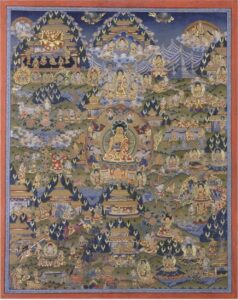
Life of Buddha, Tibetan Thangka. Meulenbeld, Ben. 2001. Buddhist Symbolism in Tibetan Thangkas: The Story of Siddhartha and Other Buddhas interpreted in Modern Nepalese Painting. Holland. Binkey Kok Publications.
FUNCTIONS
As the name suggests, storytelling and spiritual preaching are at the heart of the thangkas. This is why travelling monks, lamas, and Buddhists guard their thangkas and travel with them. Moreover, the very nature of folded thangkas allows easy transportation. It is only the enthusiastic art lover or antique collector who hangs the thangka for the aesthetics in their living room.
The most important function, as author Ben Meulenbeld in his book Buddhist Symbolism in Tibetan Thangkas (2001) points out, is religious aid in ritual actions or as a guideline in meditation. It is summarised as “liberation through beholding”. On one hand, the unveiling of thangkas is believed to grant spiritual merit by the act of sight and on the other, it serves as focal points for concentration. Meulenbed writes that this way “thangkas provide in visual form precise iconographic information that the meditator can utilise”.
Another feature is that thangkas are believed to ward off evil, illness, death and other problems through their positive force or energy and at times are commissioned by families, particularly for this reason. Such thangkas only display lucky symbols, astrological configurations and medicinal plants. Meulenbed argues that herein, the thangka gains the function of a “lucky charm” or “amulet”.
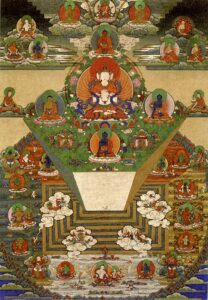
Mt. Meru and the Buddhist universe, 19th century, Trongsa Dzong, Trongsa, Bhutan. Wikipedia Commons.
THEME AND COMPOSITION
The thangkas as pertaining to the Buddhist tradition, depict the Buddha, his life, bodhisattvas, other Buddhist deities – both benevolent and malevolent and other mystic and lesser beings. Hierarchy is central to the composition of any thangka. The primary deity is always at the top or centre and usually the largest in size. Then in the order of decreasing importance come – bodhisattvas, yidams, dakinis, dharmpalas, lokapalas and lesser deities.
Accompanying the beings are elements of nature – mountains, rivers, lakes, waterfalls, clouds, flowers, trees and animals. Along with this, several symbols dot the thangkas, such as – treasure vase, a conch shell, the wheel, the lotus, a victory banner, the parasol, and several mudras (hand gestures). All of these elements and symbols have their own significance, which impart various teachings of Buddhism. They serve to visualise the theoretical framework of the tradition. To not understand these imageries and their symbolism would be to not understand the whole thangka itself.
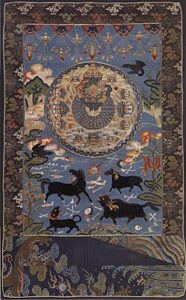
Mount Meru, Tibetan Thangka. Wikipedia Commons.
THE HIMALAYAS AS SACRED PILLARS
As Tibetan Buddhism is nestled in the Himalayas, it is obvious that they frequently make their appearance in the thangkas. Moreover, in the Buddhist cosmology, the mythical Mount Meru is a crucial spiritual element. Similarly, Mount Kailash, also revered in Buddhist tradition, is the home of several sacred deities such as Chakrasamvara, Padmasambhava, Dakinis and other protective spirits.
According to the legend, after the churning of the ocean, Mt. Meru emerged with four directional faces and was composed of precious elements like – crystal, gold, ruby, lapis lazuli, sapphire and so on. Surrounding the Mt Meru are supposed to be seven concentric rings of golden mountains. Though it is a mythical mountain, it is believed to be in the Himalayan ranges of Northern India and Tibet. The seven rings of mountains are seen as other Himalayan ranges.
Mt. Meru is considered to be the axial centre of the universe, and within the human body, it symbolises the central channel. Iconographically, according to Robert Beer (1999), it is represented by a central vertical “brahma line” that runs through the centre. And in mandala thangkas, it is intersected by a second horizontal brahma line.
It is no wonder that staying in the Himalayas, be it India, Tibet, Nepal or Bhutan, the thangka painters have always used the majestic Himalayas as the backdrop when painting thangkas. The Himalayas represent the timeless and unchanging nature of dharma and thus serve as symbols of spiritual centrality. They symbolise truth, guardianship, and their peaks show the ascent of the soul to higher wisdom.
Spiritual ascent is visualised through the steep and snow-covered peaks of the Himalayas. The Himalayas showcase the meditative path towards achieving higher consciousness and breaking free of the illusions of samsara. In this manner, the real geography of the Himalayas is intertwined with mystical and spiritual realms in the Buddhist thangkas.
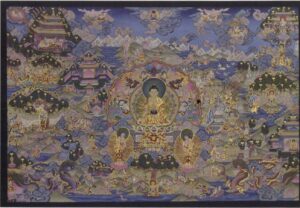
Life of Buddha. Meulenbeld, Ben. 2001. Buddhist Symbolism in Tibetan Thangkas: The Story of Siddhartha and Other Buddhas interpreted in Modern Nepalese Painting. Holland. Binkey Kok Publications.
THE SYMBOLISM OF NATURE
Nature captures the essence of Buddhist teachings and visualises them. In the thangkas and other forms of visual art, they are not mere decorations but spiritual symbols. They impart teachings, cosmic law, and express insights. The white elephant in Maya’s dream foreshadows Buddha’s birth; Lake Man Sarovar and other water bodies symbolise vitality, movement, and the cycle of birth, death and rebirth; the opening of lotus petals shows unfolding spiritual awareness, the Bodhi tree stands for enlightenment, and several other Himalayan trees like cedar, rhododendron and juniper dot the landscape of the thangkas.
All of them stand for something of their own and not as props. Furthermore, there are visualisation tools, aids in meditation, and offer insights on Buddhist teachings, cosmology and laws. Above all, they help us in understanding the interconnectedness of life and remind us that nature is a part of the spiritual journey towards enlightenment.
BIBLIOGRAPHY & REFERENCES
1. Meulenbeld, Ben. 2001. Buddhist Symbolism in Tibetan Thangkas: The Story of Siddhartha and Other Buddhas interpreted in Modern Nepalese Painting. Holland. Binkey Kok Publications.
2. Beer, Robert. 1999. The Encyclopaedia of Tibetan Symbols and Motifs. Massachusetts. Shambhala Publications, Inc.
3. Symbolism of Nature in Thangka Art: Mountains, Rivers and Flora (https://enlightenmentthangka.com/blogs/thangka/symbolism-of-nature-in-thangka-art-mountains-rivers-and-flora?srsltid=AfmBOoqoby4MYYuBn5xizf0box764daNWlsvZCuK11VidpPoWInC1w4H)
4. Singh, Vaishnavi. Barthel, Alexandre. 2025. Buddhist Scroll Paintings and Outdoor Ceremonies in Korea and Ladakh. China. 22nd National and International Conference on Humanities and Social Sciences. (View of BUDDHIST SCROLL PAINTINGS AND OUTDOOR CEREMONIES IN KOREA AND LADAKH)