

RAVNEET KAUR
“Spring has brought forth groves of flowering
Palasha trees swinging in the wind, bowed
with loads of flowers resembling raging fire
and the earth resembles a just-married bride
dressed in elegant radiant red attire.”
~ Kalidasa, Ritusamhara
Every poet of feeling has written a worthy couplet or two on the joys and unadulterated bliss of spring after the season of frosts. One such delight is the Vasanta Vilāsa, trans. The Joys of Springtime, a 14th century poem in Old Gujarati. Vasanta Vilāsa heralds the arrival of springtime and speaks alike of the joys and sorrows that come along. The text is laced with Shringara rasa and erotic sentiments. The poem is great significance in terms of its literary genre, phāgu; its place in old Gujarati literature; “and its unique character as a repository of an extensive series of paintings in the Early Western Indian style devoted to secular themes rather than the Jaina religious subjects with which most of that art is concerned.”
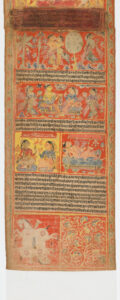
Figure I: Vasanta Vilāsa Scroll Manuscript, Opaque watercolor, ink and gold on paper mounted on cloth, 1451, Gujarat. Freer Gallery of Art Collection. (https://share.google/szhzYKT0E4IwUtfTK)
THE VASANTA VILĀSA MANUSCRIPTS
Keshav Harshad Dhruv first discovered the Vasanta Vilāsa scroll manuscript (S) and published it Gujarat Salapatra in 1892. The scroll manuscript has 85 stanzas and thus is known as the longer recension. Later, he found manuscript B at Bhandarkar Oriental Research Institute, which now houses both manuscripts A and B, and published it with notes in Haji Muhammad Smarak Granth (1923). In 1942, Professor Kantilal B. Vyas republished the text as Vasanta Vilasa edited with a critical introduction and explanatory and philological notes. By 1932, another manuscript (C) was found from Muni Sri Jinavijayaji. In1947, Vyas published his Vasanta Vilasa: The Revised Collated Text, using manuscripts A, B and C to do a comparative study of the text. By 1953, two other manuscripts – G and L. Manuscript L is the short recension with 52 stanzas. By 1954, manuscript P were discovered making a total of seven manuscripts all in all.
Manuscript S is of grave significance as it mentions the copyist’s date to be 1451 CE, thereby guaranteeing the “lower limit for the work’s date”. The scribe mentions both his name – Acharya Ratnagara – and that of his patron – Śāha Śri Candrapāla. The S is made up of paper mounted on a cloth.
Each verse of the text in old Gujarati is accompanied by stanzas in Sanskrit or Prakrit. Followed by a painting illustrating, more or less, the central theme of the stanzas. The text is on black or coloured ink on a plain white surface while every fifth stanza is in gold with a red background. All stanzas conclude with auspicious words or phrases.
Vyas gives the approximate date for the text to be 1343-1368 CE based on orthography of the manuscripts and his comparisons of phonology and morphology of the text with old Gujarati specimens (Bender, 1947). The original author of Vasanta Vilāsa remains unknown. One question of contention was whether or not the author was Jaina or not. Vyas holds that the writer is a non-Jaina and that the work might even be Brahmanical. Chanchani (2012) furthering Ratnagara’s cause calls him “a creator” and illustrates his role as more than a mere copyist as and when he moulds, manipulates and embellishes the text with his own additions\.
The accompanying Sanskrit and Prakrit stanzas have proven to be full of intrigue too. W. Norman Brown makes two arguments – firstly, the Vasanta Vilāsa began as a text of 50 or 52 verses and over time grew into a work of 84 stanzas by the mid-15th century. Secondly, the accompanying Sanskrit and Prakrit stanzas were not a part of the original Gujarati work but subhasitas, a later addition of the poets to satisfy their own poetic appetites. Scholars also make note of the absence of Perso-Arabic words in the poem which otherwise were a common enough occurrence in other works of the mid-14th to 15th century of the subcontinent, with Bender remarking that –“words of Perso-Arabic origin are conspicuous by their absence.”
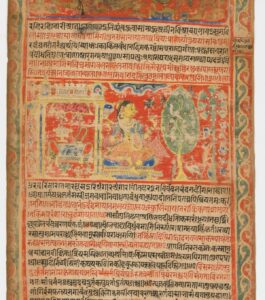
Figure II: Vāsakasajjā nāyikā. Vasanta Vilāsa Scroll Manuscript, Opaque watercolor, ink and gold on paper mounted on cloth, 1451, Gujarat. Freer Gallery of Art Collection. (https://share.google/szhzYKT0E4IwUtfTK)
POETIC DELIGHTS AND FANCIES
The Vasanta Vilāsa is a phāgu – a non-sectarian regional genre – “extolling the pleasures of springtime.” The poem is an ode to the season of spring and its brimming life force. The verses are centred around lovers in pursuit of their beloved and how the latter eventually succumb to such charms. It relegates the pangs of separation when the couples separate and describes how the lovers engage in love ecstasies with abandon upon union.
The lush and abundant springtime is the backdrop for all trysts and rendezvous. The garden or the forest becomes the metaphorical city of Kamadeva, the god of love, where the lovers meet and indulge. The blossoming flowers become an allegory when the rueful wife reprimands her adulterous husband and compares him to an ever restless bee.
The Sanskrit verses are also “polysemic” (Chanchani, 2012) and drawn from Kalidasa and Magha’s Mahakavyas. In the stanzas, Kama emerges as an intolerant commander “armed with a bow and arrow, as well as the fixed gaze of an archer, Kama, like the rays of his friend the moon, pierces the hearts of obstinate women and triumphs.” The lovers further moulded into nayikas of classical Sanskrit drama.
Shiva’s romance with Bhilana, a tribal woman, is also showcased. It is seen as a plea for Shaivism – “reviving Shaivism by refurbishing Shiva’s image as a passionate householder and not an ash smeared wanderer among crematoriums” – in an era when Vaishnavism enjoyed popularity and patronage.
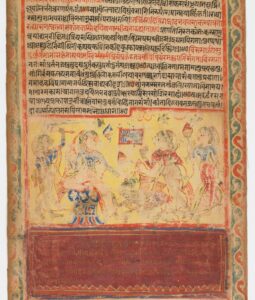
Figure III: Svādhinpatikā nāyikā. Vasanta Vilāsa Scroll Manuscript, Opaque watercolor, ink and gold on paper mounted on cloth, 1451, Gujarat. Freer Gallery of Art Collection. (https://share.google/szhzYKT0E4IwUtfTK)
THE SCROLL PAINTINGS
The length and breadth of the paintings “is virtually unparallel[ed] in the history of Indian painting.” There are about 78 preserved illustrations. Each panel is an individual work, each separated from the other while the whole work shows cohesion and unison use of established local conventions. The scroll paintings are interesting specimens of early Western Indian Paintings as they are not particularly Jaina in content and expression unlike the vast majority of the school.
The paintings depict lovers in beds, elegant pavilions, ponds, pastures, picnic in groves of mango and banana trees, woods inhabited by wildlife like lions, macaques and cuckoos “threading of compositions into garlands to visualize the leitmotifs of love in separation and in union.”
The Sanskrit nayikas add another interesting layer atop.
“Stop [warbling], stop at once, female Kokila! Look my house over well!
My dear lord has not yet come; the sport of springtime does not me”
So chides the Vāsakasajjā nāyikā (Figure II),the wife who adorns herself and waits upon her husband. In Figure she can be seen seated her gathering clouds, which overshadow her own forlornness. The blooming spring fails to bring her to newer pastures. On the other hand, Figure III, showcases the svādhinpatikā nāyikā, who bosses around her husband. She can be seen seated and fanned while her husband
While the verses complaining of the unrelenting moonlight are followed by an illustration of the utkā nāyikā, who falls ill by looking at the moon and is being comforted by a friend.
Further ahead, the lovers are painted in various embraces and coital positions (Figure V). Chanchani (2012) believes that the postures parallel the prescriptions of “widely circulating Kamasutras” and was partly to transmit carnal knowledge to its patron, a nagarika “living in the recently founded city of Ahmedabad” and newlywed chaste wives who had to “devise schemes to compete with courtesans” and lure their husbands to the marital bed.
Another prominent motif are the attendants in paintings and their silent yet steady omnipresence highlights their vital role and position in medieval courtly culture, “where they acted as goblet and betel-nut bearers, close friends, messengers or promoters of their own schemes.” Amongst these, the parakeet is often the steady and sound advisor to the protagonists.
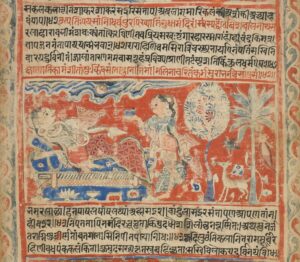
Figure IV: Utkā nāyikā. Vasanta Vilāsa Scroll Manuscript, Opaque watercolor, ink and gold on paper mounted on cloth, 1451, Gujarat. Freer Gallery of Art Collection. (https://share.google/szhzYKT0E4IwUtfTK)
THE UNRELENTING SPRING
Pondering over the poems and the paintings the intuition doesn’t fails to recognise the weariness, desolation and gloom surrounding the Vasanta Vilāsa, the very name becomes ironic – “the joys of springtime.” Even though praises of love abound but they are unable to stealthily veil the sorrows and more importantly the apathy to spring, the season of beginnings. Herein, Chanchani asks the upending question and leaves us to our own devices as to – “why did the poet, scribe and artists visualize love as deadly and the cheering season of spring as oppressive?”
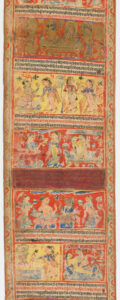
Figure V: Vasanta Vilāsa Scroll Manuscript, Opaque watercolor, ink and gold on paper mounted on cloth, 1451, Gujarat. Freer Gallery of Art Collection. (https://share.google/szhzYKT0E4IwUtfTK)
BIBLIOGRAPHY & REFERENCES
1.Brown, W. Norman. 1957. The Vasanta Vilāsa Manuscripts and Their Interrelations. Journal of the American Oriental Society, Vol. 77, No. 4 (Oct. – Dec., 1957), pp. 257-265 (9 pages). JSTOR. (https://share.google/639xOh1JXR11wfp86)
2. Chanchani, Nachikent. 2012. Telling Tales: The Freer Vasanta Vilāsa. Artibus Asiae, Vol. 72, No. 1 (2012), pp. 123-140 (18 pages). JSTOR. (https://share.google/vv8bYVf1YPy2cEUI6)
3. Bender, Ernest. 1947. Reviewed Work: Vasanta Vilāsa by Kantilal B. Vyas. Journal of the American Oriental Society, Vol. 67, No. 1 (Jan. – Mar., 1947), pp. 72-73 (2 pages). JSTOR. (Review: [Untitled] on JSTOR)
4 Western Indian painting | Mughal, Rajput & Deccani | Britannica (https://share.google/HRx47ZJi2fHRdAdOa)
5. Kalidasa. SCROLL. (https://scroll.in/article/967911/kalidasa-was-the-first-practitioner-of-ecopoetry-a-genre-that-the-world-is-waking-up-to-now)
PHOTO CREDITS
1.Figure I: Vasanta Vilāsa Scroll Manuscript, Opaque watercolor, ink and gold on paper mounted on cloth, 1451, Gujarat. Freer Gallery of Art Collection. (https://share.google/szhzYKT0E4IwUtfTK)
2. Figure II: Vāsakasajjā nāyikā. Vasanta Vilāsa Scroll Manuscript, Opaque watercolor, ink and gold on paper mounted on cloth, 1451, Gujarat. Freer Gallery of Art Collection. (https://share.google/szhzYKT0E4IwUtfTK)
3. Figure III: Svādhinpatikā nāyikā. Vasanta Vilāsa Scroll Manuscript, Opaque watercolor, ink and gold on paper mounted on cloth, 1451, Gujarat. Freer Gallery of Art Collection. (https://share.google/szhzYKT0E4IwUtfTK)
4. Figure IV: Utkā nāyikā. Vasanta Vilāsa Scroll Manuscript, Opaque watercolor, ink and gold on paper mounted on cloth, 1451, Gujarat. Freer Gallery of Art Collection. (https://share.google/szhzYKT0E4IwUtfTK)
5. Figure V: Vasanta Vilāsa Scroll Manuscript, Opaque watercolor, ink and gold on paper mounted on cloth, 1451, Gujarat. Freer Gallery of Art Collection. (https://share.google/szhzYKT0E4IwUtfTK)