

:- by Ayush Tripathi
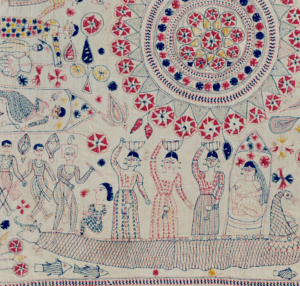
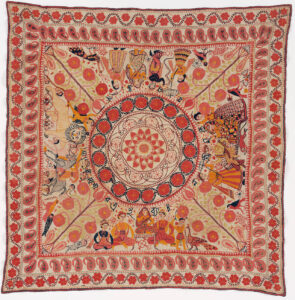
A Kantha artwork on a quilt depicting ladies at work encountering Lord Krishna while being on a boat surrounded by fish and
decorative motifs [Source: Philadelphia art museum, Kantha (Embroidered Quilt), Late 18th to Early century]
Abstract
In the homes of Bengal, both along the western bank of the Ganga and in the eastern delta, women have for centuries practiced a deeply intimate art: making kantha. These quilts are made from layers of worn cloth stitched together with a simple running stitch, often sourced from the borders of saris and dhotis. Kantha items are both useful and rich in meaning. They have served as quilts, wraps, covers for sacred texts, and carriers for gifts. Scholars increasingly recognize that they were also a way for women to express themselves, largely outside the formal systems of patronage, commerce, and religion that shaped other art forms in the subcontinent.
The term kantha comes from the Sanskrit word kanthah, which means patched garment or rag. Related words in Pali and Prakrit are associated with monks' robes. In Bengali, however, kantha specifically refers to a type of quilted textile whose social and symbolic significance goes far beyond its practical use. Kantha makers draw from a shared set of motifs passed down through generations, improvising freely while embedding their own experiences, events, and prayers within the cloth. The outcome is a material culture that is local yet global, devotional yet playful, ordinary yet visionary.
Textile as Archive : What Kantha Is and Does
Pinpointing the age of kantha is tricky because they are made from perishable materials and the craft was mostly done at home rather than in workshops that keep records. Still, literary and religious texts suggest this tradition goes back several centuries. In her key 1968 survey of Indian textiles, Stella Kramrisch noted mentions of quilted or patched garments in early Sanskrit and Pali literature. She linked the practice of stitching worn cloth into new items to broader South Asian customs of repurposing the old and discarded into objects of renewed significance. The monk's patchwork robe, known as kanthah in Sanskrit, embodies this idea. By piecing together fragments donated by laypeople, the ascetic illustrates the connection between the spiritual and social realms.
In Bengal, the domestic tradition differs significantly from this ascetic model. Niharranjan Ray, in his 1949 book Bangalir Itihas (History of the Bengalis), described kantha production as an ancient household craft rooted in the practical need to recycle cloth, especially since textile production was labor-intensive and fabric was expensive. Ray argued that this craft reflected the thrift and resourcefulness common in pre-industrial Bengali households, and its transformation into an art form was gradual and tied to the domestic rituals of everyday life. While speculative about its earliest phases, his account set the stage for future studies focusing on
kantha's connection to daily life instead of elite art. The oldest surviving kantha are usually dated to the eighteenth or nineteenth century. However, Monisha
Ahmed and other scholars have suggested that the lack of earlier examples is more about the fragile materials and storage conditions than about how recent the practice is. Medieval Bengali literature, such as the Mangalkavya corpus and Vaishnava poems, makes brief references to quilted textiles, though scholars have debated whether these are kantha or similar forms. The challenge of identifying them is heightened by the fact that medieval Bengali texts use varied terms for textiles, leading to ambiguity in identifying the described objects. A canonical kantha consists of recycled cloth, typically soft, worn cotton from old saris or dhotis that have become supple from years of washing. Choosing used cloth over new is not just about cost. Jasleen Dhamija, in her studies of Indian textile crafts, noted that layering worn garments in kantha production combines fabric that has absorbed human life. Thus, stitching these layers has social and sometimes sacred significance. The cloth carries memories of its previous wearers; by transforming it into a kantha for a birth or wedding, the maker passes along part of her life and that of her ancestors to the recipient. Pika Ghosh, in Making Kantha, Making Home (2020), highlights this aspect, emphasizing how the kantha holds a "peculiar thickness of touch and wear, emotions, experiences, and memories," accumulating the essence of the bodies it has clothed and the hands that have cared for it. The thread for kantha embroidery traditionally comes from the colored borders of the same saris that provide the ground cloth. This practice fosters a close relationship between materials, ensuring nothing goes to waste and everything is transformed. The main thread colors in older kantha are natural dyes found in Bengal: indigo blues, turmeric and lac yellows, madder reds, and unbleached cotton whites. In contrast, later kantha, especially from the late nineteenth and twentieth centuries, include commercially dyed threads in a wider range of colors, a change some scholars use as a rough chronological marker.
Art of the Running Stitch
The basic stitch of kantha is the simple running stitch, locally called the kantha stitch, which is sewn in parallel rows across the entire surface of the layered cloth. This stitching binds the layers together, preventing them from moving, while also creating the distinctive rippled texture that experts describe as the living surface of the cloth. The same running stitch is used within the embroidered area to create images and motifs. Variations in stitch density, direction, and thread color can achieve sophisticated effects. Jyotindra Jain, in the Crafts Museum collection catalogue, pointed out the skill involved in kantha embroidery, where makers show precise control over stitch length and spacing. The simplicity of the running stitch also requires great consistency from the maker's hand. Recognizing kantha as technically skilled needlework rather than just naive stitching was a crucial step in changing how this art form was viewed, which for a long time was seen as folk or domestic work compared to the professional embroidery of court workshops. Gurusaday Dutt, a Bengal civil servant and strong advocate for culture, was the first to systematically categorize kantha by type and function in the 1920s and 1930s. His work laid the groundwork for studying this tradition. Dutt identified several main types of kantha based on their use: the lep, a thick quilt for warmth; the sujani, a larger ceremonial textile for weddings and births; the baiton or bayton, a wrapping cloth for books or valuables; the asan, a seat cover for religious occasions; the durjani or theliya, a small purse or wallet; the oaar, a pillow cover; and the archilata, a cover for mirrors or combs. Dutt also noted the rumal, a small square kantha with a central design, as a distinct type for covering offerings. A Kantha artwork depicting fauna like elephant, fish, peafowl, horse, turtle etc along with floral motifs around a lotus motif in the center
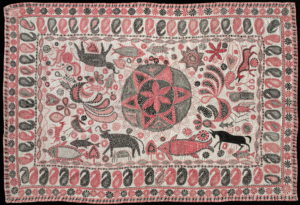
[Source: Philadelphia art museum, Kantha (Embroidered Quilt), Second half 19th Century]
Dutt presented his findings in Folk Arts and Crafts of Bengal (1939) and various articles in Indian journals. His classification remains a reference point, though later scholars have refined and sometimes challenged his categories. Ratnabali Chatterjee, in her critical review of Dutt's influence, argued that presenting kantha as a symbol of Bengali folk tradition involved selective choices, idealization, and even distortion. She noted that the categories Dutt created were often less rigid and distinct than he suggested. Many kantha served multiple purposes throughout their lives, without sticking to the functional divisions Dutt proposed. Scholars have highlighted notable regional differences between the kantha traditions in what is now West Bengal and Bangladesh. Stella Kramrisch pointed out that eastern Bengali kantha tends to show more vivid figurative content and a denser surface design, while western kantha often features geometric and floral patterns with larger open spaces. Niharranjan Ray suggested these differences arise from the unique cultural and economic histories of the two regions, including varying weaving practices and different social structures influencing women's domestic roles. The most common motif in kantha is the lotus, depicted in many styles and sizes. In the most intricate kantha, a large central lotus, sometimes very complex, is at the heart of the design. Art historians have interpreted this central lotus through various lenses. Stella Kramrisch connected it to the cosmological meaning of the lotus as a world center, found in many Indic religious traditions, suggesting that the kantha field serves as a cosmogram, with the central lotus marking the stable point around which the surrounding imagery is organized. Finding Krishna Through the Eye of a Needle Jyotindra Jain argued that the layout of the kantha surface reflects cosmological models that are common in both Hindu and Buddhist art traditions. However, returning to Dutt's original documentation, Tapati Guha- Thakurta warned against interpreting the iconographic choices of individual kantha-makers as too systematic. She noted that these makers drew from inherited visual languages that they adapted freely. The meanings they gave to specific motifs were often personal, local, or situational instead of being based on religious texts. This conflict between cosmological interpretation and individual creativity appears throughout much of the scholarly literature and remains unresolved.
Many kantha feature rich narrative or figural embroidery. Scenes from the Ramayana, the Krishna legend, the Mahabharata, and local deities appear alongside images of boats, elephants, horses, women engaged in household tasks, wedding processions, British officials on horseback, trains, and steamships. The blend of
mythological and contemporary imagery in a single textile is one of the most discussed aspects of this tradition. Pupul Jayakar, in *The Earth Mother* (1980), interpreted this mix as proof of the kantha-maker's ability to incorporate new experiences within a cosmological framework. She viewed the presence of colonial modernity in sacred contexts as a form of creative adaptation rather than disruption.
Manadasundari's Kantha : A Woman Addresses the Gentlemen Malavika Karlekar's study of women's visual culture in colonial Bengal provided a feminist perspective on Jayakar's interpretation. She argued that the figurative content of kantha should be seen as a form of autobiography and social commentary for women lacking access to formal literary or artistic production. In this view, the kantha becomes more than just decorative or devotional; it serves as a medium for the maker to express her observations and reflections on the world. Karlekar's approach has influenced feminist art history and museum practices, supporting the re-framing of kantha as women's art rather than craft. One striking example in the historical record is a sujani, currently held in the Gurusaday Museum in Kolkata, which dates back to the mid-nineteenth century. The maker stitched her name and a complete dedication encircling the central lotus medallion. The inscription reads, in translation: "This sujni was created by Manadasundari Dasi, with my own hands, to honor my father, Barada Kanta Basu of Jangal Badhal. Gentlemen, all errors are my own." Pika Ghosh dedicates a chapter in ‘Making Kantha, Making Home’ to this object, emphasizing the rich meaning contained in this brief text. The phrase "mama haste prastut" (prepared with my own hands) claims exclusive creative authorship, while the formal term "sujni," derived from Persian, places the work among more elaborate embroidered textiles instead of household linens. The closing practice of apologizing for errors, borrowed from musical and theatrical performance, adds a ceremonial, public quality that contrasts with the domestic medium.
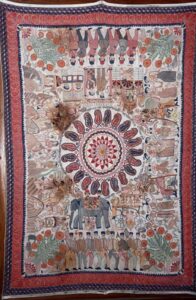
Manadasundari Dasi’s Kantha artwork [Source: Attributed to mid-nineteenth century. Collected by Gurusaday Dutt between 1929 and 1939 Khulna region, in modern Bangladesh. 167 × 118 cm. Gurusaday Museum, Kolkata, (GM 1481). Photograph courtesy of Shubhodeep Chanda]
Ghosh argues that the kantha was, likely, a gift intended for Manadasundari's natal family, possibly from a married daughter or a widow living at her parents' home. This practice aligns with the broader Bengali tradition of reinforcing emotional ties between households through meticulously crafted material gifts. The stitched coin-like design near the inscription reinforces this ceremonial aspect, indicating that the textile was meant to serve as a formal presentation object rather than just a household covering. What sets Manadasundari's work apart is her boldness in addressing "the civilized gentlemen" (shabhyagan mahashay) directly, placing herself alongside the earliest Bengali women who claimed individual authorship in print during the same decade. Ghosh interprets this address as a dual action: respectfully engaging with patriarchal authority while subtly challenging the structures it represents. A unique subgroup of kantha includes inscribed text, ranging from the names of makers and recipients to verses from devotional poetry, names of deities, and auspicious phrases. These inscriptions, stitched with the same running stitch as the surrounding embroidery, raise important questions about the makers' literacy and education, as well as the interplay between visual and verbal meanings in the textile. Scholars like Sanjukta Panigrahi have documented cases where the text is spelled phonetically but inconsistently, suggesting that the maker relied on oral rather than written memory, or had only partial literacy. Despite this, the presence of text
shows the maker's awareness of the power of the written word and her intention to incorporate it within the domestic textile. She Traded Across Oceans They Said She Never Left The link between kantha and women's social lives in Bengal has been a central focus of study since at least the1970s. Feminist art historians and anthropologists have highlighted that kantha production was almost entirely a female activity, practiced within the home and influenced by household rhythms rather than market demands.
For scholars in feminist material culture studies, the domestic setting of kantha production is significant: it places the art form within a strictly gendered social geography, and analyzing kantha requires examining the gendered structures of Bengali society. Kumkum Sangari and Sudesh Vaid, in their influential collection ‘Recasting Women’ (1989), provided a theoretical framework for understanding how domestic art forms can express agency while also serving as tools for the subjugation of women. The kantha-maker, confined to the household's inner quarters, used needle andthread as a means of expressing her subjectivity. However, the circumstances of her confinement also shaped what she could say and how she could convey it. This balance of expression and limitation has been crucial in feminist studies of kantha. Ratnabali Chatterjee's research, in particular, examined how kantha production was linked to the ritual duties of Bengali households, such as creating kanthas as gifts for births, marriages, and deaths. The kantha given at birth wrapped the newborn in fabric made from family garments, thereby enclosing the child in a textile that carried its history. Similarly, the kantha placed over the deceased followed the same logic: the fabric that clothed the living served to accompany the dead. These rituals gave the kantha a sacred significance intertwined with it domestic and feminine character. Pika Ghosh's fieldwork provides illuminating examples of this multigenerational significance. Nibedita Basu showed Ghosh a kantha originally made for her husband Anirban when he was an infant by his father's sister. After using it, his mother stored it away for about thirty years before bringing it out for her grandson's Shashthi Puja. She ceremonially sent it from her home to Nibedita's parental household, where it would eventually go to the grandson's future wife. Three generations of women cared for the object, allowing it to pass through different households as a formal testament to kinship. A similar case occurred in Houston, where Bulbul, a young Bengali woman in her twenties, spread a faded kantha on the floor for her infant daughter, recalling that she had sat on the same textile a quarter-century earlier in her joint family home in north Calcutta. By placing her baby on the cloth stitched by her grandmother, Bulbul was, as Ghosh notes, & quot;extending her grandmother and great-grandmother's embrace upon her own baby,& quot; connecting the textile across time and distance Threading Nationalism, Stitching the Nation The formal recognition and appreciation of kantha as an art form were partly the result of the colonia encounter, and the history of its reception is closely linked to colonial attitudes toward Indian crafts. Colonial government surveys of industries and arts in the late nineteenth century, in response to the decline of Indianhandicrafts, provided the first detailed records of kantha production. T.N. Mukharji's *Art Manufactures of India* (1888), prepared for the Colonial and Indian Exhibition in 1886, offered one of the earliest descriptions of kantha in English, though it was brief and did not provide a deep analysis of its iconography or technique. Gurusaday Dutt's collection and documentation efforts in the 1920s and 1930s were motivated by a cultural nationalism that aimed to revive and celebrate Bengali folk traditions amid the pressures of colonial cultural dominance and Westernized urban preferences. Dutt founded the Bratachari movement, which promoted cultural revival through folk dance, music, and crafts. His interest in kantha was part of a larger project to build a Bengali cultural identity rooted in the village and domestic life, rather than in the colonial city. His collection, donated to the Bengal government, now forms the core of the Gurusaday Museum in Kolkata and remains one of the most significant collections of historical kantha. Dinesh Chandra Sen, a well-known historian of Bengali literature and the founder of the Bengali department at Calcutta University, placed kantha firmly within nationalist thought in his major work, Brihat Banga (Greater Bengal). Ghosh mentions Sen's observation that making a kantha usually took six months. Some grandmothers would start stitching a kantha that mothers worked on for a lifetime, passing it down to their daughters to finish. This view supported Sen's swadeshi argument: these incredibly labor-intensive items cost only a rupee or two, yet the nation had turned away from them in favor of shiny German and Japanese machine-made goods. Thus, in nationalist discourse, kantha became not just a textile but also a measure of cultural self-sufficiency.
Kantha artwork showing goddess Devi Chandi standing on a lion fighting the demons Chanda and Munda, who were soldiers of the demon Shumbha; Krishna playing the flute, with Radha and two attendants; Rama and Sita enthroned, with the monkey god Hanuman paying homage before them, with either Bharata or Lakshman holding a parasol and another attendant with a fly-whisk; and a goddess, probably Lakshmi the goddess of wealth, enthroned, with Kartik with his peacock and Lakshmi's vehicle the owl to her right
[Source:Victoria and Albert Museum, London]
Tapati Guha-Thakurta has critically examined the nationalist narrative surrounding Dutt's collection. She argues that portraying kantha as a symbol of Bengali folk tradition involved considerable selection, idealization, and even distortion. The kantha celebrated by Dutt and his contemporaries mainly originated from Hindu upper-caste households in the nineteenth century. The craft traditions of Muslim women, lower-caste communities, and the urban poor were largely overlooked in this portrayal. Guha-Thakurta's critique has opened up discussions for a broader understanding of the tradition and its social roots. The Partition of Bengal in 1947 had significant effects on the kantha tradition. Millions of people were displaced, rural communities were destroyed, and trade and social networks were disrupted. This upheaval altered the conditions under which kantha had been made and passed down. In West Bengal, the arrival of refugees from East Bengal introduced practitioners of the eastern tradition, leading to new interactions between regional styles but disrupting the continuity of village-based transmission. Many women fled with only what they could carry. The kantha they had made or inherited became deeply emotional objects, symbols of a world that had been lost.
Meghna Guhathakurta and other scholars studying the cultural memory of Partition have recorded how kantha appeared in the stories of women survivors. They often remembered specific kanthas as representations of lost homes, relationships, and ways of life. Pika Ghosh encountered this history through Sagarmoni, a widow from Khulna Division in present-day Bangladesh. She crossed into West Bengal in the 1960s, bringing with her the full range of kantha-making and embroidery skills. Her employer, Banasree Nag Chaudhuri, noticed her talent and shared her techniques, leading Sagarmoni to become a teacher and collaborator. Banasree began visiting the Gurusaday Museum to study the motifs displayed there and integrated them into her work. After her husband died, she received commissions that provided extra income. The combination of Sagarmoni's village repertoire and Banasree's urban design expertise led to the creation of a whole new practice. Ghosh's account highlights how kantha knowledge often crossed boundaries of class, region, and displacement in ways that nationalist narratives of pure folk traditions cannot capture.Gathered Again, Stitch by Stitch Starting in the 1970s, various revival efforts aimed to support kantha production in settings where traditional domestic transmission had faded. The most notable of these were the craft cooperatives and non-governmental organizations in both West Bengal and Bangladesh, which united rural women to produce kantha for urban and export markets. Organizations like Sasha Associates and the Crafts Council of West Bengal in India, along with Aranya and Kumudini Welfare Trust in Bangladesh, played key roles in establishing market links for modern kantha-makers, training new artisans, and documenting the tradition. These revival efforts have received both critical scholarly attention and celebration. Maureen Daly Goggin and Beth Fowkes Tobin, in Women and the Material Culture of Needlework and Textiles, discussed the complex negotiations that arise when traditional domestic arts enter the commercial world. They warned that market demands could distort traditional forms and strip away the social and ritual meanings of kantha during the process of commodification. Lotika Varadarajan raised similar concerns, arguing that separating kantha production from its domestic and ritual contexts fundamentally changes the nature of the created objects, even when the technical processes remain the same. The nakshi kantha, a richly embroidered quilt, holds a special place in the cultural history of kantha. Its name comes from the Bengali word naksha, meaning design or pattern. Unlike the plain lep or sujani, nakshi kantha is mainly a decorative and symbolic object, featuring intricate figural and narrative imagery. This form gained prominence in Bengali culture through the poem Nakshi Kanthar Math (The Field of the Embroidered Quilt) by Jasimuddin, published in 1929. In this poem, the creation and tattered existence of a kantha symbolizes a tragic rural love story. The heroine, Shaju, stitches her life's events into the textile during a long and sorrowful separation from her husband. She instructs her mother to lay the kantha on her grave so that, as Jasimuddin writes, their sorrows, stitched line by line, might find comfort together on its surface. Jasimuddin's poem transformed the nakshi kantha from a household item into a national symbol, linking the form with the rural poor, feminine labor, love and loss, and the Bengal landscape in ways that significantly shaped later views of kantha. Scholars like Niaz Zaman, who translated Nakshi Kanthar Math into English in 1986, have discussed how the poem's romantic nationalism influenced the perception of kantha both in Bengal and globally, sometimes obscuring the social realities of kantha production. Kantha has found its way into museum collections in India, Bangladesh, the United Kingdom, and the United States. The history of their acquisition and display is also a topic of scholarly study. The earliest collections were made by the Victoria and Albert Museum in London and by Indian museums in Calcutta, Dhaka, and other locations in the late nineteenth and early twentieth centuries, often as part of broader efforts to document industrial art. During this period, the criteria for acquiring kantha favored technical skill and iconographic richness, which meant the items obtained did not accurately represent the full breadth of the tradition. Recent museum practices have attempted to address these gaps. Curatorial essays in recent decades have worked to place kantha within the social histories of their creation. The catalogue for the exhibition Kantha: The Embroidered Quilts of Bengal from the Jill and Sheldon Bonovitz Collection (Philadelphia Museum of Art, 2009), featuring contributions from Darielle Mason and others, is one of the more sophisticated attempts to
combine art historical, social historical, and feminist perspectives in presenting a major kantha collection. Mason's introductory essay focused on the lives of women in which kantha was produced, highlighting how these objects reflect social relationships that cannot be fully understood from the textile surface alone. Pika Ghosh notes the irony in Manadasundari's kantha. Although it has a stitched inscription with the maker's name, it entered the Gurusaday Museum without any documentation of her life beyond what the textile itself reveals. This outcome points to the systemic neglect of documenting the biographical circumstances of kantha- makers.
The ethical aspects of collecting kantha have garnered increasing attention amid broader debates about the provenance of non-Western objects in Western collections. Scholars like Naman Ahuja have raised questions about whether the women who made kantha agreed to or gained from their entry into the art market. They also explore the connections between heritage claims in India and Bangladesh and the dispersal of kantha the international collections. These questions are likely to take on more importance as the field continues to develop. The current kantha landscape is marked by incredible diversity, from ongoing traditional kantha-making in rural Bengal to the creation of luxury kantha-inspired textiles for global fashion and interior markets. The commercialization of kantha has unfolded along multiple paths at once. In Bangladesh, the revival cooperativesestablished in the 1970s and 1980s have transformed into major industries, providing jobs for thousands of women in kantha production for export. In West Bengal, both cooperative and private businesses produce kantha for domestic and international customers. In both countries, kantha motifs have found their way into fashion textiles, home furnishings, and consumer products, sparking significant debates about the integrity and authenticity of the tradition. Craft scholars like Eiluned Edwards have studied how market integration affects the quality and nature of modern kantha production. They highlight the economic benefits for makers, along with the pressures for standardization and simplification created by market demands. Her research challenges the simple stories of either decline or survival. Instead, it shows that the tradition actively interacts with the realities of modern economic life.
Ghosh explored the diasporic aspect of kantha's contemporary existence through various fieldwork experiences. Eva Ray, a first-generation Bengali immigrant in Philadelphia, kept a kantha shawl made from her mother’s and grandmother’s sari borders to cope with the loneliness of cold winters away from home. Years later, when she sent Ghosh photographs, her daughter had started to photograph the same shawl draped around the fifth generation. These stories suggest that the emotional significance of kantha grows rather than fades with geographic displacement. Another aspect of modern kantha practice is its adoption by trained artists who engage with the tradition. Indian and Bangladeshi artists like Rina Banerjee and Tayeba Begum Lipi have incorporated kantha techniques or styles into their contemporary artwork. They exhibit pieces in international art markets that draw from the domestic and feminist meanings of kantha while transforming these ideas through the practices of contemporary art.
Bibliography
Ahmed, Monisha. "Kantha: Living Fabric." In The Fabric of India, edited by Rosemary Crill, 196-203. London: Victoria and Albert Museum, 2015.
Akbar, Shireen. Nakshi Kantha of Bangladesh. Dhaka: Bangladesh Shilpakala Academy, 1993.
Chattopadhyay, Kamaladevi. Handicrafts of India. New Delhi: Indian Council for Cultural Relations, 1975.
Chatterjee, Ratnabali. "The Nationalist Resolution of the Women's Question: A Critique." In Recasting
Women: Essays in Colonial History, edited by Kumkum Sangari and Sudesh Vaid, 233-253. New Delhi: Kali for Women, 1989.
Dhamija, Jasleen. "Women's Craft Traditions of India." In Womanly Arts: The Craft Traditions of South Asia.
New York: Asia Society, 1985.
Dutt, Gurusaday. Folk Arts and Crafts of Bengal: The Collected Papers. Calcutta: Gurusaday Museum, 1990.
First published 1939.
Edwards, Eiluned. Textiles and Dress of Gujarat. Ahmedabad: Mapin, 2011.
Ghosh, Pika. Making Kantha, Making Home: Women at Work in Colonial Bengal. Seattle: University of Washington Press, 2020.
Goggin, Maureen Daly, and Beth Fowkes Tobin, eds. Women and the Material Culture of Needlework and Textiles, 1750-1950. Farnham: Ashgate, 2009.
Guha-Thakurta, Tapati. The Making of a New "Indian" Art: Artists, Aesthetics and Nationalism in Bengal,
c.1850-1920. Cambridge: Cambridge University Press, 1992.
Guha-Thakurta, Tapati. Monuments, Objects, Histories: Institutions of Art in Colonial and Postcolonial
India. New York: Columbia University Press, 2004.
Guhathakurta, Meghna, and Willem van Schendel, eds. The Bangladesh Reader: History, Culture, Politics.
Durham: Duke University Press, 2013.
Jain, Jyotindra. Folk Art and Culture of Gujarat: Guide to the Collection of the Shreyas Folk Museum of Gujarat. Ahmedabad: Shreyas Prakashan, 1980.
Jasimuddin. Nakshi Kanthar Math. Translated by Niaz Zaman as The Field of the Embroidered Quilt. Dhaka: University Press Limited, 1986. First published 1929.
Jayakar, Pupul. The Earth Mother: Legends, Ritual Arts and Goddesses of India. San Francisco: Harper and Row, 1980.
Karlekar, Malavika. Visualizing Indian Women, 1875-1947. New Delhi: Oxford University Press, 2006.
Kramrisch, Stella. Unknown India: Ritual Art in Tribe and Village. Philadelphia: Philadelphia Museum of Art,
1968.
Mason, Darielle. Kantha: The Embroidered Quilts of Bengal from the Jill and Sheldon Bonovitz Collection.
Philadelphia: Philadelphia Museum of Art, 2009. Mukharji, T.N. Art Manufactures of India. Calcutta: Superintendent of Government Printing, 1888.
Ray, Niharranjan. Bangalir Itihas: Adi Parba. Calcutta: Dey's Publishing, 1980. First published 1949.
Sangari, Kumkum, and Sudesh Vaid, eds. Recasting Women: Essays in Colonial History. New Delhi: Kali for Women, 1989.
Sen, Dinesh Chandra. Brihat Banga. Calcutta: University of Calcutta, 1935.
Varadarajan, Lotika. South Indian Traditions of Kalamkari. Ahmedabad: National Institute of Design, 1982.
Zaman, Niaz. The Art of Kantha Embroidery. Dhaka: University Press Limited, 1993.