

By Ashutosh Pandey
Introduction
Walk through the lanes of Delhi today, and the stones beneath your feet whisper stories of power, faith, and knowledge. Long before the Mughals left their magnificent mark, the Delhi Sultanate was already transforming the city, building grand mosques and madrasas that would shape Delhi’s identity for centuries. These monuments were far more than places of worship or study—they were statements of authority, hubs of learning, and enduring symbols of a city rising under new rulers.
Faith Carved in Stones
The story begins in Mehrauli, at the iconic Quwwat-ul-Islam Mosque, commissioned by Qutbuddin Aibak in 1198 CE. Built soon after the conquest of Delhi, the mosque stood as a clear symbol of Islamic sovereignty in a city steeped in centuries of Hindu and Jain traditions. Its massive courtyard, tall arches, and intricately carved columns immediately draw the eye, while many of its pillars were reused from earlier temples—a testament to the adaptive creativity of Sultanate architects. The mosque’s very name—Quwwat-ul-Islam, or “Might of Islam”—reflected the dual purpose of spiritual and political assertion.
Inside the mosque, one can see inscriptions and architectural motifs that combine Islamic calligraphy with local craftsmanship. These early experiments in Indo-Islamic architecture set the stage for later innovations, proving that Delhi was not just a conquered city but a canvas on which rulers could project power and faith simultaneously.
Begumpuri Mosque: Monument of Grandeur & Authority
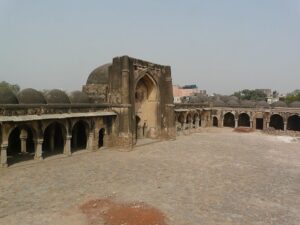
The Begumpuri Mosque, constructed during the reign of Muhammad bin Tughlaq, further illustrates the Sultanate’s penchant for monumental design. With its massive courtyard and multiple entrances, the mosque could host large congregational prayers while simultaneously projecting the ruler’s authority. Its imposing arches, slender minarets, and intricately carved screens conveyed both aesthetic sophistication and a subtle message of political dominance.
These mosques were never merely religious structures—they were instruments of statecraft. By strategically placing them in new city areas or near administrative centres, the Sultans anchored their rule in the daily lives of Delhi’s residents, blending spiritual devotion with the display of power.
Khirki Mosque:
As the Sultanate expanded, so did its architectural ambition. The Khirki Mosque, built during the reign of Alauddin Khalji in the early 14th century, represents one of the earliest examples of a covered congregational mosque in Delhi. Its unique grid-like layout, with an array of vaulted cells, was designed to accommodate large numbers of worshippers in a compact space. The covered halls provided shelter from the harsh Delhi summers, showing how practicality influenced design without compromising grandeur.
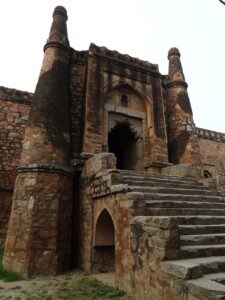
Khirki Mosque also reflects the Sultanate’s desire to integrate religious architecture within growing urban settlements. Situated in the heart of the city, it served both as a spiritual centre and a focal point for community gatherings, making worship a shared public experience. Its austere exterior hides an ingenious use of space, light, and ventilation, highlighting the architectural sophistication achieved during the Khalji period.
Madrasas : Hubs of Knowledge & Governance
Alongside mosques, madrasas became essential to the intellectual and administrative life of Sultanate Delhi. These institutions were dedicated to the teaching of Islamic theology, law, philosophy, and sciences, producing scholars who would serve as judges, teachers, and administrators. Education, in this context, was inseparable from governance.
The Hauz Khas Madrasa, established by Firoz Shah Tughlaq in the fourteenth century, stands as a prime example. Overlooking a serene reservoir, it combined beauty, learning, and urban design. Scholars from across the Islamic world studied here, engaging in debates, writing treatises, and interpreting religious law. The madrasa was closely linked to the adjoining mosque, reinforcing the connection between faith and intellectual pursuit.
Madrasas ensured continuity of knowledge and ideology. By training scholars loyal to the Sultanate, these institutions became instruments for preserving legal, theological, and administrative norms. They were also a means of cultivating elite networks, tying scholars, administrators, and rulers together in a web of authority and education.
Architecture that Speaks
The mosques and madrasas of the Delhi Sultanate tell a story through their very structure. Large courtyards encouraged communal worship and social gatherings, while domes, arches, and mihrabs emphasized direction, unity, and the Sultanate’s ideological presence. Many mosques display inscriptions praising the ruler or quoting Quranic verses, reminding visitors of the divine sanction behind political authority.
The adaptation of local construction techniques, such as corbelled arches and the reuse of temple pillars, created a distinctive Indo-Islamic style. Over time, architects moved from experimental designs to more refined engineering, mastering true arches, domes, and vaulted halls. Sultanate architecture, therefore, was both a reflection of evolving technical skill and a symbol of a new cultural synthesis in Delhi.
Mosques & Madrasas in daily life
Beyond their religious and educational roles, these monuments were hubs of daily activity. People gathered in mosque courtyards for prayers, legal discussions, and public announcements. Madrasas produced scholars who guided society, administered justice, and advised rulers. Together, they formed the backbone of Sultanate governance, blending civic life, faith, and learning.
This integration of religion and administration helped consolidate the Sultanate’s rule in a diverse city. It ensured that power was exercised not only through military might but also through ideology, education, and social cohesion. The strategic placement of mosques and madrasas within urban centres made them visible, functional, and influential in the everyday lives of Delhi’s residents.
Legacy & Influence
The architectural and cultural innovations of the Delhi Sultanate laid the foundation for the grandeur of later periods, especially the Mughals. Many Mughal mosques and educational complexes borrowed spatial layouts, structural techniques, and decorative motifs first explored during the Sultanate.
Even today, these monuments stand as living testaments to Delhi’s layered history. The Quwwat-ul-Islam Mosque, Khirki Mosque, Begumpuri Mosque, and Hauz Khas Madrasa remind us that the city’s past was shaped as much by faith, learning, and civic planning as by conquest. They reveal a Delhi where religion, knowledge, and authority were inseparably intertwined—a city whose stones still tell stories of ambition, devotion, and intellect.
Conclusion
The mosques and madrasas of the Delhi Sultanate were far more than religious structures; they were foundational institutions that shaped Delhi’s political authority, intellectual life, and urban form. Through deliberate patronage and strategic placement, the Sultans used sacred architecture to legitimize their rule, cultivate learning, and integrate diverse communities into a shared public space. These monuments reveal how faith and knowledge were embedded within the mechanisms of governance, allowing the Sultanate to exercise power not only through force but also through ideology and education. The legacy of these mosques and madrasas endures in Delhi’s architectural landscape, standing as lasting testimonies to a period when religion, learning, and statecraft were inseparably intertwined.
Bibliography
1) Asher, Catherine B. Architecture of Mughal India. Cambridge: Cambridge University Press, 1992.
(Useful for understanding Sultanate architectural foundations influencing later periods.)
2)Brown, Percy. Indian Architecture: Islamic Period. Bombay: D. B. Taraporevala Sons & Co., 1956.
3)Chandra, Satish. History of Medieval India. New Delhi: Orient BlackSwan, 2007.
4)Eaton, Richard M. India in the Persianate Age: 1000–1765. London: Allen Lane, 2019.
5)Habib, Irfan. Medieval India: The Study of a Civilization. New Delhi: National Book Trust, 2007.
6)Nath, R. History of Sultanate Architecture. New Delhi: Abhinav Publications, 1978.
7)Archaeological Survey of India (ASI). Delhi Circle Monuments and Sites. Government of India publications and official website records.
8)Welch, Anthony. “Architectural Patronage and the Past.” In Muqarnas, Vol. 5, 1988.