

By Tehreem Asad
What does love look like in its truest form, and how does one obtain it? The answers to these age-old questions are far from linear and difficult to contemplate. Multiple answers exist, of course, but if any group has definitive clarity on this matter, it is the mystics. The concept of love is deeply ingrained in mysticism. There is only one Beloved, God, and unification with the Divine is the ultimate attainment of love. The journey to achieving this form of love is, however, unimaginably difficult. In Sufism, Ishq (love) is the foundational force that guides the seeker to the path of the Divine. Ishq is an all-consuming and transforming love for God that transcends everything that constitutes worldly existence. It is a stage of devotion in which the distinction between the lover and the Beloved dissolves, which creates a sense of oneness with the Divine.
This concept defies simple explanations. However, with the arrival of Sufism in India, there arose a need to present its concepts in a more accessible manner to a broader audience. One such attempt resulted in the creation of the genre of Sufi romances or Premakhyans in India. Premakhyan (literally meaning love story) or ‘Sufi Romances’ was a literary genre that emerged in the 14th century in northern India and gained much popularity by the 16th century. The main feature of the genre was its use of human love as an allegory of love for the divine.
The first known Premakhyan is Chadayan (also known as Laur-Chanda), written by Maulana Daud in c.1379. The most important feature of the text is that it replaces Persian or Arabic in favour of Awadhi, which was the local language. Chandayan is significant because it is the first literary work to integrate elements of Persian Masnavi tradition and concepts of Sufism into religion, language, landscape, folklore, and philosophy of the Indian subcontinent by weaving them into a folk romance.
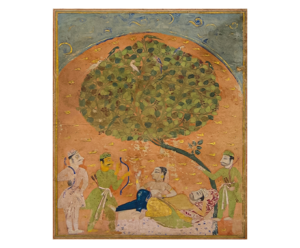
Laurak and Chanda rest on their journey to a trysting place, leaf from a Chandayana manuscript; Mandu, India; Early 16th century; Opaque watercolour and gold on paper; 25.4 x 19.5 cm; Brooklyn Museum, New York
(Courtesy:https://imp-art.org/articles/the-chandayana-manuscripts/#gallery-gallery-69a48656810900.31700106-2)
Context and Creation of Chandayan:
Beginning in the 13th century, the Mongol invasions of Persia and its neighbouring regions resulted in the migration of scholars, artists, saints, and statesmen from Central Asia and Persia to the Indian subcontinent. As they settled in the region, the influence of their arts, literary traditions, belief systems, music, and poetic traditions became apparent. According to scholar Naseem Hines, this was also the period when the Delhi Sultanate was a newly established regime, which made it necessary for the Muslim rulers to promote tolerant policies in their newly acquired territories. This led to an interaction and integration of the cultures of the indigenous population and that of the newly arrived. This close contact between the two cultures was also reflected in the exchange of beliefs and philosophies between the medieval Hindu mystic traditions and Sufism, which resulted in mutual appreciation and synthesis of ideas.
With the spread of Islam outside Arabia, it became important to contextualise universal principles of Islam at a regional level, so that they are better understood by the locals. In South Asia, it was the Sufis who undertook the task of spreading Islam through the process of vernacularisation. The origin of Premakhyans is linked with this process. Sufis familiarised themselves with the local languages, history, beliefs, and practices, and urged their disciples to do the same, which promoted coexistence and earned them the trust and respect of the local communities. They found great popularity, especially among the people of the lower sections of society, regardless of their faith. They familiarised themselves with the local languages in order to teach Sufi doctrines and converse with people in these languages with the aim of bringing people closer to God.
Sufi khanqahs (hospices) became centres of cultural assimilation, where different languages, beliefs, and cultures interacted, and Sufi literature and poetry widened the reach of Islamic and Sufi teachings. The oldest Sufi order in India was that of the Chishtis, which was established in 1192 by Khwajah Mu’inuddin Chishti (1142-1236). It is to this order that the author of Chandayan, Maulana Daud, belonged. Through his writing of Chandayan, he became a pioneer of the Premakhyan (Sufi romance) or the Hindavi Sufi masnavi tradition. Maulana Daud used the local folk tale called Chanaini as a point of reference for his story, transforming it into an allegorical tale of a devotee’s journey towards God by the way of Sufism. Not only did he use Awadhi and well-known prosody to engage with his audience, but he also incorporated the local folklore, philosophy, and landscape to make the story feel familiar to his audience.
The Story of Chandayan:
Chandayan follows the tradition of Persian masnavis by starting with a prologue section in which the author begins by acknowledging his reverence to God, then praises the Prophet Muhammad, which is then followed by panegyric verses on the four Caliphs of Islam. Then he acknowledges his patrons, his spiritual preceptor, and finally, the author introduces himself.
The story begins with a detailed description of the city of Gowar. A daughter, Chanda, is born to the local chief (Rao) of Gowar, Mahar Sahadev. At the age of four, Chanda is married to Bavan despite the fact that their horoscopes did not match. After eight years, at the age of 12, Chanda moves into her husband’s house but soon finds out that her husband is one-eyed and impotent. So after a year living with her husband in an unhappy marriage, she returns to her father’s house.
One day, a bard travelling by her palace sees Chanda and is extremely taken aback by her beauty. He is so overcome by her beauty that he wanders around singing songs of her comeliness. He eventually reaches Rao Rupchand’s town, Rajpur, where his description of Chanda piques Rupchand’s curiosity. Rupchand is so impressed by this description that he gathers an army and proceeds towards Gowar in order to take her away. A battle ensues between Sahadev’s and Rupchand’s forces. Seeing that his forces are getting closer to defeat, Sahadev desperately calls a local hero, Lorik, for help. Although his mother and wife try to stop him from going into the battle, Lorik joins Sahadev’s forces, and eventually they defeat Rupchand.
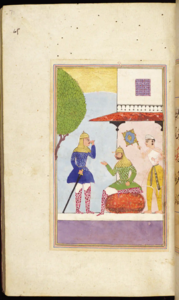
‘Lorik Meets Rao Mahar’, Hindustani Manuscript 1, page no. 155, John Rylands Research Institute and Library, Manchester University
(Courtesy: https://www.livemint.com/mint-lounge/art-and-culture/chandayan-epic-translation-awadhi-to-english-pre-mughal-miniature-paintings-11714882187164.html)
After seeing Lorik for the first time, Chanda falls in love with him. Her friend Biraspati asks her to request her father to throw a feast in order to celebrate their victory, which would allow her to meet Lorik again. During the feast, Lorik happens to see Chanda and, predictably, he also falls in love with her. Their union, however, seems unattainable because both of them were already married. So Lorik renounces his worldly attachments, becomes a yogi, and starts residing in a temple chanting the name of his love, Chanda. He resides in the temple for a year. One day, Chanda and Biraspati visit the temple where Lorik lived. Chanda is unable to recognise him because his appearance has completely changed, but Lorik, upon seeing Chanda, collapses at her feet. Biraspati prompts Lorik to give up his life as a yogi and meet Chanda.
Lorik abandons his life as a monk and, with the help of Biraspati, reaches Chanda’s palace. Here, the two lovers finally meet for the first time. However, soon the rumours of their affair spread. Lorik’s wife, Maina, is distraught after hearing of this news, which leads to a physical altercation between her and Chanda. Loriks and Chanda decide that in order for them to be together, they must leave Gowar and elope.
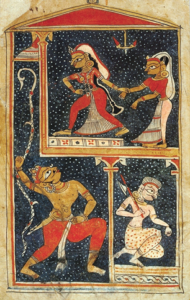
The Heroin Elopes, from Chandayana, Probably present-day Delhi or Jaunpur, Uttar Pradesh, India, c. 1450–70
(Courtesy:https://commons.wikimedia.org/wiki/File:4_The_Heroin_Elopes._Laur_Chanda_%28or_Chandayana%29_of_Mulla_Da%27ud._1450-75_Bharat_kala_Bhavan,_Banaras_Hindu_University,_Varanasi..jpg)
For a while, they undertake a meandering journey, travelling from place to place. They face several trials in their path, including the death of Chanda by snakebite and her subsequent resurrection. Meanwhile, Maina is devastated by her condition. She comes to know that Lorik is staying at Hardi Patan, and so she requests Surjan (a caravan leader) to bring back her husband. Eventually, Lorik returns home with Chanda. He asks for his mother’s forgiveness and urges both Chanda and Maina to reconcile. His mother accepts both women as her daughters-in-law. Lorik then decides to fight all those who had disrespected his mother and wife during his absence.
Our story concludes rather abruptly at this point. Five illustrated manuscripts of the story survive, yet none of them provide a definitive ending. However, the Premakhyans that followed Chandayan were largely modelled on its structure and narrative style. So, considering the typical endings in later Sufi romances, it is reasonable to assume that Chandayan, too, likely culminated in the self-annihilation of its protagonists.
Chandayan as an Allegory of Love
The Sufis composed masnavis in a way that allowed them to be appreciated on both secular and spiritual levels. On the surface, the tale of Chanda and Lorik appears to be a doomed love story. However, when we turn to Malik Muhammad Jayasi’s Padmavat, which is a work most closely modelled after Chandayan, we are given a ‘key’ that opens the door to the spiritual interpretation of the masnavi. On the basis of the symbolic structure established in Padmavat, the audience comes to realise that the characters and events of Chandayan are spiritual symbols. Lorik symbolises the human soul, while Chanda represents ishq-i-Haqiqi (the True Love or the Divine Majesty). The battle between Rupchand (personifying desire) and Mahar is a symbol of conflict between good and evil. Lorik’s wife, Maina, embodies ishq-i-majazi (Lorik’s secular existence and worldly attachments). Biraspati, in turn, symbolises the pir, the spiritual guide who leads the Seeker toward the Ultimate Beauty. Candayan, thus, invites its audience to move beyond mere worldly accomplishments and embark on a mystical journey to achieve spiritual enlightenment. Through each stage of the Sufi path, the soul moves progressively closer to God.
The purpose of Sufi romances was to fashion human love as an allegory for the love of the divine. The notion of ashiq (lover) is combined with that of a salik (the seeker on the mystical path). This journey is given a general structural design in Chandayan, which became a blueprint for the later masnavis. The following structure was followed by the story: (1) The Prologue (2) The description of the Abode of the Beloved (3) The description of the Beauty of Beloved/Nakha-Sikha Varnana (4) The Pain in Separation/ Barahmasa (5) The Mystic’s Spiritual Quest (6) The Reconciliation/Homecoming (7) The Key to the Masnavi.
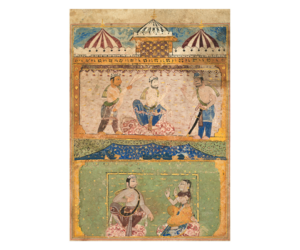
A traveler persuades Lorik to return home (top), Chanda objects (bottom), from a Chandayana manuscript; Sultanate India; 1525–1540; Gum tempera, ink, and gold on paper; 25.5 x 20 cm; The Cleveland Museum of Art, Ohio
(Courtesy: https://imp-art.org/articles/the-chandayana-manuscripts/#gallery-gallery-69a48656810900.31700106-4)
Each section of the story serves as a metaphor for different concepts within Sufism. Typically, the prologues of these poems assert that the significance of the message is multilayered. Chandayan begins with a portrayal of Chanda’s hometown, Gowar. The abode of the beloved is supposed to mirror the description of Jannat al-Firdaus (the Paradise). The subsequent description of Chanda’s beauty, or Nakha-Sikha Varnana, draws from the masnavi concept of Sarapa. The bard describes Chanda’s beauty as unsurpassed, presenting it as a reflection of the divine. This beauty is not an end in itself but rather a means to guide the seeker towards Eternal Beauty.
Similarly, Barahmasa (a feature in Indian literature) is employed in Premakhyans, where a woman expresses her sorrow during the separation from her lover (viraha) through the twelve months of the year. Both Chanda and Maina recount their own periods of separation from their respective husbands in this manner. This exploration of love and separation reinforces the central theme, which is the journey of the mystic’s spiritual quest.
The love story of Chanda and Lorik symbolises the spiritual journey of the seeker. For a mystic, however, the experience of spiritual ecstasy cannot be sustained indefinitely. Once the seeker reaches their spiritual goals, they must return to their secular life and fulfil the duties and responsibilities that they temporarily set aside. The goal of the mystic is, then, to reconcile their worldly life with their spiritual one and bring a balance between them.
Finally, Lorik’s journey can be understood as the symbolic journey of the individual soul (atman) in search of the Supreme Soul (paramatman). Lorik’s homecoming and return to Maina signal his success in finding harmony between the spiritual and worldly realms. As mentioned before, at the very end of the tale, the ‘Key’ unlocks the allegorical meaning of the entire narrative and provides the ultimate understanding of the story.
Influence and Legacy:
Maulana Daud refashioned the teachings of Sufism into a regional folk romance, and by doing so, he describes the process of union with the divine through the pleasant experience of listening to stories. Chandayan gained widespread popularity among locals, as its themes and language were relatable and familiar. Although Chandayan was meant to be based on the local traditions, it also gained considerable popularity among the courtly elite. Its acclaim went well beyond the time of the Delhi Sultanate. Bada’uni (c. 1540-1615), who was a chronicler in the Mughal court, mentions in Muntakhab-ut-tawarikh that Muslim preachers frequently recited sections from Chandayan in the Friday sermon.
Maulana Daud’s work inaugurated a tradition of Sufi romances and set a precedent for later compositions like Qutban’s Mrigavati (composed 1503 CE), Malik Muhammad Jayasi’s Padmavat (composed 1540 CE), and Manjhan’s Madhumalati (composed 1545 CE). While the compositions in the north were mainly in Awadhi, in southern regions like Golconda and Bijapur, Dakkani Urdu was chosen as the preferred medium of expression. These Premakhyans broadened the scope of Sufi literature in India not just by adding nuances to the meaning and nature of love as depicted in these romantic narratives but also by bringing together the Persian and the Indian traditions. They exemplify the influence of Sufi thought in shaping the literary and spiritual culture of that time.
BIBLIOGRAPHY:
1. Hines, Naseem A. The English Translation of Cāndāyan: The Pioneer Indo-Sufī Masnavī of Maulanā Dāūd. Taylor and Francis, 2023.
2. Ahuja, Naman. “Ishq between Languages, Cultures & People: The Historical Context of the Chandayan.” The Chandayan (ISBN: 978-81-955878-4-1), 2024.
3. Anjum, Tanvir. “Vernacularization of Islam and Sufism in South Asia: A Study of the Production of Sufi Literature in Local Languages.” Journal of the Research Society of Pakistan, vol. 54, no. 1, 2017.