
The Custodians of Heritage – Institutions that showcase traditional houses
- May 18, 2025
By Riya Pradhan
Kathleen Norris says, “Peace — that was the other name for home.” Rightly so, home is not just four walls and cement, home is an emotion. It is built and decorated with a part of the owners soul. Over the years the structure, make and design of the houses have changed but what has remained constant is the feeling of being safe and at peace
that arises within us when we are home.
Traditional houses are rich living testaments of the wisdom of our community values. Built with locally procured materials and traditional methods, these structures demonstrate sustainable practice exactly suited to climate and geographic conditions. They reveal the character of a community itself—its social traditions, cultural expression, even the symbolic dynamics of everyday living, such as unique aspects of architecture. As repositories of traditional knowledge and skilled craftsmanship, they are priceless guides, connecting what has been known with what now is, inspiring modern sustainable practice.
Across the nation, museums and cultural centers have assumed the critical responsibility of maintaining these vernacular architectures, safeguarding the sophisticated craftsmanship, regional materials, and adaptive designs against oblivion so that they remain part of our shared memory. By exhibiting these traditional homes, these guardians of heritage provide a tangible link with the past, shedding light on how communities have reconciled their ways of living with the surrounding environment and sculpted their cultural stories over the centuries.
Dakshsinchitra museum
Opened in 1996 by- Dr. Deborah Thiyagarajan the DakshinChitra museum located in the bustling city of Chennai is one of the best examples of restoration and preservation of traditional architecture of Southern India. The museum houses around 19 traditional homes from across the five Southern Indian states- Tamil Nadu, Kerala, Karnataka, Telangana and Andhra Pradesh.
From the extravagant houses built by the Chettiar community to the simple yet functional cyclone resistant Chutillu houses of coastal Andhra this museum has a wide range of traditional dwellings. The main activity undertaken by the museum is to carefully dismantle heritage houses from their places of origin and rebuild them in the museum premises. These rebuild traditional houses make maximum use of the original material. The everyday objects displayed in these houses are often aquired with the house of donated by the community to whom the structure belongs, making the exhibits as authentic as possible.
Each house in this museum encompasses traditional culture, indigenous architecture and multiple stories of the community it belonged to. For example in some southern parts of India doors of the houses were deliberately made shorter than average human height so that when one enters they bow down as a sign of respect to the structure that
protects and shelters them. This lesser known aspect of traditional houses is perfectly captured in this museum.
These houses are divided as exhibition spaces according to museum standards. These exhibitions often are centred around the profession, rituals, social status, everyday objects, clothes etc of the community. What is fascinating is that each house was traditionally designed to support the profession to the owner. For example the Ikkat house in the Telangana section has a very small courtyard as the weaver community to whom the house belongs need more working space in the house. On the other hand the Syrian Christian house belonging to the Agricultural community has a well built right outside the window of the kitchen for ease and convenience. In such ways the museum has made sure to include small details of the communities which shape these houses according to their needs. The grandeur in this museum is a constant reminder of the splendid artisan work that goes behind creating these functional and eye pleasing traditional houses.
Indira Gandhi Rashtriya Manav Sangrahalaya (IGRMS)
On 21 March 1977 at Bhalwalpur House, New Delhi the project of- Indira Gandhi Rashtriya Manav Sangrahalaya (IGRMS) was announced to commence after a visionary appeal at the 1970 Indian Science Congress made by Sachin Roy. He highlighted the necessity of a "Museum of Man" to document human evolution and cultural diversity. Subsequently, the Madhya Pradesh State Government allocated 200 acres of land at Bhopal, thus the foundation stone of the museum was laid on 21 April 1979 by Union Minister Dr. P. C. Chunder and was later renamed Rashtriya Manav Sangrahalaya in 1985 and subsequently added with the prefix Indira Gandhi in 1993
renamed to commemorate her efforts towards preservation.
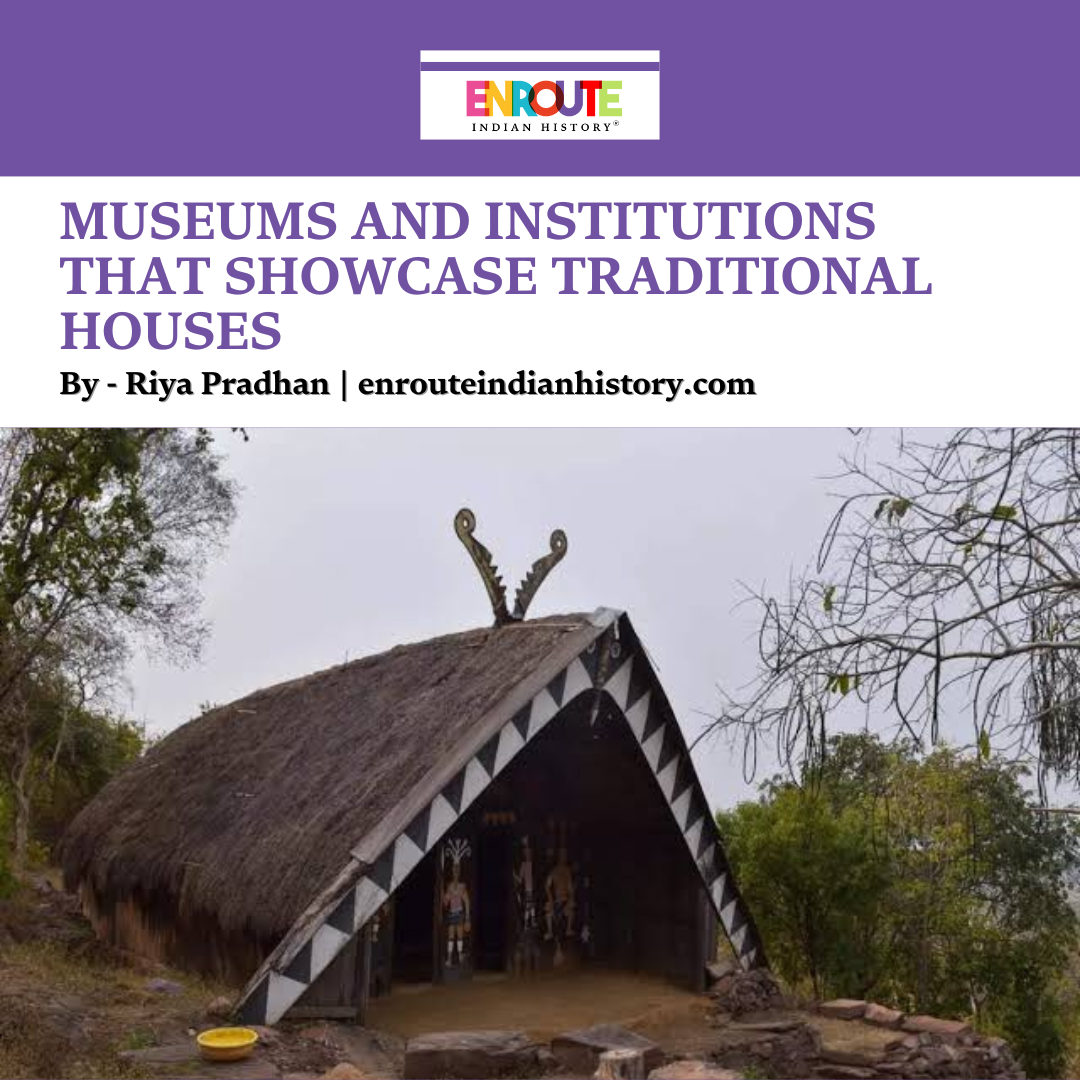
The Tribal Habitat, a large outdoor exhibit on IGRMS's sprawling campus, shows authentic tribal homes constructed by various cultures. These are the authentic houses of the Warli, Toda, Kota, Bodo, Mishing, Karbi, Kutia Kond, Saora, Gadaba, Bhil, Tharu, Rajwar, and Santhal tribes. These are constructed of locally procurable materials like mud, bamboo, cow-dung, and thatch—materials selected due to their conformity to local climatic conditions as well as ecologinity.Among these origional buildings, there are a precisely chosen range of everyday household items, religious artefacts, individually made furniture, and household tools which, collectively, represent the people's social heritage, organisational community, and craftsman skill.
The coastal village section showcases replicas of Indian coastal houses including houses from the regions of- Kerala, Odisha, Andhra Pradesh, Tamil Nadu and Gujarat. These houses exhibits architectural adaptability of the structure in the extreme weather and salt water environments. By presenting these real coastal houses, the museum illustrates how individuals have utilized natural materials to create practical, stable homes that are a part of their social and economic identity.
The Himalayan Village and Desert Village segments provide compelling accounts from precisely opposite Eco-climatic zones. The Himalayan Village section is home to indigenous stone and wood architecture,that shows alpine settlements harness local stone and wood to fashion dwellings which are resistant to seismic shocks yet harmonious to the dramatic setting. On the other hand, the Desert Village gallery exhibits the unique desert architecture—dramatizing the complex Rajput settlements of Jaisalmer juxtaposed with vernacular Bhunga buildings of nomadic Rabari communities of Kutch.
These exhibits are not merely highlight the need for clever adaptations to survive within harsh ecosystems but also save for posterity the rich interstices of ritual practice, social structure, and traditional systems of knowledge developed across centuries in the varied territories.
Shilpagram, Udaipur
Shilpgram, situated around 3 km west of Udaipur in Rajasthan, is a 70‐acre large rural arts and crafts complex that serves as an open‐air ethnographic museum. It is committed to conserving and promoting the traditional way of life and craft traditions of India's folk and tribal populations. Started in 1989 as a committed site for conventional craftsmen, Shilpgram re-creates village settings true to nature by building a set of representative "huts" with native materials and construction methods.
Every hut is inspired by a particular occupational or cultural identity. The complex has several traditional Rajasthan huts that recall the Marwari and Mewari vernacular architecture, as also similar structures inspired by Gujarat, Maharashtra, and Goa crafts. Alongside these houses, the complex contains a vast collection of everyday artifacts—ranging from terracotta cutlery and handmade textiles to wooden furniture and metal tools—that collectively provide a realistic insight into rural life. To complement its permanent galleries is an open-air amphitheatre with a seating
capacity of around 8,000, which hosts the annual Shilpgram Festival. This ten-day festival of culture not only attracts huge crowds with its vibrant folk performances, workshops, and food stalls but also provides a direct interface between rural craftspeople and city dwellers, thus contributing to the preservation of India's rich traditional heritage.
Organizations such as DakshinChitra museum, Indira Gandhi Rashtriya Manav Sangrahalaya, Goa state museum, Shiplagram in Udaipur, Rajasthan are among the few museums whose efforts make it possible for us to understand ethnography beyond text books and stories. Such museums bring to life everything we read and hear about
our traditional houses. These houses are not just reminders of architectural abilities; they are lessons in physical sustainability and cultural resilience; they illustrate how indigenous people have adapted creatively in their environment, mobilizing natural materials to construct houses that afford climatic comfort, foster social cohesion, and enable ritual activities, thus offering valuable lessons to contemporary architecture and conservation efforts.
References
Roy Chowdhury, B. (2018) 'Indira Gandhi Rashtriya Manav Sangrahalaya: A new paradigm to preserve our Cultural Heritage,' International Journal of Research in Engineering, IT and Social Sciences, 08(07), pp. 243–246. http://indusedu.org.
Chaturvedi, V. (2022) 'Bhopal: Tribal huts at Indira Gandhi Rashtriya Manav Sangrahalaya get a revamp,' The Times of India, 24 November.
https://timesofindia.indiatimes.com/city/bhopal/bhopal-tribal-huts-at-indira-gandhi-rashtriya-manav-sangrahalaya-get-a-revamp/articleshow/95727019.cms.
Kuriakose, B. (2022) 'The story of evolution of Dakshinachitra Heritage Village,' bennykuriakose, 21 March. https://www.bennykuriakose.com/post/the-story-of- evolution-of-dakshinachitra-heritage-village.
Chennai’s Best Heritage Museum | Cultural Centre for Indian Arts – Dakshinachitra.
https://www.dakshinachitra.net/.
Thiagarajan, Deborah (1988) 'Dakshinachitra, a museum for the performing arts and crafts of South India,' Museum- Museum and Crafts by UNESCO, 40, pp. 52–56.