

By Aryan Singh
Just beyond the bustling heart of Delhi University’s North Campus, where rickshaws rattle through tree-lined streets and the air still hums with youthful debate, a quiet ascent begins. Follow the curve of the road past the Vice-Regal Lodge and through the winding slopes of the Delhi Ridge, and you’ll find yourself standing before a place where time lingers — Hindu Rao Hospital – a place where the present hums with healing but the air still murmurs with memories of empires, mystics, and mutiny.
From St. Stephen’s College or Hansraj College, begin your short journey towards the Kamla Nehru Ridge. Walk or take a quick e-rickshaw ride past Vishwavidyalaya Metro Station, then trace the curve of the Ridge Road, where the canopy of trees whispers over stone paths and colonial-era walls — this hospital is no ordinary medical institution. It is a monument in disguise, a stone sentinel that has watched centuries unfold. What appears today as a bustling civic hospital was once a 14th-century hunting lodge, built by Firoz Shah Tughluq, a sultan with a passion for architecture and wilderness. Later, it was shrouded in legend as Pir Ghaib — “the vanished saint” — whose mystic presence still whispers through the ruins.
In the 19th century, it became the home of Hindu Rao, brother-in-law to the Scindia ruler of Gwalior, and then a pivotal British stronghold during the Revolt of 1857, caught in the thunder of cannon fire and cries for freedom.
According to the hospital’s website, it began as a 16-bedded nursing home in 1911, established by Sir Edward Colebrooke, a British resident. Later, the estate, covering 1,692 bighas from Kabul Gate to the Northern Ridge, was owned by William Fraser, a British officer and an agent to the governor general & commissioner of Delhi during the reign of Bahadur Shah Zafar. But Fraser’s life was cut short in a tale of jealousy and revenge.
On the fateful night of March 22, 1835, Fraser was returning from a dinner with the Raja of Kishangarh in Dariya Ganj. The streets were dark, the air heavy with silence. Hidden in the shadows was Kureem Khan—an assassin hired by none other than Nawab Shamsuddin Ahmed Khan of Ferozepur. With a single shot, Fraser fell, murdered in cold blood.
The motive? As described in The Seven Cities of Delhi by Gordon Risley Hearn, Fraser’s closeness to a woman related to the Nawab had stirred rage and dishonour in Shamsuddin’s heart. From the underbelly of Chandni Chowk, in the lanes of ‘Billimori’—known in colonial records as Bulvemar’s Ward—assassins were recruited to carry out the Nawab’s vengeance.
This incident is also mentioned by William Dalrymple in his book The City of Djinns, where he confirms that Nawab Shamsuddin was behind the murder. The killer was later caught and executed. Nawab Shamsuddin was tried and found guilty. He was publicly hanged outside Kashmiri Gate on 10 October 1835.
After the tragic assassination of William Fraser in 1835, his grand estate passed into the hands of Raja Hindu Rao, a nobleman and brother-in-law of the Scindia of Gwalior. Today, the hospital that stands on this historic site still bears his name—Hindu Rao Hospital. But this house is more than just a building; it is a silent witness to one of the fiercest chapters in India’s history—the Revolt of 1857.
Perched on high ground overlooking the city, Hindu Rao’s house became a vital stronghold for the British during the uprising. From this elevated position, British forces launched attacks and resisted the relentless fire of rebel artillery. The defence of this post was led by the Simur Gurkha Battalion under Major Charles Reid, a veteran of the Sindh and Burmese campaigns. They were joined by men of the 60th Rifles, infantry from the Guide Corps, and the 1st Punjab Infantry—all fighting shoulder to shoulder against the rebels. (Gordon Rishley, 1906)
For more than two and a half months, the house was under constant bombardment. Cannons roared, muskets cracked, and the air was thick with smoke and blood. The walls of Hindu Rao’s house shook under the fury of fire, but the defenders held their ground. The Gurkhas, renowned for their courage, paid a heavy price. Out of their ranks, 320 men laid down their lives in the fierce clashes with the sepoys.
Pir Ghaib
As you step out from the hospital’s main entry gate, A short walk uphill, shaded by old canopies and guarded by stone and silence, leads you toward Pir Ghaib. The monument is approximately 250 to 300 meters away and can be reached within 5 to 7 minutes on foot. It is a double-storeyed building and was built by Firoz Shah Tughluq in 1354 as a hunting lodge. Sir George Everest used this place as a survey point for his important measurements during the Great Trigonometrical Survey, and he referred to it as an observatory. But over time, many stories have added to its mystery and changed the way people see it.
One story narrates that when construction was over, the king visited the lodge, and when he reached the 1st floor, he saw a saint praying. When he looked again, the saint had vanished. The same saint appeared in his dream and told him to build a cenotaph – a small memorial on the spot where he had seen him and gave up his idea of making it a hunting lodge. The king ordered to build a cenotaph, but it was later removed due to its incorrect position as per Islamic rules. (Bhaavan Goswami, 2016)
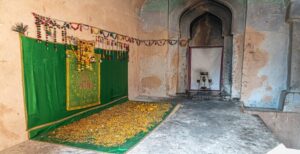
(Source: Kevin Standage; First floor)
Another version of the story says the saint simply disappeared into the tower itself. That’s why the structure is now called Pir Ghaib, which means “the vanished saint.” The rooms have arched openings towards the eastern side and mihrabs in the western walls, suggesting the area might have been used as a Mosque at some point in time. (Kevin Standage, 2025)
It’s believed that Timur, the Central Asian invader, damaged this lodge during his attack on Delhi in 1398. One of his court historians, Sharaf-ad-din Ali Yazdi, wrote that Firoz Shah had named the building Kushk-i-Jahan-Numa, which means “the palace that shows the world” in Persian. To this day, locals of Chandrawal village gather on Thursday to offer flowers & burn incense in his memory. During the revolt of 1857, Pir Ghaib was used as an observation post by the British, and they stationed heavy batteries here and suffered more damage during the war. (Kevin Standage, 2025)
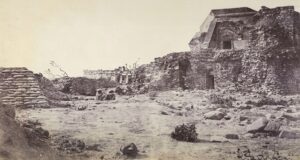
(Source: Kevin Standage; After the 1857 revolt)
Just a few steps away, there is an old Baoli which was also constructed by Firoz Shah Tughluq, and it is believed that it was used to provide water to the hunting lodge. Currently, the water quality is very deteriorated and in a very bad state. But during 1857, it was heavily guarded by the Britishers because it was the only source of water in the ridge, and there was a fear among the Britishers that nationalists could poison the Baoli. There are also some reports that Baoli had a tunnel that connected it to Firoz Shah Kotla, but it is no longer accessible. (Bhaavan Goswami, 2016)
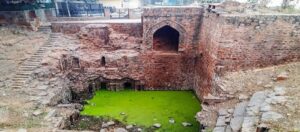
(Source: Kevin Standage; Baoli in 2023)
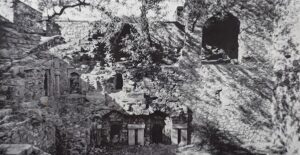
(Source: Kevin Standage; Baoli in 1900)
The Hindu Rao Hospital is more than just a place of healing — it’s a silent witness to centuries of history, hidden in plain sight. Few know that its story began long before it became a hospital. In 1912, two ancient structures were transformed into a nursing home, and one of the structures, called Balak Ram ki Kothi, was converted into an Indian hospital. (Indian Express, 2022) By 1951, it had grown into a general hospital with 127 beds under the Delhi government. In 1958, the MCD stepped in, and in 1963, the Ministry of Health elevated its status to a referral hospital, turning it into one of Delhi’s key lifelines. Behind its walls lie not just patients, but echoes of a forgotten past.
References
1. Upadhyay, Ankita. “A Delhi Hospital’s Journey: From Tales of a Disappearing Saint to Mutiny of 1857.” The Indian Express, 25 Sept. 2022, indianexpress.com/article/cities/delhi/a-hospitals-journey-from-tales-of-a-disappearing-saint-to-mutiny-of-1857-8171085/. Accessed 28 June 2025.
2. “History | Hindu Rao Hospital: North DMC.” Hindurao.com, 2022, hindurao.com/history.html. Accessed 27 June 2025.
3. Goswami, Bhaavan. “Secrets behind Delhi’s ‘Hindu Rao Hospital’ Complex.” Medium, 17 Sept. 2016, medium.com/@bhaavangoswami/secrets-behind-delhis-hindu-rao-hospital-complex-6dc6fa5d2817. Accessed 28 June 2025.
4. Kevin Standage. “Pir Ghaib and Baoli – Delhi.” Kevin Standage, 25 Feb. 2025, kevinstandagephotography.wordpress.com/2025/02/25/pir-ghaib-and-baoli-delhi/. Accessed 28 June 2025.
5. Safvi, Rana. “The Saint Who Disappeared from a Tughlaq Era Hunting Lodge: Pir Gaib on Delhi’s Ridge.” Rana Safvi, 26 Apr. 2023, ranasafvi.com/the-saint-who-disappeared-from-a-tughlaq-era-hunting-lodge-pir-gaib-on-delhis-ridge/. Accessed 29 June 2025.
6. Maheshwari, Shruti. “Pir Ghaib and Baoli.” Times of India Travel, 18 June 2015, timesofindia.indiatimes.com/travel/destinations/pir-ghaib-and-baoli/articleshow/47722313.cms. Accessed 29 June 2025.
7. Risley, Gordon. The Seven Cities of Delhi. William Clowes and sons, limited, London and Beccles, 1906.
8. Frykenberg, R E. Delhi through the Ages. Oxford University Press Bombay, 1993.
9. Wood, Sir Evelyn. The Revolt in Hindustan 1857-59. London, Methuen, 1908.