

The Fascinating Story of Body Doubles and Stunt Artist of Indian Cinema
- October 10, 2025
By Ananya Vishnu
The core function of body doubles and stunt performers hinges on their invisibility. the stuntman’s paradox dictates that “the more successful they are, the less they are known” (Smith,2004). Their success is measured by their seamless substitution for the star, rendering their own identity superfluous to the final product.Conversely, the industry heavily promotes the trope of the star “doing their own stunts”, strategically attaching an aura of authenticity and commitment to the actor’s image. This deliberate erasure extends beyond the screen into film scholarship, where, as noted, the stunt performer’s invisibility has extended to film and media studies, where stunts and stunt work have been largely ignored (Mazumdar,2015).This academic blind spot mirrors the industry’s treatment, relegating these vital contributors to the periphery despite forming “the backbone of our media industries”.
The social composition of stunt artists and body doubles in Mumbai reflects broader socio-economic realities. Recruitment often occurs through highly exclusive, familial, or apprentice-based networks via the Movie Stunt Artists Association (MSAA). As research indicates, membership is “hardwired”, frequently favoring “protégés and sons of members” over outsiders, with women constituting a small minority (Kaur,2020). This creates a closed ecosystem, albeit one born from historical necessity to combat exploitation.
The economic precarity faced by these workers is stark. The MSAA sets wages, but these remain shockingly low. Local Stunt artists typically earn between Rs.2,500–3,500 for an eight hour shift with fees rarely exceeding Rs. 10,000 per sequence (Mazumdar, 2015). Only a minuscule elite (around 5%) command significantly higher fees (up to Rs. 50,000). In comparison, local stunt workers are paid Rs.4000 per day, whereas stunt directors can earn around Rs.30,000 and above. Crucially, 75% of MSAA-registered stunt artists reportedly live below the poverty line, with only 20% securing regular work (Kaur,2020). Erratic or non-payment is a common grievance. Retirement often means facing a “bleak and uncertain future”, compounded by the physical toll of the job.
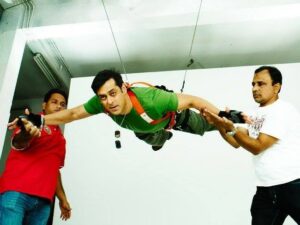
Actor Salman Khan with stuntmen
Gendered Invisibility and Vulnerability
Female body doubles occupy an even more precarious and invisible space. While some perform stunts, a significant cohort specializes in “intimate scenes” – sequences involving nudity, simulated sex, or other content the lead actress declines to perform. These women work under strict contracts and affidavits guaranteeing anonymity, often sourced through informal networks. They are severely underpaid; the case of Jessica Choksi, paid only Rs.12,500 for nine intimate scenes in “Ek Choti Si Love Story (2002)”, alongside Rs.9,000 for the privacy affidavit, is emblematic. Their vulnerability is heightened by the constant threat of exposure, as Choksi experienced when her name was dragged into a public feud between the actress Manisha Koirala and the director, shattering the promised anonymity and demonstrating the stark “lines that separate stardom from this other kind of creative work”.
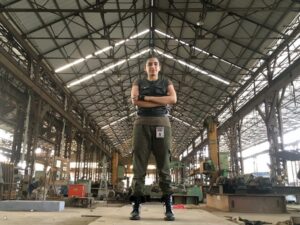
Stuntwoman Sanoner Pardiwalla
Globalization and Competition
The influx of foreign capital and the globalization of Bollywood productions have significantly impacted local stunt workers. Producers increasingly hire specialized foreign stunt teams from Europe, the US, or East Asia for films. While justified by producers as necessary for specialized skills (martial arts, parkour, complex vehicle stunts), this practice creates intense anxiety and job insecurity among local artists, who view it as direct competition.
This dynamic resonates powerfully with Arjun Appadurai’s concept of “production fetishism”. Appadurai argues that in the globalized economy, focusing on the local site of production obscures the globally dispersed forces driving it. The local (the Mumbai set) becomes a fetish masking
transnational capital, management, and labor flows. For Mumbai’s stunt artists, this manifests as a double alienation:
1. Alienation from the Product: Their contribution is rendered invisible in the final film. They do not benefit from all the global fame coming from the movie that actors may get.
2. Alienation from Power: The decisions shaping their work environment (hiring foreign teams, safety budgets) are increasingly made by distant global entities, disempowering local associations like the MSAA. As one source notes, stunt performers “often fail to recognize themselves on screen because a single action sequence may be heavily divided between their performance and that of a foreign stunt performer’s”.
Furthermore, this globalization exacerbates existing hierarchies based on race and language. Local stunt artists often describe themselves as having a “gunda look” – darker skin and “harsh” features – seen as unsuitable for doubling heroes, unlike the “gora, lamba, chauda” (fair-skinned, tall, well-built) foreign performer (Kaur,2020). Female stunt doubles report being passed over for heroines’ stunt work due to complexion mismatches. Stunt directors like Pervez Sheikh, despite being highly respected, face marginalization when collaborating with foreign coordinators due to language barriers (lack of English fluency).
The Voice of the Artists : MSAA
The Movie Stunt Artists Association (MSAA), formed in 1954 in response to the collapse of the studio system and the ensuing freelance precarity, represents a significant effort to organize and protect these workers. Affiliated with the powerful Federation of Western India Cine Employees (FWICE), the MSAA has fought for minimum wages, payment security (acting as an intermediary between producers and workers), medical aid, compensation for injury/death, and retirement funds. It enforces strict rules against hiring non-union workers, wielding significant power through potential boycotts, often viewed by producers as “cartelization”.
Critically, it has established essential welfare mechanisms: maintaining funds for medical aid, interest-free loans for education and marriage, retirement support, and compensation for injuries or death – a significant institutional safeguard absent in the past. However, a critical gap remained: the absence of formal, comprehensive life and accident insurance coverage for these high-risk workers, a deficit long lamented by the community.
A landmark intervention addressing this gap emerged in 2017 through the dedicated efforts of actor Akshay Kumar. The actor, having begun his own career as a stuntman,had deep personal connection to stunt work which fueled his advocacy. In collaboration with a leading cardiac surgeon, Kumar spearheaded the creation of a dedicated insurance scheme. This initiative provides substantial coverage for hundreds of registered stunt artists aged 18-55, including cashless medical insurance up to Rs.6 Lakh across a vast network of hospitals and an accidental death benefit of Rs.10 Lakh for beneficiaries.
However, the MSAA’s power faces new challenges in the globalized era. Its ability to regulate the influx of foreign labor is limited. Its familial recruitment structure, while providing security for insiders, restricts opportunities for outsiders and potentially hinders diversification and fresh skill development. Crucially, while it provides essential welfare mechanisms, it cannot fundamentally alter the global market forces driving producers towards foreign specialists or the deeply ingrained biases regarding appearance and language that disadvantage its members.
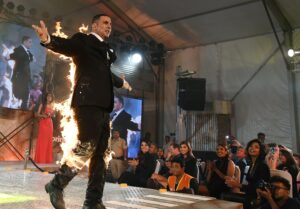
Stuntman and Actor Akshay Kumar walks the stage on fire for the announcement of his web-series ‘The End’
Conclusion
The world of body doubles and stunt artists in Bollywood is one defined by a fundamental contradiction: their labor is indispensable for creating the illusion of the star’s physical authenticity and for delivering high-octane spectacle, yet they are systematically rendered invisible, underpaid, exposed to risk without adequate safeguards, and increasingly vulnerable to displacement by globalized production practices. Their experiences expose the deep inequalities underpinning the glamorous facade of the film industry.
Studying this “invisible scaffolding” is not merely about acknowledging hidden labor; it is crucial for understanding the political economy of contemporary Indian cinema. It demands critical attention to labor relations, the impact of global capital, entrenched social hierarchies (caste, gender, colorism), and the ethical responsibilities of an industry that profits immensely from the risks and erasures endured by these essential workers. Only by bringing their struggles and contributions out of the shadows can we develop a truly comprehensive and ethical understanding of how the magic of Bollywood is made. As Appadurai reminds us, fetishizing the local spectacle obscures the global forces and local sacrifices that make it possible. Recognizing the stunt artist and body double is a necessary step towards demystifying that spectacle.
References
1. Smith, Jacob. “Seeing Double: Stunt Performance and Masculinity”. Journal of Film and Video, vol. 56, no. 3, 2004, pp. 35–53. JSTOR, http://www.jstor.org/stable/20688462. Accessed 29 May 2025.
2. Mazumdar, Ranjani. “Invisible Work in the Indian Media Industries”. Media Industries Journal, vol. 1, no. 3, 2015.
3. Kaur, Pawanpreet. “If Globalization Is Happening, It Should Work Both Ways : Race, Labor, and Resistance among Bollywood’s Stunt Workers”. Media Industries Journal, vol. 7, no. 1, 2020.
4. Appadurai, Arjun. Modernity at Large: Cultural Dimensions of Globalization. University of Minnesota Press, 1996, pp. 40-43.
5. Govil, Nitin. “Recognizing Industry”.Cinema Journal, vol. 52, no. 3, Spring 2013, pp. 172-76.
6. Thomas, Katharine. Bombay before Bollywood: The History and Significance of Fantasy and Stunt Film Genres in Bombay Cinema of the Pre-Bollywood Era. PhD dissertation, University of Westminster, 2016.
7. Insurance Business Asia staff. “First-Ever Insurance Scheme for Bollywood Stunt Artists Launched”. Insurance Business Asia, 13 Apr. 2017, www.insurancebusinessmag.com/asia/news/breaking-news/firstever-insurance-scheme-for-bollywood-stunt-artists-launched-65928.aspx.
8. “Controversial Life”. The Times of India, 22 Aug. 2003, timesofindia.indiatimes.com/bombay-times/controversial-life/articleshow/20883508.cms.
Images-
1. Shaikh, Parvez. Parvez Shaikh Stunt Director, parvezshaikh.net/equipments.html.
2. Pardiwalla, Sanober. Sanober Pardiwalla Photography, sanoberpardiwalla.com/portfolio-3/.
3. “Akshay Kumar”.IMDb, www.imdb.com/name/nm0474774/.