

By Aryan Singh
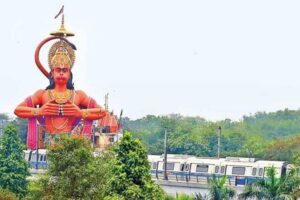
Source: Aartigyan.com; Sankat Mochan Hanuman Temple
As the metro doors slide open at Jhandewalan Station on Delhi’s bustling Blue Line, most commuters step out with minds full of office meetings, market errands, or coaching classes. But just a few steps away from the city's buzzing metro line lies a world where the past still breathes, and devotion still echoes. In the heart of Delhi’s lively and crowded streets rise two sacred symbols of faith and tradition: the Jhandewalan Mandir, devoted to Maa Aadi Shakti, and close by, the impressive Sankat Mochan Hanuman Mandir, built in honour of Lord Hanuman, the eternal protector. Rich in heritage and spiritual energy, these temples welcome streams of devotees every day, offering them a place to pause, pray, and find strength amidst the city’s constant rush.
These temples are more than just spiritual landmarks. They are timeless witnesses to Delhi’s evolving landscape — from Aravalli hills to concrete metro lines — preserving centuries of faith, myth, and memory. In this article, we will step back in time to uncover the fascinating stories behind these sacred sites, explore their significance, and discover why their architectural beauty continues to inspire awe in the hearts of millions of people in Delhi.
Jhandewalan Temple
As you step out of the metro station, you can either hop on a rickshaw or take a short 5–10- minute walk along Jhandewalan Road towards Karol Bagh. There, you’ll find a temple which is deeply rooted in worship and devotion to Maa Aadi Shakti, a powerful goddess in Hinduism.
Dating back to the late 18th century, Jhandewalan Mandir stands as one of Delhi’s most ancient and cherished places of worship. Throughout the year, countless devotees visit to offer prayers and receive the divine blessings of the goddess. According to legend, Badri Das— a well-known cloth merchant from Chandni Chowk and a devoted follower of Mata Vaishno Devi — had a dream revealing that an idol was buried in a cave near a spring.
When the idol was unearthed, its hands were found to be broken. Undeterred, Badri Das installed a new idol of the goddess right above the original and performed the consecration with great devotion. The sacred spot where the idol was discovered soon became known as Gufa Wali Mata — the goddess of the cave. In this cave, a lamp was lit later, which has been burning continuously for more than 8 decades.
To honor the damaged idol, beautifully crafted silver hands were added, and worship continued with full rituals and unwavering faith. On this auspicious occasion, a massive flag was hoisted high above the temple. At that time, the temple stood surrounded by the lush green hills of the Aravalli range and thick forests. Because the temple was built atop this hill and marked by its striking flag (“jhanda” in Hindi), it came to be fondly known as
Jhandewalan Mandir — the temple of the flag.
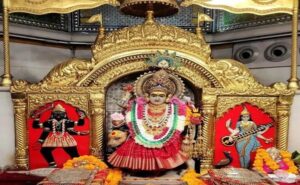
Source: Temple Website, Idol of Maa Jhandewali
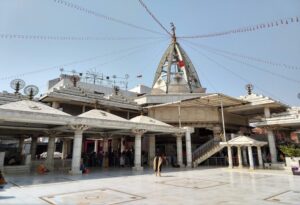
Source: Light Up website, Temple Complex of Jhandewalan Mandir
A Shiva lingam carved on a rock, found at the same excavation site along with a pair of snakes etched on it, was also installed in the temple and became a centre of devotion for visitors. This temple holds great importance among Hindus, and visitors arrive with pure hearts, hoping to receive Mata’s blessings, see their wishes granted, and bring peace and prosperity to their families. The temple attracts thousands of devotees during Navratri and Durga Puja and has become a centre of devotion as devotees chant, sing bhajans, organize kirtans, and immerse themselves in spirituality.
According to local legends, people from Delhi and nearby villages would flock to the temple for the much-anticipated “Pavan Ka Mela” or “Pavan Pariksha Ritual.” At exactly 6:30 AM on Ashad Shukla Purnima (the full moon in June–July), an astrologer would step forward to read the winds. If the wind blows from the east (Purv), then the clouds give excessive rains. If it drifted in from the northeast, it signalled just enough rain for a good
harvest. But later, this ritual was stopped due to political reasons.
As the oral narratives go, the area where today’s offices and buildings surround the mandir was once a serene garden known as Ram Bagh, shaded by ber and jamun trees and dotted with majestic banyan trees. The garden originally belonged to a Muslim owner who, burdened by debt, was compelled to sell it. It was then that Badri Das, guided by faith, purchased the land to carry out the excavation of the temple. According to these stories, he
dedicated the rest of his life wholeheartedly to Maa Jhandewali, transforming what was once a quiet garden into a sacred place that still draws countless devotees today.
Sankat Mochan Hanuman Mandir
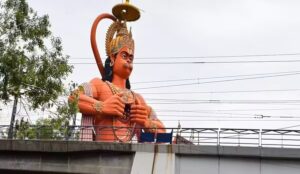
Source: Navbharat Times, Hanuman Mandir
Rising majestically at 108 feet, this colossal idol of Lord Hanuman, captured in the divine act of tearing open his chest to reveal Lord Ram & Sita, has become one of Delhi’s most iconic sights. Its powerful presence has even lit up the silver screen in films like Vicky Donor, Fukrey, Band Baaja Baraat, Bajrangi Bhaijaan, and Delhi-6, and even in Indian TV serials, and you might have recognised this iconic statue.
Located just a short five-minute walk between Jhandewalan and Karol Bagh Metro stations, this magnificent mandir isn’t just a monument—it’s a living symbol of faith that draws thousands of devotees, especially on Tuesdays and Saturdays. With offerings of boondi and laddus, worshippers come to seek Lord Hanuman’s blessings for strength, courage, and protection from all evil, turning this towering statue into a beacon of hope and devotion that watches over the heart of Delhi.
According to legends, this sacred spot once housed a Shiv temple alongside a small Hanuman shrine. But one day, while deep in Tapasya (meditation), Mahant Naga Baba Sevagiri ji Maharaj had a divine vision—Lord Hanuman himself appeared and expressed his wish for a grand idol to be established here.
Inspired by this powerful dream, Baba Sevagiri ji set the plan in motion, and in 1994, construction of the majestic temple began—a labour of devotion that took 13 years to complete. Today, the towering Hanuman idol stands as a spiritual landmark, and right beside it, a temple dedicated to Goddess Kali adds to the sacred energy of this revered site, making it a magnetic centre of faith and devotion.

Source: Templepurohit.com, entrance of the temple
In the basement of the Hanuman temple is a replica of the Vaishno Devi temple. The devotees have to climb down in a cave-like structure made of concrete, which finally leads to the deity of Vaishno Devi in the form of a sacred rock called Pindi, which is believed come up on its own. The underground water that constantly seeps into this cave is considered holy and flows like the Ganga River. It also has a sacred lamp or Akhand Jyot lit by the Baba Sevagiri since 2006.
Beneath the giant Hanuman temple lies a basement, where there is a small replica of the Vaishno Devi temple. To reach it, devotees walk through a narrow, cave-like tunnel made of concrete, designed to feel like the real holy cave. Inside, there is a sacred rock called the Pindi, which many believe appeared on its own. Cool underground water flows through the cave like the holy Ganga River, adding to the peaceful atmosphere. Since 2006, a sacred lamp known as the Akhand Jyot has been burning here continuously, lit by Baba Sevagiri ji Maharaj, making this hidden shrine a calm and spiritual corner within the bustling temple complex.
Every Tuesday and Saturday, during the aarti, something truly magical happens—the massive hands of the Hanuman murti slowly move apart, revealing the gold-plated idols of Bhagwan Ram and Sita lovingly nestled in his chest.
It’s a breathtaking moment that captures the very heart of devotion, reminding every visitor of Hanuman ji’s boundless love and loyalty. This powerful sight leaves devotees filled with awe, faith, and a deep sense of peace, making the temple not just a place of worship but a living celebration of divine love and devotion.
References
1.“Jhandewala Online Service for Bhakt or Devotees.” Jhandewalamandir.org, 2025, jhandewalamandir.org/. Accessed 27 July 2025.
2. प्रियंका शर्म. “Shardiya Navratri 2024: दिल्ली में माता के इस मंदिर का इतिहास 200 साल पुराना, यहां सुबह 4 बजे होती है आरती.” Navbharat Times, 3 Oct. 2024,
navbharattimes.indiatimes.com/travel/religious-trip/jhandewalan-devi-temple-near-karol- bagh-in-delhi-know-about-the-schedule-of-aarti-on-navratri 2024/articleshow/113895461.cms. Accessed 27 July 2025.
3. Sharma, Mahima. “Jhandewalan Mata Mandir: Know Everything about This Temple.” The Times of India, Times of India, 23 Nov. 2022, timesofindia.indiatimes.com/religion/religious- places/jhandewalan-mata-mandir-know-everything-about-this- temple/articleshow/95709759.cms. Accessed 26 July 2025.
4. Jinnealogy: Time, Islam, and Ecological Thought in the Medieval Ruins of Delhi: Taneja, Anand Vivek, 1980- Author: Free Download, Borrow, and Streaming: Internet Archive.” Internet Archive, 2017, archive.org/details/jinnealogytimeis0000tane/page/286/mode/2up. Accessed 27 July 2025.
5. Pati, Sushmita. “Building “Monuments” in a World Class City: Aesthetics and Politics of Contemporary Delhi.” Uwe Skoda and Birgit Lettmann Eds. India and Its Visual Cultures: Community, Class and Gender in a Symbolic Landscape, Sage Publications, 2018,
www.academia.edu/35239536/Building_Monuments_in_a_World_Class_City_Aesthetics_and_Politics_of_Contemporary_Delhi. Accessed 28 July 2025.