
By Ananya Vishnu
Pabuji and the Rabaris
In the arid expanses of Rajasthan, where the land is both unforgiving and sacred, the Rabari community finds strength, meaning, and resilience in a singular folk deity: Pabuji. Worshipped as a protector of cattle, an upholder of promises, Pabuji’s legend has endured for centuries etched not in stone temples but on Phad scrolls, and carried from village to village by the Bhopa-Bhopi duos. While the traditions of Pabuji’s worship and tales may appear to be a male heroic epic on the surface, a closer examination through the lens of ecofeminism reveals a profound and complex tapestry where women, nature, and sustainability coalesce into a living heritage. For the Rabaris, a traditionally pastoral nomadic tribe, Pabuji is not just a god, but a guardian of their very existence.(Dadheech, 2024)
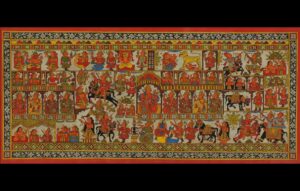
Rajasthani folklore captured in detailed Phad artwork.
The Legend of Pabuji: A Brief Retelling
The epic of Pabuji, a 14th-century folk deity from Rajasthan, is one of heroism, loyalty, and divine connection. Born of a Rajput prince and a celestial nymph or Apsara, Pabuji was raised by his extended family after his mother’s demise. From an early age, he stood against injustice, fighting the Khinchi clan who would attack their land and sacred cows.
A pivotal moment in the tale occurs when Deval, a wise woman from the Charan community, gifts Pabuji a magical mare named Kesar Kalami, who is believed to be the reincarnation of his mother. With this divine horse, Pabuji sets out on various quests including crossing the Indus to fetch camels as a wedding gift for his niece, battling kings and defeating Ravana in Lanka.
He later marries Princess Phulvanti, but in the midst of the wedding, learns that Deval’s cattle are being stolen by the treacherous Jidrav Khichi. Honoring his vow to protect her, Pabuji abandons his marriage and goes into battle. Though victorious at first, he is ultimately fatally wounded and ascends to heaven. (Bhaskar & Bahl,2022)
This epic, passed down through oral storytelling and Phad scroll paintings, is performed by the Bhopa-Bhopi duo using songs, dance, and music that often continues from dusk till dawn. The full tale is vast and varies across regions, as oral traditions allow for multiple interpretations and renditions, making each retelling a unique experience.(Sarkar & Tyagi,2024)
The worship of Pabuji is a vibrant night-long ritual performed not in temples, but in open spaces with a hand-painted scroll called the Phad. This scroll acts as a mobile temple, depicting scenes from his life in vivid colors, with red highlighting Pabuji at the center. As dusk falls, the Bhopa, a priest-singer, and his wife, the Bhopi, begin the sacred storytelling.(Akhtar & Farooq,2023)
The Phad is unrolled, and offerings of sweets, incense, and prayers are placed before it. The Bhopi holds an oil lamp to illuminate different scenes while singing alongside the Bhopa, who plays a traditional stringed instrument called the Janter and wears ankle bells to enhance rhythm. The narration flows across the scroll, not always chronologically, as the Bhopa links past events to the present, making the deity’s story feel immediate and alive.
The soundscape is enriched by traditional Rajasthani instruments: the Ravanhatta with its bowed strings and ghungroos, wind instruments like the narh, and a variety of drums including the bam of Bharatpur, a large, single conical drum. (Pareek et.al., 2018)
The villagers gathered in rows, listens deeply sometimes laughing, sometimes mourning, as the tale of Pabuji’s battles, vows, and sacrifices unfolds. Breaks for tea or local banter blend seamlessly with the sacred atmosphere.
The entire experience is more than worship it is a performance, a healing ritual, and a way of sustaining faith and memory in the community.
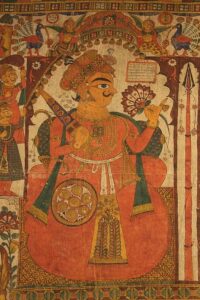
Traditional depiction of Pabuji in a hand-painted Phad scroll.
The Voice That Sings the World: Women and the Living Epic
In the deep desert dusk of Rajasthan, when the world is washed in ochre and silence, a painted scroll is unfurled. And then, not with spectacle but with invocation, a woman begins to sing.
She is the bhopi, the custodian of song and memory, and in her voice lives the story of Pabuji warrior, protector, and deity. The story belongs to a man, but the voice that brings him alive, night after night, has always been a woman’s.
Within the performance tradition of Pabuji ki Phad, the bhopi does more than sing; she speaks the world into being. As she holds the lamp, lighting scenes painted on the Phad, her voice meanders through centuries, spinning tales of courage, betrayal, duty, and longing. Unlike the sharp, conclusive voices of history, hers is fluid, often circular. The gav, the longest and most emotionally laden part of the epic, is her domain. It is in this space that the sung narrative opens itself to improvisation, to complaint, to tenderness often slipping between the mythic and the mundane.(Mathur,2015)
It is here that the concerns of women breathe and protest, softly but insistently. In metaphors of milk and curd, in laments of unpaid dowries, in asides about domestic cruelties, the bhopi inscribes the unrecorded. One might call it gossip; but it is truth-telling. Here is a woman standing before a village audience, articulating what cannot be said across the dinner mat or within four mud walls. She speaks of exploitation, of broken promises, of familial ridicule not as an outsider or as a revolutionary, but as someone rooted in the same soil, speaking in the same idiom, but with the liberty that song offers and prose cannot hold. (Shukla, 2022)
These aren’t just outpourings of sorrow. They are layered acts of witnessing. Through her performance, the bhopi becomes both the archivist and the oracle. She doesn’t ask for reform; she remembers, and in doing so, makes forgetting impossible.
The women of the epic itself mirror this same gravity. Deval Charani, for instance, is not a secondary character. It is she who grants Pabuji the celestial mare, the Kesar Kalami, and with it, the future of his journey. Kelam Dé, too, whose marriage promise pulls the epic into motion, is not merely a prize to be won but a symbol of honor, of obligation. Their voices do not echo through swords and conquests, but through choices and words, through the quiet force of promise and its breaking.
What is extraordinary here is not the empowerment of women in a loud, declarative way, but the suggestion that narrative itself is female, that the song of the world is first sung by women, and that the moral axis of the epic turns not on conquest but on commitment.
And just as the bhopi’s voice breathes life into the scroll, women in the Phad painting tradition once denied the opportunity to paint for fear that the technique might “leave the family” through marriage are now reclaiming the brush. Not just assisting in mixing natural dyes or stretching the cloth, but painting whole scrolls, experimenting with new themes, teaching across regions. They do not merely replicate; they innovate, and in doing so, they expand the very boundaries of what this art can hold.
The scrolls, once repositories of masculine heroism, now hold stories shaped by feminine hands and eyes. In their expanding presence lies not just inclusion but a transformation of gaze from the eye that observes to the eye that witnesses, from the painted deity to the woman who paints him.
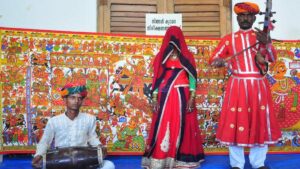
Bhopa and Bhopi performing before a Phad.
The Ecology of Devotion
Far from the temples of stone and marble, in the arid lands near Kolu Pabuji village, lies an Oran a sacred grove. It is vast, green, and untouched. No axe has met its trees in over 600 years. No branch is cut, no herb removed for private use. The trees especially the resilient khejri stand tall, not as resources, but as ancestors.
The grove belongs to Pabuji. Or rather, it is protected in his name.
To fell a tree here is not an environmental violation it is a spiritual betrayal. The punishment is not legal but moral: a fine, a public apology, and more potently, the fear of divine anger. The villagers do not protect the grove because of ecological awareness campaigns or forest acts; they protect it because it is holy.
This sacred geography creates a moral ecology, where land is kin, not commodity, and where reverence functions better than regulation.
If the Phad is a portable temple, then the Oran is a rooted one. Where one moves with voice and song, the other stands still with wind and silence. But both are animated by sacred presence, and both resist commodification.
Today, these groves are recognized as biodiversity hotspots, maintaining microclimates, preserving water, and serving as sanctuaries for rare species, including the endangered Great Indian Bustard. This is a theology not of dominion but of guardianship. It suggests that land can be held without owning, protected without fencing, loved without extracting. It offers a counter-narrative to modern development, one that sees relationship, not utility, as the basis of value.
The performance of Pabuji ki Phad and the protection of the Oran mirror each other in spirit. One unfolds the ethical imagination, the other sustains the material reality. Both are rituals of care one for the world of memory, the other for the world of roots.(Devi et.al., 2023)
But this is just one strand. Sustainability in the Pabuji tradition is also animal-centered. Worship of Pabuji is deeply tied to the health of livestock, among Rabari community, whose livelihoods depend on camel herding. Rituals are performed at key moments in an animal’s life: before inserting a nose-pin into a young camel, during her first milk, when the herd sets out for migration, or after cauterizing a sick animal. On each of these occasions, a prayer to Pabuji is offered, often a performance is commissioned to seek protection and healing. (Sharma, 2021)
This ritual cycle reveals a profound symbiosis: animals are not passive resources but companions in a spiritual and economic journey. When they thrive, the community thrives; when they fall sick, so does the collective spirit.(Pachori, 2016)
Even the material culture of the tradition is marked by ecological restraint. The Phad scroll itself, central to the epic’s performance, is made from cloth and painted using natural colors derived from stones, flowers, spices, and minerals. These colors are painstakingly prepared, often over days.(Bhandari,2006)
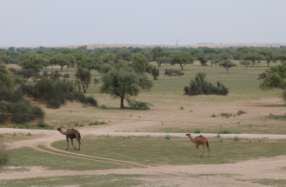
Landscape view of Kolu Pabuji Oran land
Obstacles to Survival: Modernity and the Marginalization of Living Traditions
In the blistering heat of Rajasthan’s deserts, traditional Bhopa performers of Pabuji ki Phad now find themselves battling erasure. Once custodians of a living oral epic, these folk musicians are now landless and scattered, forced to swap sacred songs for Bollywood tunes in distant cities to survive. Heat damages their instruments, travel becomes punishing, and even those who persist, perform for dwindling audiences. Young Bhopas drift toward wage work, while only a handful carry on the lineage. Despite its richness, the tradition lives on the margins of museums and tourism brochures, rather than as living pedagogies and spiritual inheritances.
Subhash, a Bhopa from Rajasthan, now spends his summers performing on the Delhi-Haridwar highway with his wife, far from the sacred spaces where the Phad once came alive under starlit skies. The punishing heat, the roar of traffic, and the uncertain generosity of passersby replace the ritual reverence of village courtyards. One can only imagine the quiet dignity it takes to carry centuries of sacred song into such unkind settings, an art born of devotion now rendered into survival.
In a rented room in Meerut, another Bhopa Amar Singh holds on to a vanishing world. Once surrounded by singing elders patronised by wealthy locals, he now performs Pabuji ki Phad for dwindling audiences, earning barely enough to survive. The camels are gone, replaced by tractors; his children no longer wish to learn the art. He laments, “Out of a hundred Bhopa families, only two remain” ,his voice bearing the weight of a fading legacy. (Hindustan Times, 2025)
Conclusion: A Renaissance
In a quiet lab at IIT Jodhpur, Pabuji ki Phad found an unexpected ally in the Thorr Collective a group of researchers, artists, and technologists determined to breathe new life into fading traditions. Their project didn’t aim to modernize the sacred scrolls, but to reimagine access. With the help of virtual reality, they built a game-like experience where users don’t just watch the Phad they step into it. Voices of real Bhopas echo through the digital corridors, and each frame of the painted scroll becomes an immersive story-space. In this meeting of ancestral art and algorithm, tradition isn’t overwritten, it’s reawakened.(Virmani, 2025)
To preserve this tradition is not merely to archive a scroll or record a performance. It is to respect the voices of women, honor the Earth as a sacred entity, and value indigenous knowledge systems as legitimate frameworks for sustainability.
In a time when the world searches for climate resilience, gender equity, and cultural identity, the legend of Pabuji offers a time-tested template, one that does not separate women from nature, or myth from morality, but weaves them together in a story still waiting to be told.
References
1. Bhaskar, L. and Bahl, D. (2022) The Story of Colour in Traditional Indian Folk Media and Art, in Proceedings of the International Colour Association (AIC) Conference 2022. Toronto, Canada.
2. Dadheech, C. (2024) Divine Tapestry: Tracing the Presence of Indigenous Gods in India, Journal of Rajasthan Association for Studies in English, 20, pp. 105-112.
3. Sarkar, S.K. and Tyagi, N. (2024) The culture of storytelling: Richly present in the entire Indian subcontinent, International Research Journal of Social Sciences, 13(2), pp. 1-4.
4. Akhtar, S. and Farooq, N. (2023) Folk Dance and Music of Rajasthan: A Study of their Role in Fairs and Festivals, Social Science Journal for Advanced Research, 3(4), pp. 59-64. DOI: 10.54741/ssjar.3.4.9.
5. Pareek, A., Pant, S. and Tailor, S. (2018) RELATIONSHIP BETWEEN RITUALISTIC USE AND STYLE OF WORSHIPPING OF MATA NI PACHEDI AND PHAD TEXTILE PAINTINGS, Quest International Multidisciplinary Research Journal, 7(1). Available at: http://www.researchjournals.in [Accessed 22 Jul. 2025].
6. Mathur, P. (2015) Women in Tribal Folk Narrative of Rajasthan “Pabuji Ki Phad”, International Journal of Multidisciplinary Approach and Studies (IJMAS), 2(1), pp. 96-101.
7. Shukla, S. (2022) Phadchitra of Rajasthan: Significant contribution of women artists among the unique art forms, IOSR Journal Of Humanities And Social Science (IOSR-JHSS), 27(5, Series 8), pp. 15-23. Available at: www.iosrjournals.org [Accessed 22 Jul. 2025].
8. Devi, S., Kumar, S., Choyal, G. and Saran, R.K. (2023) Traditional Practices in Water Resources Conservation in the Thar Desert of Rajasthan, IJFANS International Journal of Food and Nutritional Sciences, 12(07).
9. Sharma, P. (2021) Religious Practices among a Nomadic Community: Raika, in Rajasthan Journal of Sociology. Vol. 13. Jaipur: Rajasthan Sociological Association.
10. Pachori, S. and Kannan, M. (2016) Sustainable Development as Depicted in Pabuji Ki Phad, Rajasthan, India, Humanities and Social Sciences Review.
11. Bhandari, V. (2006) Wandering Minstrels – The Tale of the Phad, in Textile Society of America Symposium Proceedings. Available at: https://digitalcommons.unl.edu/tsaconf/351 [Accessed 22 Jul. 2025].
12. Hindustan Times (2025) Folk musicians of Rajasthan battle landlessness, rising heat in fight to save ancient art. Available at: https://www.hindustantimes.com/lifestyle/art-culture/folk-musicians-of-rajasthan-battle-landlessness-rising-heat-in-fight-to-save-ancient-art-101746338896626.html [Accessed 23 July. 2025].
13. Virmani S., (2025) How digital artists are reimagining the centuries-old ‘Pabuji Ki Phad’ art form,TNA Mag. Available at: https://tnamag.xyz/art-tech/pabuji-ki-phad-art/ [Accessed 23 July. 2025].
14. Martins, S. and Singhvi, R. (2024) Literature of the Rural Life: Folk Deities in Indigenous Performing Arts, IIS Univ.J.A., 13(3), pp. 131-141.
Images
1. Thorr Collective, 2023. Pabuji Ki Phad Art and Technology: A New Medium for an Ancient Story . TNA Mag. Available at: https://tnamag.xyz/art-tech/pabuji-ki-phad-art/ [Accessed 23 Jul. 2025].
2. Sarmaya Arts Foundation. Pabuji Ni Phad – Phad. Available at: https://sarmaya.in/objects/indigenous-tribal-art/pabuji-ni-phad-phad/ [Accessed 23 Jul. 2025].
3. Exotic India Art. Phad artwork – The folklore painting tradition of Rajasthan . Available at: https://www.exoticindiaart.com/article/phad-artwork/ [Accessed 23 Jul. 2025].
4. Nagarajan, S., 2017. Phad and the portable temple . The Hindu. Available at: https://www.thehindu.com/society/history-and-culture/phad-and-the-portable-temple/article19645174.ece [Accessed 23 Jul. 2025].
5. Khan, M., 2018. Human awareness and wildlife conservation in western Rajasthan. Available at: https://www.researchgate.net/publication/329217401_Human_awareness_and_Wildlife_conservation_in_western_Rajasthan/figures[Accessed 23 Jul. 2025].