

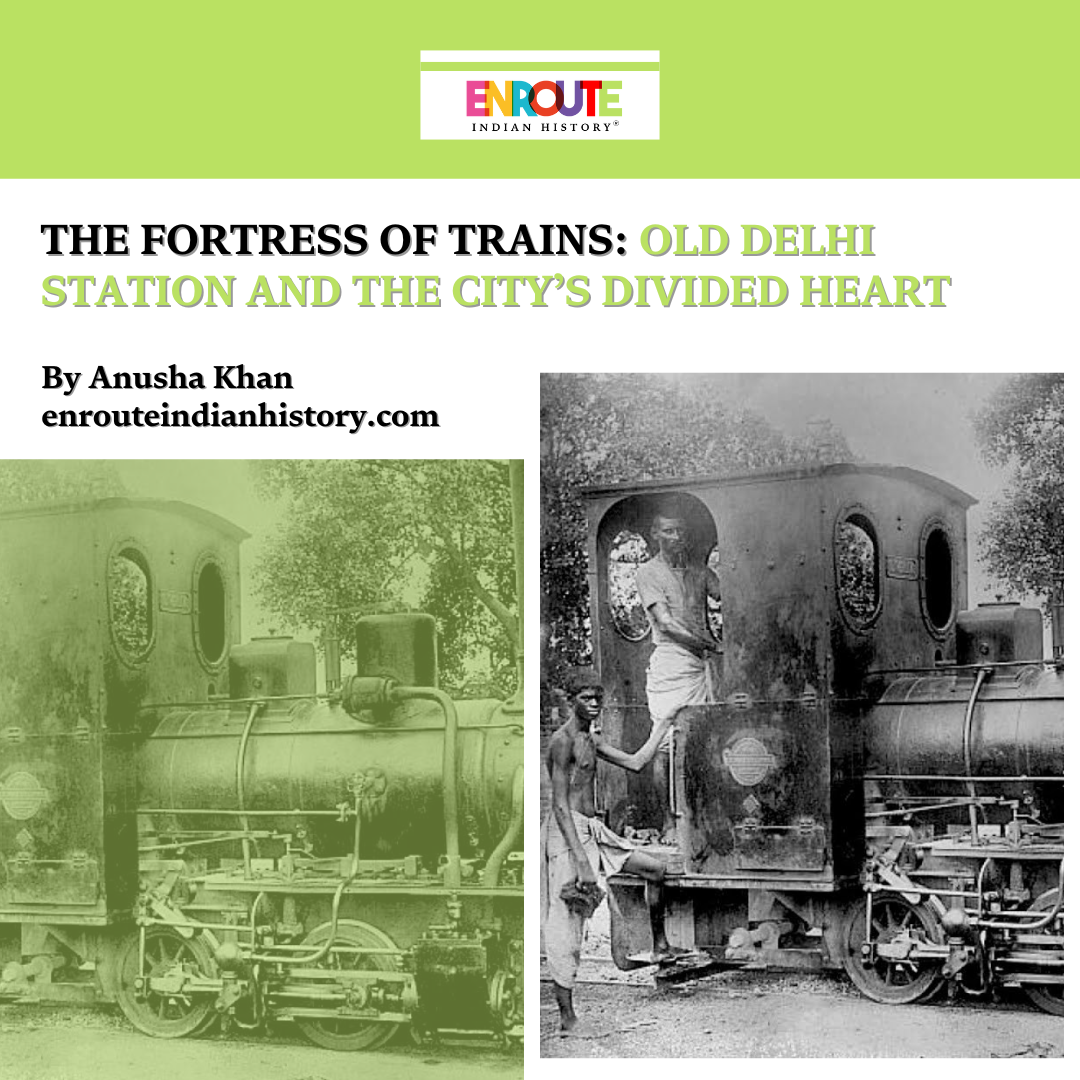
By Anusha Khan
Silence in the Noise
Amid the noise of Old Delhi—the clang of rickshaw bells, the cries of chai-sellers, the smell of dust and diesel—stands a large red building that has quietly helped shape the city’s story. The Old Delhi Railway Station, or Delhi Junction as the signs call it, faces the Red Fort across a narrow stretch of traffic. Both are built of red sandstone, both command attention, yet they hold different kinds of memory.
Every few minutes, a train pulls in with a deep metallic sigh. Porters weave through the crowd with luggage on their heads, families wait under slow-turning fans, and pigeons flutter above the arches. The station seems chaotic, but there is rhythm in the disorder, an old, familiar pulse that belongs to the city itself.
For over 150 years, the station has stood at the meeting point of empire and everyday life. It has seen the city rise from rebellion to empire, from empire to independence. It was built by the British not as a monument for movement, but as an act of control. A century and a half later, its red walls still breathe with the memory of those who passed through them—soldiers, merchants, refugees, dreamers, the displaced and the hopeful.
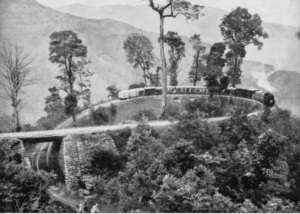
Courtesy of the economic times
A Fortress of Iron and Stone (1864–1903)
The railway came to Delhi in 1864, only a few years after the rebellion of 1857 had left the city broken and its old empire gone. The British were attempting to rebuild Delhi in their own image, cutting new roads, clearing what they called “ruins”, and laying down the rails of empire. When the first train arrived, it brought a new kind of order as well as passengers: steel, symmetry, and surveillance. The lines cut through the heart of Shahjahanabad, dividing the old Mughal city from the new colonial quarters.
This was not a neutral act of connection. The railway lines themselves became political, a form of punishment written into the city’s geography. The British built the tracks to run across Delhi’s middle, using them as a defensive boundary between the “native” city to the south and the European Civil Lines to the north. If another rebellion were to rise from the ruins of Shahjahanabad, soldiers could be moved instantly by rail, cutting off the old city from the rest of the province. The train, for the colonial state, was not an innocent symbol of progress, it was an instrument of power, a way to render Delhi legible, mobile, and containable.
By 1903, the British had rebuilt the station entirely in red sandstone. Its domes and arches echoed the Red Fort nearby. The resemblance was deliberate, meant to suggest continuity and inheritance of the previous regime and derive legitimacy. Where the Red Fort had once symbolised kingship, the new station represented circulation and control. The British were staking a quiet claim: that they were the rightful heirs of Delhi’s imperial tradition, able to fold Mughal grandeur into their own empire of trade and administration.
Officials from the East Indian Railway Company described the design as “harmonising with the native architecture.” But this harmony was one of dominance, not dialogue. The building’s symmetry and Mughal-inspired details—the cusped arches, the octagonal turrets, the chhatris—gave it a sense of familiarity even as its purpose was entirely different. What had been a fortress of rulers became a fortress of trains, a structure that faced, and in some sense replaced, the fort of kings.
The echoes between the two were unmistakable. Both were built of the same red sandstone, both framed by high gates and battlement-like projections. The symmetry that once represented cosmic order under the Mughals was repurposed into mechanical precision under the British. The city’s centre of gravity shifted quietly, from the court to the platform.
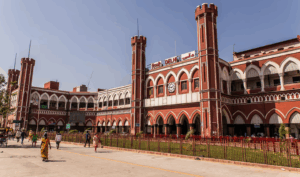
courtesy of HT
Robert Clarke, the East Indian Railway’s chief engineer, called the project part of Delhi’s “arterial reform.” His plans show straight roads radiating from the station toward Chandni Chowk and Kashmere Gate, cutting through dense neighbourhoods in the name of improvement. But these new arteries were also boundaries, carving up the old city into zones that could be more easily governed. The British imagined this geometry as progress; underneath it lay anxiety: the need to make a rebellious city legible, visible, and under watch once again.
For the people of Delhi, the change was both spectacular and disorienting. The familiar rhythm of bullock carts and narrow gullies met the shrill whistle of engines and the rush of smoke. Where Mughal Delhi had been a city of intimacy—courtyards, mosques, and slow movement—the railway introduced a new tempo, faster and louder, one that demanded the city adapt. Hawkers began gathering outside the station gates; small tea stalls and carriage stands appeared, forming a new kind of bazaar. The old city had lived by the logic of proximity; the colonial city lived by the logic of circulation.
Even in its earliest years, the station embodied the contradictions of colonial modernity. It was both imitation and assertion, a monument to progress and an emblem of control. It gave the British an architectural claim to the past they had destroyed, a way to stand within Delhi’s imperial lineage while keeping its people under watch. Every arch and dome seemed to whisper the same quiet message: that power could travel under new names but wear familiar stone.
Remaking the City
Robert Clarke, Delhi’s deputy commissioner and president of the municipality, saw the railway as both Delhi’s rebirth and its problem. In an 1899 memorandum, he declared that the city had “risen from the ashes” of the Rebellion to become “the capital of India once again, in a different sense from that which it was known to history.” What he meant was not a return of sovereignty, but of commerce. Delhi, now a terminus for the major northern railways, was to be the new imperial crossroads. Yet Clarke fretted that its success was being strangled by congestion—“the interchange of traffic” had become, to him, a municipal crisis. The colonial city, he believed, had to be rebuilt for movement.
Separate routes were proposed for heavy goods carts and for pedestrians, so that the “native congestion” could be tamed into predictable order. Even gardens were enlisted into this vision of discipline. The Queen’s Gardens, lying between the station and the Town Hall, were redesigned as open, well-lit spaces with benches, footpaths, and a single “ruined burj” for aesthetic effect: what Clarke imagined as a civilising lesson in the midst of motion. Beauty, in this plan, was a means of control.
Yet the anxiety beneath this order was unmistakable. The same plans that promised smooth movement were laced with fear of rebellion and theft, of itinerant ‘disreputable characters’ near the station, of the city’s restless poor. The gardens that were to remain open “day and night” were also ringed with railings and gates, to make ingress and egress visible under police watch. Even as Delhi was remade as a city of circulation, it was being fenced, divided, and watched. Policing and planning became inseparable, each feeding the other. Clarke’s geometrical Delhi was a map of imperial anxiety.
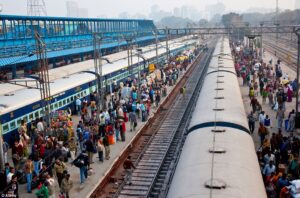
courtesy of the Indian wire
Raghav Kishore has shown how these efforts to manage traffic and visibility were part of a larger “politics of scale.” The municipality’s designs often collided with those of the Government of India, which imagined Delhi not as a living city but as an instrument of state control—a “territorial work” to be inscribed with imperial authority. For the municipality, planning meant circulation: the movement of goods, people, and capital. For the government, it meant consolidation: the management of land and surveillance. These competing logics of power produced the city’s uneven modernity. Roads were widened, over-bridges proposed, and “nuisances” removed in the name of ventilation and visibility, but much of it was driven by the fear that Delhi, once the heart of rebellion, might again refuse the order imposed upon it.
When the British moved their capital from Calcutta to Delhi in 1911, they built a new railway terminus at the other end of the city, closer to the Viceroy’s palace on Raisina Hill. Yet Old Delhi Station endured, not as a relic, but as a reminder that the life of a city cannot be planned from above. It would soon bear witness to a far greater tide of movement than even Clarke could have imagined.
Trains of Partition
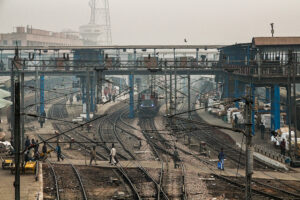
In August 1947, the trains that had once carried the empire’s goods began to carry its ghosts. Delhi Junction became one of the epicentres of Partition. Where the British had once imagined order and circulation, there was now panic and flight.
courtesy of wikimedia commons
Witnesses recall trains arriving from Punjab “packed beyond sight,” roofs layered with people, compartments sealed and silent. Some trains came with no sound at all, only the smell of death. Porters who had once carried luggage now carried bodies. Refugees waited under the same arches that had seen soldiers of the empire march through, clutching whatever they could hold onto, metal trunks, bundles of clothes, sometimes just the memory of home.
The railway, built as an instrument of imperial control, became a witness to its collapse. Tracks that had divided the native city from the European one now divided the living from the dead. Delhi Junction was transformed into a refugee camp, a distribution centre, a space of mourning and resettlement. The symmetry of the building, once a monument to colonial precision, was undone by the chaos of survival.
Yet even in this moment of rupture, the station became a space of reassembly. The same platforms that had seen the machinery of empire now saw the birth of a new nation with tents pitched on the concourse, meals cooked on signal boxes, names shouted over the din of departure lists. Delhi, swollen with hundreds of thousands of refugees, began to rebuild itself from this human tide. The station’s walls, darkened by smoke and grief, absorbed these new beginnings too.
It was here that the meaning of movement changed again. The trains that once symbolised control now spoke of displacement; the routes of empire became the routes of exile. And yet, in the same motion, Delhi’s heart began to beat anew. The refugees who arrived at Old Delhi Station did not just pass through but remade the city. Around the station grew new neighbourhoods, new bazaars, new languages of belonging. From the ruins of partition, Delhi once again became a city of arrivals.
Echoes and Afterlife
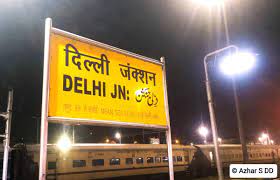
Today, the Old Delhi Railway Station still stands where it always has with its red walls soot-stained, its arches cracked by time, and its platforms crowded from dawn till night. Every day, thousands arrive here from distant towns—vendors from Saharanpur, students from Aligarh, workers from Bihar—each stepping into the city’s long story of movement and survival. The platforms, lined with chipped benches and sleeping figures, hold the same mixture of noise and stillness that has always defined this place.
Across the road, the Red Fort glows faintly under floodlights. Between the two—the fortress of kings and the fortress of trains—stretches a century and a half of Delhi’s history. The view has changed, but the conversation between them continues. Where one once announced the empire of sovereignty and the other the empire of circulation, both now stand as monuments of memory, silent and enduring.
courtesy of India.com
The British, in their imitation of Mughal architecture, had tried to root themselves in Delhi’s past. What they could not foresee was that the station would become part of the city’s future instead—a place that refused to remain only a symbol of control. The geometry that once served surveillance now shelters small acts of everyday life. In the same forecourt where Robert Clarke once dreamed of smooth, orderly movement, rickshaw pullers nap between fares, children chase pigeons, and tea-sellers pour steaming cups for passengers waiting beneath the archways. The design meant for imperial display now hosts an unplanned choreography of human routine.
Old Delhi Station is not simply a relic; it is a reminder that the city’s past is not behind it but beneath it, layered in the bricks, the arches, the dust. Each generation inherits it differently: the colonial engineers with their plans, the refugees with their pain, the commuters with their urgency. And in that continuous occupation—in the noise, in the routine, in the refusal to stand still—Delhi finds its endurance. The station, like the city it anchors, has learned the oldest lesson of all: to keep moving.
References
Dastidar, Avishek G. “When Railways Nearly Derailed New Delhi.” Hindustan Times. Accessed 30 Oct. 2025.
“Old Delhi Railway Station: A History of the People and Their Journeys.” Shahjahanabad e-Heritage Project. Accessed 30 Oct. 2025. https://shahjahanabad.eheritageproject.in/old-delhi-railway-station-a-history-of-the-people-and-their-journeys/.
“Old Battle Stations.” The Patriot. Accessed 30 Oct. 2025. https://thepatriot.in/community/old-battle-stations-37396.
“Oldest Railway Station in Delhi.” Jagran Josh. Accessed 30 Oct. 2025. https://www.jagranjosh.com/general-knowledge/oldest-railway-station-in-delhi-1820001148-1.
“Old Delhi Railway Station History, Location and Facilities.” RentoMojo Blog. Accessed 30 Oct. 2025. https://www.rentomojo.com/blog/old-delhi-railway-station-history-location-and-facilities/.
Kishore, Raghav. “Planning, Traffic and the City: Railway Development in Colonial Delhi, c. 1899–1905.” Urban History 44, no. 2 (2017): 253–269. JSTOR. https://www.jstor.org/stable/26398746.
Prasad, Ritika. “‘Time-Sense’: Railways and Temporality in Colonial India.” Modern Asian Studies. University of North Carolina at Charlotte. Accessed 30 Oct. 2025.