
RAVNEET KAUR
“But whom to love?
To trust and treasure?
Who won’t betray us in the end?
And who’ll be kind enough to measure our words and deeds as we intend?”
~ Alexander Pushkin, Eugene Onegin (1833)
“And I? I wanted to dive into you like water, to press my face to your shoulder and vanish like sugar into tea”
~ Clarice Lispecter, The Passion According to G.H. (1964)
Love. Who has not thought, felt, fought and yearned for it? It has carved poets and tyrants alike. Every poet and writer has understood and made something of it. Susan Sontag tells us that of all emotions and feelings only one is inexplicable and mysterious – love. Lord Byron called it the answer to the four questions of value in life – “What is sacred? Of what is the spirit made? What is worth living for? And what is worth dying for? The answer to each is same. Only love.” James Baldwin (1962) asks us the haunting question – “How can you live if you can’t love? And how can you live if you do?”. And in his seminal work, The Count of Monte Cristo (1844), Alexander Dumas writes – “Out of love for you, I have forgiven the world.”
Every language, place and people have their own vocabulary of love. As early as the earliest extant writings, humans in every place and every age have etched their ramblings of love and stringed together chains of affection with words. The Love Song for Shu-Sin (c. 2000 BCE) from Mesopotamia to Sappho’s fragmented poetry on the shores of Lesbos, the examples abound. One amongst the many testimonies of love is the Gathasapta Shati, also called the Sattasai or Gaha Kosa. The Gaha Kosa or Book of Songs are seven hundred verse in the gatha form written in Maharastrati Prakrit and one of the oldest poetry anthologies of the Indian subcontinent while simultaneously being the earliest set of secular poems of the subcontinent.
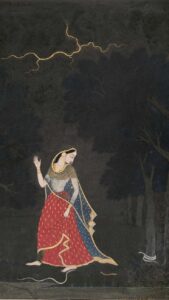
Figure I: Abhisarika Nayika (“The Heroine Going to Meet Her Lover at an Appointed Place”) by Mola Ram. c. 1800. Wikimedia Commons. (https://commons.wikimedia.org/wiki/File:Abhisarika-nayika-mola-ram.jpg)
THE BOOK OF SONGS
Among countless elegant poems,
King Hāla, patron of poets,
Has selected seven hundred. [3]
The Gathasapta Shati has been attributed to the 1st century CE Satavahana King Hala. Several dates have been accorded to the text, some ranging between 2nd century BCE to 2nd century CE and other dating it to the 3rd-7th century CE. In any case, the text gained its formal shape in the early centuries of the common era. Out of the seven hundred poems, 44 verses attributed to Hala while the others belong to several other authors. Commentaries of the anthology give varying lists of possible authors and thus there has been much debate over the text’s authorship. Some list the number of poets to be 261 while others at 389 (Sahgal, 2019). Significantly some of the poets are also women.
Another troubling issue are the poems themselves. Albrecht Weber’s Critical edition (1881) noted that different copies of the text housed different poems altogether. In total there were 964 poems across all variations, amongst which 430 poems were common to all editions. The poems were never removed but replaced to retain the titular number 700. So often, in the later editions or commentaries when one poem was replaced another was added in its place to maintain the canonical number of seven hundred.
The poems are written in Maharashtri Prakrit, are concise, make use of simple vocabulary and “free of rhetorical embellishments”. They are set in the ārya meter with 8 bars. The poems are written in the style of either monologues or conversations among two or more people. Women serve as the chief transmitters of the verses as is often the case with folk lores, songs and literature. Shringara rasa permeates the entire anthology, both union (sambhoga) and separation (vipralambha). Ample use has been made of vocatives, similes, allegories and puns.
GEOGRAPHIA: SOUNDS AND SETTING OF THE POEMS
Geographically, the poems are set in the Deccan with – the Godavari, the Tapti, the Murala, Karanja trees of the Western Ghats and the Vindhyanachal hills – serving as markers. The setting is essentially a rural one. The main occupation of the inhabitants of these verses is agriculture and cattle rearing with hardly any mentions of any traders and markets and thus by extension of trade and commerce. Though the absent husband/ traveller is a recurring theme and commerce could thus be relegated to the sphere of the urbane. Some secondary specializations can be witnessed as weavers, dyers, goldsmith, carpenter, potter, garland maker and so on find a mention.
Dr. Smita Sahgal notes that the world of the text is that of “a society in transition from a tribal to a class/ caste based society. It was not completely braminized but the process had begun. No clear mention of a caste but some kind of social stratification is evident”. The process of Brahminization and Sanskritization thus had not yet crystallized.
Gathasaptasati as a literary work of such open frankness may have been possible “as the society of ancient Deccan was still not fully stratified or complex. Patriarchy had not yet consolidated and did give women a voice which was preserved in folklore”
Over time, the text was also subject to evolving rules of grammar which had seeped into Prakrit language and thereby “one can accept that Hala’s verses were not for the ears of common folk alone; they had courtly listeners too” which by thus “reflects the beginnings of early literary systemization.” (Sahgal, 2019).
SANSKRIT AND PRAKRIT – THE LANGUAGE OF THE GODS AND THE LANGUAGE OF THE PEOPLE
“Shame on those who cannot appreciated
This ambrosial Prakrit poetry
But pore instead
Over treatises on love” [2]
Sanskrit, the language of the Gods as it has been termed, was the language of the political, social and religious elites. Sanskrit, courtly, ornamental, full of verbiage and pleonastic, was used for normative, theoretical and narrative texts alike by these elites. Often, it presented a closely guarded view of reality, bound by societal conventions and its own rigorous aesthetical standards. Dr. Sahgal writes that “its Brahmanical (upper caste) veneer does not allow us to read the mind of common people, more so of women”.
In such a scenario, the Gathasaptasati is a respite and offers a “rare glimpse into the minds of the populace, women and their intimate desires, anguish and deprivations with a sense of abandon and honesty”. Prakrit, with its tilt towards orality and popular usage, thus becomes the language of the people and confronts the chants of the gods.
In comes the notorious Kamasutra, a prose work written in Sanskrit, with a theoretical approach to love and sex. The writers of the Gathasapta Shati seem to have some acquaintance with the Kamasutra as in view of the explicit contrast made in poem 2. Chiefly concerned with classifications and listings, and proclaiming finesse through these, the treatise stands in stark contrast to the Sattasai. There are several polarities between the two – while the Kamasutra is for the man about the town, the Gatha Kosa is “essentially a woman’s book, a compendium of her sighs, utterances, silences….”’; moreover, the former belongs to a cosmopolitan setup while the latter is undoubtedly a rural one. The instructions in Kamasutra also address to a specific class of educated and rich who have more than enough time for leisure. While the Gathasapta shati speaks of the tidings of labouring classes, toiling and sweating and often of a household constrained by lack of money.
Khorche and Tieken thus aptly summarising the contrasts, in Poems on Life and Love in Ancient India (2009), write – “Kamasutra and Gathasaptasati represent two totally different views on love and sex …. Kamasutra … product of an ingenious but academic mind. Sattasai …. [shows] the futility of the Kamasutra’s list and enumerations, where Kamasutra is concerned with theory, the Sattasai confronts this theory with the untidy reality of life”.
POEMS ON LOVE
I love you,
Of that I am certain.
What I do not know
And what you must teach me, please,
Is how you will come to love me. [750]
The main theme of the poems is certainly love and eroticism. “Practically all the poems are in one way or another about love ….The poems about love’s joys and love’s excesses are notable for their frankness but as with all love poetry, the greater part of the Sattasai is about unhappy love: love thwarted, unrequited, dissembled or betrayed, as well as love in separation” (Khorche and Tieken, 2009). They centre around lovers’ rendezvous, erotic desire, marriage, separation, infidelity, rivalry between co-wives and paramours, lovers’ quarrels, resistance to social accountability. Further ahead, other related themes and matters find their way in – in laws, pregnancy, menstruation and so on.
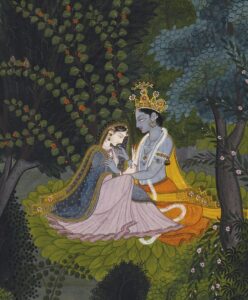
Figure II: Krishna Charms Radha Forest. An Illustration From ‘Lambagraon’ Gita Govinda Series. Circa 1820. Kangra. Attributed Purkhu His Circle.
Read some for yourself, dear reader:
EXCHANGING GLANCES
Due to these cursed villagers
Who brandish a cudgel at a mere pinprick
I dare not set eyes on my lover
Though we live in the same village. [502]
You fool,
How can you say she didn’t say a word?
She looked at you all the time
But her sight was blurred
By the tears welling up in her eyes. [371]
He looked at her
In such a way,
And she at him,
That, at the same moment,
They both consummated their love. [627]
LONGING & YEARNING
Mother,
That young man
Who downriver drank the water
That was bitter with my turmeric soap,
Has as good as drunk my heart. [246]
The tinkle of bracelets
As she took a bath in the backyard of her parent’s house
Redoubled the passion of her husband
Who had arrived in the late afternoon. [685]
RENDEZOUS
When he comes what shall I do?
What shall I say?
And how will it be?
The girl’s heart trembles
At her first chance to be reckless [187]
Look!
The freshly dyed skirt
That the woman hurriedly kicked off
In her desire to make love
Hangs over the bower
Like a banner proclaiming her immodesty. [461]
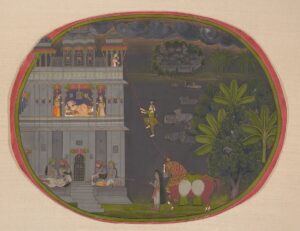
Figure III: Escapade at Night. Attributed to Chokha (Indian, active 1799–ca. 1826). c. 1800–10, Mewar. The Metropolitan Museum of Art. (https://www.metmuseum.org/art/collection/search/73261)
A MENSTRUATING WOMAN
Though people condemn it,
Though it is highly inauspicious
And considered most improper,
The sight of a woman during her period
Fills the heart with heavenly bliss. [480]
“People will be angry.”
Let them be.
“They will disapprove.”
Who cares?
Come, forget about your period
And snuggle down beside me,
For I can get no sleep. [530]
THE RIVALRY
The red
That during the night her husband
Removed from her lips
Appears the next morning
In her co-wives’ sleepless eyes. [106]
You love her,
I love you,
She hates you,
And you hate me.
I speak plainly since love is full of complications. [126]
INFIDELITY
Just look!
After her husband had addressed her with his mistress’s name
The ornaments she had put on for the fair
Suddenly appeared like a garland on the head of a buffalo
Being led to sacrifice. [496]
Dear friend,
The man for whom I abandoned modesty
Destroyed my character
And lost my good name
Now treats me just like anyone else. [525]
With food and water
The false woman has trained the dog
To welcome her lover
And bark at her husband as he comes home. [664]
SEPARATION
As the wife embraced her husband
Who was about to depart,
The bracelets slipped from her slender arms
Clasped around his neck
And fell at his feet like shackles. [786]
As her husband is about to depart
She goes from door to door
Asking all the women who suffer from absent husbands
For the secret of surviving the farewell. [47]
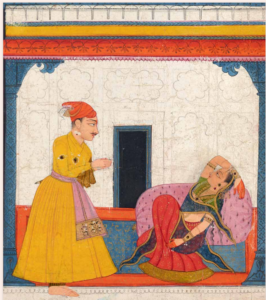
Figure IV: The Lover Prepares to Depart: folio from the Rasamanjari III series. Attributed to Golu. c. 1710-20, Nurpur, Himachal Pradesh. Wonders of the Age: Master Painters of India 1100-1900. 2011. The Metropolitan Museum of Art.
EPILEGOMENA
If you want to be happy
Take care in choosing a lover,
For what is dear to you
Does not bring happiness
Unless you are dear to it. [652]
Fate,
Please, don’t let me be born as a human again.
But if it must be,
Then don’t let me fall in love.
But if it must be,
Then don’t let me fall in love
With a man who is so hard to get. [844]
Love vanishes
Through not seeing enough of one another,
Through seeing too much of one another,
Through spiteful gossip,
And sometimes just like that. [81]
INTERPRETING THE INNENDOS
The commentaries on the text were written approximately between 13th and 16th centuries. These commentaries offer varying interpretations for the poems. Some of them seem plausible while some are definitely far-fetched. Moreover, often there is no consensus amongst various commenters and interpreters. Take for example –
“Take it and have a look!”
With a broad smile on her face
She hands her husband the jujube fruit
With the marks on it
Of their son’s first pair of teeth. [200]
Khorche and Tieken warn that though it seems like a charming domestic scene, the erotic implications run deeper. One commentor writes that the mother is overjoyed that the child can now be weaned and thus she can make love with her husband. Another writes that “it is not the infant who has implanted the tooth marks but the wife in her impatience to have sex” while yet another holds that the wife is making an open invitation to her husband to come and bite her!
Amidst such mayhem, the lingering question is whether or not such erotic connotations can be inferred or can actually be sought in the first place merely because the Gatha Kosa is an anthology of love poems.
SAUDADE: THE SIGHTS AND SLIGHTS
The friends of our youth have passed away,
Of those bowers nothing remains but stumps,
Gone is the vigour of former days
And love has been cut to the roots. [232]
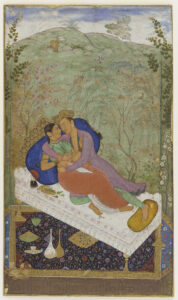
Figure V: Sultan Murad and a Consort. Attributed to Manohar. c. 1597, Mughal. Wikimedia Commons. (https://commons.wikimedia.org/wiki/File:Lovers,_Mughal_dynasty.jpg
The Gathasapta Shati thus proves to be a rare delight with its openness of manner and unabashed verses. The poems truly offer a gateway into the minds of people, especially women, in ancient India and their heartfelt desires, yearnings, hopes and deprivations. And yet again as any literary work of merit, the Sattasai reminds us that whatever maybe the age or the place, that one explicable and mysterious feeling of all has been felt and held close by all alike.
BIBLIOGRAPHY & REFERENCES
1. Khoroche, Peter and Herman Tieken. 2009. Poems on Life and Love in Ancient India Halas Sattasai. Suny Series in Hindu Studies. State University of New York Press, Albany.
2. Sahgal, Smita. 2019. Gathasaptashati: Retelling Intimate history of Ancient Deccan. Advances in Social Sciences Research Journal, 6(2) 467-474.
3. Selby, Martha Ann. 1987. From Hala’s ‘Gathasaptasati’. Indian Literature, Vol. 30, No. 1 (117) (January-February, 1987), pp. 23-26 (4 pages). (https://www.jstor.org/stable/44292212)
PHOTO CREDITS
1.Figure I: Abhisarika Nayika (“The Heroine Going to Meet Her Lover at an Appointed Place”) by Mola Ram. c. 1800. Wikimedia Commons. (https://commons.wikimedia.org/wiki/File:Abhisarika-nayika-mola-ram.jpg)
2. Figure II: Krishna Charms Radha Forest. An Illustration From ‘Lambagraon’ Gita Govinda Series. Circa 1820. Kangra. Attributed Purkhu His Circle.
3. Figure III: Escapade at Night. Attributed to Chokha (Indian, active 1799–ca. 1826). c. 1800–10, Mewar. The Metropolitan Museum of Art. (https://www.metmuseum.org/art/collection/search/73261)
4. Figure IV: The Lover Prepares to Depart: folio from the Rasamanjari III series. Attributed to Golu. c. 1710-20, Nurpur, Himachal Pradesh. Wonders of the Age: Master Painters of India 1100-1900. 2011. The Metropolitan Museum of Art.
5. Figure V: Sultan Murad and a Consort. Attributed to Manohar. c. 1597, Mughal. Wikimedia Commons. (https://commons.wikimedia.org/wiki/File:Lovers,_Mughal_dynasty.jpg