

By Aryan Singh
In Delhi’s historic Red Fort, which once stood as the sentinel of the 1857 revolt and was the site for Bahadur Shah Zafar’s trial, nearly a century later, this place resonated with cries for justice in 1945-46. The Great INA trial, or court martial, began on November 5, 1945, in Lal Quila, where three men from the Indian National Army (INA) were charged with treason, which the IPC defined as waging war against the King.
This trial ignited a wave of nationalism among Indians and energized Congress, whose leaders were in jail after the Quit India Movement, which was crushed by the British. This trial was not just an ordinary legal case; it led to a series of events that accelerated the end of the British Raj and culminated in India’s independence in 1947.
This article will explore the details of this monumental trial and its profound impact on India’s freedom struggle.
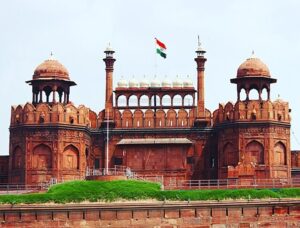
Source: Wikipedia Commons, Red Fort
Before moving forward, let us understand what a court-martial is. It is a military court that tries soldiers of the armed forces for breach of military discipline and law. These courts are different from civilian courts, and they operate under the Army Act. These courts handle offenses ranging from minor infractions to serious crimes like desertion, mutiny, etc.
During World War II, the British were part of the Allied forces fighting against the Axis powers, which included Germany, Italy, and Japan. Indian soldiers also fought under the British against Japanese forces and became prisoners of war of the Imperial Japanese Army. When Japan took control of Singapore, Subhas Chandra Bose established the Provisional Government of Free India in 1943, formed the Azad Hind Fauj, and popularized the slogan “Delhi Chalo” to free India from British rule. (NDTV, 2021) Japanese officials also promised Indian independence if prisoners of war joined Japan in fighting the British. As a result, thousands of Indian soldiers joined the Azad Hind Fauj under Bose’s leadership and, with Japanese support, captured Imphal. However, after the Axis powers were defeated and the British reclaimed the lost territories, many INA soldiers were arrested and tried. (Dr Harkirat singh 2018) One notable trial was the Red Fort trial of three INA officers, which fueled nationalist feelings among Indian soldiers.
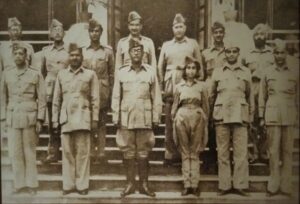
Source: Wikipedia Commons, Cabinet of the Provisional Indian Government
These three were Indian commissioned officers (ICO), Captain Shah Nawaz Khan of the 1st Battalion, Lieutenant Gurbaksh Singh Dhillon of the 14th Punjab Regiment & Captain Prem Kumar Sahgal of the 2nd Battalion, who deserted the British Indian Army to join the INA, where they became senior battlefield commanders. They were accused of murder & abetment of murder and of executing 5 INA jawans in March 1945 because they tried to re-desert back to the British. (Chandar Sundaram, 2022)
According to Chandar Sundaram, the British held this trial in the Red Fort, just as they did with the last Mughal emperor, Bahadur Shah Zafar, to send a message to Indians that they are supreme and hold authority over India. They believed that holding another treason trial would send a strong message to nationalists that the power of the Raj could bring any Indian to its knees. They also believed that putting INA officers on trial would show Indians the seriousness of these crimes and also show fairness if it were held open in contrast to an ordinary court-martial trial.
But why did this Court Martial become so popular and historic that it unleashed a nationalist fervor among Indians? Chandar Sundaram gave the reason that these three officers were from Punjab and belonged to 3 religions, which include Hindu, Muslim, and Sikh, occupying 98% of the total population. Thus, Indian outrage was immediate and unified. Another factor was Punjabi ethnicity, as this province was long regarded as the main recruiting ground of the British Indian army and occupied nearly 75% share of the armed forces. So, it threatened the security of the Raj.
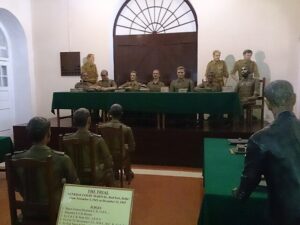
Source: Wikipedia Commons, INA trial Red Fort
The Congress party, which did not back the INA and opposed their methods of liberation from the British, now supported the INA soldiers. The congress stalwarts, such as Jawaharlal Nehru, who once said, “Hitler & Japan can go to hell. I shall also fight Mr. Subhas Chandra Bose & his party along with Japan if he comes to India.” But according to Chandar Sundaram, the same Nehru again, who had retired from the bar 25 years ago, decided to wear his lawyer’s robe & wig and came out in defense of the INA soldiers. The Congress working committee appointed 9 senior counsels, which include Tej Bahadur Sapru, Bhulabhai Desai, KN Katju, RB Badri Das, Asaf Ali, Bakshi Tekchand, and PK Sen, and Jawahar Lal Nehru. (Dr Harkirat Singh 2018)
But why does Congress suddenly shift and vehemently support the INA? These can be attributed to many factors, as mentioned by Chandar Sundaram, that in September 1945, Congress leaders were released from jails after spending 3 years due to the crackdown of the Quit India movement of 1942. In these years, Congress realized that it had lost its momentum and lost ground after spending a long time in prison, and the Muslim League emerged powerful in many provinces, challenging the Congress. Now, Congress was looking for an issue that could shift the momentum in their favour and bring political limelight across India, especially since the elections to the central provinces were due in the year 1945-46. The INA trial allows Congress to revive itself and expand its mass appeal to the Indians. They formed the INA relief committee and approved a resolution calling for the immediate release, and decided to appear for the INA defense.
The case was about Indian Army officers who, after being taken as prisoners of war, joined the Indian National Army (INA). The British accused them of waging war against the Crown. The prosecution was led by Noshirwan P. Engineer, the Advocate General and the highest legal officer at the time. (Chandar Sundaram, 2022)
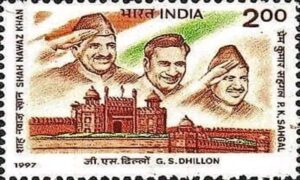
Source: Wikipedia Commons, Stamp issued by the Government in 1997
In defense, Bhulabhai Desai argued that the real question was whether these men should be treated as traitors under the Indian Army Act, or as soldiers of the INA, which claimed to be a lawful army of a sovereign state. He said that what was really on trial was the right of Indians to fight for their own freedom. Desai also pointed out that the provisional government of Azad Hind, to which the INA belonged, had the full structure of both a government and an army, and therefore met the standards of international law. (Chandar Sundaram, 2022)
He rejected the accusation that INA officers had committed atrocities against their own men, saying that the punishments were carried out under the INA’s own military code. Finally, he compared the INA’s struggle to that of George Washington’s Continental Army, which had fought to free America from British rule. (Chandar Sundaram, 2022)
The court-martial finally ended on 3 January 1946, and all the accused were found guilty and sentenced to Transportation for life. Britishers believed that taking a hard line against the INA would ensure discipline and loyalty to the British, but in contrast, there was a wave of sympathy for the INA among Indian officials and civilians. (Chandar Sundaram, 2022)
Newspapers like The Hindu praised the role of the INA in the Battle of Imphal. Hindustan Times even published a cartoon showing Viceroy Wavell in the dock, being tried by a court-martial led by INA officers Sahgal, Dhillon, and Shah Nawaz. Across the country, protest marches were held, and people shouted slogans like “Save INA patriots.” Huge crowds gathered outside the Red Fort demanding the release of the soldiers. By 23 November 1945, police firing on protestors had already left 97 people dead. (Chandar Sundaram, 2022)
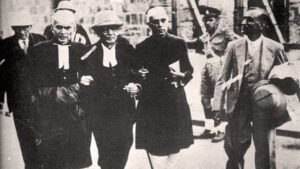
Source: The Print, Pt Nehru with Sir TB Sapru & Dr K Katju during the Red Fort trials
According to Nagaratna.B.Tamminal, the unexpected reaction of the Indian public created pressure on British officials. The governor of Punjab & NWFP advised Auchinleck, commander-in-chief, to cancel the trial. They were of the view that trials were serving no purpose, and it would make them heroes in the eyes of Punjabis, and treating them as traitors only adds to their popularity. Despite the strong opinions, the commander was not convinced and urged the British cabinet to dispatch 3 additional British battalions, but the cabinet declined his plea.
In January 1946, the British faced another shock when soldiers of the Royal Indian Navy and Air Force revolted. They demanded the release of INA prisoners and equal pay for Indian and British sailors. The revolt began on the ship HMIS Talwar in Bombay and quickly spread, with 78 out of 88 naval ships joining in. This uprising deeply worried British Prime Minister Clement Attlee, who soon announced the Cabinet Mission to discuss India’s independence. (Nagaratna b.Tamminal, 2020)
Later, Field Marshal Sir Claude Auchinleck cancelled the prison sentences of INA soldiers but expelled them from the army for life, taking away their ranks, pensions, and other benefits. Years later, in 1956, Clement Attlee himself admitted that the INA had played a decisive role in India’s independence—more important than even Gandhi’s civil disobedience movement. (Chandar Sundaram, 2022)
References
1. Sundaram, Chandar. “Trial at the Red Fort 1945-1946: The Indian National Army and the End of the British Raj in India.” Association for Asian Studies, 2022, www.Chandar Sundaram, 2022/publications/eaa/archives/trial-at-the-red-fort-1945-1946-the-indian-national-army-and-the-end-of-the-british-raj-in-india/.
2. Nagaratna.B.Tamminal Trial of Indian National Army in Red Fort; Simla Conference World War II Ends. 2020.
3. “Remembering the Red Fort Trials That Tipped India towards Complete Freedom.” The Print, 5 Nov. 2018, theprint.in/india/governance/remembering-the-red-fort-trials-that-tipped-india-towards-complete-freedom/145260/.
Singh, Harkirat. Historicity Research Journal The INA TRIAL: A CHALLENGE to the LEGITIMACY of the RAJ. 2018.