

By Ashutosh Pandey
Introduction
Nested in the serene expanse of North Delhi , Roshanara Club stands today as one of the city’s most layered heritage spaces where Mughal memory,colonial recreation and modern public culture find an unlikely intersection.Spread across 22 acres near the historic Roshanara Bhag the club existed for more than a century witnessing Delhi’s shifting political climates,changing social hierarchies the birth of India’s highest cricketing body and the ultimately transformative process of being reclaimed and restored for the city’s public. Roshanara Club is a place where the past doesn’t simply linger, it breathes.
For Delhites today,Roshanara Club is not merely a recreational site ,it is a living fragment of the city’s historical evolution .Today as its restored corridors once again fill with families,athletes and heritage lovers Roshanara Club reminds us that history is not confined to museums,sometimes it thrives quietly in the everyday corners of our city.To understand this club is to understand a crucial chapter of Delhi’s identity where old world overlaps and new ones take shape.
Origin
Roshanara Club was established on 15 August 1922 during the height of British colonial administration in Delhi .Its foundation was directly inspired by the growing needs for recreational spaces for British officials and the emergent Indian elites who lived in and around civil lines i.e. the administrative heart of Delhi during the early 20th century
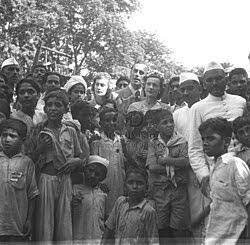
(Lord & Lady Mountbatten at Roshanara cricket club)
What made Roshanara unique was its location beside Roshanara Bhag , the 17th century garden built by princess Roshanara,Shah Jahan’s daughter. While many colonial clubs of the time were designed as exclusive social bubbles , Roshanara Club was envisioned as a both leisure space and a symbol of British attempt to cultivate cultural and administrative life in Delhi , The lush greenery ,the open field and the cool winds coming from Mughal garden made the spot a natural oasis for colonial elites.
Architecture and layout
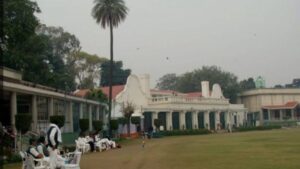
Spread across 22 acres Roshanara Club layout is one of the most defining features,a vast area in the crowded North Delhi region the club have long tree lined paths,colonial era pavilions,cricket grounds,tennis lawns,Banquet halls,Billiards and card rooms,etc.The original design emphasized airy openness ,natural circulation and European style structural elements. It was built to provide comfort from Delhi’s harsh climate.Its adjacency to the Mughal Roshanara Bagh gave the club the rare combination of British architectural sensibility and Indo-Islamic historical memory.
Who designed the club
Unlike several other colonial institutions whose architects are well documented,Roshanara Club precise designer remains uncertain in public historical records ,what we do know is that the architectural style was distinctly colonial with european style windows,Mangalore tiled roofs,tall wooden trusses and airy verandahs.But the lack of a named architect does not diminish the club’s heritage character.Instead it reflects a common practice of the era where many administrative and recreational structures were designed by public works department or military engineers rather than celebrated architects.
Roshanara Club and the Birth of BCCI
One of the most important milestones in the club’s history came in 1928 when the cricket administrator held a crucial meeting at Roshana club. The meeting resulted in the formation of The Board of Control for Cricket in India(BCCI). Which is today the world’s wealthiest and most influential cricket body. This single event at Roshanara is not just in Delhi’s history but firmly in the national story of Indian sports .The fields saw some of the earliest organized cricket activities in North India shaping generations of players and administrators. Thus we can say that Roshanara Club is rightly remembered as the birthplace of Indian cricket’s institutional life.
After independence Roshanara Club underwent a shift in identity. No longer a British stronghold ,it became a favored location for many of India’s leading personalities. In the decades after independence the club symbolized influence,status and Delhi’s rising postcolonial middle class.Yet the space also retained its older colonial structure,creating a fascinating blend of new political reality and old world charm.
Decline Over Time
By the early 21st century ,Roshanara Club began experiencing neglect,delays in renovation,management conflicts and legal complications.Its land lease originally granted by government expired around 2012 and later again in 2017.Despite renewals begin pursued the club’s internal infrastructure steadily declined.Along with that other issues also surfaced like damages due to weather,outdated plumbing and wiring ,cracks in the facades ,fading interiors and mismanaged sporting facilities.
After several years of dispute regarding the lease , Delhi Development Authority eventually stepped in. On 29 sept.2023,DDA officially sealed and took the possession of Roshanara Club,citing lease expiry and structural deterioration.This decision stirred emotions among long time members many of whom had personal histories spanning decades with the club.Yet the government justified the action as necessary for preserving the heritage structure and making it relevant for a wider public.For the first time in its history Roshanara Club was no longer a private member controlled institution.
Rebirth & Restoration
Following the takeover DDA began a massive two year restoration effort.Care was taken to preserve the original colonial architecture while modernizing it.Restoration of cricket ground and tennis lawns was done,new wellness and fitness zones were created,restoration of wooden trusses,upgrading water and electrical system,etc. In early 2024 the club was partially reopened under a new pay and play model,allowing non members to use the outdoor facilities for nominal fees. By 2025,the fully renovated Roshanara Club emerged as a modern yet heritage sensitive recreational hub.
Present Day Relevance for Delhi
Roshanara Club now serves a far broader audience than at any earlier point in its history.Today it offers sports facilities for cricket,tennis,football,basketball,etc to Delhites. It provides open green space to city where open land is shrinking day by day.Families use the club for leisure fitness and children’s activities,Heritage lovers adores the Mughals architecture and many more.And most importantly its restoration shows how heritage spaces can be revived for contemporary public life without losing their identity.
Conclusion
Roshanara Club’s journey captures the layered history of Delhi itself.Born beside Mughal garden,shaped during British Raj,pivotal in the making of Indian cricket,enjoyed by the country’s early leaders,challenged by neglect and legal disputes.Its story reflects the city’s own fluctuating fortunes.
Today as a beautifully restored public friendly recreational space,Roshanara Club stands as a bridge connecting Delhi’s rich past with its evolving urban present. It reminds us that heritage is not merely something to be preserved behind locked gates , it can be active,alive and participatory offering value to the very people whose history it represents.
BIBLIOGRAPHY
1)Guha, Ramachandra. A Corner of a Foreign Field: The Indian History of a British Sport. New Delhi: Picador India, 2002.
2). Bose, Mihir. A History of Indian Cricket. London: Andre Deutsch, 1990.
3). Sengupta, Rudrangshu. Delhi: A Historical Companion. New Delhi: Oxford University Press, 2017
4.)The Times of India, Archives (1910–1930).
Reports on cricket matches, social gatherings, and the establishment of the Roshanara Club.
5.) The Pioneer, Allahabad/Delhi Editions (1920s).
6.)Board of Control for Cricket in India (BCCI). Historical Records & Founding Documents (1928).
7.) ESPN Cricinfo. “The Birth of the BCCI.” Online historical essays and archives.
8.)Wikimedia Commons. Public Domain Photographs of Roshanara Bagh & Early Delhi (Accessed 2025).
9.) British Library Online Gallery. Photo Collection: Delhi, Early 20th Century (Accessed 2025).