

THE IMPERIAL FRUIT A Botanical and Cultural History of the Mango under the Monarchs of Delhi, Bengal, Gujarat, Malwa, Awadh, Punjab and the Deccan
- June 3, 2026
:- by Ayush Tripathi
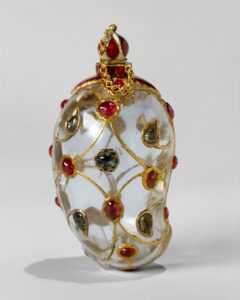
17th century Mango-Shaped Flask set with gold, enamel, rubies, and emeralds [Source: The Metropolitan Museum of Art]
Naghza Tarin Mewa: The Sovereign Fruit and Its Royal Patrons
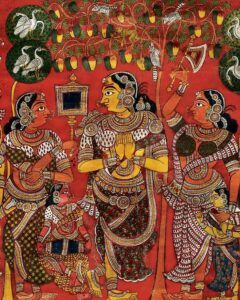
Telugu scroll painting depicting lush mango tree behind Bhadravati waiting for Bhavana Rishi [Source: Jagdish and Kamla Mittal Museum of Indian Art, Hyderabad]
Among the many botanical gifts that the Indian subcontinent has lavished upon the world, none has been more thoroughly woven into the fabric of political power, literary imagination, religious devotion, and popular festivity than Mangifera indica. Acknowledged by botanists as indigenous to the eastern and northeastern reaches of the subcontinent, its greatest centre of antiquity most likely lying in the arc of territory between Assam, upper Burma, and the eastern Himalayan foothills, the mango spread westward across the Gangetic plain and southward along the flanks of the Western Ghats in remote prehistory, long before the first states arose to claim dominion over the land. Yet it was precisely through the structures of kingship, through the agency of sultans, nawabs, rajas, and emperors, that individual cultivars were selected from the teeming diversity of spontaneous seedlings, named, grafted, propagated, and perpetuated across generations; that orchard planting was elevated from a domestic utility into an act of statecraft; and that the capacity to appreciate a specific variety, with all its microclimatic specificities of flavour and fragrance, was transformed into a mark of refined sensibility distinguishable from mere appetite.
The present essay undertakes what may best be described as a cultural biography of the mango across the medieval and early modern periods of Indian history, a biography necessarily plural, since the fruit’s story ramifies across the regional courts and folk traditions of a subcontinent too vast and too diverse for any single narrative to contain. The sources drawn upon are deliberately eclectic and heterogeneous. Royal memoirs and imperial chronicles in Persian and Brajbhasha sit alongside the ghazals of Urdu court poets; the careful botanical observations of European physicians complement the ecstatic proverbs of Rajasthani village women; Ibn Battuta’s market price records are read alongside Nazeer Akbarabadi’s rollicking Urdu poem on the mango’s democratising joy. The Dakkhani masnawis of the Qutb Shahi court, the Braj verses of Keshavdas, the Awadhi seasonal songs of the Lucknow haveli, and the barahmasa compositions of the Guru Granth Sahib are all admitted as evidence, because the history of the mango is not a history that lives in any single archive. It lives simultaneously in the technical vocabulary of the grafting specialist, in the royal decree that names a variety after a battle, in the folk proverb that turns the mango’s sweetness into a philosophical position, and in the Urdu poet’s discovery that a basket of mangoes can say what no letter can express.
Food historian K.T. Achaya, whose Indian Food: A Historical Companion (1994) remains the indispensable starting point for any investigation of this kind, observed that the mango’s cultural penetration in India is so deep that its absence from the literary, ritual, and agronomic record would make the entire corpus of Indian civilization from the Vedic period onward literally unrecognisable. Achaya counted more than forty distinct named mango varieties documented in Sanskrit, Pali, and vernacular literature before the arrival of the Mughals, a figure that he notes compares favourably with the entire recorded diversity of fruit cultivars in medieval Europe. The ethnobotanist S.K. Mukherjee, who devoted the better part of his career at the Indian Agricultural Research Institute to the systematic study of the genus Mangifera, estimated that the number of named cultivars in India during the height of Nawabi patronage in the eighteenth century may have exceeded fifteen hundred, a figure that dwarfs the current commercial diversity of perhaps five hundred recognised varieties and that reflects the extraordinary scale of the selective breeding enterprise conducted, generation by generation, in the orchards of the subcontinent’s courts and villages. Colleen Taylor Sen, in her Food Culture in India (2004), argues that the mango was not merely one cultivated plant among many but served as the primary medium through which the aesthetics of taste, the refined discrimination between varieties, the evaluation of flavour profiles, the hierarchies of quality across growing regions, were first developed as a domain of intellectual and cultural activity in India. The mango, on this reading, was India’s equivalent of the grape: the fruit through which a civilisation first learned to think systematically and passionately about the pleasures of the palate.
Three organising arguments structure what follows. The first is that the variety name is itself a historical document of the first order. Names such as Chausa, Dussehri, Langra, Fazli, Kesar, Totapuri, Sindhu, and Banganapalli are not botanical accidents or arbitrary labels but sedimentations of event, place, patronage, and memory, each one a small archive in which royal ambition, folk etymology, and botanical fortune have been compressed into a few syllables. The second argument is that royal patronage of the mango was never merely horticultural; it was simultaneously a form of territorial inscription, a mode of diplomatic communication, a medium of competitive display among nobles, and a vehicle for the articulation of aesthetic values that could not be expressed through any other cultural form. The third argument is that the folk tradition, in song, proverb, ritual, and oral narrative, preserves memories and meanings that the formal archive has lost or never possessed, and that any history of the mango confined to the evidence of chronicles and court poetry will miss what was most alive in the culture’s engagement with this fruit.
Rasala, Amra & Pikavallabha: Mango in Sanskrit, Buddhist and Classical Tradition
Prehistory, Archaeology, and Vedic Textual Evidence
The mango tree’s presence in the Indian subcontinent predates not only the historical record but all but the most archaic layers of the literary tradition. Carbonised mango seeds and wood charcoal identified as Mangifera indica have been recovered from late Harappan and Chalcolithic sites in the Gujarat and Rajasthan regions, attesting to human familiarity with the tree in the third and second millennia BCE. The archaeobotanist Marijke van der Veen, reviewing the archaeobotanical evidence from South Asian sites in a 2011 survey, notes that the mango’s domestication, the transition from exploitation of wild trees to the deliberate cultivation of selected individuals, was almost certainly a gradual process that began in the forest margins of northeast India and spread westward as agricultural communities moved into the Gangetic plain, carrying with them the seedlings of trees whose fruit they had found exceptionally good. This diffusion was not a single event but a series of local selections occurring independently across hundreds of communities over thousands of years, which is why the mango’s cultivated diversity is so enormous that no two orchards, even in the same district, are identical in the range of seedling types they contain.
By the time of the Vedic literature, whose oldest layers are conventionally dated to around 1500 to 1200 BCE though the texts themselves were composed over many centuries, the mango (Sanskrit: amra, feminine amra) had already acquired the density of association that marks a plant embedded deeply in a culture’s symbolic and practical life. The Atharvaveda invokes the amra tree in hymns of fertility and protective magic; the mango grove (amravana) is a liminal, power charged space in which spells are performed and protective boundaries are established. The plant’s association with Kamadeva, the god of desire, is established already in the Vedic period: Kama’s arrow is tipped with the mango flower, and his banner displays the mango panicle, associating the fruit with the archery of erotic compulsion in the oldest surviving stratum of Indian mythological literature. This Kama and mango complex would be elaborated across two millennia of Sanskrit, Braj, Awadhi, and Urdu poetry, generating the vast literary tradition in which the mango blossom is the invariable signal of spring, desire, and the pain of separation from the beloved.
The Arthashastra of Kautilya, compiled in its extant form between the fourth century BCE and the second century CE and representing the accumulated administrative wisdom of the Mauryan and post-Mauryan state tradition, provides the earliest systematic governmental reference to the mango. Kautilya prescribes that the Superintendent of Agriculture (Sitadhyaksha) shall oversee orchards of mango and other fruit trees attached to the royal domain; the amra grove is classified as crown property generating revenue, and unauthorised felling of a royal mango tree carries a fine graduated according to the tree’s age and productive capacity. More revealing still, Kautilya instructs the Superintendent of the Forest Produce Department to maintain a census of the mango trees on crown lands, an early instance of the kind of horticultural bureaucracy that would be elaborated, centuries later, in the orchard records of the Mughal and Nawabi states.
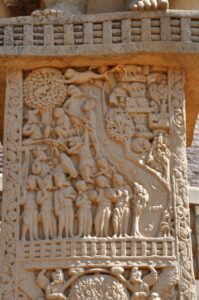
Depiction of the story of Mahakapi Jataka showing Bodhisattva in the form of a monkey on a mango tree [Source: Wikimedia Commons]
The Buddhist Amravana and the Mango of Royal Merit
Depiction of the story of Mahakapi Jataka showing Bodhisattva in the form of a monkey on a mango tree [Source: Wikimedia Commons]
Buddhism contributed one of the most enduring mythological associations of the mango with royal and spiritual authority, and several of the Jataka tales, the stories of the Buddha’s previous lives, employ the mango as a narrative pivot. The most celebrated is the miracle of the mango grove at Shravasti: the physician Jivaka, whose medical arts served King Bimbisara of Magadha and whose fame had spread throughout the Gangetic plain, presented the Buddha with a mango seedling, and upon the Tathagata’s planting of it in the ground of the Jetavana monastery, the tree immediately grew to miraculous proportions and bore fruit. This miracle, the Amra-phaladana-patihariya or the wonder of the mango fruit, is depicted in the sculptural programmes at Sanchi (second to first century BCE) and at Amaravati (second century CE), constituting some of the earliest representations of the mango tree in Indian visual art. The Sanchi reliefs show the tree laden with fruit, surrounded by devotees, its canopy forming a natural pavilion that recapitulates the sacred geography of the Bodhi Tree, a visual equation of the mango’s abundance with the spiritual plenitude of enlightenment.
Xuanzang, the Chinese Buddhist pilgrim who traversed India between 629 and 645 CE, recorded in his Da Tang Xi Yu Ji (Great Tang Records of the Western Regions) the presence of the Amravana of Shravasti as a living pilgrimage site, noting that mango groves had been planted by kings and wealthy merchants in imitation of the original gift to the Buddha. He observed that the largest mango groves he encountered on his journey through Bihar and the Gangetic plain were maintained by Buddhist monastic establishments and by royal donors who sought merit through the provision of shade and food for pilgrims and travellers. Xuanzang’s account reveals that by the seventh century CE, the planting of mango orchards had been institutionalised as a specifically royal act of Buddhist merit, a practice with direct implications for the orchard building programmes of later rulers who, whatever their religious affiliations, operated within a cultural landscape shaped by this long tradition of connecting royal power with the planting of the mango.
The Pali commentarial literature preserved in Sri Lanka, particularly the Dhammapada atthakatha (fifth century CE commentary), contains numerous Jataka stories in which the mango figures as a test of character and wisdom. In the Amra-jataka, the Bodhisattva appears as a king’s gardener who is able to distinguish the ripe fruit from the unripe by the sound it makes when tapped, a parable about the discernment needed to distinguish true spiritual maturity from false appearance. In another Jataka, the mango tree’s extraordinary sweetness is contrasted with the sourness of the tree of false teachers; the wise king selects the sweet mango tree as his seat of meditation. These allegorical uses of the mango’s qualities, its sweetness, the deceptiveness of its outer appearance, the labour required to bring it to ripeness, encode a sophisticated folk botany in the service of ethical instruction.
Kalidasa, Vatsyayana, and the Eight Names of the Amra
No Indian writer did more to fix the literary identity of the mango than Kalidasa, whose works, generally placed in the Gupta period (fourth to fifth century CE) though the dating remains disputed, established a set of poetic conventions around the fruit that persisted across a millennium and a half of Indian literary practice. In the Ritusamhara (Garland of Seasons), Kalidasa’s description of spring (Vasanta) is organised primarily around the mango’s flowering: the amra manjari, the fragrant panicle, is the season’s announcement and its emblem. The cuckoo (kokila) finds its voice in the mango’s branches, an association already fixed in the Vedic tradition and here given its definitive literary expression. The bees, driven from their winter quiescence by the mango flower’s nectar, become figures for the lover awakened by desire. The Meghaduta’s cloud messenger, tracing its path northward across the subcontinent from Ramagiri to the Himalayan city of Alaka, passes over mango landscapes that serve as coordinates of emotional as well as geographical mapping: the sight of mango groves in flower reminds the exiled yaksha of the garden he tended with his beloved, and the cloud is instructed to pause and absorb the beauty of the orchards it passes over.
Vatsyayana’s Kamasutra, whose date is contested between the third and fifth centuries CE, situates the mango grove as the ideal setting for aristocratic pleasure. The nagaraka, the man of culture, the ideal sophisticated urbanite whose lifestyle the Kamasutra prescribes, takes his afternoon rest in the shade of a mango grove with his companion, eating the ripe fruit, drinking flavoured wines, and practising the conversational arts that distinguish the cultured man from the merely wealthy one. The Kamasutra also lists the preparation of mango pickle and mango chutney among the sixty four arts (kalavidhis) that a cultivated woman should master, an indication that the culinary transformation of the mango was already, by the early centuries CE, a form of cultural competence associated with the feminine arts of the aristocratic household.
The Sanskrit lexicographical tradition is remarkably revealing about the depth of the mango’s cultural penetration. Amarasimha’s Amarakosha (approximately fifth century CE), the great Sanskrit thesaurus, lists no fewer than eight principal Sanskrit names for the mango tree and its products, each encoding a different dimension of cultural meaning. The name rasala (that which is full of rasa, a word meaning simultaneously juice and aesthetic emotion) connects the mango’s gustatory qualities to the rasa theory of aesthetics that was the Sanskrit tradition’s most sophisticated account of how art produces emotional experience. The name sahakara (that which assists or accompanies) reflects the mango’s role as an accompaniment to other pleasures, to the season, to love, to festivity. Pikavallabha (beloved of the cuckoo, the kokila) encodes the cuckoo and mango association that runs through the entire Sanskrit tradition. Madhuphala (honey fruit) and madhulli (she who is full of sweetness) give the mango a feminised sweetness that aligns it with the erotic register of Sanskrit poetry. The name atisaurabha (extraordinarily fragrant) prioritises the olfactory over the gustatory, a reminder that for many medieval Indian writers, the mango’s perfume was as significant as its flavour. Varahamihira’s Brihatsamhita (sixth century CE), that encyclopaedic compendium of astrology, divination, and natural science, contains practical directions for the cultivation and grafting of mango trees, including the observation that trees grown from the seeds of particularly fine specimens sometimes produce offspring inferior to their parents, the earliest Indian textual recognition of the problem of genetic variability in seedling propagation that would eventually be solved by the systematic adoption of vegetative propagation.
The food historian Pushpesh Pant, writing in his Mango: The King of Fruits (2013), draws attention to an aspect of the classical mango tradition that is often overlooked: the mango’s role in the medical literature of Ayurveda, which gave it a physiological significance alongside its aesthetic one. The Charaka Samhita and Sushruta Samhita both classify the mango according to its dosha regulating properties, noting that ripe mango increases kapha and pitta while reducing vata; that unripe mango is sour, astringent, and kapha reducing; and that the mango’s kernel (amra bija) has medicinal applications in the treatment of diarrhoea, dysentery, and haemorrhage. This medical framework shaped the conditions of mango consumption at Indian courts: the quantity consumed, the timing within the season, the combination with other foods, and even the variety selected were all influenced by Ayurvedic prescriptions that the court physician (vaidya) enforced with varying degrees of rigour. Akbar’s reported preference for mango juice over the whole fruit, recorded by Abu’l Fazl, may reflect Ayurvedic advice that the juice is easier to digest than the whole fruit for someone whose constitution tends toward pitta, a consideration that would be well known to any competent court physician.
The Braj Tradition: Surdas, Keshavdas, and the Mango of Vrindavan
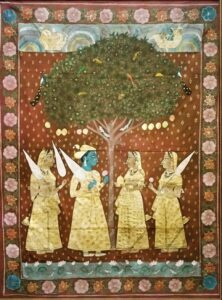
Pichwai Painting depicting Srinathji (Krishna) With Gopi’s Under Mango Tree [Source: Cotton Nine]
The Braj literary tradition, the vast body of devotional poetry composed in the Braj Bhasha dialect of the Mathura Vrindavan region, primarily between the fifteenth and eighteenth centuries, developed the mango’s symbolic resources in directions that diverged sharply from both the Sanskrit erotic tradition and the Persian Sufi tradition, while drawing on both. The central figure of Braj poetry is Krishna, and the mango appears in the Braj corpus primarily in connection with the landscape of Vrindavan, the forest paradise on the banks of the Yamuna where Krishna spent his divine childhood and youth, and with the seasonal festivals associated with his worship.
Surdas (c. 1478 to 1583), the blind saint poet who is the greatest figure of the Braj tradition, composed in his monumental Sursagar a series of poems describing the landscape of Vrindavan through the twelve months. The mango appears in Surdas’s Jeth and Asadh verses (the early summer months) as the tree whose ripening fruit signals the fullness of the season and the urgency of the devotee’s longing for Krishna’s darshan. In one particularly celebrated pad, Surdas describes the milkmaids (gopis) of Vrindavan gathering under the mango trees in the afternoon heat to discuss their longing for Krishna, who has departed for Mathura; the mango’s sweetness, hanging heavy on the branches around them, intensifies by contrast the bitterness of his absence, a use of the mango as a figure for the devotional experience of viraha (longing in separation) that is among Surdas’s most characteristic emotional moves.
Keshavdas (1555 to 1617), the court poet of the Bundela Rajput rulers of Orchha and the author of the Rasikapriya, a systematic treatise on the aesthetics of love poetry in the Braj tradition, employs the mango in the context of the nayika bhed (classification of heroines) that is the Rasikapriya’s central organisational scheme. The nayika who longs for her beloved in the summer heat is described in the Jeth section of the Rasikapriya’s seasonal chapter as sitting under a mango tree heavy with ripe fruit: the heat of the season, the sweetness of the mango, and the sharpness of her longing are superimposed in a characteristic Riti kala poetic construction in which multiple sensory registers reinforce a single emotional effect. The Awadhi tradition, represented supremely by Tulsidas (c. 1532 to 1623) in his Ramcharitmanas, employs the mango primarily as a landscape feature of the Gangetic plain, a marker of the sacred geography of Ayodhya and its environs, and as an image of abundance and natural grace. The Ramcharitmanas’s description of spring in Ayodhya, which anticipates the birth of Rama, invokes the mango’s flowering as one of the signs of auspicious seasonal arrival: the amra manjari, the cuckoo’s song, and the return of the bees are the trinity of spring omens that signal the approaching fulfilment of Dasharatha’s desire for a son.
The Amba of the Sultanate: Amir Khusrau, Ibn Battuta and the Mango of Delhi
Amir Khusrau’s Panegyric and the Politics of Taste
When Qutb ud Din Aibak founded the Delhi Sultanate in 1206, he inherited a landscape in which mango cultivation had been an integral part of agricultural and garden culture for centuries. The Ganga Yamuna doab, the heartland of the new polity, was already among the most productive mango growing regions of the subcontinent, and the fertile plains stretching south toward the Vindhyas and east toward Bihar were threaded with the orchards of ancient settlement. The most eloquent and historically influential tribute to the mango from the Sultanate period comes not from a monarch but from a poet: Amir Khusrau Dihlavi (1253 to 1325), whose Persian verses constitute one of the most important literary records of the culture of the Delhi Sultanate and who was, by all accounts, among the most acute sensory intelligences of the medieval Indian world. Khusrau served at the courts of no fewer than seven sultans, from Ghiyas ud Din Balban through Qutb ud Din Mubarak Shah Khalji, and his poetry reflects the full range of experience available to a man who combined the literary education of the Central Asian Persian tradition with the sensory education of a lifetime spent in the orchards, bazaars, and pleasure gardens of the Ganga plain.
In his masnavi Nuh Sipihr (Nine Skies), composed in 1318 for Qutb ud Din Mubarak Shah Khalji and structured as a celebration of India’s natural and cultural superiority over other lands, Khusrau devotes an extended and celebrated passage to the praise of the mango. He calls it naghza tarin mewa i Hindustan, the most exquisite fruit of Hindustan, and nadir ul wujud, a rarity of existence, something so perfectly itself that it could not have been imagined in advance. The passage is remarkable for the deliberate rhetorical strategy it deploys: Khusrau, who was himself of mixed Khurasani and Indian descent and who therefore brought to the mango the evaluative gaze of someone familiar with the fruits that Central Asian and Persian culture had long considered the world’s finest, the melons of Khwarazm, the grapes of Herat, the pomegranates of Yazd, explicitly sets the mango against these celebrated fruits and finds them wanting.
Khusrau writes in the Nuh Sipihr: the people of Khurasan boast of their grapes, the Arabs of their dates, the Persians of their pomegranates. But when they taste the amba of Hindustan, they fall silent. For this fruit contains in itself the sweetness of the grape, the richness of the fig, the perfume of the rose, and a flavour that has no name in any language but the Indian tongue. (Nuh Sipihr, Third Sky; translated after Wahid Mirza, 1950)
This passage from the Nuh Sipihr became one of the most frequently cited texts in all subsequent Indo Persian discourse on the mango. Poets at courts from Bijapur to Lahore quoted it, paraphrased it, or took it as a standard against which their own mango tributes were measured. Its significance exceeds the merely literary: by articulating the mango’s superiority over the fruits of the Islamic world’s most celebrated garden cultures, Khusrau was performing a cultural act of considerable political courage, asserting the superiority of Indian nature at a court whose ruling class was defined by its Central Asian origins and whose cultural prestige hierarchies placed the Persianate world above all others. The mango, in Khusrau’s hands, becomes an argument: India need not look to Khurasan or Arabia for excellence. It has produced something that neither of those civilisations can match.
Khusrau returned to the mango in other compositions. His Persian ghazals employ the amra manjari in the manner of the Sanskrit tradition, as a figure for the spring awakening of desire, but translate the Sanskrit erotic register into the Persian Sufi idiom in which the beloved’s sweetness is simultaneously the sweetness of the divine. The mango’s fragrance becomes, in these ghazals, the fragrance of the Sufi beloved (mahbub), whose presence perfumes the entire landscape of the soul. This Sufi appropriation of the mango image would be taken up and elaborated by later poets in the Chishti tradition, the order to which Khusrau was himself affiliated through his discipleship of Nizamuddin Auliya, and would eventually migrate into the bhajan and kirtan traditions of the Vaishnava devotional movement, where the mango’s sweetness was mapped onto the sweetness of Krishna’s grace.
Ziauddin Barani and the Commercial Amba of Delhi
Ziauddin Barani’s Tarikh i Firuz Shahi, composed in the 1350s at the court of Firuz Shah Tughlaq and drawing on Barani’s personal experience of the courts of Muhammad bin Tughlaq and his predecessors, provides the most detailed picture of the mango’s place in the commercial life of the Sultanate capital. Barani’s account of Alauddin Khalji’s price control system, the elaborate market regulation mechanism that fixed prices for all commodities sold in Delhi’s markets, lists mangoes among the products of the royal orchards whose prices are set by the market superintendent. Barani distinguishes between the prices of mangoes from different sources: those produced in the royal orchards (which are distributed at controlled prices), those brought from the doab’s commercial orchards (subject to market regulation but not state production), and those arriving from more distant regions such as Bihar and Bengal (which command premium prices reflecting their rarity and the cost of transport).
This commercial picture reveals several important historical facts. First, the mango market of Delhi in the fourteenth century was sufficiently differentiated by origin and quality to require separate pricing schedules, which implies that consumers could distinguish between the products of different regions and were willing to pay premiums for particular origins. Second, the state’s intervention in mango pricing was motivated by the same concern that drove Alauddin Khalji’s general market reforms: the prevention of price exploitation of the urban population, particularly the soldiers and officials whose economic welfare the sultan regarded as a political priority. Third, and most revealing, the regulation of mango prices implies that the fruit was consumed across the social spectrum, not merely at the court but in the households of soldiers, artisans, and minor officials whose purchasing power the state sought to protect.
Ibn Battuta’s Rihla: Markets, Pickles, and the Royal Mango Gift
Ibn Battuta, the great Moroccan jurist and traveller who spent approximately eight years in India (1333 to 1341) in the service of Muhammad bin Tughlaq’s court and who left in his Rihla one of the most detailed contemporary foreign accounts of medieval Indian civilisation, describes the mango with the precision of a trained observer who has never seen the fruit before and is determined to record everything about it that might be useful to a reader in the Islamic west. He identifies what he calls the anbaj (a rendering of the Sanskrit/Prakrit amba via Arabic) as the most remarkable fruit of Hindustan, and distinguishes between several varieties on the basis of size, colour, flavour, and season, noting that the market in Delhi offered specimens ranging from fruits as large as a man’s fist to others no bigger than a sparrow’s egg, and that the former were not necessarily the sweetest.
Battuta records with evident approval the practice he observed at Muhammad bin Tughlaq’s court of distributing mangoes to courtiers as a mark of royal favour. He notes that the sultan would send baskets of the finest seasonal mangoes to officials who had performed distinguished service, and that the receipt of this gift was understood throughout the court as a signal of the sultan’s pleasure, a reading confirmed by Barani’s chronicle, which records similar episodes of mango distribution at Sultanate courts as instances of royal largesse (in am). Battuta’s account also provides the earliest detailed foreign description of the Indian mango pickle (achar): he notes that unripe mangoes are preserved in brine with salt, vinegar, and spices to produce a sour, intensely flavoured condiment that is eaten with bread and rice throughout the year. He remarks that this pickle, unknown in the Arab world, struck him as an unusual but effective solution to the problem of preserving the mango’s culinary interest beyond the brief season of its ripeness.
Firuz Shah Tughlaq: The Orchard Sultan and the Mango as State Policy
Firuz Shah Tughlaq (r. 1351 to 1388) stands out among the Delhi sultans as the most systematic and self conscious patron of horticulture. His personal memoir, the Futuhat i Firuz Shahi, composed in simple Persian and intended as a record of his pious and administrative achievements, devotes remarkable attention to the planting of orchards and the development of agricultural infrastructure. Firuz Shah writes with evident personal satisfaction of having established 1,200 gardens in the territories under his governance, many of them planted with mango trees; he specifies that these orchards were organised not merely as pleasure gardens for the court but as revenue generating enterprises whose produce was in part distributed to mosques, hospitals (bimaristans), and the deserving poor (masakin), an act of charitable redistribution that he presents as an extension of the Quranic obligation of sadaqa (charitable giving) into the domain of botanical patronage.
Shams i Siraj Afif’s Tarikh i Firuz Shahi, a biography of the sultan composed within a generation of his death and drawing on the author’s personal knowledge of the court, provides important corroborating detail for Firuz Shah’s horticultural programme. Afif describes the pleasure gardens developed around Hauz Khas, the great reservoir that Firuz Shah renovated and surrounded with a college and tombs, as containing mango orchards of considerable size whose produce was available both to the students of the college and to the general population of Delhi during the season. He also records Firuz Shah’s personal interest in irrigation: the canals drawn from the Yamuna and Sutlej that the sultan constructed or renovated were used not only for the watering of agricultural fields but for the maintenance of the royal orchards and pleasure gardens, creating a hydraulic infrastructure that served botanical as well as administrative ends. K.T. Achaya, commenting on Firuz Shah’s horticultural record, describes him as the first ruler in Indian history to treat the mango as a matter of explicit state policy, a judgment that correctly identifies the qualitative shift that Firuz Shah’s reign represents in the institutionalisation of mango patronage.
Fazl Bibi’s Orchard: The Fazli, Himsagar and Khirsapati of Bengal

A roundabout depicting the Fazli Mango in Rajshahi [ Source: Wikimedia Commons]
The Hussain Shahi Court and the Mango Heartland of Malda
The independent Sultanate of Bengal, which flowered most brilliantly under the Hussain Shahi dynasty (1494 to 1538) and which presided over one of the most productive mango growing regions of the subcontinent, left a mango legacy that is richer in folk memory and living variety culture than in formal chronicle record. The Malda district, watered by the Mahananda and Kalindri rivers, lying in the northernmost reach of Bengal in the shadow of the ruins of the great medieval capital Gaur, had been famous for its mango orchards since at least the twelfth century, when the Pala dynasty’s Buddhist monasteries maintained extensive fruit gardens in the region. The rich alluvial soil of the Malda and Murshidabad belt, combined with a distinctive microclimate of humid summers, a concentrated monsoon, and relatively cool winters, produced mangoes of exceptional flavour that became the foundation for Bengal’s most celebrated named varieties.
Alauddin Hussain Shah (r. 1494 to 1519), the greatest of the Hussain Shahi sultans and a ruler whose cultural patronage extended to the promotion of Bengali vernacular literature alongside the Persian tradition of his court, is associated by Malda’s local tradition with the formal recognition of the region’s mango orchards as revenue producing crown assets. The Hussain Shahi court at Gaur maintained a market infrastructure that channelled the produce of the Malda orchards into the commercial networks linking Bengal with the rest of the subcontinent; Portuguese traders arriving at Chittagong and Saptagram in the early sixteenth century recorded their astonishment at the variety and abundance of fruits available in Bengal’s markets, and the mango is consistently singled out in their reports as the most remarkable. The traveller Tome Pires, writing his Suma Oriental around 1515 on the basis of observations from his time in Asia, describes the Bengal mango as a fruit of such extraordinary sweetness and perfume as to make the European visitor doubt his senses.
The ethnobotanist S.K. Mukherjee, whose life’s work on the genus Mangifera established the framework within which all subsequent mango taxonomy has operated, argued in his Monograph on Genus Mangifera (1949) that the Malda district of Bengal represents one of the two or three most significant centres of mango diversity in all of South Asia, the other centres being the Malihabad and Lucknow belt of eastern Uttar Pradesh and the Ratnagiri and Devgad belt of coastal Maharashtra. Mukherjee identified Malda’s exceptional diversity as the product of a specific combination of factors: the antiquity of the mango’s cultivation in the region (he estimated that the Malda orchards had been continuously cultivated for at least two thousand years), the influence of the Buddhist monastic tradition in preserving and propagating exceptional individual trees, and the commercial incentives created by the Bengal Sultanate’s market infrastructure, which rewarded the producers of the finest fruit with premium prices that justified the investment of selecting and propagating named varieties.
The Fazli: Etymology, Legend, and Botanical Identity
The Fazli mango, which remains the premier commercial variety of the Malda district and commands the highest prices in the markets of Kolkata and Dhaka, carries in its name one of the most contested folk etymologies in the history of Indian fruit culture. The variety’s distinctive characteristics are unambiguous: it is among the largest of all Indian mangoes (individual fruits routinely exceeding 700 grams, with exceptional specimens approaching a kilogram), its ripening season extends well into July and August when most other varieties have finished, its flesh is mild, pale yellow, and loosely fibred, and its flavour is delicately sweet without the intense perfume of the smaller Malda varieties. These characteristics, particularly the exceptional size and late season, made the Fazli a natural focus of aristocratic attention: it was the fruit that extended the mango season beyond its expected limits, providing the pleasure of fresh mango when the rest of the season’s abundance had already been consumed.
Two competing traditions account for the Fazli’s name. The first, and more widely circulated, tradition holds that the variety was discovered growing as a chance seedling on the property of a woman named Fazl Bibi, a widow or matriarch whose small orchard lay near the ruins of Gaur, possibly in the village of Gour Malda. In this tradition, Fazl Bibi was the first to recognise the exceptional quality of the seedling that had grown at the edge of her garden; she preserved and tended it, distributed grafts from it to her neighbours, and eventually brought the fruit to the attention of the local administration, from which it reached the larger market. The second tradition, favoured by some local historians in the Malda district, attributes the name to a male owner, Fazl Ali, a local notable or zamindar whose orchards near the ruins of Gaur contained the original tree. In both traditions the tree’s discovery is placed before the Mughal conquest of Bengal in 1576, and both agree that the variety was already known and valued before the end of the Bengal Sultanate.
The food historian Colleen Taylor Sen, discussing the Fazli in her Food Culture in India, notes that the variety’s late ripening characteristic, biologically unusual in the mango which typically completes its fruiting cycle by July, has the quality of what breeders call a chance seedling mutation that was preserved by human selection precisely because of its commercial and aesthetic value. Sen observes that the Fazli’s persistence as a named variety through the transition from the Bengal Sultanate to Mughal rule to the Nawabi period to the colonial period and into the present day, a span of more than four centuries, is itself remarkable, and she attributes this persistence to the specific geography of the Malda orchards: the variety’s mother trees grew in soil and under climatic conditions that made their qualities difficult to replicate elsewhere, giving the Malda Fazli a kind of protected origin status long before the legal concept of Geographical Indication was developed. The Fazli received its formal GI designation from the Government of India in 2017, legally recognising what the folk tradition had always known: this mango belongs to a specific place.
The Himsagar, Khirsapati, and the Bengali Vaishnava Tradition
The Himsagar (literally ocean of coolness) is a variety associated by tradition with the orchards of the Murshidabad district and represents a different strand of Bengali mango culture from the commercial Fazli. Where the Fazli is valued for its size and late season, the Himsagar is prized for its exceptional sweetness, its smooth, fibre free flesh, and an aromatic intensity that connoisseurs describe as approaching the quality of a floral perfume. The name itself, evoking the cool depths of the ocean in the heat of the summer, encodes a specific sensory promise: that the act of eating this mango will provide a form of thermal relief that operates through the imagination as much as through the physiology of the cool, sweet juice.
The Khirsapati (known outside Bengal as the Mishri Bhog, the sugar delight) is perhaps the most revered of all Bengal’s mango varieties in the folk and devotional tradition. Its name (khira meaning condensed milk or cream; sapati meaning resembling) describes the texture and richness of its flesh, which has a density and sweetness that indeed recalls the richness of condensed milk. The variety is associated in Bengali folk tradition with the prasad (sacred food offering) of the Vaishnava temples of the Murshidabad and Nadia districts, the regions that were the heartland of the Gaudiya Vaishnava tradition founded by Chaitanya Mahaprabhu (1486 to 1534). Chaitanya’s movement, which transformed Bengal’s religious life in the sixteenth century and generated an enormous body of devotional literature in Bengali, Braj, and Sanskrit, gave the mango a specifically devotional significance in the Bengali context: the offering of fresh mangoes to Krishna’s image during the summer festival season was a practice that Gaudiya Vaishnavism adopted from the older bhakti traditions and elaborated with considerable theological attention.
The devotional Bengali poet Chandidas (c. fourteenth to fifteenth century), whose padas addressed to Radha and Krishna are among the earliest and most beloved compositions of the Bengali bhakti tradition, employs the mango in characteristically Bengali fashion: as a figure for the overwhelming sweetness of divine love that the devotee cannot contain. In one celebrated pad, Chandidas describes Radha’s experience of Krishna’s presence as aamer madhurer moto, like the sweetness of the mango, a comparison whose force depends on the assumption, shared between poet and audience, that the mango represents the apex of gustatory experience and therefore the most adequate available language for the inexpressible sweetness of divine love. The Padavali literature of Bengali Vaishnavism, the vast collection of padas composed by poets from the fifteenth through the eighteenth centuries in honour of Radha and Krishna, returns again and again to the mango as the figure of supreme sweetness against which all other sweetnesses are measured.
The medieval Bengali Mangalkavyas (auspicious songs composed in honour of regional deities), particularly the Manasamangal (dedicated to the snake goddess Manasa) and the Chandimangal (dedicated to the goddess Chandi), situate their narratives in landscapes saturated with mango cultivation; the orchard is a recurring site of encounter between the human and divine worlds, and the mango’s abundance or failure serves as an index of divine favour or displeasure toward the human community. The Chandimangal poet Mukundaram Chakravarti (c. sixteenth century), who wrote the most celebrated version of this tradition, describes the orchards of the Bengal deltaic landscape with the precision of someone who knows their agricultural rhythms intimately: he distinguishes between early varieties and late varieties, between those grown in irrigated gardens and those in rain fed orchards, and between the uses of the fruit at different stages of ripeness.
Kesar and Hapus: The Mango of Gujarat, Saurashtra and the Konkan Coast
Mahmud Begada’s Legendary Constitution and the Bodily Logic of Sovereignty
The Gujarat Sultanate (1407 to 1573) was among the wealthiest and most commercially sophisticated polities of the pre-Mughal period, and its position at the intersection of the overland and maritime trade routes connecting the mango growing regions of the Konkan coast with the Persian Gulf, East Africa, and Southeast Asia gave it a pivotal role in the early modern mango trade. Mahmud Begada (r. 1458 to 1511), whose six decade reign was the Sultanate’s political and cultural apogee, left in the historical tradition one of the most remarkable mango related legends in Indian history.
Muhammad Qasim Ferishta, whose Tarikh i Firishta (also known as Gulshan i Ibrahimi) was composed in the early seventeenth century and draws on Gujarati chronicles and oral court tradition, preserves the claim that Mahmud Begada had from early childhood been fed on a regimen of mangoes and other foods so systematically extraordinary that his physical constitution had been transformed beyond the human norm. Ferishta writes, with a credulity that is itself historically informative about the genre of the marvellous in Indo Persian historiography, that the sultan could eat a hundred mangoes at a sitting, that his sweat had become poisonous to insects, and that venomous snakes died on contact with his skin. This legend of the mango constituted king is almost certainly the literary elaboration of a historical reality: that Mahmud Begada was known at his court as an extraordinary consumer of mangoes, that this capacity was a mark of his physical and regal power, and that the folk memory of his consumption had been amplified in the retelling into the language of the marvellous.
The Portuguese physician Garcia da Orta, writing in Goa in 1563, provides in his Coloquios dos Simples e Drogas da India the first systematic European botanical description of the mango, including the earliest attempt to classify the variety diversity of the west coast’s mango culture. Garcia da Orta had lived and practised medicine in Goa for over thirty years by the time he wrote the Coloquios, and he had accumulated an extraordinary breadth of botanical and medical knowledge from his contacts with Indian physicians, merchants, and cultivators. His description of the mango distinguishes between what he calls the manga de Goa (the Goa mango, of highest quality), the mangas do Reino (the mangoes of the interior, meaning the varieties grown in the territories of the Indian sultans to the east and north), and the mangas do norte (the northern mangoes, meaning those arriving by trade from the doab and Bihar). K.T. Achaya, discussing Garcia da Orta’s contribution to the history of Indian botany, describes the Coloquios as the first truly scientific document in the history of the Indian mango, the first text that attempts to describe the fruit’s variety diversity systematically and to explain, in causal terms, the relationships between growing conditions, cultivar characteristics, and quality.
The Kesar of Junagadh: Saffron in Laterite Soil
The Kesar mango, its name invoking the most expensive spice in the world, Persian and Urdu kesar for saffron, represents one of the most distinctive and geographically bounded of India’s regional mango traditions. Grown in the Gir forest region of the Saurashtra peninsula of Gujarat, where the red laterite and limestone soils of the Junagadh and Amreli districts impart to the fruit a characteristic deep orange saffron colour quite unlike the golden yellows of the doab varieties or the pale greens of the Konkan, the Kesar is a mango of compact size, remarkable sweetness, and an absence of fibre that makes its flesh almost liquid in the mouth. The fruit’s colour, which gave it its name, was compared in the oral tradition of the Junagadh court to the colour of the finest threads of Persian saffron dissolved in warm milk, and this comparison was itself a claim about status: saffron was among the most expensive commodities in the medieval world, and to name a mango after it was to assert a price and a prestige.
The Babi Nawabs of Junagadh, who ruled the state from 1748 under the suzerainty of successively the Mughals, the Marathas, and the British, are associated by local tradition with the formal patronage of the Kesar as a named variety. The nawab’s orchards in the Junagadh environs produced Kesar mangoes that were sent each season to allied courts and to British political agents as diplomatic gifts. The Kesar received its Geographical Indication designation from the Government of India in 2011, and the GI application’s historical section draws on the Junagadh State Gazetteers of the colonial period and on the local tradition to establish the variety’s connection to the Nawabi court, a connection that, while difficult to document with precision, is consistent with the general pattern of aristocratic mango patronage across the subcontinent.
The Alphonso (Hapus): Portuguese Grafting Technology and the Birth of a Cultivar
The Portuguese conquest of Goa in 1510 and the subsequent establishment of the Estado da India along the Konkan coast introduced a new and transformative element into the history of mango cultivation on the west coast. The Portuguese were not passive consumers of India’s botanical diversity: they actively intervened in the landscape, establishing fruit orchards on the outskirts of Goa and the surrounding settlements and promoting the development of new varieties through systematic grafting and selection. The technique of vegetative propagation by grafting, which the Portuguese called enxertia and which had been practised in various forms in India for centuries though not with the systematic consistency that the Portuguese brought to it, was the key technological enabler of the named cultivar tradition.
Before systematic grafting, most mango cultivation in India relied on seedling propagation: a seed was planted, grew into a tree, and produced fruit that was genetically variable and rarely identical to the parent in its most desirable characteristics. The consequence was that varieties in the pre-grafting tradition were loose categories, aggregates of genetically diverse trees whose shared characteristics reflected only the selection pressure of local growing conditions, not the preservation of a single exceptional genotype. After the adoption of clonal propagation through grafting, it became possible for the first time to establish orchards in which every tree was genetically identical to a single outstanding mother plant, the botanical prerequisite for a named variety in the modern sense, in which the name refers to a specific, reproducible set of characteristics that can be relied upon from tree to tree and season to season.
The Alphonso mango, named after Afonso de Albuquerque, the Portuguese conqueror of Goa and architect of the Estado da India, is the most celebrated product of this Portuguese horticultural intervention. The Alphonso (known in Marathi as Hapus, from the Marathi rendering of Albuquerque’s name) is the result of the grafting and selection of local Konkan mango varieties, varieties that had been growing on the laterite plateaus and river valleys of the Ratnagiri and Sindhudurg districts for centuries, under conditions of sustained Portuguese horticultural interest and commercial incentive. The variety’s characteristics, its brilliant orange red skin with yellow undertones when ripe, its deep saffron orange flesh of exceptionally smooth texture with virtually no fibre, its balance of sweetness and acidity that creates the complex flavour profile, and above all its extraordinary fragrance that can be smelled from across a room, represent the outcome of centuries of selection pressure applied to the genetic material of the Konkan’s wild and semi wild mango population.
The food writer and gastronome Chitrita Banerji, in her Life and Food in Bengal (1991), quotes the Bengali proverb Hapuser gondho pele bhalo manus o bhule jay, even a good man forgets himself when he smells the Alphonso, as evidence of the variety’s reputation as a kind of sensory narcotic. The Alphonso’s perfume, which is produced by a complex mixture of volatile terpenes and esters quite distinct from those responsible for the aroma of North Indian varieties, was recognised as extraordinary across cultural and geographical barriers: Jahangir, who evaluated the Goa mango against the doab varieties he knew from his own garden, singled out precisely this olfactory quality as the Alphonso’s most distinguishing characteristic.
Amva Bour Aayo: The Mango of the Malwa Plateau
The Malwa Sultanate (1401 to 1531), controlling the elevated plateau between the Vindhyas and the Satpuras from its twin capitals of Mandu and Dhar, occupied a pivotal geographical position between the mango cultures of the North Indian plain and those of the Deccan. The plateau’s climate, hot and arid in summer with concentrated monsoon rainfall, limited mango cultivation to the river valleys and lower elevations of the plateau’s edges, but these zones were productive enough to support a distinct regional mango tradition whose folk memory has survived in the songs and proverbs of the Malwi speaking communities.
The most evocative mango associated tradition from Malwa concerns not a sultan but a love story: the legend of Sultan Baz Bahadur (r. 1554 to 1562) and the singer Rani Roopmati, whose doomed romance became the central myth of Malwi cultural identity and the subject of poetry and music that is still performed in the region. Baz Bahadur was a gifted musician and an aesthete whose preference for the pleasures of his garden city at Mandu, one of the most spectacularly situated forts in India, perched on the edge of the Vindhya escarpment overlooking the gorge of the Narmada, over the practical demands of governance eventually cost him his kingdom when Adham Khan’s Mughal forces invaded in 1561. The gardens of Mandu, with their elaborate water channels, baoli (stepwells), domed pavilions, and terraced orchards, provided the physical setting for the Baz Bahadur and Roopmati legend; the mango orchards of the Narmada valley visible from the fort’s southern ramparts figure in the oral tradition as the place where the lovers would descend from the fort’s heat to seek the coolness of the orchard shade.
The Malwi folk song tradition is particularly rich in mango associated compositions. The genre of songs known as Fagun geet (songs of the month of Phalgun, roughly February to March, when the mango blossoms) celebrates the flowering of the orchard with an abandon that reflects the release of tension after the cold, leafless months. A typical Fagun geet from the Ujjain region, collected by the folklorist Rahul Bararpurkar in his survey of Malwi folk music (1956), begins: Amva bour aayo re, fagan mast aayo re (The mango has blossomed, the month of Phalgun has come drunk with joy), a couplet in which the mango’s flowering and the month’s festive arrival are identified as a single event. These songs were performed not in the courts of the sultans but at the mango vendor’s stall, in the village threshing ground, and at the seasonal fairs associated with the spring festival cycle, sites of popular festivity where the mango’s sweetness was celebrated democratically, without reference to the hierarchies of variety and quality that organised aristocratic mango culture.
The Malwa Sultanate’s position on the trade routes connecting Gujarat’s ports with the North Indian plain meant that Gujarati mango varieties, the Rajapuri, the Safeda, varieties from the Konkan coast, circulated through the Malwa market alongside the plateau’s own cultivars. This interregional exchange, facilitated by the merchant communities of the Lohana and Bania castes who dominated the plateau’s trade routes, contributed to the botanical diversity of Malwa’s mango orchards and created conditions in which new varieties could emerge through the accidental cross fertilisation of geographically distant parents. The ethnobotanist Darshan Shankar, writing in the Indian Journal of Traditional Knowledge (2008) on the mango diversity of central India, notes that the Malwa plateau’s contact zone position between the mango cultures of North, West, and South India makes it one of the most botanically interesting regions for mango genetic diversity in all of the subcontinent.
The Chausa: Sher Shah Suri’s Mango of Victory
The Chausa mango, distinguished by its almost cream like pale yellow white flesh, its exceptionally high juice content, its low fibre, and its notably early ripening in late June that allows it to reach the market before the main season’s harvest, takes its name from the site of one of the most consequential battles in the political history of Hindustan. On 26 June 1539, at the village of Chausa on the Ganga’s southern bank near the Karmanasha river confluence in modern Buxar district of Bihar, Sher Khan Sur inflicted a catastrophic defeat on Humayun’s Mughal forces. The Mughal emperor’s army was caught in its camp at dawn; Humayun himself barely escaped with his life, reportedly crossing the flooding Ganga on an inflated waterskin while his soldiers drowned or were cut down on the riverbank. The victory at Chausa transformed Sher Khan from a formidable regional power holder into the inevitable successor to the Mughal throne, and the title he assumed immediately afterward, Sher Shah, marked the moment of his formal claim to imperial authority.
The identification of the mango variety with this victory is attested in multiple layers of historical tradition. The earliest contemporary reference is in Abbas Khan Sarwani’s Tarikh i Sher Shahi, composed in the 1570s under Akbar’s patronage but drawing on oral tradition and earlier records from Sher Shah’s own circle. Sarwani notes, in a passage discussing Sher Shah’s roadside tree planting programme along the Grand Trunk Road, that the mango trees planted in the vicinity of the Chausa battlefield were of a specific variety that the local population subsequently named Chausa in commemoration of the sultan’s victory. This account has the character of an aetiological legend, a story that explains the origin of something already known, rather than a contemporary document, but its presence in Sarwani’s text, composed within living memory of the events, gives it more weight than later elaborations.
Sher Shah’s roadside tree planting programme, the most remarkable act of botanical statecraft recorded from the Suri interregnum, is described by Sarwani in terms that reveal its dual function as infrastructure and inscription. Sher Shah ordered that fruit trees, including mangoes, be planted at regular intervals along the entire length of the Sadak i Azam, the Grand Trunk Road from Bengal to the Punjab, to provide shade and food for travellers and animals. This programme continued a tradition that Ashoka had established nearly two millennia earlier (the Asokan edicts speak of planting fruit trees and digging wells along roads for the benefit of men and animals), and it was continued in modified form by Akbar and subsequent Mughal emperors. The mango trees of the Chausa region, planted in the aftermath of the battle that gave Sher Shah his empire, were simultaneously botanical gifts to the community of travellers and permanent memorials to a moment of political transformation.
The Chausa mango’s botanical characteristics are consistent with the tradition of its origin in a specific, geographically bounded growing environment. The Buxar and Chausa region of Bihar, lying on the Ganga’s southern bank in a zone of rich alluvial soil with high groundwater and the moderating influence of the river on local temperatures, produces mangoes of distinctive character: the very high juice content and the cream like texture of the Chausa’s flesh reflect the specific combination of soil moisture, summer temperature, and humidity that the Ganga floodplain provides. The food historian K.T. Achaya, discussing the Chausa in Indian Food: A Historical Companion, observes that the variety’s pale colour, almost white rather than golden, sets it apart from all other major North Indian cultivars and may reflect the specific genetic ancestry of the original seedling from which all Chausa trees are clonally derived.
The Urdu and Hindi literary tradition of the Buxar and Varanasi region preserves numerous references to the Chausa that reflect its emotional register as the first mango of the season. The poet Nazeer Akbarabadi (1735 to 1830), whose Urdu poem Aam is the most famous poetic celebration of the mango in the entire Urdu tradition, singles out the Chausa for praise in terms that capture its early season character: it is bahar ka paigam (spring’s message), the herald that announces the coming abundance. Nazeer’s Aam is a remarkable composition, a celebration of the mango in the demotic Urdu idiom of the Agra bazaar, written not for the connoisseurs of the aristocratic darbar but for the common people whose seasonal joy in the mango required no refinement of vocabulary to express. In it, Nazeer lists variety after variety, Chausa, Dussehri, Langra, Safeda, with the enthusiasm of a market vendor and the precision of a connoisseur, and his democratic celebration of the mango as har khas o aam ka phal (the fruit of every distinguished and ordinary person) makes it the most explicitly inclusive mango poem in the literary tradition.
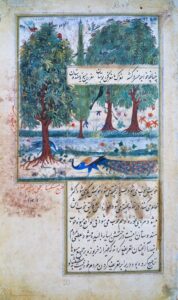
Depiction of mango trees alongside peafowls from Baburnama (c 1590) [Source: Chester Beatty
Library, Dublin]
Nadir ul-Wujud: The Safeda, Totapuri and Goa Mango at the Mughal Court
Babur: The Reluctant Convert and the Founding of the Garden Tradition
Depiction of mango trees alongside peafowls from Baburnama (c 1590) [Source: Chester Beatty Library, Dublin]
Zahiruddin Muhammad Babur (r. 1526 to 1530), the founder of the Mughal dynasty in India, came to the mango bearing the full weight of a Timurid prince’s sensory education. His emotional and aesthetic benchmarks had been formed in the gardens of Fergana and Kabul, the paradise gardens of Central Asia whose grapes, melons, apricots, pomegranates, and cherries represented, for the Persianate cultural tradition in which Babur was steeped, the pinnacle of fruity excellence. When he descended from the Kabul passes into Hindustan, he brought with him not only an army and a political ambition but a set of deeply held aesthetic opinions about what constituted a good fruit, a good garden, a good meal, opinions formed by a literary tradition that had praised the fruits of Khurasan and Transoxiana in verse since the time of Rudaki and Firdausi.
His Baburnama, composed in Chagatai Turkic prose of extraordinary directness and psychological acuity and later translated into Persian by Abdur Rahim Khan i Khanan at Akbar’s instruction, records his reactions to India’s natural world with an honesty that makes it an invaluable document in the history of taste. Babur’s first encounter with Hindustan was dispiriting in precisely the botanical dimension: he found the landscape hot, flat, and monotonous, the flowers without fragrance, the fruits without the quality he was accustomed to. He notes that melons in India were poor compared to those of Khurasan, that grapes were sour and inadequate, and that the landscape lacked the meadows, clear streams, and varied terrain that he associated with beauty.
His attitude toward the mango evolved with characteristic intellectual honesty. In the Indian sections of the Baburnama, composed after the conquest of Delhi in 1526, Babur records tasting the mango, which he calls the amba, and conceding: When good, very good. This qualified praise is the testimony of a man who has tasted inferior specimens but has encountered enough quality to recognise the potential. Most significantly for the mango’s subsequent history under the Mughals, Babur established at Agra the Aram Bagh (Garden of Relaxation) on the Yamuna’s eastern bank, the first Char Bagh in India, laid out in the geometric style of the Central Asian and Persian garden tradition that would become the template for all subsequent Mughal garden making. The Aram Bagh included fruit trees alongside the imported species that Babur unsuccessfully attempted to acclimatise to Hindustan’s climate; mango trees were planted in the orchard sections alongside the plantain and the pomegranate, initiating the process by which the mango was incorporated into the Mughal garden tradition.
The literary historian Muzaffar Alam, discussing the Baburnama in The Languages of Political Islam in India (2004), notes that Babur’s evolving appreciation of the mango can be read as a microcosm of the larger process by which the first Mughal emperor was slowly but irresistibly assimilated into the cultural world of the subcontinent he had conquered. The reluctance with which Babur first approached the mango, his loyalty to the fruits of his Central Asian homeland and his resistance to what India had to offer in their place, mirrors his resistance to other aspects of Indian culture. And his eventual, qualified acknowledgment that the mango, when good, very good, represents a small but real concession to the reality that India possessed something his homeland could not match.
Humayun and the Mango in Exile: Gulbadan Begam’s Account
Nasir ud Din Humayun (r. 1530 to 1540 and 1555 to 1556) ruled the Mughal empire twice, a first reign ended by Sher Shah Suri’s victory at Chausa and Kanauj, and a second brief reign restored by the Battle of Sirhind in 1555. His fifteen years of exile, spent partly at the court of Shah Tahmasp of Persia and partly in the arid regions of Sind and Afghanistan, created a period of interruption in the Mughal mango tradition, but the exile years paradoxically enriched the tradition’s subsequent development: Humayun returned from Persia with a refined Safavid aesthetic sensibility that his court painters and architects applied to the Mughal visual tradition.
The Gulbadan Begam’s Humayunnamah, the memoir composed by Humayun’s sister at Akbar’s request and one of the rare texts of the Mughal period written by a woman, describes the feasts and garden parties of Humayun’s court in terms that include the seasonal consumption of mangoes as a standard feature of the warm weather entertainments. Gulbadan records that Humayun maintained a personal interest in the gardens at Agra and Delhi, and that the distribution of fruit from these gardens to his sisters and other female relatives was a regular form of affectionate communication within the imperial household, the mango as a private gift economy running parallel to the public gift economy of the court.
Akbar: The Lakhi Bagh and the Science of the Imperial Orchard
Jalal ud Din Muhammad Akbar (r. 1556 to 1605) elevated the Mughal engagement with the mango from personal preference to imperial policy with a decisiveness and systematic intelligence that was characteristic of his approach to every domain of governance. The most dramatic expression of this elevation was the establishment of the Lakhi Bagh, the Orchard of One Hundred Thousand mango trees, at Darbhanga in northern Bihar, a region whose combination of alluvial soil, groundwater abundance, and sub Himalayan climate made it among the most productive mango growing zones in all of Hindustan. The Lakhi Bagh, described in Abu’l Fazl’s Ain i Akbari, was not a pleasure garden in the intimate, aestheticised sense of Babur’s Aram Bagh or Shah Jahan’s Shalimar; it was a large scale agricultural enterprise of imperial proportions, managed by crown servants and producing fruit not only for the court but for charitable distribution and commercial sale.
Abu’l Fazl’s Ain i Akbari, that monumental administrative and cultural encyclopaedia of Akbar’s reign, compiled in the 1590s, provides the most detailed imperial period account of the mango as an agricultural and culinary commodity. Abu’l Fazl lists the varieties cultivated in Akbar’s imperial orchards with the precision of an official who has actually inspected the planting records: the Safeda (white), the Totapuri (parrot face, valued for the consistency of its large fruit), varieties from Goa (whose distinctive perfume made them prized as much for their fragrance as for their flavour), and a range of Bihar regional cultivars whose specific names are transcribed in their local form. He records that Akbar himself consumed six or seven mangoes per day during the season and that the emperor had a specific preference for the mango’s juice over the whole fruit, a preference that Abu’l Fazl connects to the emperor’s generally liquid approach to food in the hot season.
Abu’l Fazl also documents the technical infrastructure that supported the imperial mango culture. He describes the employment of specialist orchardists (baghbans) in the royal gardens who maintained the mango trees according to prescribed techniques, and notes that grafting specialists (kalamband kars) were employed specifically to maintain the integrity of named cultivars through vegetative propagation. The dissemination of these specialists’ knowledge from the imperial orchards to those of the Mughal nobility, through the practice of lending trained gardeners to nobles who requested them and through the sale or gifting of grafted saplings from the imperial nurseries, was a significant mechanism of cultural and botanical influence.
The food historian Salma Husain, in her meticulous reconstruction of Mughal court cuisine published as The Emperor’s Table (2008), draws on the partial records of the imperial kitchen (matbakh) that survive in various manuscript collections to describe the range of mango preparations served at Akbar’s dastarkhwan. She identifies at least twelve distinct preparations: the whole ripe fruit served in its natural state; aam ras (fresh mango juice, strained and spiced); aam papad (sun dried mango leather prepared from the pulp of fully ripe fruit); aam ka achar (mango pickle in mustard oil with salt and spices); aam ka murabba (mango preserve in sugar syrup); aam ka sharbat (cold mango drink sweetened with sugar and flavoured with rosewater and cardamom); aam ki kheer (mango in reduced milk); aam ka halwa (mango based sweet); aam ki chutney (fresh mango chutney with mint and green chilli); and several less familiar preparations including mango vinegar and a form of mango wine that the Ain i Akbari mentions among the alcoholic beverages of the imperial table. This culinary diversity, the transformation of a single fruit into twelve distinct culinary products, reflects both the sophistication of the imperial kitchen and the fundamental importance of the mango to the Mughal culinary imagination.
Jahangir: The Tuzuk and the Art of Regional Comparison
Nuruddin Salim Jahangir (r. 1605 to 1627) was the greatest Mughal connoisseur of the mango and left in his Tuzuk i Jahangiri (Jahangirnama) the most eloquent, precise, and historically revealing royal account of mango appreciation in Indian literary history. The Tuzuk, written in a personal Persian prose of remarkable directness and sensory specificity, is structured as a year by year memoir in which the emperor records his daily observations of the world with the passionate attention of a man who takes aesthetic experience seriously as the measure of a life well lived. In the entries for the fourth year of his reign (1609 to 1610), Jahangir records a comparative assessment of mangoes from different regions that demonstrates the depth and range of his experience:
Of the fruits of Hindustan, the mango is the finest. But not all mangoes are equal. Those of the doab, of Lucknow and its environs, have the sweetest flesh and the most perfectly balanced flavour, neither too sharp with acid nor too heavy with sweetness. The mango of Goa has a perfume that no northern variety can match; its scent fills the room before one tastes it, and the fragrance remains on the fingers for an hour after eating. Those of the Deccan are good but coarser, the flesh more fibrous. I have tasted the mango of Bengal, which is large and mild, pleasant without being astonishing. The mango of Sind is sweet but flat, like music without elevation. Among all these, my preference is for the mango of the doab in flavour, and for the Goa mango in fragrance, though they are rarely found in the same fruit. (Tuzuk i Jahangiri, Year 4; translated after Rogers and Beveridge, 1909, with modifications)
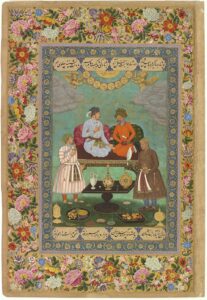
Painting depicting Jahangir entertaining Shah Abbas with many fruits including mangoes [Source: Wikimedia Commons]
This passage is extraordinary on multiple levels. It demonstrates the existence, by the early seventeenth century, of a sophisticated multi regional mango market at the Mughal court: the varieties of at least five distinct regions (the doab, Goa, the Deccan, Bengal, and Sind) were available for comparison at the emperor’s table, which implies a logistical network of remarkable reach and efficiency. It reveals a critical vocabulary, balanced flavour, too sharp with acid, coarser, flat, that prefigures the vocabulary of modern professional food criticism by more than three centuries. And it reveals Jahangir’s specific aesthetic sensibility: his preference for the complex balance of the doab variety over the straightforward sweetness of the Sind mango, and his appreciation of the Goa mango’s olfactory dimension as a quality distinct from and complementary to flavour, suggest a palate of genuine discrimination.
The Tuzuk also contains a celebrated passage in which Jahangir discusses the relative merit of eating mango ripe versus using it unripe. He observes that the unripe mango, eaten with salt and red chilli in the manner of the common people, or served sliced with rock salt and cumin at the court table, provides a sharpness and astringency that is its own form of pleasure, quite distinct from the sweetness of the ripe fruit, and that to know the mango only in its ripe state is to know only half of its character. The art historian Milo Cleveland Beach, in his study The Imperial Image: Paintings for the Mughal Court (1981), discusses the representation of the mango in Mughal miniature painting as a marker of royal abundance and seasonal festivity, noting particularly the naturalistic botanical studies of mango varieties commissioned by Jahangir for the imperial album, small, precisely observed paintings of individual mango specimens that represent the intersection of Jahangir’s passion for natural history with the Mughal painterly tradition’s capacity for exact representation.
Shah Jahan: The Shalimar Bagh and the Court Poet Kalim Kashani’s Mango Odes
Shah Jahan (r. 1628 to 1658), whose reign produced the Taj Mahal, the Red Fort, the Jama Masjid, and the city of Shahjahanabad, was an emperor whose aesthetic vision extended from the macro scale of urban planning to the micro scale of garden design, and the mango was an integral element of the garden landscapes he created and maintained across the empire. The Shalimar Bagh of Lahore, constructed between 1641 and 1642 on the banks of the Ravi by the master engineer Ali Mardan Khan under Shah Jahan’s direct supervision, represents the most elaborate integration of fruit orchards into a formal Mughal garden design. The garden’s three terraces, each at a different elevation connected by cascades and water channels, were allocated to different functions: the lowest terrace (aram gah, place of rest) was the most public and contained the largest planting of fruit trees, including mango orchards of considerable extent.
Francois Bernier, the French physician whose account of the Mughal empire during Aurangzeb’s reign (1656 to 1668) provides some of the most detailed European observations of Mughal court life, describes the mango orchards around Lahore in terms that capture the extraordinary scale of Mughal horticultural investment. Bernier notes that the road approaching Lahore from the south passed through continuous mango groves, groves so extensive and so densely planted that they formed a natural tunnel of shade for several miles, and that these groves were maintained partly as royal property and partly as the private orchards of Lahore’s great nobles, each vying with the others in the quality and variety of his planting.
The court poet Kalim Kashani (d. 1651), who served as Shah Jahan’s poet laureate (Malik ush Shu’ara) and composed the Padshahnama in verse alongside the prose chronicle by Amina Qazwini, included in his Diwan several qasidas (odes) addressed to the pleasures of the seasonal garden. In these qasidas, the mango’s flowering and ripening provide the occasion for elaborate praise of the emperor’s garden and of the abundance that his rule has produced. The mango blossom is described as more fragrant than the rose of Shiraz, a claim that explicitly asserts the superiority of the Indian garden over the Persian garden tradition’s most celebrated symbol, and the ripe mango is compared to a golden lamp hung in the green cathedral of the orchard, its sweetness a form of divine generosity mediated through royal patronage.
Aurangzeb: The Ascetic and the One Indulgence He Could Not Refuse
Muhy ud Din Muhammad Aurangzeb Alamgir (r. 1658 to 1707) presents the most psychologically complex case in the entire catalogue of Mughal mango relationships. His reign was characterised by a sincere and progressively more intense personal piety that expressed itself in the renunciation of the court’s musical entertainment, the abandonment of pictorial art, and a general austerity in personal consumption that stood in marked contrast to the sybaritic splendour of his father’s court. Yet the historical record, as preserved in the Ruqaat i Alamgiri (his personal letters), in the Ahkam i Alamgiri (records of his decrees), and in the memoir tradition that accumulated around his long reign, consistently preserves a single exception to his general practice of self denial: the mango.
The Ruqaat i Alamgiri, a collection of Aurangzeb’s personal letters preserved in several manuscript traditions and published in various editions during the colonial period, contains multiple references to mango related matters of a specificity that reveals ongoing personal engagement. In letters to sons and provincial governors, Aurangzeb refers to the sending and receiving of mangoes as gifts with an attentiveness quite at odds with his general detachment from worldly pleasures. In one letter addressed to Prince Azam Shah and dated to the later years of his Deccan campaign, Aurangzeb writes of having received a basket of mangoes from the orchards of Aurangabad and of having found them of acceptable quality but inferior to those of the doab, a comparative evaluation that demonstrates both his continuing personal interest in mango quality and the persistence of his developed aesthetic standards even in the exhausting conditions of the Deccan campaign.
The tradition preserved in later Urdu and Persian biographical literature holds that the emperor, when reproached by his pious attendants for his continuing consumption of the mango in a reign of proclaimed austerity, responded with a formulation that has passed into the Indian proverb tradition: Allah ne aam meetha banaya, kisi insan ki koshish se nahin (God made the mango sweet, not through any effort of man), meaning that the mango’s sweetness was a divine gift requiring no human elaboration, no music, no painting, no luxury, to make it pleasurable, and therefore could not be considered a form of worldly self indulgence. Whether this saying is genuinely Aurangzeb’s or a later attribution, it captures something real about the cultural logic that gave the mango its exceptional status: it was the one sensory pleasure that even an ascetic tradition found difficult to prohibit, because it was so thoroughly natural.
Aurangzeb’s three decade campaign in the Deccan (1682 to 1707) brought the Mughal court into sustained contact with the mango cultures of the peninsula. The Konkan orchards, contested between Mughal forces and the Maratha chiefs of the Sahyadri range in the complex military geography of the late Aurangzeb wars, produced the Alphonso and related varieties that the imperial camp would have encountered through the provisioning networks of the mobile court. Jadunath Sarkar, in his monumental Mughal Administration (1920) and History of Aurangzib (1912 to 1924), notes that the mobile Mughal camp of the Deccan period, which was in effect a moving city of several hundred thousand people, maintained its own market system including fruit vendors, and that the mango orchards of the Konkan and the Deccan plateau were an important source of seasonal supply for this enormous community. The military campaigns thus paradoxically contributed to the spread of mango variety knowledge across the subcontinent: soldiers, camp followers, merchants, and administrators moving between the Deccan and the North carried with them both the knowledge of local varieties and, sometimes, the physical grafts and seedlings from which new orchards could be established.
Aam ka Darbar: The Dussehri, Langra and Chausa under the Nawabs of Awadh
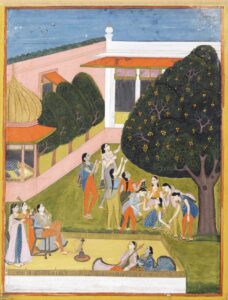
18th century depiction of women plucking Lucknowi mangoes from Farrukhabad palace groves [Source: Bonhams]
The Malihabad Belt, the Dussehri, and the Architecture of Nawabi Connoisseurship
If the Mughal emperors created the institutional framework within which mango patronage became a dimension of imperial statecraft, it was the Nawabs of Awadh, ruling from Lucknow through a century and a half of political semi autonomy between 1722 and 1856, who raised the appreciation of individual mango varieties to the level of a systematic aesthetic practice, a form of cultural activity as elaborate and as seriously pursued as the appreciation of ghazal poetry, thumri singing, or the subtleties of Lucknawi cuisine. The Nawabi court at Lucknow created, in the mango culture of the Malihabad and Kakori and Daryabad belt, the most sophisticated horticultural connoisseurship in the world at that time, a culture of varietal discrimination, seasonal anticipation, competitive gifting, and precise verbal evaluation that finds no equivalent in the global history of fruit appreciation before the development of modern wine criticism.
The geographical heartland of this culture was the Malihabad tehsil of the Lucknow district, a zone of rich alluvial soil watered by the streams descending from the Rohilkhand uplands, lying approximately thirty kilometres northwest of the city, and blessed with a microclimate of sufficient humidity and moderate temperatures to produce mangoes of exceptional balance and sweetness. The village of Dussehri in this tehsil gives its name to the variety that has become the standard against which all North Indian mangoes are measured in the contemporary market, a medium sized, thin skinned mango of brilliant golden colour when ripe, with flesh of such smoothness and sweetness that the ethnobotanist S.K. Mukherjee described it, in his review of Indian mango cultivars, as the variety that best represents the North Indian mango ideal in all its dimensions. The Dussehri’s mother tree, the single ancient individual from which all subsequent Dussehri trees in North India are clonally derived, still stands in the village, protected by local tradition and by official designation as a heritage tree, and is reported by the horticulturalists of the Central Institute of Subtropical Horticulture in Lucknow to be of considerable age, consistent with the tradition that it was already old and celebrated when the Nawabi court first took formal notice of it.
The Nawabi court’s patronage of the Dussehri and of the broader Malihabad orchard culture operated through several interlocking mechanisms. The assignment of mango growing land as jagir (revenue grant) to trusted nobles and administrators ensured that the orchards received the investment and management they required; the jagirdar’s interest in the quality of his orchard’s produce was both economic (fine mangoes commanded premium prices) and social (the quality of the mangoes he presented to the Nawab was a measure of his status and competence). The institution of the mango darbar, the mango court, held annually at the height of the season, was the culmination of these competitive incentives: nobles brought the finest specimens from their orchards for the Nawab’s evaluation, and the Nawab’s judgment on their relative merit was at once an aesthetic assessment and a political act that distributed honour and shame among the gathered elite.
The food historian Pushpesh Pant, in his Mango: The King of Fruits, describes the Nawabi mango culture with the insider’s intimacy of a scholar whose own family maintained orchards in the Lucknow district. Pant notes that the Nawabi court developed a specific vocabulary for the evaluation of mango quality, a technical language that distinguished between varieties on the basis of rasa (flavour, including the balance of sweet and acid), saurabha (fragrance, distinguished by its intensity, character, and persistence), varna (colour, both external and of the flesh), sutra (the quality of the fibre, from completely fibre free to coarsely fibred), and kal (the season of ripening, distinguished into ageti or early, madhyama or mid season, and pacheti or late). This five dimensional vocabulary of evaluation, whose Sanskrit derivations connect it directly to the aesthetic theory of Bharata’s Natyashastra and Bhartrhari’s rasa theory, gave the Nawabi mango connoisseur a technical language as precise and as culturally loaded as the vocabulary of any other domain of Lucknawi aesthetic practice.
Asaf ud Daula, Mir Taqi Mir, and Insha’s Aam-nama
Nawab Asaf ud Daula (r. 1775 to 1797), under whose reign the characteristic Lucknawi culture of tehzeeb (refined courtesy), naaz o andaaz (gracious style), and pechida baat (the art of elaborate indirection) reached its fullest development, was among the most extravagant patrons of mango culture in the Nawabi period. His court maintained an elaborate system for the procurement, storage, and formal presentation of mangoes: special messengers (qasids) were dispatched each year to the Malihabad orchards at the first signs of ripening, with instructions to bring back not merely the finest fruit but a detailed verbal report on the season’s prospects.
The institution of the aam ki kothi, literally the mango treasury, referring to the great storerooms in which the season’s harvests of different named varieties were stored separately, catalogued by variety, orchard of origin, and date of arrival, reached its most elaborate development under Asaf ud Daula’s administration. The kothi was managed by a specialised official (aam daro) responsible for the proper storage, periodic inspection, and distribution of the fruit; his records, which distinguished between varieties with the precision of a modern inventory system, created what amounted to a bureaucratic infrastructure for the management of mango appreciation.
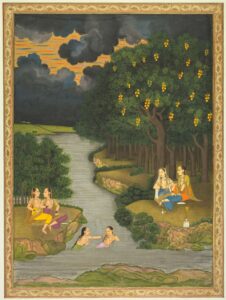
Painting from 1765 A.D. in style of Hunhar II depicting women enjoying at river bank near a lush mango tree [Source: The Cleveland Museum Of Arts]
Mir Taqi Mir (c. 1723 to 1810), who spent his most productive years in both Mughal Delhi and the Nawabi court at Lucknow and who is regarded as one of the two or three greatest poets in the history of Urdu ghazal, employs the mango in his verses not as the object of direct celebration but as a figure of temporal transience and seasonal impermanence, the emotional register that is most characteristic of his mature poetic voice. In a ghazal from his fourth divan, Mir writes: Mausam ka aam hai, phir na milega / Jo mila so mila, jo gaya woh gaya (It is the mango of the season, it will not come again / What was found is found, what has gone is gone), using the mango’s brief season as a figure for the general precariousness of pleasure in a world of political instability and personal loss. Mir composed this verse in the period after the Nadir Shah invasion of 1739, when Delhi’s courtly world had been shattered and the pleasures he had known in the Mughal capital were irrevocably past; the mango’s season becomes, in this context, a figure for all the seasons of pleasure that history has brought to an end.
The Urdu poet Insha Allah Khan Insha (1756 to 1817), who served at the Lucknow court and was among the most versatile and playful literary personalities of the Nawabi period, composed a humorous masnavi titled Aam nama (Book of Mangoes) in which he catalogues the varieties of Lucknow’s mango culture with the comic hyperbolism that was his characteristic mode. Insha lists variety after variety, Dussehri, Safeda, Chausa, Langra, Tota, and more obscure cultivars, with the enthusiasm of a collector who takes pleasure equally in the things themselves and in the act of naming them. The Aam nama is important as a literary document because it preserves the names of several Nawabi period varieties that have subsequently disappeared from the market and from horticultural records, suggesting that the varietal diversity of the Lucknow mango culture was even greater than the surviving cultivar lists indicate.
The Langra: The Lame Man’s Mango and the Philosophy of Hidden Excellence
The Langra mango, named in its literal Hindi meaning the lame one or the cripple, carries in its name one of the most charming and most discussed folk etymologies in the history of Indian food culture. The variety is distinguished by several characteristics that set it apart from the other major North Indian cultivars: its skin remains green even when fully ripe (it does not turn the golden yellow of the Dussehri or the pale yellow green of the Chausa), its flesh is deep orange yellow with a complex flavour that combines sweetness with a trace of tartness and a distinctive resinous note that connoisseurs find elevating rather than unpleasant, and its season runs from mid July to late August, well after the Dussehri and Chausa have finished.
The folk tradition of Varanasi (Banaras) attributes the Langra to a lame Brahmin devotee, accounts differ on whether he was a priest attached to one of the ghats’ temples, a sadhu living in a garden on the river’s edge, or a small farmer cultivating a patch of ground near the Asi Ghat, who cultivated a single mango tree of exceptional quality that grew from a chance seedling in his garden. The devotee’s lameness, in this tradition, is not merely a biographical detail but an interpretive key: the Langra is a mango of imperfect external appearance (its green skin marks it as apparently unripe even when fully mature, a form of visible disability that disguises its inner excellence), and this paradox of external imperfection concealing internal superiority is read as a correspondence between the tree and its cultivator. The variety’s name, in this reading, honours the lame man who discovered it by encoding in the fruit itself the characteristic that made him its appropriate guardian: both were judged by the world on the basis of external appearances that concealed a deeper excellence.
The Urdu literary tradition preserves the Langra in contexts that reflect its special status as the philosopher’s mango. The ghazal tradition of Lucknow and Delhi employs the Langra’s deceptive greenness as a figure for the gap between appearances and reality: Langra ke didar se mat karo bhaav, / Sab se meetha wahi jo dikhe kacha (Do not judge the Langra by its look / The sweetest of all is the one that seems raw) is a verse attributed in various collections to poets of the Nawabi period. The proverb Langra ki tarah hona (to be like the Langra) passed into colloquial Hindi as an expression meaning to possess hidden qualities that external appearances conceal, a compliment that derives its force entirely from the mango’s specific character.
Ghalib’s Letters and the Mango as Medium of Social Bond
Mirza Asadullah Khan Ghalib (1797 to 1869), who spent most of his life in Delhi and who experienced in his own biography the disintegration of the Mughal court culture that had been the sustaining context of his art, was by all accounts a mango enthusiast of the most uncritical and uninhibited kind, a man who, despite his formidable aesthetic discrimination in other domains, abandoned all pretension to connoisseurship when confronted with a good mango and simply ate it with unrestrained pleasure.
The anecdotes about Ghalib and mangoes are numerous and consistent. The most famous holds that when a friend, observing Ghalib’s complete absorption in a basket of mangoes, remarked that donkeys do not eat mangoes, Ghalib replied: Ji haan, woh mango nahin khate (Yes indeed, they do not eat mangoes), a retort that simultaneously denied the implicit comparison and celebrated the mango’s status as a fruit reserved for beings of intelligence and discrimination. Another anecdote, preserved in the biographical accounts compiled by his contemporary Hali in Yad gar e Ghalib, reports that Ghalib evaluated the entire worth of a human being partly on the basis of whether they appreciated mangoes: Jo aam nahin khata, usse main kya jaanta hoon? (What do I know of someone who does not eat mangoes?), a formulation that elevates mango appreciation to a criterion of human worth with the mock philosophical seriousness that was Ghalib’s characteristic mode of comic extravagance.
Ghalib’s Urdu letters, the Khutoot, of which several thousand survive and which constitute one of the most valuable documents of the Delhi cultural world in the mid nineteenth century, contain numerous references to mangoes that reveal the fruit’s practical importance in his social world alongside its psychological centrality in his emotional economy. He writes to friends in Lucknow asking them to send baskets of the season’s Dussehri; he writes to patrons in Delhi thanking them for gifts of mangoes from their orchards; he writes to his nephew about the decline of the Malihabad orchards under what he regards as the neglect of the British administrative regime. These letters reveal the mango as a medium of social relationship in nineteenth century North Indian Muslim culture, a currency of affection, obligation, and mutual care that circulated through the epistolary networks of the literary community with the same regularity as news, gossip, and literary criticism.
Wajid Ali Shah: Exile, Elegy, and the Mango of Memory
Wajid Ali Shah (r. 1847 to 1856), the last Nawab of Awadh and one of the most complex and poignant figures of nineteenth century Indian history, concentrated in his person the fullest expression of Lucknawi mango culture and its elegiac dimension. A gifted poet (his takhallus or pen name was Akhtar), dramatist, and musician, his thumri compositions, particularly Babul mora naihar chooto jaaye (Father, my maternal home slips away from me), are among the most moving songs in the entire Hindustani classical tradition, composed in anticipation of his own exile. Wajid Ali Shah experienced the loss of his kingdom to the British annexation of February 1856 as a displacement not only from political power but from the entire sensory and cultural world that the Nawabi court had created.
Exiled to Calcutta, where he maintained a reduced court at Matiaburj in the city’s southern suburbs, the last Nawab is said to have composed verses lamenting the loss of the Lucknow mangoes, the Dussehri, the Safeda, the Langra, the dozen varieties of his dastarkhwan, with the same grief and the same literary sophistication with which he lamented the loss of Lucknow itself. In his autobiographical prose poem Huzn i Akhtar (The Grief of Akhtar), Wajid Ali Shah writes of his exiled condition in terms that specifically invoke the lost pleasures of the Malihabad orchard:
Woh Lucknow ki amben, woh Malihabad ki khushbu / Woh subh ki thandi hawa, woh baghon mein ruhu / Ab Kalkatey mein hun, kahaan wohi aaish / Baad e bahar kahan, kahan woh naghma o naish(Those mangoes of Lucknow, that fragrance of Malihabad / That cool breeze of morning, that breath in the gardens / Now I am in Calcutta, where is that same luxury / Where the spring wind, where that music and pleasure) — Wajid Ali Shah, Huzn i Akhtar, c. 1860
The mango, in this verse, serves as a figure for everything that exile has taken away, but it is more than a convenient symbol. It is a specific, irreplaceable sensory experience tied to a specific geography: the Dussehri of Malihabad, with its particular flavour produced by that particular soil and that particular climate, cannot be reproduced in Calcutta any more than the culture of Lucknawi tehzeeb can be reproduced in a British administered colonial city. The mango’s terroir, the untranslatable specificity of a taste produced by a specific conjunction of place and variety and season, makes it the perfect vehicle for the Nawabi exile’s grief, because it encodes in a single, irreplaceable flavour the entirety of a lost world.
Totapuri, Banganapalli and Neelam: The Southern Mango in the Deccan
Muhammad Quli Qutb Shah and the Dakkhani Mango
The Qutb Shahi dynasty of Golconda (1518 to 1687) produced in Muhammad Quli Qutb Shah (r. 1580 to 1611) one of the most remarkable royal poet patrons in Indian history, a ruler who composed extensively in Dakkhani Urdu (the southern variety of the Urdu language, blending Persian vocabulary with the Telugu, Kannada, and Marathi phonological and grammatical substrate of the Deccan) and who left a substantial divan whose verses celebrate the pleasures and landscapes of the Deccan with an immediacy and sensory vividness quite unlike the more formal Persian qasida tradition. Muhammad Quli founded the city of Hyderabad in 1591 and composed a dedicatory qasida celebrating the new city in terms that invoke the fertility of the Deccan landscape, including its mango orchards, as evidence of divine blessing upon the enterprise.
Golconda miniature painting (dating back to 1670–1680 A.D.) depicting Utka Nayika (a heroine who anxiously awaits the arrival of her absent lover) under a lush mango tree [Source: Carlton Rochell Asian Art]
Muhammad Quli’s Dakkhani verses employ the mango in the seasonal and erotic registers familiar from the broader Indo Islamic literary tradition, but with a specifically Deccani inflection that reflects the geographical and cultural world of the Golconda plateau. In a masnawi addressed to the pleasures of spring in the new city of Hyderabad, he writes of the mango orchards visible from the walls of the Golconda fort in terms that situate the fruit within the syncretistic cultural world of the Qutb Shahi court, where Persian literary conventions were blended with Telugu folk traditions and Vaishnava devotional imagery. The food historian Lizzie Collingham, in Curry: A Tale of Cooks and Conquerors (2005), notes that the Dakkhani literary tradition’s treatment of the mango reflects the broader cultural hybridity of the Deccan Sultanates, a hybridity that was also expressed in the distinctive cuisine, architecture, and music of the region.
The Dakkhani poet Wali Muhammad Wali (c. 1667 to 1707/1725), commonly known as Wali Dakhani or Wali Aurangabadi and widely regarded as the founding figure of classical Urdu ghazal poetry, composed in Aurangabad, a city deeply embedded in the mango growing landscape of the northern Deccan, verses that employ the mango’s seasonal presence with the Sufi literary tradition’s characteristic transformation of sensory experience into spiritual allegory. Wali’s contribution to Urdu literary history was decisive: his ghazals, when he visited Delhi in 1700, are said to have transformed the city’s literary consciousness and initiated the classical tradition of Urdu poetry that Mir and Ghalib would subsequently bring to its highest development.
The Totapuri: Parrot Face of the Deccan Plateau
Ibrahim Adil Shah II (r. 1580 to 1627) of Bijapur, whose court was arguably the most culturally eclectic in the entire history of the Deccan Sultanates, simultaneously patronising Persian, Arabic, Kannada, Marathi, and Sanskrit literature and music, maintained extensive pleasure gardens at his capital that incorporated both the Persianate garden tradition and the indigenous Deccan horticultural practice of growing mango orchards in the black cotton soil (regur) of the plateau. His own Kitab i Nauras (Book of Nine Rasas), a remarkable collection of songs in praise of the nine aesthetic moods recognised by classical Indian aesthetics, employs the seasonal landscape of the Bijapur plateau, including its mango orchards, as the setting for devotional and erotic verses that blend Sufi Islamic imagery with the Vaishnava and Shaiva devotional traditions of the Deccan.
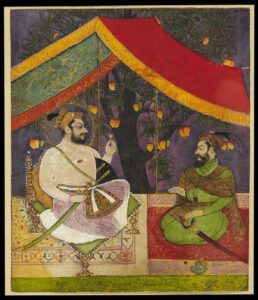 Dakkhani painting depicting Sultan Ali Adil Shah II of Bijapur seated on a throne in front of his general Afzal Khan under a canopy beside a mango tree (dating back to 1656-59 A.D.)[The Metropolitan Museum of Art]
The Totapuri mango, whose name means parrot face in Telugu and Kannada, referring to the distinctive beak-like shape at the fruit’s apex, is the most characteristic South Indian cultivar and represents the Deccan Sultanate period’s most significant contribution to the canon of named Indian mango varieties. The Totapuri, known in different South Indian languages as Collector (in its commercial incarnation), Bangalora (in Andhra Pradesh), and Kili Mooku (parrot’s beak, in Tamil), is distinguished from North Indian varieties by its very large size, its slightly elongated shape terminating in the characteristic beak, its firm yellow flesh that is mildly sweet and virtually fibre free, and its exceptional keeping quality: it can be stored at room temperature far longer than most other varieties. These characteristics made it particularly well suited to the large scale commercial production and long distance trade in which the Deccan Sultanates’ maritime trade networks specialised.
The Banganapalli and Neelam: The Nizams’s Legacy in Andhra
The Nizams of Hyderabad, ruling from 1724 to 1948 under a succession of titles and in evolving relationships with the British Raj, maintained in their capital and its hinterlands an elaborate culture of aristocratic consumption that encompassed mango appreciation as one of its characteristic pleasures. The Banganapalli mango, named for the town of Banganapalle (previously Banganapalli) in the Kurnool district of Andhra Pradesh, which was a feudatory princely state under the suzerainty of the Nizam, is among the most significant South Indian contributions to the global diversity of named mango varieties. Its characteristics are distinctive and commercially compelling: individual fruits regularly exceed 400 grams, the skin turns uniformly pale yellow when ripe, the flesh is almost completely fibre free with a texture that food writers consistently describe as like rich cream, and the flavour is a mild, honeyed sweetness that achieves a kind of unpretentious perfection in its category.
The Neelam mango, associated with the gardens of Bangalore (then a city of the Mysore kingdom under Hyder Ali and Tipu Sultan before its annexation by the British) and with the patronage of the Wodeyar rulers of Mysore, is another South Indian cultivar of considerable importance whose aristocratic origins are encoded in its distribution. The Neelam’s intensely sweet, rose and jasmine scented flesh, and its very late season extending into August and September, made it a luxury available when all other varieties had finished, a temporal monopoly on freshness that gave it its aristocratic cachet.
Tipu Sultan and the Gardens of Seringapatam
Tipu Sultan (r. 1782 to 1799), the Tiger of Mysore whose resistance to British expansion in South India made him one of the most formidable opponents of British imperialism, maintained at his island capital of Seringapatam (Srirangapatna) on the Kaveri river extensive pleasure gardens in which mango cultivation was a major element. The Lal Bagh (Red Garden) at Bangalore, established by Hyder Ali and expanded by Tipu Sultan, was among the most ambitious botanical gardens in pre colonial India, and it included a large collection of mango varieties alongside the ornamental and medicinal species that reflected Tipu’s broad botanical curiosity.
The British officers who participated in the siege of Seringapatam in 1799 note the extraordinary beauty and variety of the mango orchards in the island’s gardens. James Kirkpatrick, the British Resident at Hyderabad who visited Seringapatam shortly after the conquest, recorded in his letters (collected in Iris Butler’s The Eldest Brother, 1973) his astonishment at the diversity of mango varieties maintained in Tipu’s orchards, varieties from the Konkan coast, from the Deccan plateau, from the Karnataka interior, and from the Tamil south, assembled in a single orchard that represented a deliberate collection of the region’s horticultural diversity. The destruction of these orchards during and after the siege of 1799 was a cultural and botanical loss whose significance historians of Indian horticulture have only recently begun to appreciate.
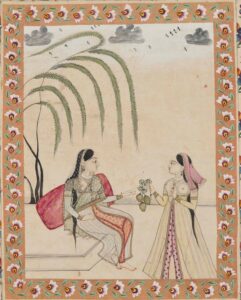
19th century painting from Punjab Hills depicting two ladies sharing mangoes [Source: Christie’s]
Sindhri, Safeda and the Sacred Grove: The Mango in Punjab
The Barahmasa of the Guru Granth Sahib and the Mango’s Sacred Resonance
The Punjab’s relationship with the mango is inseparable from the literary tradition of Sikhism, which from its earliest period incorporated the seasonal and botanical imagery of the Punjabi landscape into its devotional vocabulary with a directness and specificity that distinguishes the Gurbani tradition from the more allegorically mediated Sanskrit and Persian literary conventions. The Adi Granth (Guru Granth Sahib), compiled under the editorship of Guru Arjan Dev (1563 to 1606) and containing compositions by six Gurus and fifteen saint poets of different religious backgrounds, includes several barahmasa compositions that use the seasonal progression of the Punjab’s agricultural landscape as a vehicle for the expression of devotional longing.
19th century painting from Punjab Hills depicting two ladies sharing mangoes [Source: Christie’s]
The barahmasa composed by Guru Arjan Dev in the raag Majh (one of the fundamental raags of Punjabi devotional music, associated with the monsoon season and with the emotional register of longing and love) describes the months of Jeth and Asadh (roughly May to July) in terms that make the mango’s ripening a central figure for the devotee’s readiness to receive the divine:
Jeth jishthan tin paaiye jinhaa ditthaa Hari / Dhan sohagan sach sukh gurmukh Hari mileh(In the month of Jeth, those who have seen the Lord obtain fulfilment / Blessed is the true bride who, as Gurmukh, meets Hari, the Lord) — Guru Arjan Dev, Barahmasa, Raag Majh, Guru Granth Sahib, Ang 133 to 136
The mango’s presence in this barahmasa is not explicit but structural: the devotional fulfilment described in the Jeth verse is mapped onto the landscape of the month in which the mango ripens, and the associations of abundance, sweetness, and the completion of a long growing season that the mango carries in the Punjabi folk imagination are silently invoked as the emotional backdrop of the verse. Guru Nanak Dev’s bani, the earliest layer of the Guru Granth Sahib, employs natural imagery drawn from the landscape of the Punjab and from the broader Indian landscape that his extensive travels revealed to him. His barahmasa compositions (in raags Tukhari and Majh) use the Punjabi folk song tradition’s seasonal framework to express the soul’s longing for the divine with an immediacy that makes the spiritual and the natural inseparable. The mango appears in Guru Nanak’s seasonal verses as part of a natural landscape whose abundance and beauty are evidence of the divine generosity that sustains all creation, a theological position that gives every natural thing, including the mango, a sacred significance without requiring it to serve as a symbol of anything other than itself.
Bernier’s Account and Ranjit Singh’s Darbar
Francois Bernier’s account of Lahore during his travels in the Mughal empire (1656 to 1668) provides the most detailed European description of the Punjab’s mango orchard culture in the Mughal period. He distinguishes between the mango varieties of the Punjab on the basis of size, colour, flavour, and season; he describes the grafting technique practised in the Lahore orchards; and he provides a vivid account of the social practice of the harvest, the temporary movement of wealthy households into their mango orchards, the informal consumption of fruit directly from the branch, the distribution of surplus to the poor at the orchard gates, that captures the public, communal dimension of mango culture that the formal chronicle accounts tend to elide. Bernier also records a revealing anecdote about the competitive dimension of mango quality at the Mughal court: the nobles of Aurangzeb’s court engaged in a form of horticultural competition in which the quality of their orchards’ mango produce was a proxy for the more general competition for status and royal favour.
Maharaja Ranjit Singh (r. 1799 to 1839), the Lion of Punjab who unified the Sikh misls into a powerful state and created at Lahore the most opulent court in early nineteenth century Asia, maintained the mango culture of the Punjab with the competitive enthusiasm that he brought to every dimension of royal self presentation. Emily Eden’s Up the Country (1866), the memoir compiled from her letters to her sister during the Governor General Lord Auckland’s tour of the Punjab in 1838 to 1839, provides one of the most vivid British accounts of the mango’s place in the Lahore Darbar’s social life:
The Maharajah sent us again today a quantity of mangoes, and I begin to understand that mango sending is one of the highest forms of compliment in the Punjab, and that to refuse them or to fail to praise them extravagantly would be a grave social error. The mangoes themselves are, I must confess, much better than any I have tasted in Calcutta or Simla, sweeter, with a perfume that the Bengal variety lacks entirely. — Emily Eden, Up the Country (London: Richard Bentley, 1866), letter of 12 August 1838
Eden’s observation that she was beginning to understand the social meaning of mango giving captures the moment at which a British observer recognised the mango as a medium of political communication rather than merely a food gift. The Sindhri mango, a cultivar associated with the Sind region to the southwest of the Punjab, circulated through the networks of trade and tribute that connected Ranjit Singh’s empire with the Amirs of Sind, who maintained their own tradition of mango cultivation in the irrigated orchards of the Indus plain. The Sindhri’s large size, its deep orange flesh, and its intensely sweet, almost caramel like flavour distinguished it from the Punjab’s own varieties and made it a prized commodity in the Lahore market.
Anbaj, Manga & Amba: Foreign Witnesses and Botanical Science
The mango’s literary biography in the Indo Persian and vernacular traditions is enriched and often corrected by the accounts of foreign travellers who encountered the fruit in the course of their journeys through India. These accounts, written for audiences unfamiliar with the mango and therefore compelled to describe it from first principles, without the shared cultural codes that structured the indigenous literary discourse, provide observations of a kind that the Indian literary tradition took for granted: precise botanical descriptions, comparative evaluations against the fruits of other cultures, and records of cultivation and trade practices that the court chronicle tended to omit as beneath its dignity.
Ibn Battuta’s Rihla, already discussed in the context of the Delhi Sultanate, establishes the template for the foreign traveller’s engagement with the mango: meticulous physical description, careful attention to the variety diversity visible in the market, note of the social contexts of consumption, and the specific observation of preservation techniques (the mango pickle) not known in the traveller’s homeland. The Moroccan traveller’s account was followed, at two century intervals, by those of the Portuguese naturalists and the French and Italian visitors of the Mughal period, each adding a new layer of observation and a new cultural perspective to the developing portrait of the mango.
Garcia da Orta’s Coloquios dos Simples e Drogas da India (Goa, 1563) remains the first truly scientific account of the mango in any language. Written as a dialogue between Garcia and a fictional interlocutor named Ruano, a device that allowed the author to present conflicting views and to acknowledge the limits of his own knowledge, the Coloquios describes the mango’s botanical characteristics, its variety diversity on the west coast, its medical properties in the Ayurvedic tradition, and the Portuguese horticultural practice of grafting. Garcia’s comparative approach, systematically evaluating the mango against the fruits of Europe and the Middle East and concluding that the mango, in its finest varieties, surpassed all of them, echoes and reinforces the cultural strategic argument that Amir Khusrau had made two and a half centuries earlier: India’s nature is not inferior but superior to that of the Islamic world’s great garden cultures.
Niccolao Manucci’s Storia do Mogor, covering Aurangzeb’s reign on the basis of personal observation, provides accounts of mango distribution at the Mughal court that illuminate the social life of the fruit among the Mughal elite. Manucci, a Venetian adventurer who arrived in India as a teenager and spent sixty years in various capacities including as a physician and court observer, had the unusual advantage of combining insider access to the Mughal court with the outsider’s capacity for observation. His accounts of the elaborate protocols governing the distribution of royal mangoes as gifts, who received them, in what quantities, in what order of precedence, provide the most detailed picture available of the mango gift economy as it operated at its peak of institutional development.
Jean Baptiste Tavernier, the French jewel merchant who made six journeys to India between 1631 and 1668 and who left in his Travels in India one of the most commercially detailed accounts of the Mughal economy, records the mango trade from a perspective entirely different from that of the physician botanists or the court observers. Tavernier was interested in the mango primarily as a commodity, its prices at different markets, the networks through which it moved from orchard to consumer, the seasonal fluctuations of supply and demand. His observations reveal that by the mid seventeenth century, the mango had developed a substantial inter regional wholesale trade involving merchant intermediaries who bought fruit at the orchard and transported it to distant markets, a commercial infrastructure whose sophistication implies a long prior history of market development.
Company style painting of mango by artist Sita Ram (1814, Calcutta)[Source: Arts of Hindostan]
William Roxburgh, Superintendent of the Calcutta Botanic Garden from 1793, provided in his Flora Indica (published posthumously 1820 to 1832) the first systematic application of Linnaean botanical taxonomy to the Indian mango’s variety diversity. Roxburgh’s descriptions of the major commercial varieties of the Bengal, Bombay, and Madras markets provide an invaluable baseline for understanding the state of mango diversity at the beginning of the colonial period. The ethnobotanist S.K. Mukherjee, whose own monograph on the genus Mangifera built directly on Roxburgh’s foundation, describes him as the indispensable starting point for any scientific account of the Indian mango, a judgment that acknowledges both Roxburgh’s priority and the limitations of his Linnaean approach for capturing the full complexity of a diversity that had been shaped by millennia of human selection rather than by the processes that taxonomic botany was designed to describe.
Mausam ka Aam: The Mango in Folk Song, Proverb and the Democratic Imagination
The barahmasa, the poem of twelve months, found in virtually every North and Central Indian literary tradition from Sanskrit through Brajbhasha, Avadhi, Punjabi, Rajasthani, Bhojpuri, Maithili, Bangla, and Odia, is the literary form in which the mango’s role in Indian popular culture is most comprehensively documented across the broadest range of social levels and literary registers. The barahmasa’s structural principle, the systematic mapping of emotional states onto the seasonal calendar, gives the mango a structurally predetermined place: it is the fruit of the early summer months (Jeth and Asadh, roughly May to July), the season of maximum heat and maximum abundance, when the body’s need for sweetness and moisture and the landscape’s provision of both are most dramatically aligned.
The Bhojpuri barahmasa tradition, which serves the cultural world of the eastern Uttar Pradesh and western Bihar region that is also the heartland of the Chausa and Langra mango cultures, is particularly rich in mango specific seasonal compositions. A Bhojpuri barahmasa from the Banaras region, collected by the ethnomusicologist Chandrakala Padia in her fieldwork in the 1960s, describes the Jeth month’s emotional world in terms that make the mango the central figure of the entire month’s experience:
Jetwa mein amwa paklan laage / Kokil gaave, man machalag laage / Piya ke bina ke karatani saiyaan / Amwa mithaiya zehir lage(In the month of Jeth the mangoes begin to ripen / The cuckoo sings, the heart begins to churn / Without the beloved, O friend / The mango’s sweetness feels like poison) — Bhojpuri Barahmasa, collected Varanasi district, c. 1963, in Padia, Bhojpuri Lok Sangeet (1967)
This verse exemplifies the characteristic double movement of the barahmasa’s mango passages: the mango’s sweetness and the season’s abundance are simultaneously the objects of desire and the instruments of pain, because they intensify by contrast the anguish of the separated lover. The cuckoo’s song in the mango grove, a figure inherited from the Sanskrit tradition’s oldest layers and preserved unaltered across two and a half millennia of literary practice, is the auditory equivalent of the mango’s gustatory presence: both are pleasures that, in the absence of the beloved, become forms of torture.
The Maithili poet Vidyapati (c. 1352 to 1448), the founder of the Maithili literary tradition and one of the most influential poets in the history of medieval Indian literature, composed barahmasa verses that are among the earliest and most beautifully realised expressions of the seasonal emotional genre. Vidyapati’s Jeth verses invoke the mango’s ripening as a figure for the fullness of desire that cannot be satisfied in the beloved’s absence, a use that is consistent with the pan Indian tradition but that Vidyapati renders with a specificity of sensory detail (the colour of the ripe fruit, the weight of the branches, the heat of the afternoon in the orchard) that grounds the emotion in an experience both poetic and physical.
Nazeer Akbarabadi’s “Aam” and the Democratic Catalogue of Varieties
Nazeer Akbarabadi (1735 to 1830), the Agra based Urdu poet who occupies a unique position in the history of Indian literature as the supreme poet of popular festivity, bazaar life, and democratic celebration, composed in his poem Aam (also known as Aam ka Bayan, The Description of the Mango) one of the most extraordinary documents in the cultural biography of the fruit. Nazeer’s literary achievement lies precisely in his refusal to confine himself to the elevated registers of the ghazal and the qasida, the forms cultivated by court poets for aristocratic audiences, and in his insistence on celebrating the pleasures of everyday life in the demotic Urdu of the Agra bazaar, using the language and imagery accessible to every inhabitant of the city regardless of social station.
Hain aam ke bazar mein kya dhoom phir aayi / Har khas o aam ki suno marne ki taiyaari / Phir aam se galiyan hain bhari dopahar mein / Phir bazaar mein ambe ki lagaai gai qataar(What a commotion has come again in the mango market / Hear how everyone, distinguished and common, is dying of longing / The lanes again are full of mangoes in the afternoon / Again the rows of ambas are arranged in the bazaar) — Nazeer Akbarabadi, Aam, in Kulliyat i Nazeer (ed. Wahid Qureshi, 1971)
Nazeer proceeds through the poem to list the varieties available in the Agra market, Chausa, Safeda, Dussehri, Langra, Tota, Sindhu, with the enthusiasm of a market vendor calling out his wares, and then expands his celebration to encompass all the social classes who share in the mango’s joy: the noble in his haveli ordering baskets from his orchards; the merchant in his shop arranging the display; the servant carrying the baskets through the noon heat; the child who cannot wait for the fruit to be washed before biting into it; the old woman who eats the last of the season’s mangoes with the deliberate concentration of someone who knows she must wait another year. This social panorama, in which the mango functions as the common denominator linking every class and condition of person in a shared seasonal joy, is Nazeer’s most characteristic literary move and his most important contribution to the cultural biography of the mango: he reinserts the fruit into the social totality from which the aristocratic connoisseurship of the Nawabi aam darbar had partly abstracted it.
The Kajri, the Sohar, and the Mango’s Ritual Year
The kajri song tradition of the Awadh and Banaras belt, performed by women during the monsoon months of Sawan and Bhadon (approximately July to September) as a form of communal celebration of the rains’ arrival, frequently invokes the mango as the fruit of the season just past, already finished, the memory of whose sweetness intensifies the longing of the rainy season’s emotional world. A kajri from the Banaras tradition, collected by Thakur Prasad Singh in his anthology of Bhojpuri kajri (1958), records this emotion with characteristic directness:
Gaya aam ke mahina, ab barsaat aayi / Meethi yaad rahi, phir saal bhar judaayi / Dussehri ke rasiya, Langra ke deewane / Ab kaatein kaise barsaat ke afsaane?(The mango month has gone, now the rains have come / Sweet memories remain, then a year’s separation / Devotees of the Dussehri, mad for the Langra / How now shall we endure the monsoon’s long story?) — Bhojpuri Kajri, collected Varanasi, in Singh, Bhojpuri Lok Git (Varanasi, 1958)
Birth songs (sohar) across the North and Central Indian folk tradition incorporate the mango as an auspicious element in the celebration of the newborn’s arrival. The connection between the mango and birth has both mythological and practical dimensions: mythologically, the mango grove is associated with auspicious events; practically, the mango’s nutritional richness (its high sugar content, its vitamins, the concentrated calories of its flesh) made it an appropriate and sought after food for the new mother in the weeks after delivery. Wedding songs (vivah geet) similarly invoke the mango across the entire geography of North India as a symbol of sweetness and abundance: the torana of mango leaves marks the bridegroom’s house; the presentation of mango fruit to the bride’s party signals the groom’s household’s prosperity.
Proverbs: The Mango as Philosophical Touchstone
The proverb literature of North and Central India constitutes one of the richest archives of the mango’s penetration into everyday cognitive life, and its wealth reflects the fruit’s simultaneous presence in the material economy (as a seasonal food commodity of great importance), the cultural economy (as a luxury associated with aristocratic pleasure), and the moral imagination (as a natural standard of sweetness, abundance, and transience against which human experiences are measured).
Aam ke aam, guthliyon ke daam (the mango itself and the price of its seeds too), the most widely known of all mango proverbs, expresses the ideal of extracting maximal value from a single resource, a philosophy of comprehensive exploitation that reflects both the practical reality of communities where no part of the mango could be wasted and the mercantile culture of the bazaar communities that traded in mango products. The kernel of the mango seed, dried and ground, had medicinal and culinary uses; the skin was fed to animals; the leaves served as cattle fodder and ritual decoration; the wood of old trees was used in construction and furniture making; the resin had industrial applications. The proverb thus encodes a complete ecology of mango use that goes far beyond the fruit itself.
Baur dekh ke aam mat samjho (do not think it a mango just because you see a blossom), a proverb warning against premature conclusions, is widely used in contexts of commercial and personal trust: the mango blossom does not guarantee a mango, just as a promise does not guarantee its fulfilment. This proverb reflects the horticultural reality that mango trees frequently bear magnificent flowers in years when the actual fruit set is poor. Adha aam, poora aam (half a mango, a whole mango) paradoxically asserts that a partial good shared is worth more than a whole good hoarded, a proverb about generosity and the social multiplication of pleasure that reflects the folk tradition’s repeated insistence that the mango is most fully itself when shared. Jab tak jiye, aam khaye (as long as you live, eat mangoes) from the Bhojpuri belt expresses a philosophy of present centred enjoyment that is simultaneously practical advice about nutrition and a form of philosophical counsel. The Chhattisgarhi proverb Jangal ka aam sabka (the forest’s mango belongs to everyone) articulates the commons ideology of the forest communities of central India, the belief that the natural abundance of unenclosed land is the common property of all who need it, in deliberate contrast to the private orchard culture of the aristocracy.
Guthliyon ke Daam: The Variety as Archive and Elegy
The botanical and cultural history of the mango under India’s monarchs is, at its deepest level, a history of naming and what naming makes possible. The variety name, Chausa, Dussehri, Langra, Fazli, Kesar, Alphonso, Totapuri, Banganapalli, Sindhri, Neelam, is not a botanical accident or an arbitrary label assigned by bureaucratic convention. It is a compressed historical document whose syllables encode event, place, patronage, and memory in the form of a name that has survived, through use, long after the institutions and individuals that created it have passed away. Chausa encodes a battle, the shock of Humayun’s dawn defeat at the Ganga’s bank in 1539, translated by Sher Shah’s commemorative imagination into a mango name that has outlasted his dynasty by five centuries. Dussehri encodes a village in the Malihabad tehsil, and through that village the entire social world of the Nawabi court whose patronage gave the variety its market reach and its cultural prestige. Langra encodes a lame man at the edge of the Ganga, and through him the folk tradition’s insistence that botanical excellence, like moral excellence, can emerge from improbable circumstances and that it requires a discerning eye to recognise it. Alphonso encodes a Portuguese viceroy and the transformative encounter between European grafting technology and the genetic diversity of the Konkan coast’s wild and semi wild mango population. Fazli encodes a woman’s name, or a man’s, preserved by the orchard communities of Malda against the erasure of four centuries of political change.
The food historian K.T. Achaya, closing his discussion of the mango in Indian Food: A Historical Companion, observed that the mango is the one fruit in which India’s botanical, literary, political, and popular traditions have converged with equal intensity and equal productivity. This convergence is not accidental: the mango’s characteristics, its extraordinary variety diversity, its brief but intense seasonal presence, its capacity to be appreciated at multiple levels of sophistication simultaneously (the child eating it in the street and the Nawab evaluating it at the aam darbar are both responding to the same essential qualities, transformed by their cultural frameworks into different kinds of experience), and its ancient embeddedness in the ritual and symbolic life of the subcontinent, made it the natural vehicle through which a civilisation’s accumulated feelings about pleasure, nature, power, and loss found expression.
The ethnobotanist Darshan Shankar, writing in the Journal of Ethnobiology and Ethnomedicine (2009) on the traditional knowledge systems embedded in Indian mango cultivation, argues that the named mango variety should be understood not merely as a botanical entity but as a cultural artefact, an object that encodes in its physical characteristics and its name the aesthetic preferences, the horticultural knowledge, the social relationships, and the historical experiences of the communities that created and maintained it. On this reading, the destruction of a named variety is not merely a loss of genetic diversity (though it is that too) but a form of cultural destruction equivalent to the burning of a library: it destroys an irreplaceable record of human experience and human intelligence accumulated over generations.
What emerges from this survey of eight centuries and eight regional political traditions is not a single narrative of progress or decline but a network of interlocking stories about the relationship between political authority and botanical cultivation; between aesthetic discrimination and agricultural practice; between the formal literary culture of the court and the democratic folk culture of the orchard village; between the deliberate commemorative naming of the royal patron and the accidental, ungovernable excellence of the chance seedling. Royal patronage without popular cultivation would have produced isolated botanical curiosities; popular cultivation without royal patronage would have lacked the commercial and social infrastructure needed to select, name, propagate, and preserve the exceptional individual over the undifferentiated many. The mango’s history is the history of their collaboration, imperfect, often exploitative, sometimes tender, always productive.
The mother tree of the Dussehri still stands in Malihabad, producing each summer a modest harvest of the fruit to which it has given its name and from which the entire North Indian Dussehri population descends. The Alphonso orchards of Ratnagiri and Devgad still produce their saffron fleshed fruit each April and May, and the Portuguese viceroy’s name still echoes in the Marathi Hapus that the vendor calls out in the Mumbai market. The Langra still turns the same philosophically suggestive green even when it has reached the fullness of its sweetness. The Fazli tree of Malda still fruits in July and August when all the other varieties are done, extending the season with its mild, enormous bounty. And across the markets of the subcontinent, from Kabul to Colombo and from Karachi to Chittagong, the names of varieties, each one a small archive of royal ambition, folk memory, botanical chance, and the human desire to name and preserve what is most excellent, are called out each summer in voices whose ancestors have been calling them, in the same heat and the same anticipation, for centuries.
Bibliography
Abul Fazl Allami. Ain i Akbari. 3 vols. Vol. 1 translated by H. Blochmann; vols. 2 to 3 translated by H.S. Jarrett. Calcutta: Asiatic Society of Bengal, 1873 to 1894.
Abul Fazl Allami. Akbarnama. 3 vols. Translated by H. Beveridge. Calcutta: Asiatic Society of Bengal, 1897 to 1921.
Abbas Khan Sarwani. Tarikh i Sher Shahi. Translated and edited by B.P. Ambashthya. Patna: K.P. Jayaswal Research Institute, 1974.
Aurangzeb Alamgir. Ruqaat i Alamgiri. Edited by Sayyid Murtaza Husain Bilgrami. Hyderabad: Matba Ibrahimiyya, 1885. English selections translated by Jamshid H. Bilimoria. London: Luzac and Co., 1908.
Barani, Ziauddin. Tarikh i Firuz Shahi. Edited by Sayyid Ahmad Khan. Calcutta: Bibliotheca Indica, 1862. Partial translation by Ishtiyaq Ahmad Zilli. New Delhi: Primus Books, 2015.
Babur, Zahiruddin Muhammad. Baburnama. Translated by Annette Susannah Beveridge. 2 vols. London: Luzac and Co., 1921. Also translated by Wheeler M. Thackston. Washington D.C.: Smithsonian Institution, 1996.
Ferishta, Muhammad Qasim. Tarikh i Firishta (Gulshan i Ibrahimi). Translated by John Briggs as History of the Rise of the Mahomedan Power in India. London: Longman, 1829. Reprint, Calcutta: Editions Indian, 1966.
Firuz Shah Tughlaq. Futuhat i Firuz Shahi. Edited and translated by Aziz Ahmad. Aligarh: Aligarh Muslim University Press, 1954.
Gulbadan Begam. Humayunnamah. Translated by Annette Susannah Beveridge. London: Royal Asiatic Society, 1902. Reprint, New Delhi: Idarah i Adabiyat i Delli, 1972.
Jahangir, Nuruddin Muhammad. Tuzuk i Jahangiri. Translated by Alexander Rogers; edited by Henry Beveridge. 2 vols. London: Royal Asiatic Society, 1909 to 1914. Also translated by Wheeler Thackston. Washington D.C.: Smithsonian Institution, 1999.
Kalim Kashani. Diwan i Kalim. Edited by Partaw Baydaee. Tehran: Sazman i Chapva Nashrat, 1957.
Shams i Siraj Afif. Tarikh i Firuz Shahi. Edited by Maulawi Vilayat Husain. Calcutta: Bibliotheca Indica, 1891.
Wajid Ali Shah. Huzn i Akhtar. Lucknow: Matba Munshi Nawal Kishore, 1880.
Amarasimha. Amarakosha. Edited by H.D. Sharma. Poona: Oriental Book Agency, 1941.
Amir Khusrau Dihlavi. Nuh Sipihr. Edited by Mohammad Wahid Mirza. Calcutta: Royal Asiatic Society of Bengal, 1950.
Bihari Lal Chaube. Satsai. Edited with commentary by Vishwanath Prasad Mishra. Varanasi: Nagari Pracharini Sabha, 1953.
Chandidas. Shrikrishnakirtan. Edited by Manomohan Chakravarti. Calcutta: Vangiya Sahitya Parishad, 1916.
Ghalib, Mirza Asadullah Khan. Khutoot i Ghalib. Edited by Ghulam Rasul Mihr. 2 vols. Lahore: Aziz Book Depot, 1969.
Insha Allah Khan Insha. Kulliyat i Insha. Edited by Sayyid Murtaza Husain. Lucknow: Uttar Pradesh Urdu Akademi, 1971.
Kalidasa. Meghaduta. Translated by Leonard Nathan as The Transport of Love. Berkeley: University of California Press, 1976.
Kalidasa. Ritusamhara. Edited and translated by Charu Deva Shastri. Delhi: Motilal Banarsidass, 1966.
Keshavdas. Rasikapriya. Edited by Vishwanath Prasad Mishra. Varanasi: Nagari Pracharini Sabha, 1954.
Mir Taqi Mir. Kulliyat i Mir. Edited by Zill ur Rahman. 4 vols. Aligarh: Aligarh Muslim University, 1972. Selected ghazals translated by Shamsur Rahman Faruqi. Cambridge, MA: Harvard University Press, 2019.
Muhammad Quli Qutb Shah. Kulliyat i Muhammad Quli Qutb Shah. Edited by Sayyid Mu’in ul Haqq. Hyderabad: Idara i Adabiyat i Urdu, 1940.
Mukundaram Chakravarti. Chandimangal. Edited by Sukumar Sen. New Delhi: Sahitya Akademi, 1975.
Nazeer Akbarabadi. Kulliyat i Nazeer. Edited by Wahid Qureshi. Islamabad: Muqtadira i Qaumi Zaban, 1971.
Surdas. Sursagar. Edited by Nanddulare Vajpeyi. 16 vols. Varanasi: Nagari Pracharini Sabha, 1948 to 1972.
Tulsidas. Ramcharitmanas. Translated by F.R. Allchin as The Petition to Ram. London: Allen and Unwin, 1966.
Vidyapati. Maithil Poet (selections). Translated by Deben Bhattacharya. London: Allen and Unwin, 1963.
Wali Muhammad Wali (Wali Dakhani). Kulliyat i Wali. Edited by Nurul Hasan Hashmi. Delhi: Anjuman Taraqqi i Urdu, 1950.
Barbosa, Duarte. The Book of Duarte Barbosa. Translated by Mansel Longworth Dames. 2 vols. London: Hakluyt Society, 1918 to 1921.
Bernier, Francois. Travels in the Mogul Empire, A.D. 1656 to 1668. Translated by Archibald Constable; revised by Vincent A. Smith. Oxford: Oxford University Press, 1916. Reprint, New Delhi: S. Chand and Co., 1972.
Eden, Emily. Up the Country: Letters Written to Her Sister from the Upper Provinces of India. 2 vols. London: Richard Bentley, 1866. Reprint, London: Curzon Press, 1978.
Garcia da Orta. Coloquios dos Simples e Drogas da India. Goa: Joao de Endem, 1563. Translated by Clements Markham as Colloquies on the Simples and Drugs of India. London: Henry Sotheran, 1913.
Ibn Battuta. The Rihla of Ibn Battuta (India, Maldive Islands and Ceylon). Translated and edited by Mahdi Husain. Baroda: Oriental Institute, 1953.
Linschoten, Jan Huyghen van. Voyage to the East Indies. 2 vols. Edited by Arthur Coke Burnell and P.A. Tiele. London: Hakluyt Society, 1885.
Manucci, Niccolao. Storia do Mogor, or Mogul India 1653 to 1708. Translated by William Irvine. 4 vols. London: John Murray, 1906 to 1908.
Pires, Tome. Suma Oriental. Translated and edited by Armando Cortesao. 2 vols. London: Hakluyt Society, 1944.
Tavernier, Jean Baptiste. Travels in India. Translated by V. Ball; revised by William Crooke. 2 vols. London: Oxford University Press, 1925.
Della Valle, Pietro. The Travels of Pietro della Valle in India. Translated by G. Havers; edited by Edward Grey. 2 vols. London: Hakluyt Society, 1892.
Xuanzang. Si Yu Ki: Buddhist Records of the Western World. Translated by Samuel Beal. 2 vols. London: Kegan Paul, Trench, Trubner, 1884.
Guru Granth Sahib. Edited by Bhai Kahn Singh Nabha et al. Amritsar: Shiromani Gurdwara Prabandhak Committee, 1953.
Kautilya. The Kautiliya Arthasastra. 3 vols. Edited and translated by R.P. Kangle. Bombay: University of Bombay, 1960 to 1965.
Roxburgh, William. Flora Indica. 3 vols. Serampore: Mission Press, 1820 to 1832.
Varahamihira. Brihatsamhita. Translated by M. Ramakrishna Bhat. 2 vols. Delhi: Motilal Banarsidass, 1981 to 1982.
Vatsyayana. Kamasutra. Translated by Wendy Doniger and Sudhir Kakar. Oxford: Oxford University Press, 2002.
Achaya, K.T. Indian Food: A Historical Companion. Delhi: Oxford University Press, 1994.
Achaya, K.T. A Historical Dictionary of Indian Food. Delhi: Oxford University Press, 1998.
Banerji, Chitrita. Life and Food in Bengal. London: Weidenfeld and Nicolson, 1991.
Collingham, Lizzie. Curry: A Tale of Cooks and Conquerors. London: Chatto and Windus, 2005.
Husain, Salma. The Emperor’s Table: The Art of Mughal Cuisine. New Delhi: Roli Books, 2008.
Pant, Pushpesh. Mango: The King of Fruits. New Delhi: Roli Books, 2013.
Sen, Colleen Taylor. Food Culture in India. Westport, CT: Greenwood Press, 2004.
Sharar, Abdul Halim. Lucknow: The Last Phase of an Oriental Culture. Translated by E.S. Harcourt and Fakhir Hussain. London: Paul Elek, 1975.
Gangolly, S.R., R. Singh, P.L. Katyal, and D. Singh. The Mango. New Delhi: Indian Council of Agricultural Research, 1957.
Mukherjee, S.K. Monograph on Genus Mangifera. Calcutta: Indian Agricultural Research Institute, 1949.
Mukherjee, S.K. The Mango: Its Allopolyploid Nature. New York: S. Karger, 1985.
Pant, N.D. and B.P. Singh. Documentation of Indigenous Knowledge on Mango Cultivation in North India. Indian Journal of Traditional Knowledge 7, no. 2 (2008): 318 to 325.
Popenoe, Wilson. Manual of Tropical and Subtropical Fruits. New York: Macmillan, 1920.
Shankar, Darshan, and P. Majumdar. Mango Diversity in Central India: Ethnobotanical Perspectives. Journal of Ethnobiology and Ethnomedicine 5, no. 1 (2009): 1 to 14.
Singh, L.B. The Mango: Botany, Cultivation, and Utilization. London: Leonard Hill Books, 1960.
Singh, R.N. and N.N. Majumder. Mango. New Delhi: Indian Council of Agricultural Research, 1983.
Van der Veen, Marijke. The Archaeobotany of South Asian Food Plants. In The Oxford Handbook of the Archaeology of Diet, edited by John Marston. Oxford: Oxford University Press, 2011.
Alam, Muzaffar. The Languages of Political Islam in India, c. 1200 to 1800. London: Hurst and Co., 2004.
Beach, Milo Cleveland. The Imperial Image: Paintings for the Mughal Court. Washington D.C.: Freer Gallery of Art, 1981.
Chandra, Satish. Medieval India: From Sultanat to the Mughals. 2 vols. New Delhi: Har Anand, 1997.
Habib, Irfan. The Agrarian System of Mughal India, 1556 to 1707. 2nd ed. New Delhi: Oxford University Press, 1999.
Mukhia, Harbans. The Mughals of India. Oxford: Blackwell, 2004.
Richards, John F. The Mughal Empire. Cambridge: Cambridge University Press, 1993.
Sarkar, Jadunath. History of Aurangzib. 5 vols. Calcutta: M.C. Sarkar and Sons, 1912 to 1924.
Sarkar, Jadunath. Mughal Administration. 5th ed. Calcutta: Orient Longman, 1963.
Commissariat, M.S. A History of Gujarat. 3 vols. Bombay: Longmans Green, 1938 to 1957.
Fisher, Michael H. A Clash of Cultures: Awadh, the British, and the Mughals. New Delhi: Manohar, 1987.
Grewal, J.S. The Sikhs of the Punjab. Cambridge: Cambridge University Press, 1990.
Hasan, Mushirul, ed. The Lucknow Omnibus. New Delhi: Oxford University Press, 2001.
Sarkar, Jadunath. Shivaji and His Times. 6th ed. Calcutta: Orient Longman, 1973.
Faruqi, Shamsur Rahman. Early Urdu Literary Culture and History. New Delhi: Oxford University Press, 2001.
Gode, P.K. Studies in Indian Cultural History. 3 vols. Hoshiarpur: Vishveshvaranand Vedic Research Institute, 1960 to 1969.
Hali, Khwaja Altaf Husain. Yad gar e Ghalib. Lahore: Matba Islamiyya, 1897. Translated by K.H. Qadiri as A Memorial of Ghalib. New Delhi: Idarah i Adabiyat i Delli, 1990.
Kothari, Komal. Folk Music and Musical Instruments of Rajasthan. Jodhpur: Rajasthan Sangeet Natak Akademi, 1977.
Kothari, Komal. Rajasthani Kahawaten (Rajasthani Proverbs). Jodhpur: Rajasthan Sangeet Natak Akademi, 1980.
McGregor, R.S. Hindi Literature from its Beginnings to the Nineteenth Century. Wiesbaden: Otto Harrassowitz, 1984.
Mukta, Parita. Upholding the Common Life: The Community of Mirabai. Delhi: Oxford University Press, 1994.
Padia, Chandrakala. Bhojpuri Lok Sangeet. Patna: Bihar Rashtrabhasha Parishad, 1967.
Schimmel, Annemarie. The Empire of the Great Mughals. Translated by Corinne Attwood. London: Reaktion Books, 2004.
Singh, Thakur Prasad. Bhojpuri Lok Git. Varanasi: Vishwavidyalaya Prakashan, 1958.
Chaube, Ram Gharib. Kahawat Sagara. Allahabad: Indian Press, 1907.
Fallon, S.W. A Dictionary of Hindustani Proverbs. Banaras: Medical Hall Press, 1886.
Temple, R.C. The Legends of the Punjab. 3 vols. Bombay: Education Society’s Press, 1884 to 1900.
Government of India, Ministry of Commerce and Industry. Geographical Indications Registry: Alphonso Mango, Dussehri Mango, Fazli Mango. New Delhi, various dates.
Parthasarathy, V.A., B. Chattopadhyay, and T.K. Bose, eds. Fruits: Tropical and Subtropical. 3 vols. New Delhi: Naya Prokash, 2003 to 2007.