

By Arnav Kala
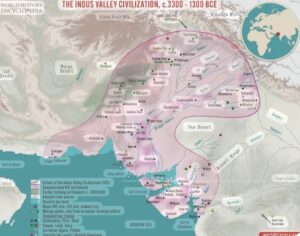
The Harappan civilisation, also known as the Indus Valley Civilisation, is known for being one of the earliest urban settlements during the Bronze Age, which reached its peak around 2600 BCE to 1900 BCE along the banks of the Indus and Ghaggar – Hakra river systems in the northwestern region of the Indian subcontinent. Among its several technological and cultural achievements is the cultivation of Gossypium arboreum – the species of cotton native to South Asia. The Harappans had extensive methods of cultivation and processing cotton and a rich material culture surrounding its usage. Not only were the Harappans the earliest known people to cultivate cotton on a significant scale, they also developed its spinning, weaving and dyeing techniques, the impact of which would go on to influence textile production in the Indian subcontinent for millenia.
Origins of Cotton in the Indus Valley Civilization
Cotton has a deep and ancient history in the Indian subcontinent. The species cultivated in the Indus Valley, Gossypium arboreum, is a cotton species indigenous to the Indian subcontinent, distinct from the New World cottons (Gossypium hirsutum and Gossypium barbadense) later introduced by the Spanish and Portuguese in the 16th century CE. The domestication of G. arboreum likely occurred around 3000 BCE or earlier, probably in the northwestern part of the subcontinent—areas that now form parts of eastern Pakistan and north western India.
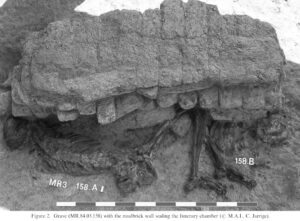
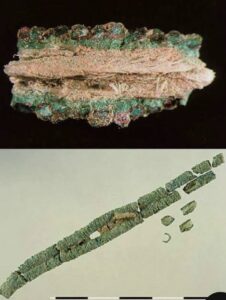
The earliest archaeological evidence of the usage of cotton comes from Mehrgarh, a pre-Harappan site in Balochistan, where impressions of cotton fibers were found on copper beads dated to around 5000 BCE. However, it was in the urbanized era of the Indus Valley Civilization (circa 2600–1900 BCE) that cotton cultivation and similar technologies truly flourished. Sites such as Mohenjo-daro, Harappa, Lothal, and Dholavira have all yielded indirect evidence of textile impressions, spindle whorls, and dye residues, which indicate a sophisticated cotton textile industry.
Cultivation Techniques and Agricultural Integration
The fertile alluvial plains of the Indus and its tributaries offered ideal conditions for cotton cultivation. As a kharif (summer) crop, cotton required warm temperatures and moderate rainfall, conditions met by the climatic regime of the region during the Mature Harappan period. The Harappans were skilled agronomists as their knowledge of crop rotation, irrigation through canal and well systems, and seasonal cycles suggests that they managed cotton as a planned component of a diversified agrarian system.
Cotton likely occupied a significant place in Harappan agriculture alongside major food crops such as barley, wheat, peas, and sesame. It was grown in the summer months, harvested in late autumn, and processed soon after. There is evidence which supports that surplus cotton or cotton textiles may have been stored and possibly traded, both within and outside the Indus region. The presence of cotton in Mesopotamian records, though not directly sourced, hints at the possibility of cotton cloth from the Indus region reaching West Asia either via overland and maritime routes.
Processing and Technology: From Ginning to Weaving
Once harvested, raw cotton had to be separated from its seeds in a process known as ginning. Though gin has not been directly discovered from Harappan sites, the presence of cleaned cotton fiber impressions and woven textiles implies knowledge of effective ginning techniques which probably involved manual tools or primitive mechanical devices. The cleaned fiber was then carded to align the strands and spun into yarn.
Spinning was a crucial part of textile production and was largely carried out using spindle whorls which were normally small, usually circular weights made of terracotta, faience, shell, or stone. These whorls, inserted into the shaft of a spindle, added momentum to the spinning motion and enabled the production of even and durable threads. Once spun, the yarn was woven into cloth, presumably on horizontal or vertical looms, although no loom structures have survived due to the perishable nature of wood and fiber.
In addition to spinning and weaving, the Harappans practiced dyeing, with evidence of indigo and madder plants used as sources of blue and red dyes, respectively. The combination of cotton with such dyes suggests a visually rich textile tradition in the Harappan world, possibly used for both everyday and ceremonial attire.
Cotton Spindles and Spindle Whorls: Material Culture and Archaeological Findings
One of the most informative artifacts in understanding Harappan cotton technology is the spindle whorl. Thousands of spindle whorls have been recovered from sites across the Indus Valley Civilisation, particularly from urban centers like Mohenjo-daro and Harappa, and trading ports such as Lothal. These whorls vary in shape, size, and material, suggesting specialized uses. The most common forms are biconical and discoidal, made from terracotta, though faience and shell variants exist, especially in elite or ceremonial contexts.
Spindle whorls typically ranged from 2 to 5 centimeters in diameter. Heavier whorls may have been used for coarse threads, while fine whorls were suitable for delicate yarns. Their presence in domestic quarters, often in association with hearths and storage jars, suggests spinning was a household activity, which may have been undertaken by women, something which could be seen millenia later as well in the Indian subcontinent. This domestic context highlights the role of textile production as an integral part of Harappan life and economy.
Some whorls also display decorative patterns, indicating aesthetic sensibilities and hints of possibility of ritual significance. The sheer abundance of whorls implies large-scale production, possibly even surplus for trade. This is supported by discoveries of similar whorls at sites in Gujarat, Rajasthan and beyond, forming part of a broader textile manufacturing and distribution network.
Socio-Economic Impact of Cotton in the Harappan World
The widespread cultivation and use of cotton had a profound economic and social impact on Harappan society. As a versatile and comfortable fabric, cotton was likely the primary textile material for clothing, household use, and possibly trade. The ability to produce lightweight, breathable garments would have been particularly suited to the semi-arid climate of the region. Unlike wool, which was also used, cotton allowed for more intricate weaving patterns and easier dye absorption.
The surplus production of cotton textiles likely contributed to internal specialization and long-distance trade. Harappan beads and pottery have been found in sites as far as Mesopotamia and the Persian Gulf, and though textiles themselves do not preserve well archaeologically, their absence may be due more to their perishable nature rather than due to a lack of production. Some Mesopotamian records refer to a “soft cloth” or “plant cloth” from Meluhha (believed to be the Indus region), which could plausibly indicate cotton fabric.
Textile production also played a role in gendered labor patterns and social organization. Spindle whorls found in domestic spaces point to the centrality of women’s work in household economies, while the scale of production hints at cottage industries or workshops. The potential standardization of spindle whorl sizes at certain sites also suggests a degree of professionalisation in textile manufacturing.
Decline and Legacy of Harappan Cotton Culture
With the decline of the Mature Harappan phase around 1900 BCE, possibly due to environmental change, tectonic activity, or shifts in trade, urban centers collapsed, and many technologies declined or transformed. However, cotton cultivation and spinning survived in post-Harappan and regional cultures such as the Painted Grey Ware and later Vedic periods. The knowledge systems and practices developed during the Indus period likely formed the foundation for the enduring Indian textile tradition.
India remained a global center for cotton textiles well into the early modern period and has been renowned for it globally. The word “calico” derives from Calicut (Kozhikode), and “muslin” was a prized Indian export to Europe and the Islamic world. The roots of this rich textile history can be traced back to the Harappan mastery of cotton agriculture and textile production.
Conclusion
Cotton in the Indus Valley Civilization was a transformative economic and cultural force more than being just a plant. From its early production and integration into agricultural systems to its role in driving household economies, facilitating trade, and shaping identity through clothing and ornamentation, cotton left an important legacy. The numerous spindle whorls unearthed across the Indus Valley provide a powerful testimony to the sophistication of Harappan textile culture. As the earliest known civilization to spin and weave cotton, the Harappans laid the foundations for one of humanity’s most essential industries. Their innovations in cotton cultivation and processing were not isolated achievements but part of a complex network of technologies, economies, and social structures that continue to influence the subcontinent’s identity even today.
Bibliography and References
1. Moulherat et al. (2002) – First Evidence of Cotton at Neolithic Mehrgarh, Pakistan
2. IJFMR (2023) – Subsistence Economy of Indus People: Agriculture and Textile