
By Tehreem Asad
The holy month of Ramzan (or Ramadan) is the ninth month of the Islamic lunar calendar. It was during this month that the Quran was first revealed to Prophet Muhammad (p.b.u.h.). During this time, Muslims around the world observe a daily fast from dawn until sunset. The intention of the fast is to cultivate gratitude, self-restraint, and an enhanced awareness of one’s relationship with Allah. In addition to abstaining from food and drink, Muslims are encouraged to practice restraint in conduct and to respond to situations with patience and kindness.
For centuries, the observance of Ramzan in Delhi has been shaped not only by religious practice but also by the city’s social and cultural life. The holy month has left its imprint in scattered historical accounts that show us how different generations of Delhi’s residents experienced this period of fasting and reflection. This article explores various anecdotes related to the celebration of Ramzan in Delhi and examines how the holy month has contributed to the city’s cultural life.
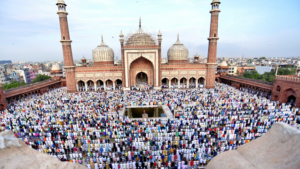
Congregational prayer at Jama Masjid, Delhi
(Courtsey: https://www.incredibleindia.gov.in/en/delhi/delhi/jama-masjid)
Ramzan in Delhi Through the Ages:
It was during the reign of Sultan Muhammad bin Tughluq that the renowned traveller Ibn Battuta reached Delhi (c.1334) as part of his extensive globetrotting expedition. From his travelogue, we get a glimpse of how Ramzan was celebrated in 14th-century Delhi. Ibn Battuta mentions how he observed great fervor among people during the holy month and how the musicians who lived around the area near the tomb of Saint Qutub ud Din Bakhtiyar Kaki would keep prayer mats under their knees so that they could perform prayer upon hearing Adhan/Azaan (the call for prayer).
A later account of Ramzan in Delhi comes from Bazm-e-Aakhir of Munshi Faizuddin, which was published twenty-eight years after the end of the Mughal dynasty. The work records the life of the last two Mughal Emperors, Akbar II and Bahadur Shah II, in the Red Fort. The book also gives us insight into how Ramzan was celebrated during this time. According to Faizuddin, the sacredness of the month was respected not only by Muslims but also by people of other faiths. He mentions that two days before Ramzan, dromedary riders set out in different directions for moon sighting. In case the riders were unable to spot the moon due to the presence of clouds, a reliable person, a qazi or a nobleman, would have to authenticate the testimony of the person who had sighted the moon in front of the emperor. Then the Emperor would consult the ulema, and after this was done, eleven cannons would be fired, indicating the arrival of Ramzan.
Munshi Faizuddin also mentions the arrangements for sehri (pre-dawn meal) and iftar (meal eaten for breaking the fast) at the Mughal court. A gong was struck for the first time, announcing that it was time for sehri. When it was struck for the second time, the dastarkhwan (tablecloth) was laid out with food. On the third gong, the Emperor would have his sehri and proceed for the Fajr prayer. A cannon was fired, indicating the end of sehri.
In the late afternoon, the preparations for the iftar would commence. Munshi Faizuddin mentions a wide array of dishes prepared by the ladies of the harem for iftar during Ramzan. These included vegetables such as methi ka saag, green chillies, the tender green stalk of moti ke phool, baigan ka dulma, and badshah-pasand karele. Several kinds of kebabs were also prepared, along with nan pao ke tukre and gajar ka lachha. Plates were filled with savouries like fried split green gram, ground chickpea snacks, roasted gram, and dry fruits seasoned with salt and pepper. The meal was accompanied by fresh salads, fruits, sherbets, and lemonades. As the sun would set , the Emperor would give orders for the cannons to be fired, signalling the end of the fast.
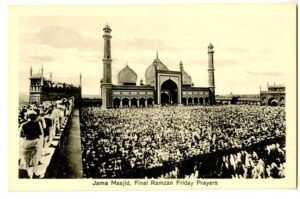
Final Ramadan Friday prayers, Jama Masjid Mosque, Delhi, India. Postcard, early 20th century.
(Courtsey: https://www.flickr.com/photos/salemstatearchives/11326400146)
One of the most significant days of the month of Ramzan is the last Friday, known as Alvida Jumma or Jumat-ul-Wida. As Friday is considered the holiest day of the week in Islam, the final Friday of the sacred month is of particular importance. This occasion was marked by a ceremonial royal procession in which the Mughal Badshah went to the Jama Masjid for Friday prayers. After the emperor had attended the khutba (sermon) and the prayer, he would proceed towards Dargah Asar Sharif inside the Jama Masjid, where he paid homage to the Prophet’s relics before returning to the fort.
The end of the month was also marked with an equal ceremony. On the 29th day of Ramzan, envoys were sent once again to sight the moon. Once the moon was sighted that day, a 25-gun salute was fired, signalling that it would be Eid al-Fitr the next day. If the moon was not sighted, the gun salute would be done the next day.
Though the month of Ramzan was spent with great zeal in the Red Fort, not everyone could undertake the pious, albeit difficult, task of fasting. Bazm-e-Aakhir mentions how ladies of the royal harem would tease those who did not keep the fast mercilessly. Perhaps the most notorious rozakhor of Bahadur Shah Zafar’s court was none other than the celebrated poet Mirza Ghalib. The self-proclaimed ‘half Muslim’, when asked by the Emperor how many fasts he kept during Ramzan, replied, ‘Ek nahi rakha’ (literally meaning I did not keep one), which could either mean that he could not keep one or did not keep any at all.
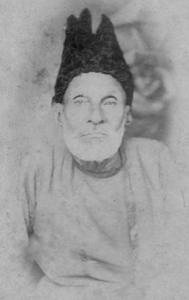
Mirza Ghalib in 1868
(Courtesy:https://en.wikipedia.org/wiki/Ghalib#/media/File:Mirza_Ghalib_photograph_3.jpg)
A hadith of Prophet Muhammad (p.b.u.h) states that the Shayateen (devils) are shackled in a room during the month of Ramzan. Once, Ghalib was playing chess when a friend of his entered the room. His friend remarked that he had read that the devil was locked up in a room during the month of Ramzan, but he doubts that this was true. Ghalib replied that what he had read was in fact true and that this room was the very room in which the devil was confined.
However, Ghalib had always been a shrewd observer of human nature. Fasting alone, he implied, did not necessarily produce virtue. Satirising the tendency of people to overindulge even in the month of Ramzan, he is attributed to have commented:
Iftaar-e-saum kii jise kuch dast.gaah ho
us shakhs ko zaroor hai rozaa rakha kare
Jis paas roza khol ke khaane ko kuch na ho
roza agar na khaaye to naachaar kya kare
(The one who has the wherewithal to break his fast
that person should indeed keep the fast.
The one who has nothing to break his fast with
what else can he do but be constrained to ‘eat the fast’.)
A similar commentary on social behaviour is found in a folktale of Mullah Nasir-ud-Din, recounted to historian William Dalrymple by Dr. Yunus Jaffery in his book ‘City of Djinns’. The story goes that once Mullah Nasir-ud-Din arrived in Delhi during Ramadan. He heard that the Emperor was distributing free iftar at the Red Fort. He was hungry, so he proceeded towards the Red Fort. However, because he looked dirty from travel, he was placed at the end of the queue. Realising this, he went back to his caravanserai and returned after dressing in fine clothes. This time, he was welcomed with drums and loud trumpets from the Naqqar Khana announcing his arrival. The Master of Ceremonies placed him near the Emperor, and a plate of freshly grilled lamb was put before him. Instead of eating, he rubbed the food on his robe and turban. Seeing this, the emperor was surprised and questioned the Mullah. Mullah Nasir-ud-Din replied that since it was his clothes that got him the meal, they deserved to eat too.
The month of Ramzan was also important in the court of the last Mughal Emperor for another reason. It was during the month of Ramzan that the sepoys reached the city of Delhi on 11th May 1857 after they had mutinied against the British. They came to Delhi to persuade the Emperor to accept the leadership of the revolt, which they succeeded in doing. Interestingly enough, nearly two centuries later, when India finally achieved independence from British rule, it was also during the month of Ramzan. This particular Ramzan, however, was marked by tension and violence. The exhilaration of independence in Delhi (and other regions of the country) was overshadowed by the riots caused by the partition of the country. Author R.V. Smith mentions how areas like Chandni Chowk, Fatehpuri, Paharganj, Beadonpura, Regarpura, and Dev Nagar became centres of riot and how people were scared to go out of their houses during this time.
Yet episodes of communal tension have never defined the city. The essence of Delhi and Dilliwalas has been their commitment towards amity, solidarity, and peaceful coexistence. One such personality who exemplifies this spirit is an eminent personality in Urdu poetry, Gulzar Dehlvi. Born in 1926 in Old Delhi to a Kashmiri Pandit family, he was deeply attached to both the city and the Urdu language. He was extremely proud of the mushtarka tehzeeb that he belonged to, so much so that every Ramzan he used to fast for a day. In fact, R.V. Smith talks about how devout Hindu women, and even some Catholics, would also fast during Ramzan. He also talks about how both high caste Hindu women and those from the sweeper community would congregate on the steps of the Jama Masjid so that the namazis coming out after Maghrib prayers during Ramzan could bless their children.
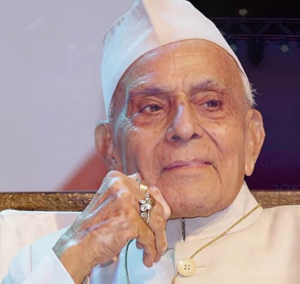
Anand Mohan Zutshi Gulzar Dehlvi
(Courtesy :https://en.wikipedia.org/wiki/Gulzar_Dehlvi#/media/File:Gulzar_dehlvi.jpg)
Observing Ramzan in Today’s Delhi :
Recently a news article by the Hindustan Times reported that the sales of dates surged by 80 per cent in Delhi during Ramzan. It is the sunnah (tradition) of Prophet Muhammad (p.b.u.h) to break fast with dates. For this reason, dates are typically the first food people reach for at the time of iftar. Ramzan in Delhi is associated with several culinary and cultural traditions that have developed over time. One of the most well-known is Rooh Afza, a staple drink of Ramzan in the Indian subcontinent. Rooh Afza was created in Delhi by Hakim Abdul Hafeez Majeed in 1906. As the story goes, Majeed set out to create a remedy against the city’s heat, leading to the creation of this drink. Another dish closely associated with Ramzan in Delhi is Nahari or Nihari. Although its precise origins remain debated, some believe that it emerged in Old Delhi during the late eighteenth century under the Mughal rulers. Nahari is a familiar part of Ramzan meals in the city and is commonly eaten during both sehri and iftar.
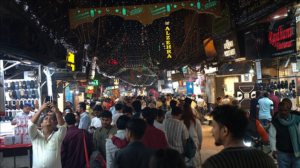
(Courtesy: https://www.aa.com.tr/en/asia-pacific/ramadan-nights-in-delhi-a-feast-of-faith-and-flavor/3500580
During the month of Ramzan, there is a noticeable change in life in Old Delhi. Markets that are quiet during the day become active late into the night, and many shops remain open even during the hours of sehri. The neighbourhood around Jama Masjid, particularly areas such as Matia Mahal, appears almost sleepless during this period. In some neighbourhoods of Old Delhi, sehri wallahs walk through the streets before dawn, knocking on doors and calling out the names of residents to wake them for the Sehri. These men are not formally paid and this practice continues largely as a voluntary service, though families often offer them small gifts or Eidi at the end of the month.
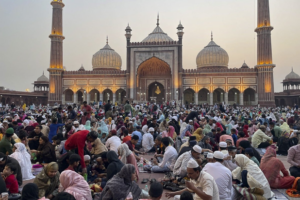
(Community Iftar at Jama Masjid, Delhi
Courtesy : https://www.scmp.com/lifestyle/travel-leisure/article/3175037/crowds-are-back-old-delhi-first-public-ramadan-celebration)
As sunset approaches, the narrow lanes and markets around Jama Masjid begin to fill with people and the smell of food from numerous stalls and eateries. Many people gather in the courtyard of Jama Masjid for community iftar, while others choose to eat in nearby streets and markets. Among the most popular food items are Kebabs, Biryani, Sheermal, Shahi Tukda, Seviyan, Khajla, and Phirni.
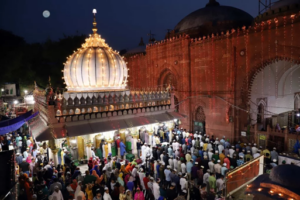
Ramadan celebrations at Hazrat Nizamuddin Aulia Dargah
(Courtesy:https://www.scmp.com/lifestyle/travel-leisure/article/3175037/crowds-are-back-old-delhi-first-public-ramadan-celebration)
After iftar, many people attend the Maghrib prayer and later the special nightly Taraweeh prayers. Some also visit nearby Sufi shrines where they spend time in prayer and reflection. The legacy of Hazrat Nizamuddin Auliya has been maintained at his dargah for hundreds of generations now where, apart from the normal tradition of organising langars twice a day , the dastarkhwan is spread for both sehri and iftar meals, feeding thousands of people daily during the month of Ramzan. The 14th century mystic Sheikh Nasir-ud-Din Mahmud, also known as ‘Chirag-e-Delhi’ was the spiritual successor of Hazrat Nizamuddin Auliya and is regarded as the last important Sufi saint in the Chisti Silsila in Delhi. His Urs (death anniversary) is celebrated every year on the 17th of Ramzan, which marks another important observance in Delhi during the month of Ramzan.
In discussing these anecdotes and accounts, it becomes evident that the observance of Ramzan in Delhi extends well beyond just the ritual practices. The holy month has been marked by unique traditions and customs of the city, as well as shared social experiences across communities that can be seen through the observance of Ramzan in Delhi across centuries. Although the forms of celebration may have evolved, the month essentially remains focused on fasting, prayer, charity, and community. These historical anecdotes and popular traditions serve to remind us of the fact that the culture of Ramzan in Delhi has been shaped by the city’s history and culture, and has now become an innate part of its public life.
BIBLIOGRAPHY:
1.https://kashmirlife.net/how-muslims-in-the-medieval-era-observed-ramzan-350472/
Safvi, Rana, translator and editor. City of My Heart: Four Accounts of Love, Loss and Betrayal in Nineteenth-Century Delhi. Hachette India, 2018
2. https://blindtobounds.blog/2011/08/02/i-love-with-ghalib-the-witty/
Dalrymple, William. City of Djinns: A Year in Delhi. Harper Collins Publishers, 1993.
3. https://www.thehindu.com/features/friday-review/religion/Penance-and-Partition/article16141383.ece
4. https://www.rekhta.org/poets/gulzar-dehlvi/profile
5. https://www.thehindu.com/features/metroplus/of-a-hindu-a-muslim-and-a-christian-fast/article7364006.ece
6. https://thewire.in/culture/an-iftar-at-hazrat-nizamuddins-dargah-a-date-with-history
7. https://www.hindustantimes.com/cities/delhi-news/sale-of-dates-skyrocket-by-80-per-cent-in-delhi-during-ramzan-101771853362717.html
8. https://www.livemint.com/mint-lounge/ideas/sehri-khans-ramadan-111681913455591.html
9. https://www.thestatesman.com/features/inder-lok-and-the-aura-piety-of-ramzan-1496353859.html
10. https://www.thestatesman.com/supplements/notebook/ramzan-diary-1503064466.html
11. https://homegrown.co.in/homegrown-explore/ramadan-in-old-delhi-personifies-community-connection-kindness